Website design gets attention, but website copy often does the selling. The words on your website explain what you do, who you help, why people should trust you, and what they should do next. If your copy is unclear, even a beautiful website can fail to convert visitors into customers.
Good website copywriting is not about using fancy words. It is about clarity. Visitors should quickly understand your offer and feel that your business can solve their problem.
Most people do not read websites from top to bottom. They scan. They look at headlines, buttons, service names, proof, and short sections. Your copy needs to work for that behavior.
What is website copywriting?
Website copywriting is the process of writing the words on your website with a clear business purpose. It includes headlines, service descriptions, homepage sections, calls to action, about page content, landing pages, product descriptions, FAQs, and contact page copy.
The goal is to guide visitors toward action. That action may be sending an enquiry, booking a call, buying a product, requesting a quote, downloading a guide, or contacting you on WhatsApp.
Strong copy makes the visitor feel understood. It answers their questions, reduces doubt, and shows why your business is a good choice.
Start with the customer, not the company
Many websites begin by talking too much about the business. They say things like “We are a leading provider” or “We offer professional solutions.” These statements are common, but they do not immediately tell the customer why they should care.
Better copy starts with the customer’s problem or desired result. For example, instead of saying “We provide digital marketing services,” you could say “Get more qualified enquiries from your website, Google, and paid ads.
The second version is clearer because it speaks to an outcome. It tells visitors what they can gain.
Before writing any page, ask: who is reading this, what problem are they trying to solve, and what information do they need before taking action?
Make your headline specific
Your headline is one of the most important pieces of copy on the page. It should quickly communicate your offer.
A vague headline like “Grow Your Business With Us” could apply to almost any company. A clearer headline might be “Website Design for Malaysian Service Businesses That Need More Enquiries.
Specific headlines help the right people stay on the page. They also help visitors decide whether your offer is relevant to them.
Your headline should usually include one or more of these: the service, audience, result, location, or problem. It does not need to include everything, but it should not be so broad that it loses meaning.
Explain benefits before features
Features describe what your product or service includes. Benefits explain why those features matter.
For example, “weekly reporting” is a feature. The benefit is that the client understands what is working and where budget is going. “Mobile-friendly design” is a feature. The benefit is that customers can browse and contact you easily from their phone.
Good website copy connects features to business value. This helps visitors see the practical reason to choose you.
Do not remove features completely. They are still useful. But frame them in a way that answers the customer’s question: “What does this mean for me?”
Build trust with proof
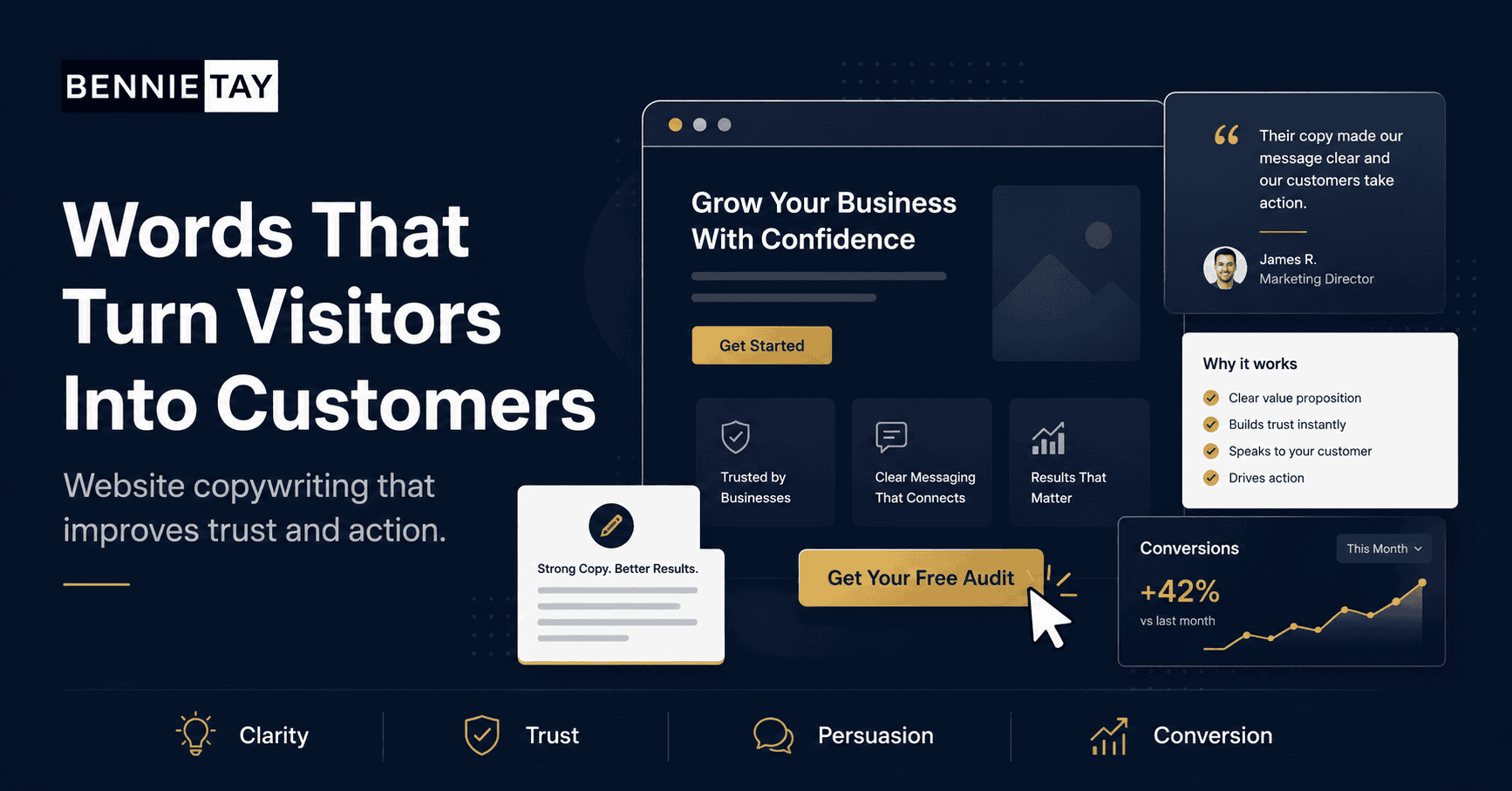
Visitors are naturally cautious. They may like your offer but still wonder whether you can deliver. Website copy should include proof.
Proof can include testimonials, case studies, project photos, statistics, certifications, client logos, reviews, before-and-after examples, media mentions, or years of experience.
The best proof is specific. “Great service” is nice, but “helped us increase quote requests within three months” is stronger. If you cannot share exact numbers, describe the situation and result clearly.
Place proof near important decision points. A testimonial beside a call-to-action button can reduce hesitation. A case study after a service description can support your claim.
Use clear calls to action
A call to action tells visitors what to do next. Many websites hide this or use weak wording.
Instead of only saying “Submit,” use clearer buttons such as “Request a Quote,” “Book a Consultation,” “Get Website Help,” or “Talk to Us on WhatsApp.
The right call to action depends on your business. If you sell a high-value service, “Book a Consultation” may work better than “Buy Now.” If you provide urgent home services, “Call Now” or “WhatsApp Us” may be more practical.
Repeat the call to action at natural points on the page. Do not make visitors scroll back to the top when they are ready to contact you.
Keep paragraphs short
Reader-friendly website copy uses short paragraphs. Long blocks of text are tiring, especially on mobile.
Use headings to break up sections. Use bullet points when listing benefits, services, or steps. Keep sentences direct. Avoid industry jargon unless your audience uses it too.
This does not mean your website must be shallow. You can explain important details, but organize them well. A page can be detailed and still easy to scan.
Answer objections
Good copy deals with hesitation. Customers may worry about price, timing, quality, support, risk, or whether your service is right for them.
Use your website to answer common objections. If people often ask about timeline, include a section explaining the process. If they worry about cost, provide price ranges or explain what affects pricing. If they worry about trust, show proof and reviews.
FAQs are useful because they answer questions directly. They can also reduce repetitive enquiries from people who are not a good fit.
Match the copy to the page goal
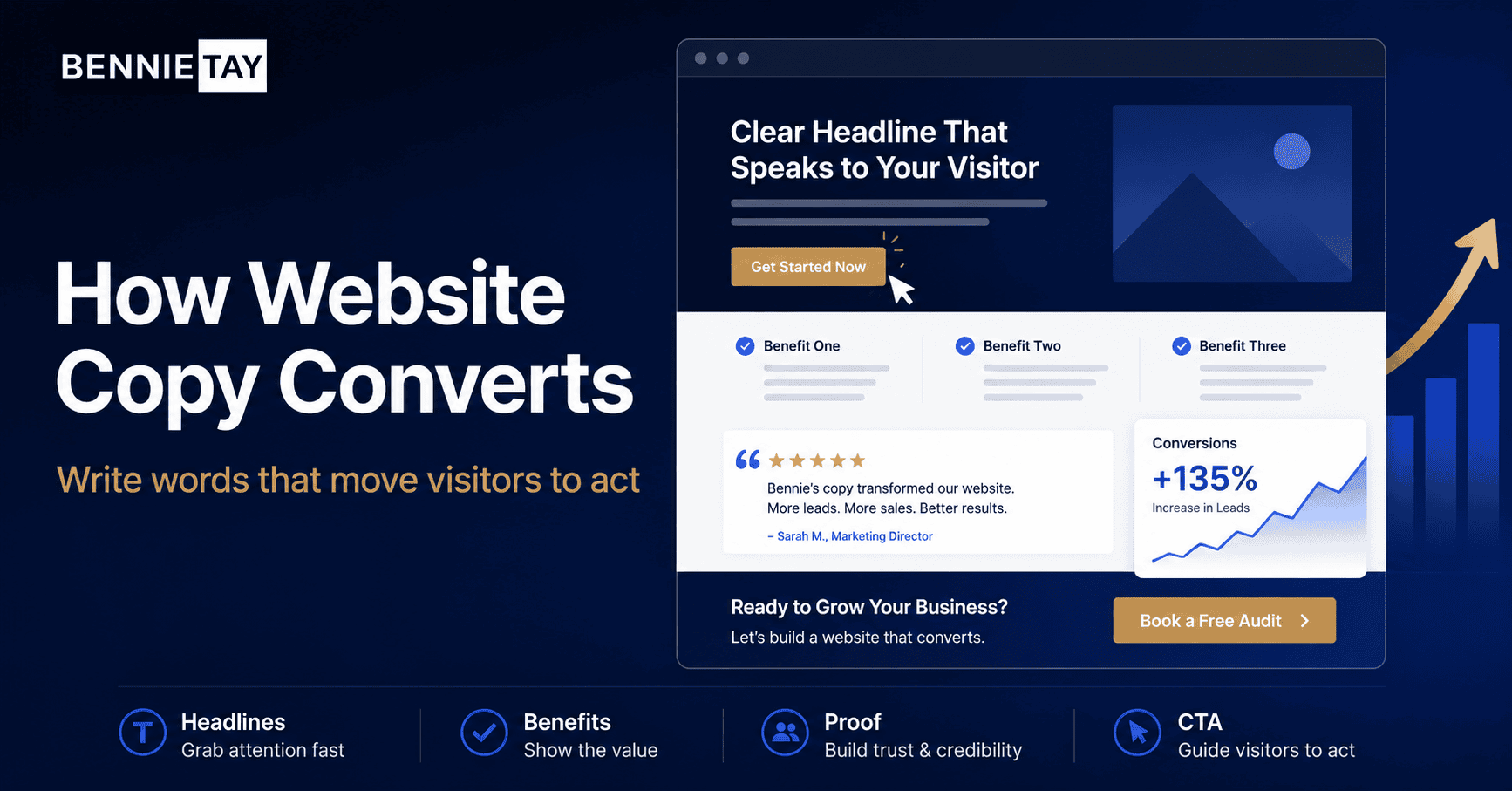
Every page should have a purpose. A homepage introduces the business and guides visitors to the right next step. A service page explains one offer in more detail. A landing page focuses on one campaign. A contact page makes enquiry easy.
Do not use the same copy structure everywhere. The message should match the visitor’s intent.
For example, someone reading a service page may already know what problem they have. They need details, proof, and a next step. Someone reading an about page may want to know your background, values, and credibility.
Write for different awareness levels
Not every visitor is ready to buy immediately. Some visitors are comparing options. Some are still learning about the problem. Some are ready to contact you now.
Your website copy should support all three groups. For people who are still learning, explain the problem and options clearly. For people comparing providers, show proof, process, and differences. For people ready to act, make the contact button easy to find.
This is why a website should not only contain sales messages. Helpful content can build trust before the visitor is ready to enquire.
For example, a web design company can explain website pricing, maintenance, SEO basics, and landing pages. A home service company can explain common problems, warning signs, and what to expect during service. This content supports both SEO and trust.
Use the customer’s language
Good copy sounds natural to the target customer. It should not be overloaded with internal terms, technical jargon, or generic marketing phrases.
Listen to how customers describe their problem in calls, WhatsApp messages, reviews, and emails. Those phrases often make better website copy than polished corporate language.
For example, customers may not search for “conversion optimization solutions.” They may search for “why my website gets traffic but no enquiries.” A good website can use both professional terms and plain-language phrases.
The clearer your copy sounds, the easier it is for visitors to trust it.
Improve copy with real data
After your website is live, review how people interact with it. Which pages get traffic? Which buttons are clicked? Which forms are submitted? Which questions do customers still ask after reading the page?
Use those insights to improve your copy. If visitors keep asking about pricing, add pricing guidance. If they ask about process, expand the process section. If they ask whether you serve their area, make the service area clearer.
Website copy is not a one-time task. The best copy improves as you learn what customers need to know before they contact you.
Common copywriting mistakes
One common mistake is writing too generally. If your copy could apply to any business in any industry, it is probably not specific enough. Mention the audience, problem, service, location, or result where useful.
Another mistake is focusing only on features. Features matter, but visitors need to understand why those features are valuable. Connect each feature to a benefit.
A third mistake is hiding the call to action. If people have to search for how to contact you, the page is not working hard enough. Make the next step visible after important sections.
Also avoid making claims without proof. If you say you are trusted, experienced, or results-driven, support it with testimonials, examples, numbers, or case studies.
Website copy checklist
Before publishing a page, read it from the visitor’s point of view. Does the headline explain the offer clearly? Does the first section answer why the page matters? Are the benefits easy to understand? Is there proof? Is the call to action specific?
Then check readability. Are paragraphs short? Are headings useful? Is the language natural? Does the page answer common objections?
Good copy should make the visitor feel more informed and more confident. If the page creates more confusion, it needs another round of editing.
Keep testing your message
The first version of your website copy does not need to be perfect. It needs to be clear enough to launch and improve from real feedback.
Pay attention to the words customers use when they contact you. If they describe a problem differently from your website, adjust your copy. If they misunderstand your offer, rewrite the section that caused confusion.
Good copy becomes stronger when it is connected to real sales conversations.
Final thoughts
Website copywriting turns design into communication. It helps visitors understand your offer, trust your business, and take action.
Start with the customer. Write specific headlines. Explain benefits clearly. Add proof. Use strong calls to action. Keep the page easy to scan.
When your website copy is clear, your website works harder. Visitors spend less time guessing and more time deciding whether to contact you.