Website copy is one of the most important parts of a business website. Design can create a good first impression, but the words explain what you do, why it matters, and why someone should contact you. If your copy is unclear, visitors may leave without enquiring.
Good website copy does not need to sound clever. It needs to be clear, useful, and focused on the customer. The best copy helps visitors understand their problem, see your solution, trust your business, and know what to do next.
Many small-business websites lose enquiries because they talk too much about the company and not enough about the customer. They use broad phrases like “professional solutions” or “quality service” without explaining the actual value. Stronger copy is more specific.
Know what the page needs to achieve
Before writing any page, decide what action you want the visitor to take. Do you want them to request a quote, book a consultation, send a WhatsApp message, call your office, download a guide, or view your services?
The action affects the copy. A landing page for ads needs a focused message and direct call to action. A service page needs more explanation, proof, FAQs, and details. A homepage needs a quick overview and links to the most important sections.
When the goal is clear, the copy becomes easier to write. Every section should help move the visitor closer to that goal.
Start with the customer situation
Visitors care about their own situation first. Start by showing that you understand what they need. This does not mean using fear-based copy. It means describing the problem, desire, or decision they are facing.
For example, instead of opening with “We are a leading website design company,” you could say, “Your website should help visitors understand your services and contact you with confidence.” This speaks directly to the result the customer wants.
Customer-focused copy makes the page feel relevant. It tells visitors that they are in the right place.
Make the headline specific
Your headline is often the first piece of copy people read. It should quickly explain the offer. Avoid vague lines that could apply to any business.
A useful headline usually includes the service, audience, problem, result, or location. For example, “Website Design for Service Businesses That Need More Enquiries” is clearer than “Build Your Online Presence.”
Specific headlines may feel less fancy, but they work better because visitors understand them faster. Clear copy respects the visitor’s time.
Explain benefits in practical terms
Benefits are not just big promises. They should explain why the service matters in real life. A mobile-friendly website means visitors can read and contact you easily from their phone. A clear service page means people understand what you offer before they call.
When writing benefits, connect each feature to a customer outcome. Do not only say you include SEO setup. Explain that it helps search engines understand your pages and gives each page a better foundation for visibility.
This approach makes your copy more useful because visitors see the reason behind each part of your service.
Use simple words
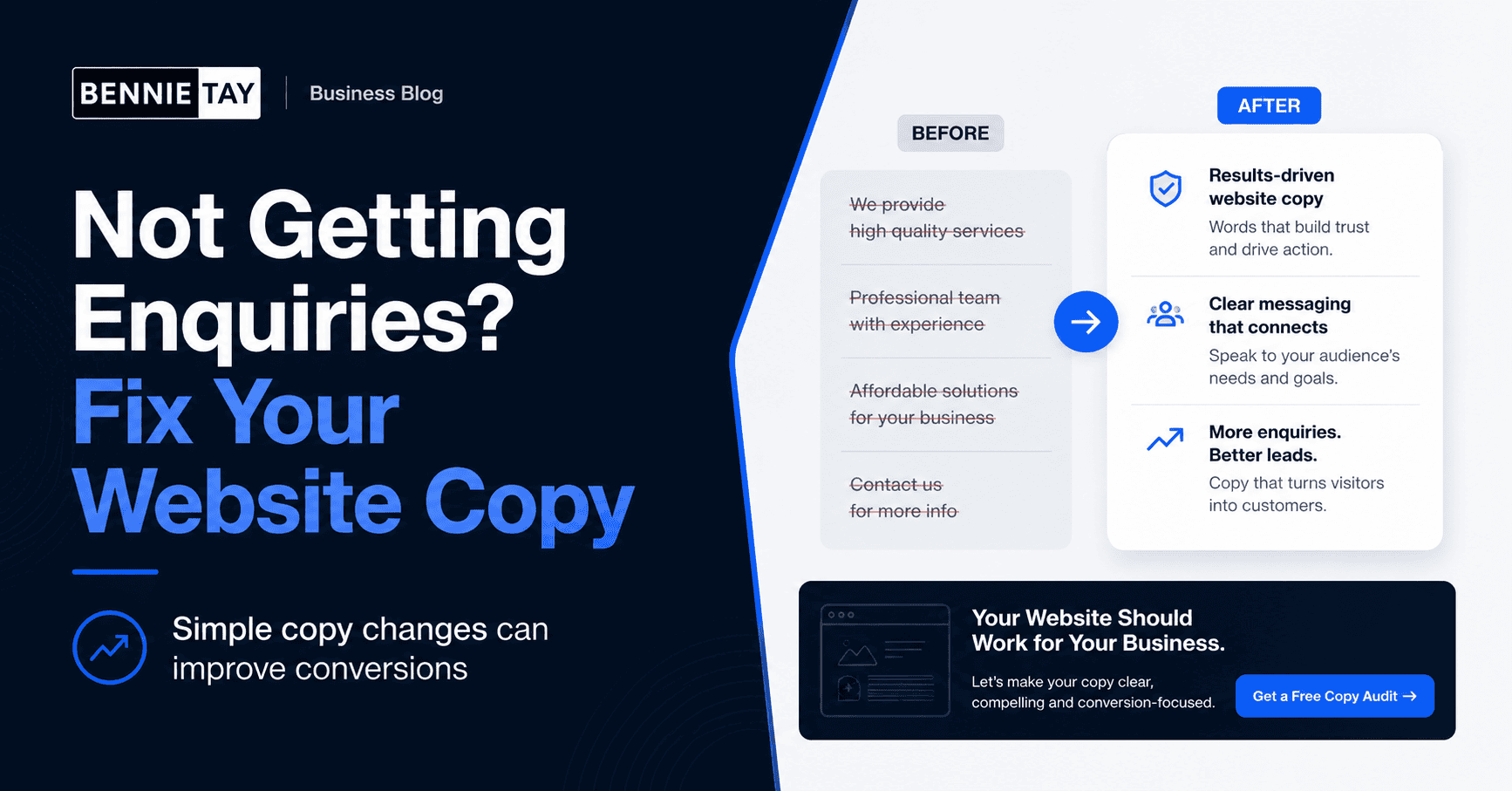
Clear copy usually uses simple language. Avoid industry terms unless your customers use them too. If you must use a technical term, explain it in a practical way.
For example, instead of saying “conversion optimization,” you can say “improving the page so more visitors contact you.” Instead of “information architecture,” you can say “organizing your pages so visitors can find what they need.”
Simple words do not make your business look less professional. They make your message easier to understand.
Write for scanners
Most people scan websites before reading carefully. They look at headings, buttons, short paragraphs, bullets, images, and proof. Your copy should support that behavior.
Use clear headings that tell the reader what each section is about. Keep paragraphs short. Break long explanations into smaller pieces. Use bullets when listing features, steps, or benefits.
A visitor should understand the page even if they only read the headings and a few key sentences.
Add proof near important claims
If you claim that your service helps businesses get more enquiries, support the claim with proof. Proof can include testimonials, case studies, reviews, project examples, client logos, screenshots, or specific process details.
Place proof near the claim it supports. If you talk about better website results, show a related testimonial or example nearby. If you talk about reliability, show reviews, experience, or support details.
Proof reduces hesitation. It gives visitors a reason to believe your copy.
Answer objections before they stop the enquiry
Customers may hesitate because of price, timeline, trust, complexity, or uncertainty. Good website copy answers these concerns before they become reasons to leave.
For example, if your service requires a consultation before pricing, explain why. If timelines depend on content and revisions, explain the typical process. If visitors worry about support after launch, explain what help is included.
An FAQ section is a good place to handle these questions. It can make the page feel more helpful and reduce repeated enquiries from people who are not ready.
Use stronger calls to action
A call to action should tell visitors what to do next. Weak buttons like “Submit” or “Learn More” are sometimes too vague. Use action-focused wording that matches your service.
Examples include “Request a Quote,” “Book a Website Consultation,” “Discuss Your Project,” or “WhatsApp Us.” The button should feel natural based on where the visitor is in the page.
Repeat your main call to action after important sections. Do not make visitors scroll back to the top when they are ready to contact you.
Edit out unnecessary copy
After writing your page, remove anything that does not help the visitor understand, trust, or act. Many websites are too long because they repeat the same idea in different words.
Look for generic phrases, long introductions, repeated claims, and company-focused paragraphs that do not add value. Replace them with specific examples, customer benefits, or clearer explanations.
Good editing often makes copy more persuasive because the message becomes sharper.
A simple website copy checklist
- Does the headline explain the offer clearly?
- Does the page speak to the customer problem?
- Are the benefits connected to real outcomes?
- Is there proof near important claims?
- Is the next step obvious on desktop and mobile?
- Can someone scan the page and still understand it?
Final thoughts
Write different copy for different pages
Your homepage copy should give a clear overview, but your service pages need more detail. A visitor on a service page usually wants to know whether that specific service solves their problem.
For each service page, explain who the service is for, what problem it solves, what is included, how the process works, and what the next step is. This makes the page more useful than a short description copied from a brochure.
If you offer website design, website maintenance, landing pages, and SEO setup, each page should have a different message. The customer concern behind each service is different, so the copy should be different too.
Use examples to make ideas concrete
Examples make website copy easier to understand. Instead of saying you help businesses improve conversion, show what that might mean. It could mean clearer service sections, stronger testimonials, simpler forms, better WhatsApp buttons, or more direct calls to action.
Examples help visitors imagine how your service applies to their situation. They also make your writing feel more practical and less like generic marketing.
You do not need to include long stories everywhere. A short example in the right place can make a page much clearer.
Match your tone to the customer decision
The tone of your copy should match the seriousness of the decision. A customer hiring a consultant, contractor, clinic, or agency may want calm, clear, confident language. A customer buying a low-cost product may accept a more playful tone.
For most service businesses, a direct and helpful tone works well. Avoid exaggerated claims. Avoid sounding too formal. Write like a knowledgeable person explaining the next step clearly.
This kind of tone builds trust because it feels human and professional at the same time.
Make forms feel less risky
The words around your contact form matter. If the form appears suddenly without explanation, visitors may hesitate. Add a short sentence that explains what happens after they submit.
For example: “Tell us about your project and we will reply with the next best step.” Or: “Send your details and we will arrange a short call to understand your needs.”
This small piece of copy reduces uncertainty. It helps visitors know that they are not committing to anything before they are ready.
Review your copy on mobile
Website copy can look readable on desktop but feel too heavy on mobile. Long paragraphs become even longer on a phone. Buttons may be pushed too far down. Important proof may be missed.
After writing your page, check it on mobile. Shorten paragraphs that look too dense. Make sure headings are clear. Confirm that the main call to action appears early enough.
Mobile review is important because many enquiries start from WhatsApp, Facebook, Instagram, Google search, or referrals opened on a phone.
Keep improving based on real questions
Your first version of website copy does not need to be perfect. After the page goes live, pay attention to the questions customers ask. If many people ask about pricing, timeline, what is included, or how to start, add clearer answers to the website.
Customer questions are useful because they show where your copy is incomplete. Each answer you add can make the page more helpful for the next visitor.
This is how website copy improves over time. You do not need to guess everything. Let real enquiries show you what needs to be clearer.
Website copy that gets more enquiries is not about sounding impressive. It is about helping visitors understand your value quickly and trust you enough to take action.
Useful reference: For clearer website copy, Nielsen Norman Group’s research on how users read on the web is a useful reference. See Nielsen Norman Group writing for the web.Start with the customer, write clearly, support your claims with proof, and make the next step easy. When your
copy answers the right questions, your website becomes much better at turning visitors into enquiries.