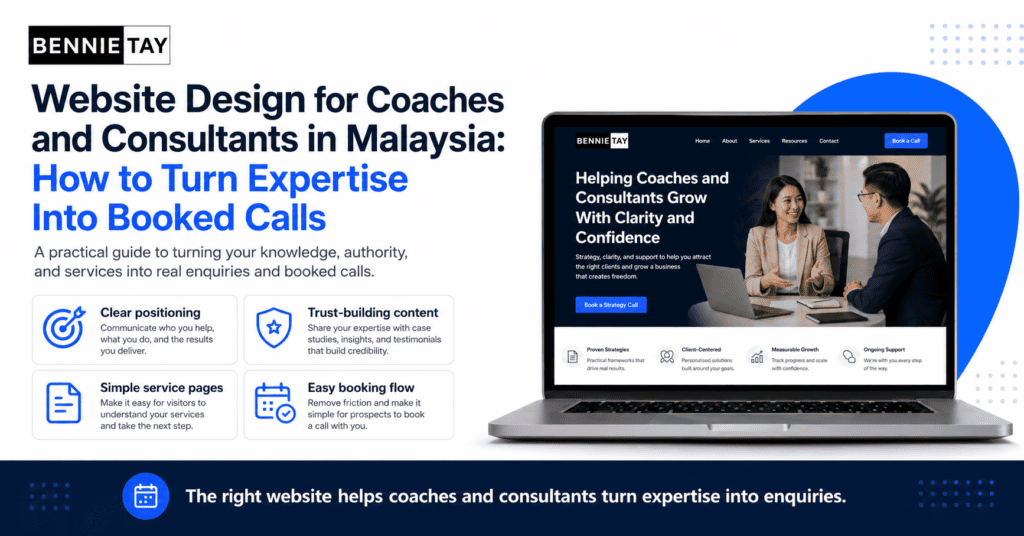
Coaches and consultants do not sell a simple product. They sell expertise, trust, guidance, and outcomes. That means your website needs to do more than look professional. It needs to explain your value clearly and help the right people feel confident enough to book a call.
Many coaching and consulting websites are too vague. They use phrases like “unlock your potential,” “transform your business,” or “achieve growth,” but they do not explain who the service is for, what problem is solved, or what makes the consultant different.
A good website should answer the questions your ideal client is already thinking about: Can this person help me? Do they understand my situation? What is their process? What results have they helped others achieve? What should I do next?
Start with clear positioning
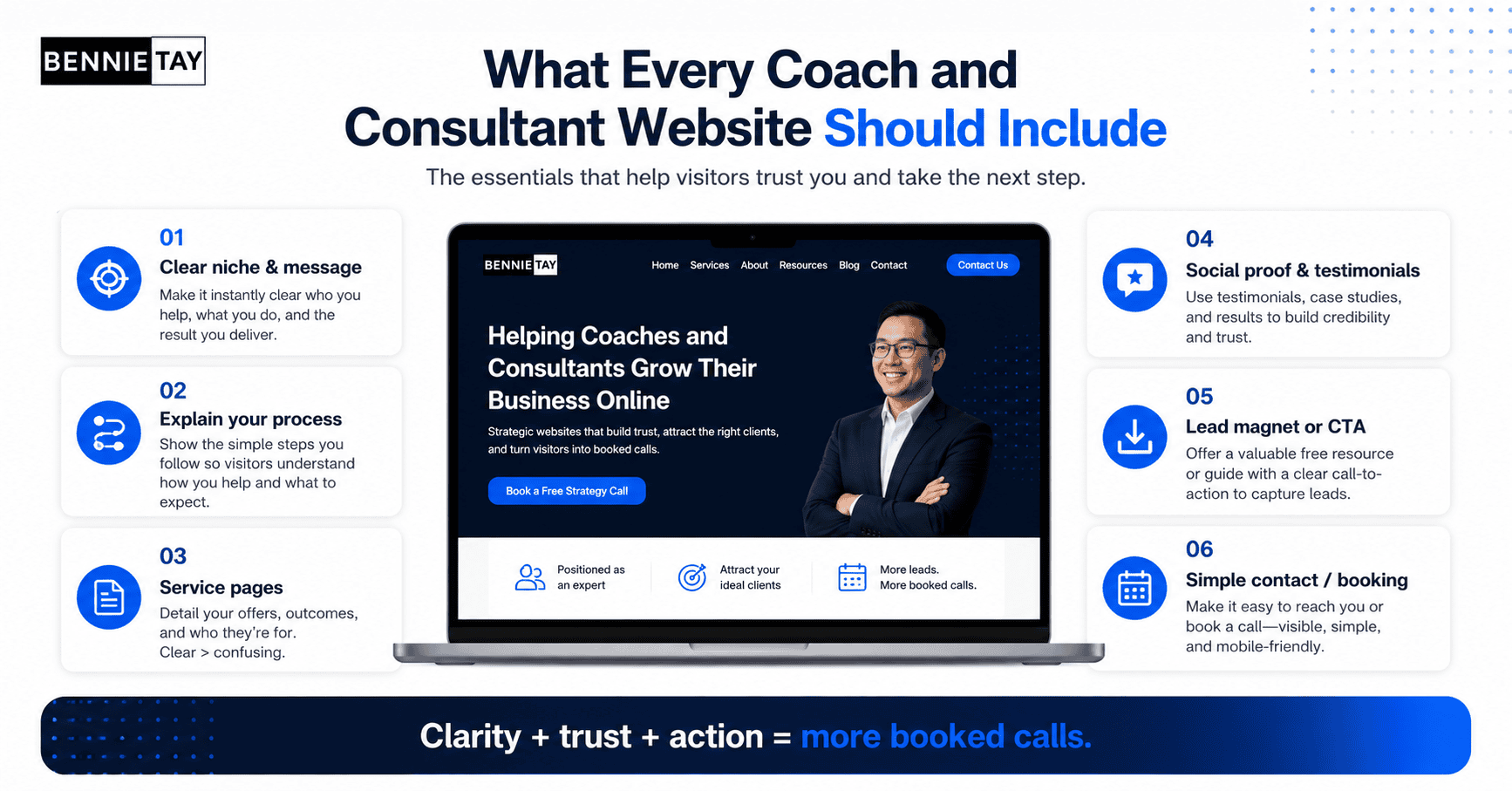
Your homepage should quickly explain who you help and what outcome you help them achieve. A clear positioning statement is more powerful than a clever headline.
For example, “I help SME founders build a sales system so they can grow without relying only on referrals” is clearer than “Helping leaders reach the next level.” The first version tells the visitor who it is for, what problem is being addressed, and what result matters.
If you serve multiple audiences, avoid trying to speak to everyone in the first sentence. You can create separate sections or service pages for different groups, but your main message should still feel focused.
Explain the problem in your client’s words
Before talking about your method, show that you understand the client’s problem. This builds trust because visitors feel seen.
A business coach may mention inconsistent sales, unclear team roles, weak systems, or founder burnout. A marketing consultant may mention poor lead quality, wasted ad spend, unclear messaging, or low conversion rates. A leadership coach may mention communication issues, team conflict, or difficulty moving from manager to leader.
Use simple language. Do not write only for yourself or your industry peers. Write for the person who is considering hiring you.
Show your process
People are more likely to enquire when they understand how working with you looks. A simple process section can reduce uncertainty.
For example, your process might include discovery call, assessment, strategy session, implementation support, and review. You do not need to reveal every detail. You just need to show that there is a clear path.
This is especially important for higher-ticket consulting or coaching services. If someone is considering investing thousands of ringgit, they want to know what happens after they book a call.
Make your offers easy to understand
Many coaches and consultants offer different formats: one-to-one coaching, group programs, workshops, advisory retainers, audits, training, or project-based consulting. If your website lists these without explanation, visitors may not know which one is right for them.
Create clear service sections. For each offer, explain who it is for, what problem it solves, what is included, and what the next step is. Avoid long lists of features without context.
If pricing is not shown, that is okay for many consulting businesses. But you can still give visitors useful guidance. You might explain who the offer is best suited for, the typical engagement style, or the level of commitment required.
Use proof that feels specific
Trust is essential. Testimonials are helpful, but specific proof is stronger. Use case studies, client outcomes, before-and-after examples, workshop photos, media mentions, certifications, or years of experience where relevant.
Instead of only saying “My clients get results,” describe the result. Did a client improve lead quality? Build a sales process? Launch a new offer? Improve team performance? Reduce operational confusion?
If you cannot share names because of confidentiality, you can still describe the situation in a general way. For example: “A B2B service founder improved their sales follow-up process and shortened the time from enquiry to proposal.” Keep it honest and specific.
Make booking a call simple
If the main goal of your website is booked calls, the call to action should be visible throughout the site. Use clear wording such as “Book a consultation,” “Request a discovery call,” or “Apply for coaching.”
The booking process should be easy. If you use a calendar tool, make sure it works on mobile. If you use a form, keep it short. Ask for enough information to qualify the enquiry, but do not make the first step feel like a long application unless that is intentional.
You should also explain what happens during the call. For example: “In this call, we will understand your goals, identify the main challenge, and see whether my coaching is a fit.” This helps reduce hesitation.
Create useful supporting pages
Your homepage is important, but it should not carry everything. A coach or consultant website can benefit from focused pages such as About, Services, Case Studies, Workshops, Articles, and Contact.
The About page should not be only a personal biography. It should connect your experience to the problems your clients face. Explain why your background matters and how it helps clients make better decisions.
Service pages should go deeper into each offer. Articles can also help build authority by answering common questions your potential clients search for before they are ready to book.
What to include on the homepage
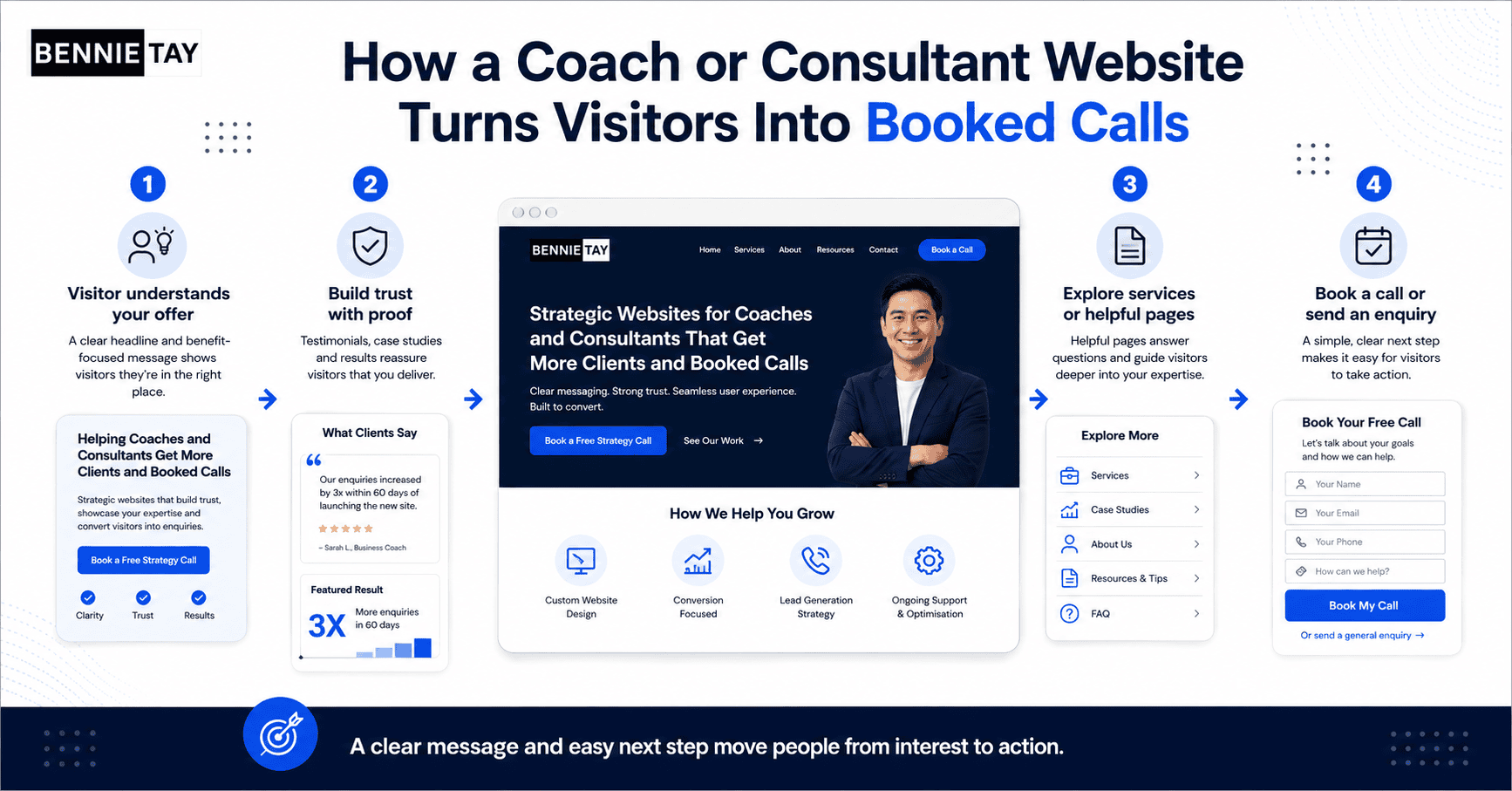
Your homepage should work like a guided conversation. The first section should explain who you help and what result you help them achieve. The next section should show that you understand the problem. After that, you can introduce your approach, offers, proof, and call to action.
For coaches and consultants, the homepage should not be too abstract. Visitors should quickly understand your niche, your method, and the type of client you work with. If they cannot tell whether you are a leadership coach, business consultant, marketing advisor, HR consultant, or life coach, the message needs to be clearer.
You can also include a short “who this is for” section. This helps qualify enquiries. For example, your coaching may be best for SME founders, senior managers, new leaders, consultants, or business owners who already have revenue but need better systems.
Then include a “how I can help” section with your main offers. Keep each offer short and link to a more detailed page if needed. The homepage should guide, not overwhelm.
Why articles can help coaches and consultants
Articles are useful because they let potential clients experience your thinking before speaking with you. A helpful article can answer a question, explain a framework, challenge a common mistake, or show how you approach a problem.
For example, a business consultant might write about improving sales follow-up, building SOPs, hiring the first manager, or reviewing marketing performance. A leadership coach might write about giving feedback, managing conflict, or moving from individual contributor to leader.
These articles can support SEO, but they also support trust. When someone reads your article and feels that you understand their problem, they are more likely to book a call.
You do not need to publish every week. It is better to have a few strong articles that answer real client questions than many generic posts that say very little.
How to qualify better enquiries
A good website should not attract everyone. It should attract the right people and gently filter out poor-fit enquiries. This saves time and improves sales conversations.
You can qualify visitors by being clear about who you help, what stage they should be at, what problems you solve, and what outcomes are realistic. If your service is best for established business owners, say so. If your coaching requires commitment over several months, explain that.
Your form can also help. Instead of asking only for name and phone number, include one or two useful questions such as “What challenge are you trying to solve?” or “What type of support are you looking for?” Keep it short, but collect enough context to prepare for the call.
Keep the tone personal but professional
For coaches and consultants, tone matters. Your website should sound like a real expert speaking clearly, not like a generic corporate brochure. Use confident language, but avoid overpromising. Clients want to feel that you are credible, grounded, and easy to talk to.
Short paragraphs, direct explanations, and practical examples make your website easier to read. This is especially important for busy founders, managers, and professionals who are scanning quickly before deciding whether to book a call.
Avoid common website mistakes
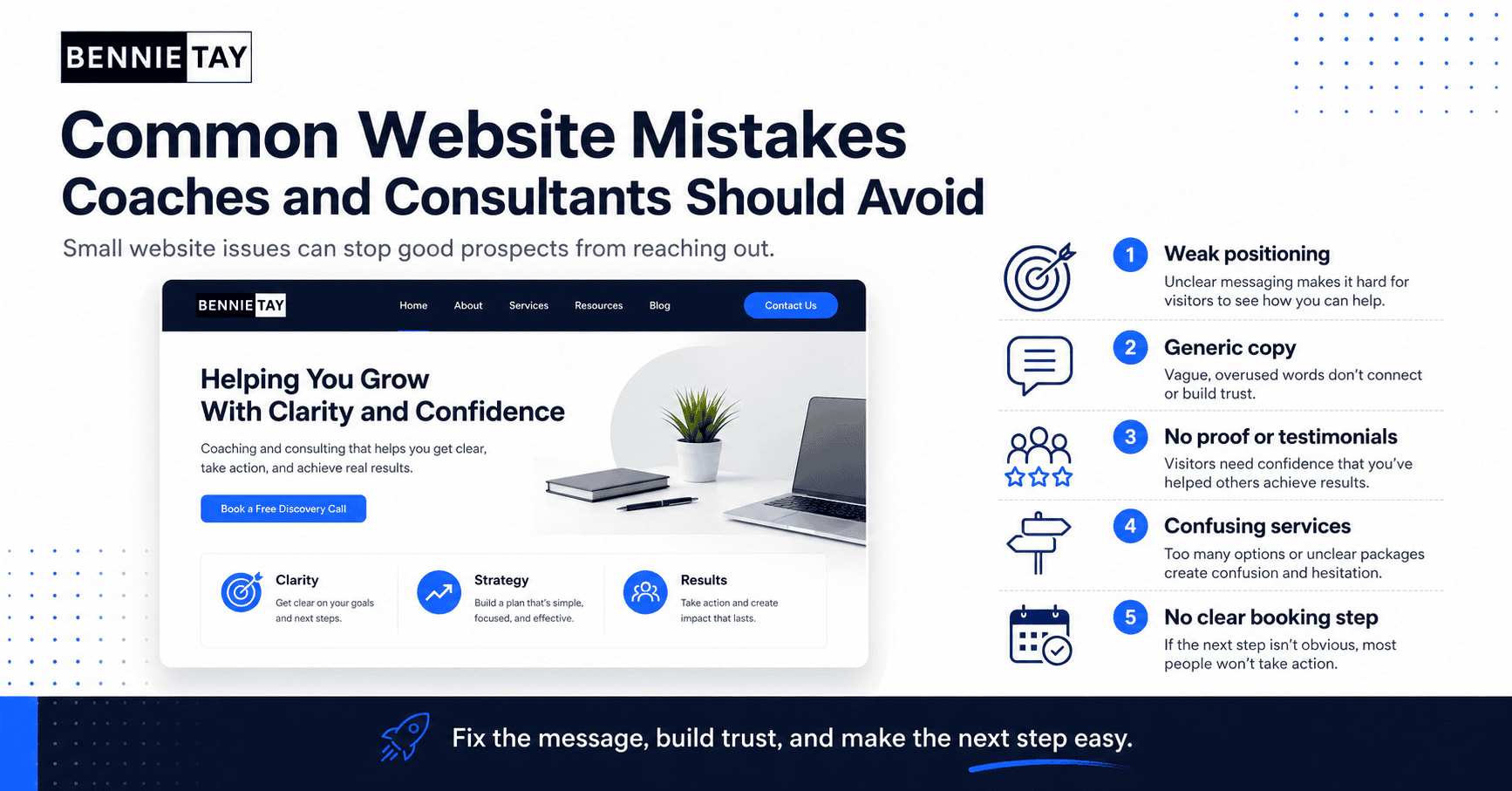
One common mistake is making the website too much about the coach and not enough about the client. Your story matters, but visitors also need to see how your story helps them.
Another mistake is using too many abstract claims. Words like clarity, transformation, growth, and breakthrough can be useful, but only when supported by specific examples.
A third mistake is hiding the next step. If people have to search for how to contact you, you will lose enquiries. Make the call to action obvious.
Final thoughts
A strong website for coaches and consultants should position you clearly, explain the problem, show your process, build trust, and guide visitors toward a booked call.
You do not need a complicated website. You need a clear one. When your message is specific and your next step is easy, the right prospects are more likely to understand your value and take action.