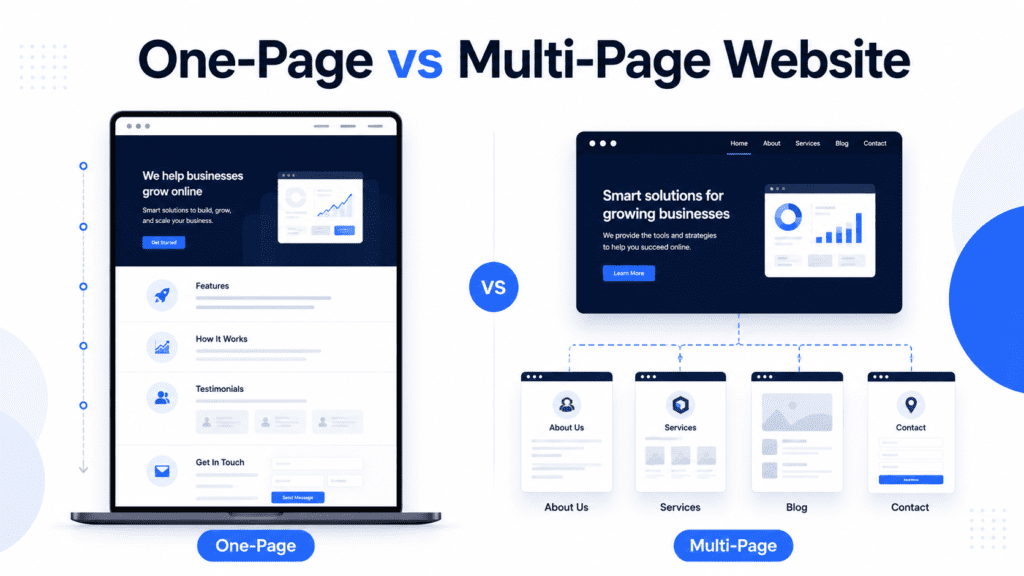
When building a business website, one of the first decisions you need to make is whether to create a one-page website or a multi-page website. At first, this may seem like a simple design choice. One page feels faster, cheaper, and easier to launch. A multi-page website feels more complete, professional, and better for long-term growth.
But the right choice is not only about page count. It depends on your business goals, services, budget, SEO strategy, customer journey, and how much information your visitors need before they contact you.
A one-page website can work very well for simple businesses, focused offers, campaigns, consultants, freelancers, and new businesses that need to launch quickly. A multi-page website is usually better for businesses with multiple services, SEO goals, location targeting, detailed content, case studies, blog posts, or a more complex buying journey.
This guide compares one-page websites and multi-page websites, including pros, cons, pricing considerations, SEO impact, conversion differences, and how to choose the best structure for your business.
What Is a One-Page Website?
A one-page website is a website where all the main information is presented on a single page.
Instead of visitors clicking through multiple pages, they scroll through sections on one long page. The navigation menu may jump to different sections on the same page, such as:
- Home
- Services
- About
- Reviews
- FAQ
- Contact
A one-page website can include all the essential sections a small business needs, such as:
- Hero section
- Services overview
- Benefits
- About section
- Testimonials
- Pricing or package details
- FAQ section
- Contact form
- Call-to-action buttons
This type of website is often used for freelancers, consultants, landing pages, simple service businesses, personal brands, events, product launches, and startup offers.
The main advantage is simplicity. A one-page website gives visitors a focused journey from top to bottom without asking them to navigate around multiple pages.
What Is a Multi-Page Website?
A multi-page website is a website with several separate pages, each focused on a specific topic.
Common pages include:
- Homepage
- About page
- Services page
- Individual service pages
- Pricing page
- Case studies
- Blog
- FAQ page
- Contact page
- Location pages
A multi-page website gives your business more space to explain different services, target different keywords, answer customer questions, publish content, and build trust. This structure is common for service businesses, local businesses, agencies, consultants, clinics, professional firms, e-commerce brands, and companies that want to grow through SEO.
The main advantage is depth.
A multi-page website allows you to create a stronger customer journey for visitors who need more information before taking action.
One-Page Website vs Multi-Page Website: Quick Comparison
| Feature | One-Page Website | Multi-Page Website |
|---|---|---|
| Structure | All content on one page | Content split across multiple pages |
| Launch speed | Faster | Usually slower |
| Cost | Usually lower | Usually higher |
| Best for | Simple offers, new businesses, campaigns | Service businesses, SEO, detailed offers |
| SEO potential | Limited | Stronger |
| Content depth | Lower | Higher |
| User journey | Simple and linear | More flexible |
| Maintenance | Easier | More involved |
| Conversion focus | Strong for one main goal | Strong for multiple goals |
| Scalability | Limited | Better for growth |
The Main Difference Between a One-Page and Multi-Page Website
The biggest difference is how information is organized. A one-page website gives visitors one clear path. They land on the page, scroll through the story, review the offer, see proof, read FAQs, and take action.
A multi-page website gives visitors multiple paths. They can visit the homepage, explore specific services, read blog posts, view case studies, check pricing, learn about the company, and then contact you when ready.
A one-page website is focused. A multi-page website is expandable. The better choice depends on whether your business needs simplicity or depth.
Pros of a One-Page Website
1. Faster to Launch
A one-page website is usually faster to build because there are fewer pages to plan, write, design, and test. This makes it useful if you need to get online quickly. For example, a new consultant, freelancer, coach, local service provider, or startup can launch a professional one-page website without waiting weeks for a full website build.
If speed matters, a one-page website can help you start selling sooner instead of spending forever “getting ready,” which is the business version of rearranging furniture during a fire.
2. Lower Initial Cost
A one-page website usually costs less than a multi-page website because the scope is smaller. There is less copywriting, fewer designs, fewer layouts, fewer forms, and less SEO setup. This makes it useful for small businesses with limited budgets.
A one-page website can be a practical starting point if you need:
- A basic online presence
- A simple service offer
- A quick launch
- A professional link to share
- A focused enquiry page
- A temporary campaign site
It may not be the final version of your website forever, but it can be enough to start.
3. Simple Visitor Journey
One-page websites are easy to follow. Visitors do not need to click through multiple pages to understand the offer. They simply scroll. A well-structured one-page website can guide visitors through a clear sequence:
- What you offer
- Who it is for
- Why it matters
- What is included
- Why they should trust you
- How it works
- What to do next
This makes one-page websites effective for simple offers and single conversion goals.
4. Strong Focus on One Goal
A one-page website works best when your business has one main goal. That goal could be:
- Request a quote
- Book a consultation
- Send a WhatsApp message
- Register for an event
- Join a waitlist
- Download a guide
- Buy one service package
- Schedule an appointment
Because there are fewer distractions, a one-page website can keep visitors focused on the action you want them to take.
This is why one-page websites often work well for landing pages and campaigns.
5. Easier to Maintain
With fewer pages, a one-page website is easier to update. If you need to change your offer, pricing, contact details, testimonials, or FAQ, you only need to update one page.
This can be helpful for business owners who do not want to manage a larger website.
Cons of a One-Page Website
1. Limited SEO Potential
The biggest disadvantage of a one-page website is limited SEO. Search engines rank pages, not entire business intentions floating in the mist. If all your services are squeezed onto one page, it becomes harder to target different keywords effectively.
For example, if you offer:
- Website design
- Website redesign
- Landing page design
- SEO setup
- Website maintenance
A single page may struggle to rank for all these topics. A multi-page website allows each service to have its own dedicated page, making it easier to target specific search queries.
2. Not Enough Space for Complex Services
Some businesses need more explanation. If your service is high-value, technical, regulated, or complex, visitors may need detailed information before they enquire.
A one-page website may not give enough space for:
- Detailed service descriptions
- Case studies
- Pricing explanations
- Multiple FAQs
- Industry-specific content
- Location targeting
- Blog content
- Comparison content
- Team information
- Detailed process breakdowns
Trying to fit too much information onto one page can make the page feel crowded and overwhelming.
3. Harder to Scale
A one-page website can work well at the beginning, but it may become limiting as your business grows. You may eventually need:
- More service pages
- Location pages
- Blog posts
- Case studies
- Pricing pages
- Landing pages
- Industry pages
- Resource pages
At that point, a multi-page structure becomes more practical. A one-page website is a good starting point for some businesses, but it is not always the best long-term foundation.
4. Less Suitable for Multiple Audiences
If your business serves different customer types, one page may not be enough. For example, a consultant may work with:
- Startups
- Small businesses
- Enterprise teams
- Agencies
- Nonprofits
Each audience may need different messaging, proof, pain points, and service details. A multi-page website can create separate pages for different audiences. A one-page website has to generalize, which can make the message weaker.
5. Navigation Can Become Messy
One-page websites often rely on scrolling. That can work well when the content is short and focused. But if the page becomes too long, visitors may struggle to find specific information.
A long one-page website with too many sections can become difficult to scan, especially on mobile. At some point, splitting content into separate pages creates a better user experience.
Pros of a Multi-Page Website
1. Better for SEO
A multi-page website gives your business more opportunities to rank on search engines. Each page can target a different keyword, service, location, question, or customer need. For example, a service business can create pages such as:
- Website Design for Small Businesses
- Monthly Website Plans
- Website Redesign Services
- Landing Page Design
- Website Maintenance
- Website Design in Kuala Lumpur
- Website Design in Singapore
This gives search engines clearer signals about what each page is about. It also helps potential customers find the exact service they are searching for.
2. More Room to Explain Your Services
A multi-page website gives each service enough space. This is especially important if your business sells professional services, consulting, local services, technical services, or higher-ticket offers.
A dedicated service page can include:
- Service-specific headline
- Problem statement
- Solution overview
- What is included
- Benefits
- Process
- Pricing guidance
- Testimonials
- FAQs
- CTA
This is much stronger than a short paragraph on a homepage.
3. Better for Building Trust
Trust takes information. A multi-page website lets you include more proof and credibility signals, such as:
- Case studies
- Testimonials
- Reviews
- Portfolio pages
- Certifications
- About page
- Team page
- Client logos
- Blog content
- Process pages
- FAQ pages
This helps visitors feel more confident before contacting you. For service businesses, trust is often the difference between a visitor leaving and a visitor enquiring.
4. Supports the Full Customer Journey
Not every visitor is ready to contact you immediately. Some visitors are researching. Some are comparing. And some are ready to buy. A multi-page website can support each stage:
- Blog posts for awareness
- Service pages for consideration
- Case studies for trust
- Pricing pages for decision-making
- Contact pages for conversion
This creates a stronger lead generation system. A one-page website usually supports a shorter journey. A multi-page website supports a deeper one.
5. Easier to Grow Over Time
A multi-page website is more scalable. As your business grows, you can add:
- New services
- New locations
- Blog articles
- Case studies
- Landing pages
- Industry pages
- Resource pages
- FAQs
- Comparison pages
This makes it easier to build long-term visibility and authority.
Cons of a Multi-Page Website
1. Higher Cost
A multi-page website usually costs more because it requires more planning, writing, design, SEO setup, and testing. Each page needs its own structure, copy, layout, CTA, metadata, and internal links.
For businesses with limited budgets, starting with too many pages may not be practical.
2. Longer Launch Timeline
More pages mean more work. A multi-page website may take longer to launch because you need to prepare more content, review more layouts, and test more paths.
If you need to launch quickly, a one-page website may be more realistic.
3. More Maintenance
A larger website needs more updates. You may need to keep service pages, pricing, contact details, blog posts, testimonials, and location pages current.
If the website is not maintained, it can become outdated or inconsistent.
4. More Planning Required
A multi-page website needs a clear structure. Without proper planning, it can become confusing. Common problems include:
- Too many menu items
- Duplicate content
- Weak internal linking
- Poor page hierarchy
- Service pages that overlap
- Blog posts with no CTA
- Important pages hidden too deep
A multi-page website is powerful, but only when organized properly. Otherwise, it becomes a digital filing cabinet with a contact form stapled to it.
One-Page Website vs Multi-Page Website for SEO
If SEO is a major priority, a multi-page website is usually the better choice. A one-page website can still be optimized, but it has limited space to target different keywords. For example, a one-page website may target a broad keyword such as: “Website design for small businesses”
But a multi-page website can target multiple specific keywords:
- Website-as-a-Service for Small Businesses
- Monthly Website Plans
- Website Redesign Services
- Landing Page Design Services
- Website Design for Consultants
- Website Design for Local Service Businesses
- Small Business Website Cost
- Website Redesign Checklist
Each page can focus on a different search intent. This gives your website more chances to attract organic traffic.
When One-Page SEO Can Work
A one-page website may still work for SEO if:
- Your business has one clear service
- Your location is specific
- Competition is low
- Your page is well optimized
- You have strong Google Business Profile presence
- You build backlinks or citations
- You do not need to rank for many different terms
For example: “Mobile Hairdresser in Subang Jaya” or “Freelance Copywriter in Penang.” A focused one-page website may be enough in a less competitive market.
One-Page Website vs Multi-Page Website for Lead Generation
Both one-page and multi-page websites can generate leads. The better choice depends on the complexity of your offer.
A one-page website can generate leads well when:
- The offer is simple
- The visitor needs little explanation
- There is one main CTA
- Traffic comes from outreach, ads, or direct links
- The goal is fast enquiry or booking
A multi-page website can generate leads well when:
- The offer needs more explanation
- Visitors compare multiple services
- SEO is important
- Trust proof matters
- Customers need case studies, FAQs, pricing, or process details
- The business serves multiple locations or audiences
For most service businesses, a multi-page website creates stronger long-term lead generation. For focused offers and quick launches, one-page can work well.
One-Page Website vs Landing Page: Are They the Same?
A one-page website and a landing page can look similar, but they are not always the same.
A one-page website is often used as the full online presence for a small business. It may include general information about the business, services, about section, reviews, and contact details.
A landing page is usually created for one specific campaign or offer. It may have fewer distractions and a single conversion goal.
For example:
- One-page website: A freelancer’s complete business website
- Landing page: A campaign page promoting a free consultation
Both can be one page, but the strategy is different.
Which Businesses Should Choose a One-Page Website?
A one-page website is a good fit if your business is simple, focused, or early-stage.
Choose a one-page website if:
- You need to launch quickly
- You have a limited budget
- You offer one main service
- You do not need strong SEO yet
- Your business is new
- You want a simple online presence
- You are testing an offer
- You mainly get traffic from referrals, outreach, or ads
- You do not need multiple service pages
- You want visitors to take one clear action
A one-page website is especially useful for:
- Freelancers
- Consultants
- Coaches
- Personal brands
- Small local services
- Event pages
- New startups
- Simple campaigns
- Single-service businesses
Which Businesses Should Choose a Multi-Page Website?
A multi-page website is better if your business needs depth, trust, and long-term growth.
Choose a multi-page website if:
- You offer multiple services
- You want to rank on Google
- You serve multiple locations
- You need case studies or portfolio pages
- You want to publish blog content
- Your customers need more information
- Your service is high-value or complex
- You want stronger credibility
- You need different pages for different audiences
- You plan to grow your website over time
A multi-page website is especially useful for:
- Local service businesses
- Agencies
- Consultants with multiple offers
- Clinics
- Professional firms
- Home service businesses
- B2B companies
- E-commerce brands
- SaaS companies
- Established service providers
Pricing: One-Page Website vs Multi-Page Website
Pricing varies depending on the platform, design quality, copywriting, SEO setup, and support included. In general, a one-page website costs less than a multi-page website.
Typical One-Page Website Pricing
A one-page website may cost:
- Lower monthly fee with a website plan
- Lower upfront fee from a freelancer or agency
- Less copywriting cost
- Less design and development time
A one-page website is often used in entry-level website plans because it is faster to launch and easier to manage.
Typical Multi-Page Website Pricing
A multi-page website usually costs more because it includes:
- More page designs
- More copywriting
- More SEO setup
- More internal linking
- More testing
- More content planning
- More technical structure
For businesses choosing a monthly website plan, the number of pages may be tied to the subscription tier.
For example:
- Managed Website: agree the page structure around the business and its enquiries
- Website Growth: add ongoing website improvement as needs grow
- Growth Partner: agree consultant-led strategic support
- Custom Website: scope WordPress or bespoke functionality through a quotation
This kind of structure helps businesses start small and upgrade as they grow.
Can You Start With One Page and Upgrade Later?
Yes, and for many businesses, this is the smartest approach. You do not need to build a large website before you have a clear offer, audience, and sales process.
A practical path could be:
- Start with a one-page website.
- Use it to explain your offer and collect enquiries.
- Track what visitors ask about.
- Add dedicated service pages based on demand.
- Add blog posts and location pages for SEO.
- Upgrade into a multi-page website as the business grows.
This approach avoids overbuilding too early. It also lets your website grow based on real business needs instead of guesses.
Best Structure for a One-Page Website
A strong one-page website should still follow a clear structure. Recommended sections:
- Hero section
- Trust indicators
- Problem section
- Solution section
- Services or offer overview
- Benefits
- Process
- Testimonials or proof
- Pricing guidance
- FAQ section
- Final CTA
- Contact section
- Footer
The page should guide visitors from clarity to trust to action. Do not turn a one-page website into an endless scroll of every thought your business has ever had. Restraint is still legal.
Best Structure for a Multi-Page Website
A strong multi-page website should organize content around customer intent. Recommended pages:
- Homepage
- Services overview
- Individual service pages
- About page
- Pricing page
- Case studies or portfolio
- Testimonials or reviews
- Blog or resources
- FAQ page
- Contact page
- Location pages if relevant
Recommended homepage sections:
- Hero section
- Trust indicators
- Services overview
- Why choose us
- Process
- Proof or case studies
- Pricing preview
- FAQs
- Final CTA
The homepage should guide visitors to deeper pages, while each service page should focus on converting visitors interested in that specific service.
Common Mistakes to Avoid
1. Choosing One Page Only Because It Is Cheaper
A one-page website can be effective, but it should still support your business goals. If your customers need detailed service information, a one-page website may limit conversion.
2. Building Too Many Pages Too Early
A large website with weak content is not better than a focused one-page website. Do not create pages just to look bigger. Each page should have a purpose.
3. Putting Multiple Services on One Page Forever
A services overview is useful, but major services deserve their own pages. This helps SEO, clarity, and conversion.
4. Ignoring SEO Structure
If you care about organic traffic, plan your page structure properly. One page cannot easily target every keyword.
5. Forgetting CTAs
Whether your website has one page or many pages, every important section should guide visitors toward action. Use CTAs such as:
- Request a Quote
- Book a Free Consultation
- Send WhatsApp Message
- View Website Plans
- Schedule an Appointment
6. Making Navigation Confusing
One-page websites need clear section links. Multi-page websites need simple menus. Do not make visitors work hard to find basic information. They are customers, not detectives.
Final Verdict: One-Page Website or Multi-Page Website?
Choose a one-page website if you need a fast, affordable, focused website for a simple offer, new business, campaign, freelancer profile, or early-stage service.
Choose a multi-page website if you want stronger SEO, more credibility, dedicated service pages, blog content, location targeting, case studies, and long-term growth.
A one-page website is best for simplicity and speed. A multi-page website is best for depth and scalability.
For many businesses, the smartest path is to start with one page and upgrade to multiple pages when the business grows. The best website is not the one with the most pages. It is the one with the right structure for your customer journey.
If your visitor can quickly understand your offer, trust your business, and take action, your website is doing its job. Whether that takes one page or ten pages depends on your business.