A service business website should do more than display your logo, company background and a basic description of what you offer. Its main purpose should be to help potential customers understand your services, feel confident about your business and take the next step.
That next step may be sending a WhatsApp message, booking a consultation, requesting a quotation, calling your team or submitting an enquiry form. Whatever action matters most to your business, the website should guide visitors towards it clearly.
For many Malaysian customers, a company website is an important part of the decision-making process. Someone may first discover your business through Google, Google Maps, Facebook, Instagram, TikTok, an online advertisement or a personal recommendation. Before contacting you, however, they may visit your website to confirm whether your company appears legitimate, professional and suitable for their needs.
This behaviour is common across many service industries. Clinics, consultants, tuition centres, renovation contractors, beauty salons, cleaning companies, accountants, fitness trainers, marketing agencies and home service providers all depend heavily on customer trust. Because customers cannot physically inspect a service before purchasing it, the website must make the business feel credible and easy to understand.
The problem is that many service business websites are designed mainly to look modern. They use polished photographs, fashionable colours and impressive animations, but provide very little useful information. Visitors are left unsure about what the company actually does, who the service is for or how they should proceed.
A visually attractive website can support a strong business message, but appearance alone does not generate enquiries. A high-converting website needs clear content, credible proof and a simple path from interest to action.
Why Service Business Websites Need a Different Strategy
A service business does not sell in the same way as an online store.
An e-commerce website can show a product image, price, specifications, customer reviews and a checkout button. The customer can compare options and complete the purchase without speaking to anyone.
A service is less tangible. Customers are often paying for expertise, time, advice, workmanship or a future result. Before they contact a provider, they need to feel confident that the business understands their situation and is capable of delivering the expected outcome.
A visitor may want to know exactly what you provide, whether your solution is appropriate for their problem and whether you serve their location. They may also be considering your experience, pricing level, working process and reputation.
Some visitors are ready to enquire immediately. Others are still comparing businesses and gathering information. Your website needs to support both types of customers.
When important information is missing, uncertainty grows. Visitors delay their decision, return to Google or contact a competitor whose website explains the service more clearly. Customers are not always choosing the company with the best technical ability. They often choose the company that makes the decision feel simplest and safest.
A strong service business website reduces this uncertainty. It recognises the visitor’s problem, explains the solution, shows why the business can be trusted and provides a clear next step.
Decide What Your Website Should Achieve
Before planning individual pages, decide what the primary goal of your website should be.
For many Malaysian service businesses, the main goal is to generate WhatsApp enquiries. For others, the priority may be telephone calls, consultation bookings, appointment requests, quotation submissions or completed contact forms.
A website may support several actions, but it should still have one main conversion goal. When too many actions are presented with equal importance, visitors may become unsure about which option to choose.
A clinic, for example, may focus on appointment bookings. A renovation company may prioritise detailed quotation requests. A consultant may want potential clients to schedule an introductory call, while a cleaning business may prefer visitors to contact the team directly through WhatsApp.
Once the main objective has been selected, the website should be structured around it. The homepage, service pages, blog articles and contact page should all guide visitors towards the same primary action.
This does not mean placing the same button after every sentence. It means creating a consistent journey. Visitors should always understand what they can do next without having to search through menus or reach the bottom of the website.
The Essential Pages Every Service Business Website Needs
A small business does not necessarily need a large website. It needs the right pages, written and structured properly.
A focused service business website may begin with a homepage, individual service pages, an About page, a Contact page and a portfolio or case study section. A blog can then be added to support SEO and attract customers who are still researching their options.
Each page should have a clear role. The homepage introduces the business. Service pages explain individual solutions. The About page builds confidence. The Contact page removes barriers to enquiry. Case studies provide proof, while blog articles attract relevant search traffic.
Creating a Clear and Persuasive Homepage
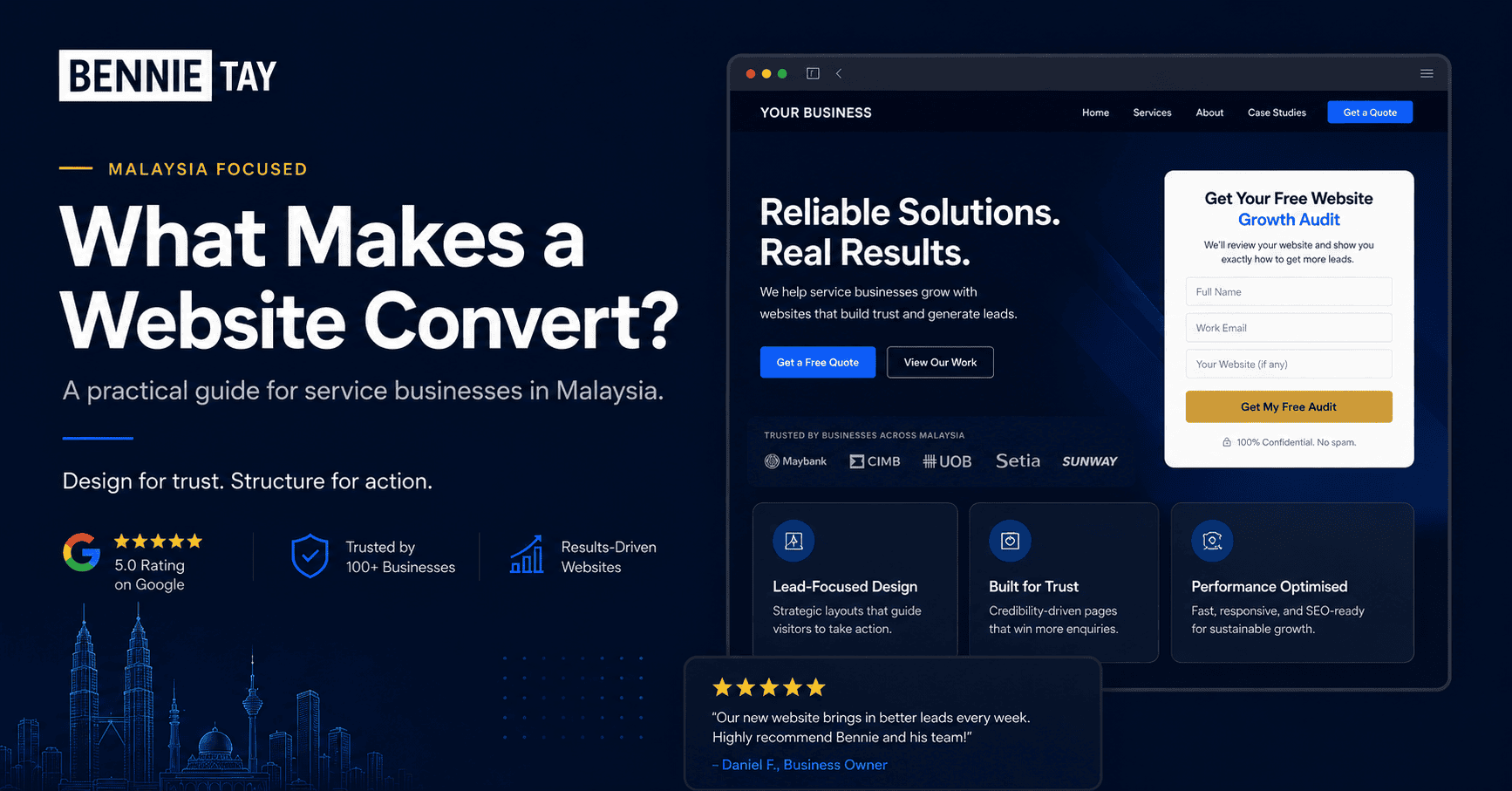
The homepage is normally the first page many visitors see. It should quickly communicate what the business does, who it helps and what result the customer can expect.
Visitors should not have to scroll through several sections before understanding the offer. The main headline should provide a direct explanation instead of relying on vague claims.
A statement such as “Your Trusted Partner for Innovative Solutions” could describe almost any business. It does not explain the service, customer or outcome.
A stronger headline would be:
Professional Website Design for Malaysian Service Businesses That Want More Enquiries
Another suitable option might be:
Lead Generation Websites for Clinics, Consultants and Local Service Companies
The supporting paragraph can then add more context:
“We create professional, mobile-friendly websites that help small businesses explain their services clearly, build customer confidence and generate more WhatsApp enquiries, calls and quotation requests.”
This approach immediately tells visitors what is being offered and why it matters.
After the opening section, the homepage should introduce the problems the customer may be experiencing. It can then explain the available services, demonstrate credibility, outline the working process and answer common questions.
The homepage does not need to explain every service in full. Its role is to provide a clear overview and direct visitors to the most relevant page.
Building Detailed Service Pages
Each major service should have its own dedicated page.
Many businesses place all their services inside one short homepage section. While this may make the website shorter, it rarely gives visitors enough information to make a decision. It also limits the number of relevant keywords the website can target.
A website design company, for example, may offer business website design, landing page development, website redesign, maintenance, local SEO pages and monthly website plans. Each service solves a different problem and attracts customers with different intentions.
A dedicated service page provides room to explain who the service is designed for, what problem it addresses and what the customer will receive. It can also describe the process, likely outcomes and frequently asked questions.
A landing page design page should explain when a landing page is useful, how it differs from a full website and how it supports advertising campaigns. A website redesign page should discuss common problems such as outdated layouts, poor mobile usability, confusing content and low enquiry rates.
The purpose of a service page is not merely to describe what your company does. It should help visitors decide whether the service is appropriate for them.
Detailed service pages can also improve SEO. A company with separate pages for “landing page design Malaysia,” “small business website design” and “website redesign Kuala Lumpur” has more opportunities to appear for specific customer searches than a company with one general services page.
Writing an About Page That Builds Trust
The About page should not be treated as a formal company biography.
For service businesses, it is primarily a trust-building page. Visitors want to know who is responsible for delivering the service, what experience the company has and how customers are treated.
A strong About page can explain the company’s background, the types of customers it serves and the principles that guide its work. It should introduce the owner or team and may include professional photographs, qualifications, industry experience or notable achievements.
However, the page should not focus only on the company.
A sentence such as “We were founded in 2020 and remain committed to excellence” provides information but gives the customer little reason to care.
A more customer-focused version might say:
“We help Malaysian service businesses turn complicated offerings into clear, professional websites that make it easier for customers to understand, trust and contact them.”
The company’s story is still important, but it should be connected to the value customers receive.
People are more likely to contact a service provider when they can see that a real, credible person or team stands behind the business. Authentic photographs and specific explanations are usually more persuasive than generic corporate language.
Making the Contact Page Easy to Use
The Contact page should remove friction instead of creating more of it.
When someone reaches this page, they are already considering an enquiry. Complicated forms, hidden contact information and unclear response processes can cause them to leave.
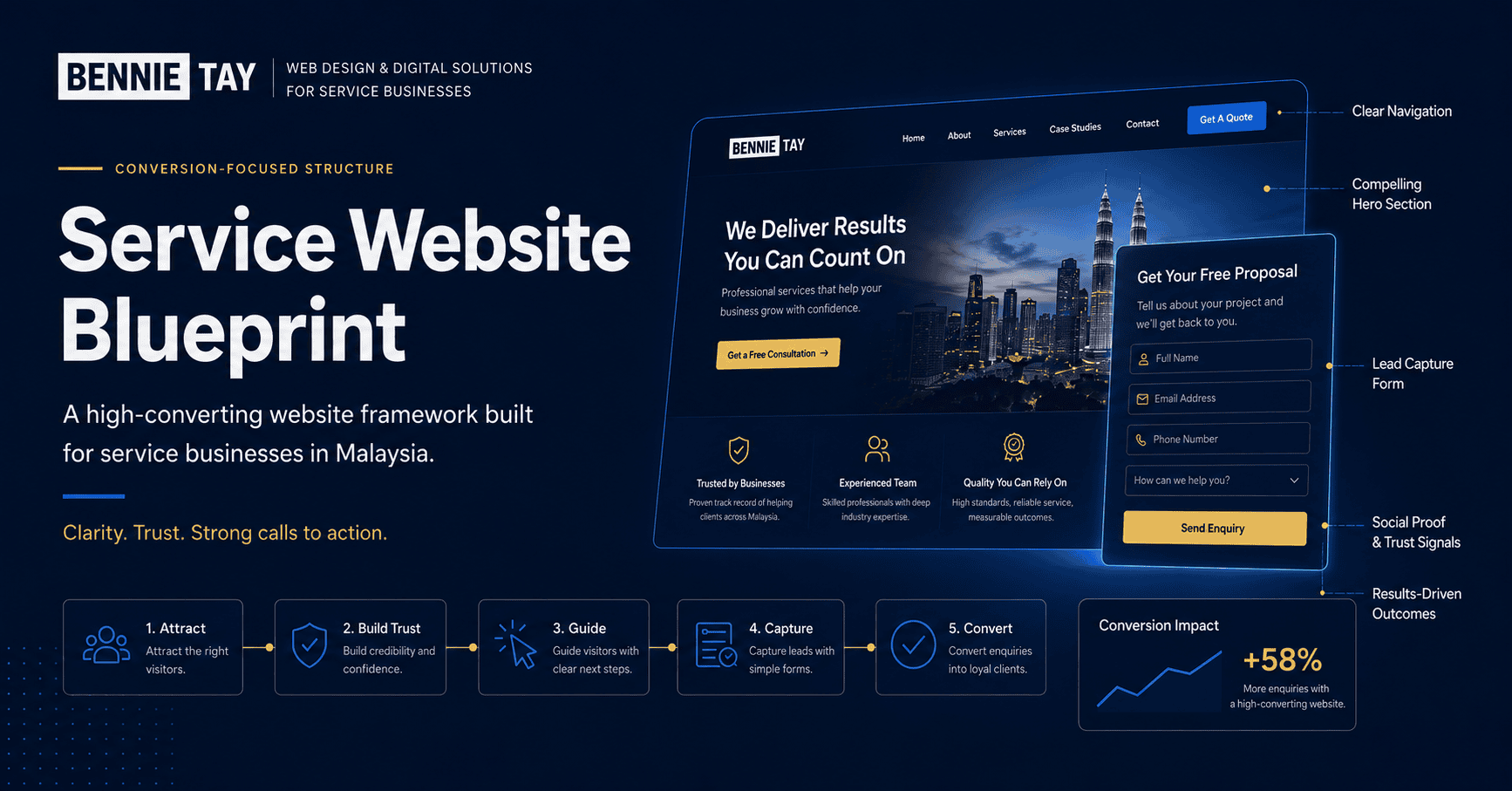
A useful Contact page should clearly show the available ways to reach the business. This may include a contact form, WhatsApp link, telephone number, email address, office location and operating hours.
The page should also explain what will happen after the enquiry is submitted. For example, you might tell visitors that a team member will review their request and respond within one business day.
Contact forms should collect only the information required for the initial conversation. Asking for too many details may discourage visitors, particularly those using mobile phones.
For many service businesses, a name, contact number, service selection and short message are sufficient. More detailed information can be collected later.
WhatsApp is especially important in Malaysia because many customers prefer direct messaging. A visible WhatsApp button allows visitors to begin a conversation without completing a form.
The button can also open with a prepared message such as:
“Hi, I would like to know more about your website design services.”
This small improvement reduces effort and makes the enquiry process feel more convenient.
Using Portfolios and Case Studies as Proof
Customers want evidence that your business can deliver what it promises.
A portfolio provides visual proof, but a case study offers deeper reassurance. It explains the customer’s situation, the problem that needed to be solved and the work completed.
Instead of publishing only a website screenshot or renovation photograph, provide context.
For example:
“A local professional services company had an outdated website with unclear navigation and limited enquiry options. The site was restructured around its main services, rewritten for clarity and updated with more visible WhatsApp and consultation buttons.”
This description helps potential customers understand the value of the project.
Case studies are particularly important for businesses where results, appearance or expertise influence the buying decision. Website designers, renovation firms, consultants, marketing agencies, beauty businesses and interior designers can all benefit from detailed project examples.
Even when exact performance figures are unavailable, you can still explain the challenge, solution and improvements made.
Using Blog Content to Attract Potential Customers
A blog can help your website reach people before they are ready to purchase.
Potential customers often search for answers long before they contact a business. They may want to know how much a service costs, what is included, how long it takes or which option is most suitable.
A website design company could publish articles about the cost of website development in Malaysia, the difference between a landing page and a full website, common reasons websites fail to generate enquiries and ways to improve WhatsApp conversions.
A clinic might answer questions about treatments, appointment preparation and aftercare. A renovation company could discuss budget planning, project timelines and contractor selection.
Useful blog content helps search engines understand your area of expertise while building trust with readers.
However, each article should connect naturally to a relevant service. A guide about underperforming websites might link to a website audit or redesign service. An article about landing pages could direct readers to a landing page package.
Without this connection, the blog may generate traffic without contributing meaningfully to sales.
Structuring the Homepage for More Conversions
The order of homepage sections affects how visitors understand your offer.
The page should begin with a clear hero section containing the main headline, a concise supporting statement and a strong call-to-action.
For example:
Website Design for Malaysian Service Businesses
“We build professional, mobile-friendly websites that explain your services clearly and help generate more calls, quotations and WhatsApp enquiries.”
The main button could invite visitors to request a free website growth audit, while a secondary button could lead to available website plans.
The hero section should remain simple. Its purpose is to help visitors understand the offer and decide whether to continue reading.
Show That You Understand the Customer’s Problem
After introducing the service, describe the challenges your target customers may be facing.
A business owner may have an outdated website that no longer reflects the quality of the company. Visitors may be leaving without contacting the business because the services are poorly explained. The site may be difficult to use on mobile devices, or the contact options may be hidden.
Other businesses may rely heavily on referrals and want a more predictable source of leads. Some may be running paid advertisements but sending visitors to pages that are not designed to convert.
When the website describes these situations accurately, visitors feel understood. They begin to see the company as a provider that recognises the real business problem rather than simply selling a generic service.
This section should be specific without becoming overly negative. The goal is to reflect the customer’s experience and prepare the reader for the solution.
Explain the Solution Through Business Outcomes
Once the problem has been established, introduce your solution.
Avoid relying only on general statements such as “We create modern websites.” Instead, explain how the service benefits the business.
A clear website structure helps visitors understand services more quickly. Mobile-friendly design allows customers to browse and enquire from their phones. Conversion-focused copy explains the value of the offer and encourages action.
WhatsApp integration makes it easier for customers to start a conversation, while local SEO structure helps search engines understand the business, services and locations.
Customers do not usually care about design tools, page builders or technical frameworks. They care about the final result.
The website should therefore explain how its features contribute to more trust, better visibility and increased enquiries.
Present Services in a Way That Helps Visitors Choose
The homepage should introduce each main service with a short, useful explanation.
A business website design service may be suitable for companies that need a complete online presence. A landing page service may be designed for campaigns or promotions with one specific goal.
A website redesign service can be positioned for businesses with outdated or confusing websites, while a monthly plan may appeal to smaller companies that prefer predictable payments instead of a large upfront fee.
Each service summary should lead to a dedicated page where the visitor can learn more.
This structure helps customers find the right solution and makes the website easier for search engines to understand.
Build Trust Without Making Exaggerated Claims
Trust can be built through customer testimonials, Google reviews, project examples, case studies, professional credentials and relevant experience.
However, newer businesses may not yet have a large collection of testimonials or client logos. This does not mean the website cannot feel credible.
A clear process, detailed deliverables, realistic promises and transparent communication can also build trust. Visitors are more comfortable contacting a company when they understand what the service includes and how the project will be managed.
Specific information is usually more persuasive than broad claims.
Instead of claiming to provide “world-class quality,” explain the steps you take to review the customer’s goals, plan the site structure, prepare the content and test the final website.
Clarity demonstrates professionalism.
Explain the Working Process
Service businesses should explain what happens after a customer enquires.
An unclear process can make a project feel complicated or risky. A simple explanation helps visitors understand what to expect.
The process may begin with an initial review of the customer’s business, target audience and current website. The next stage could involve planning the required pages, content, keywords and calls-to-action.
After the plan is approved, the design and development work begins. The website is then reviewed, tested and prepared for launch.
Ongoing support or performance improvement may be available after launch.
This information reassures visitors that they will not be left to manage the project alone. It also sets expectations before the sales conversation begins.
Answer Common Questions Before Visitors Ask Them
A frequently asked questions section can resolve objections and improve SEO.
Potential customers may want to know how much the service costs, how long the project will take and whether content writing is included. They may also ask whether the website will work properly on mobile devices or support WhatsApp enquiries.
A clear answer does not need to reveal an exact price when project requirements vary. It can explain which factors influence the cost.
For example:
“The cost of a service business website in Malaysia depends on the number of pages, required functionality, content needs and level of customisation. A straightforward company website generally costs less than a platform with booking tools, membership features or complex integrations.”
Another common question concerns the difference between a landing page and a full website.
A useful explanation might say:
“A landing page focuses on one offer or campaign and normally has one main conversion goal. A full website is more suitable for businesses with several services, a long-term SEO strategy or a need to present broader company information.”
Answers should be concise, helpful and written in language customers can understand.
Creating Strong Calls-to-Action
A call-to-action tells visitors what to do next.
Generic labels such as “Submit,” “Learn More” and “Click Here” provide little motivation. A stronger CTA explains the action and the expected benefit.
Examples include “Request a Free Website Audit,” “Get a Website Quotation,” “Book an Initial Consultation” and “Chat With Us on WhatsApp.”
Most service business websites should have one primary CTA and one secondary CTA.
The primary CTA is intended for visitors who are ready to engage. The secondary CTA gives people who are still comparing their options a lower-commitment way to continue exploring.
For example, the primary CTA might be “Request a Free Website Growth Audit,” while the secondary CTA is “View Website Plans.”
Calls-to-action should appear at natural decision points. These include the hero section, after the service explanation, below testimonials, near the FAQ section and at the end of the page.
The objective is not to overwhelm visitors with buttons. It is to ensure that a clear next step is available when they feel ready.
Website Priorities for Clinics
A clinic website should focus on professional credibility, patient reassurance and convenient appointment booking.
Visitors may want to learn about the doctors, practitioners, treatments, opening hours and clinic location. They may also need answers to common questions before making an appointment.
Doctor or team profiles help establish trust, while detailed treatment pages allow patients to understand the services available. Google Maps, operating hours and WhatsApp appointment links should be easy to find.
Medical and healthcare content should remain clear and responsible. Avoid exaggerated claims or promises about results.
Website Priorities for Renovation and Interior Design Companies
Renovation customers usually want evidence of quality and reliability before requesting a quotation.
A strong renovation website should include a detailed portfolio, project descriptions, before-and-after examples and customer testimonials.
The site should also explain the project process, typical service categories and the areas covered.
Budget guidance can help potential customers decide whether the service is suitable. This does not necessarily require publishing exact prices. Even a broad explanation of what influences renovation costs can improve lead quality.
Quotation forms should collect enough information to understand the project without becoming so long that visitors abandon them.
Website Priorities for Consultants
A consultant website should clearly communicate expertise and positioning.
The visitor should understand which types of clients the consultant serves, what problems are addressed and how the consulting engagement works.
Case studies, professional experience, industry insights and articles can help establish authority. Service packages or consulting areas should be explained clearly rather than hidden behind general statements.
A consultant should avoid vague language such as “We help businesses unlock their potential.” It is far more persuasive to explain the type of business supported, the specific challenge addressed and the expected outcome.
The main CTA may invite visitors to schedule a consultation or submit details about their business challenge.
Website Priorities for Beauty and Aesthetic Businesses
A beauty salon or aesthetic website should make services easy to explore and appointments easy to arrange.
Visitors may want to review treatment options, price guidance, customer reviews, location details and practitioner information.
Before-and-after photographs can be useful when they are genuine, appropriate and relevant to the treatment. Clear service descriptions should explain who each treatment may be suitable for and what customers should expect.
Booking buttons and WhatsApp links should be visible throughout the site, particularly on mobile devices.
Website Priorities for Local Home Service Businesses
Local service customers often care most about availability, location, trust and response speed.
A plumbing, cleaning, repair or maintenance website should clearly state the services offered and areas covered.
Telephone and WhatsApp buttons should be easy to access on mobile devices. Customer reviews can provide reassurance, while FAQs can answer questions about response times, pricing and service availability.
Where emergency or same-day services are offered, this should be communicated clearly without making unrealistic guarantees.
Building Local SEO Into the Website
Local SEO helps a service business appear when potential customers search for a service in a particular location.
A website design company might target phrases such as “website designer in Kuala Lumpur,” “small business website design Malaysia” or “website redesign Petaling Jaya.”
These keywords should appear naturally within page titles, headings and body content. They can also be used in image descriptions and internal links when relevant.
Keywords should never be repeated unnaturally. Search engines are becoming better at understanding context, and customers will quickly notice content that has been written primarily for algorithms.
The best SEO content remains useful, specific and easy to read.
Creating Useful Location Pages
Businesses that serve several areas may benefit from dedicated location pages.
A website company, for example, might create pages for Kuala Lumpur, Petaling Jaya, Shah Alam and Subang Jaya.
Each location page should provide genuinely relevant information. It can discuss the types of businesses served in the area, local customer needs, the service process and suitable examples.
The page should also include a clear enquiry option for customers in that location.
Avoid copying the same content across several pages and changing only the city name. This produces thin pages that offer little value and may weaken the quality of the website.
Strengthening Internal Links
Internal links guide visitors from one useful page to another.
A blog article about low website conversion rates can link to a website redesign service. A guide about landing pages can direct readers to the landing page package.
The homepage should connect to all major service pages, while service pages can link to relevant case studies, FAQs and articles.
Descriptive link text is more useful than vague phrases such as “click here.” For example, “explore our website redesign service” tells both visitors and search engines what the linked page contains.
Improving Technical Performance
Strong content and professional design will not compensate for poor website performance.
Pages should load quickly, especially on mobile connections. Large images, unnecessary scripts and excessive animations can slow the site and cause visitors to leave.
The website should also use HTTPS and have a valid security certificate. Browser security warnings can immediately damage customer confidence.
Mobile navigation must be simple. Text should be readable, forms should be easy to complete and contact buttons should be large enough to tap.
After an enquiry form is submitted, the website should display a clear confirmation message. Visitors should know that the message was received and when they can expect a response.
Tracking the Actions That Matter
Website traffic alone does not reveal whether the site is contributing to the business.
A service business should track actions such as form submissions, WhatsApp clicks, telephone link clicks and completed bookings.
These actions provide a clearer picture of performance than page views alone.
For example, a website may receive thousands of visits but produce very few enquiries. Another site may attract less traffic but generate a higher percentage of qualified leads.
Conversion tracking helps the business identify which pages, services and marketing channels are producing real results.
Common Reasons Service Business Websites Fail
Many service business websites fail because they do not communicate clearly.
The homepage may use a vague headline. Service pages may contain only a few generic sentences. Testimonials, case studies and proof may be missing.
The site may also perform poorly on mobile devices, load slowly or hide important contact information.
Another common problem is the absence of a clear working process. Visitors do not know what will happen after they enquire, so the service feels uncertain.
Some websites publish blog articles but fail to connect the content to commercial pages. Traffic arrives, reads the article and leaves without seeing a relevant service or CTA.
These issues may appear small individually, but together they can significantly reduce enquiries.
How to Audit Your Current Website
Begin by visiting your website as though you were a new customer.
Within the first few seconds, determine whether the offer is clear. Check whether the homepage explains who the service is for and what outcome it provides.
Review the location of the main CTA. It should be visible without requiring visitors to search for it.
Open the website on a mobile phone and test the menu, contact buttons and forms. Make sure the text remains easy to read and pages load quickly.
Visit each major service page and assess whether it answers practical customer questions. The page should explain the problem, service, process and next step.
Check whether the site includes customer reviews, project examples or other evidence. Confirm that service areas and contact information are easy to find.
Finally, verify that important actions are being tracked. Without conversion data, it is difficult to determine whether website changes are improving business results.
Final Thoughts
Effective service business website design in Malaysia requires more than an attractive visual appearance.
A strong website should help potential customers find the business, understand the services and feel confident about making contact.
It should include clear service pages, useful content, credible proof, local SEO foundations and convenient enquiry options.
When a website receives traffic but produces few enquiries, the solution is not always to purchase more advertising. The real issue may be weak messaging, confusing page structure, limited trust signals or an inconvenient contact process.
Before increasing the marketing budget, review the foundation of the website.
A service business website should not simply confirm that the company exists. It should actively support sales by guiding visitors from initial interest to informed action.