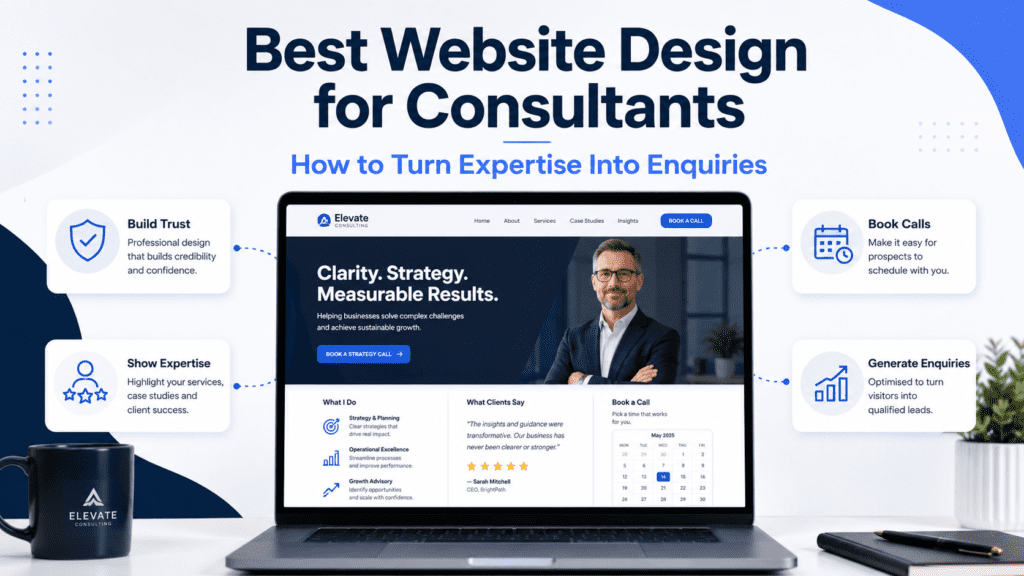
A consultant’s website has a different job from a standard business website.
It is not just there to list services, show a profile photo, and add a contact form. A good consultant website should turn expertise into trust, trust into interest, and interest into enquiries.
The challenge is that consulting is often intangible. You are not selling a physical product that people can see, touch, or compare easily. You are selling knowledge, strategy, insight, experience, problem-solving, and better decisions.
That means your website needs to make your expertise feel clear, valuable, and relevant.
Many consultant websites fail because they are too vague. They use polished but empty phrases such as “strategic solutions,” “business transformation,” “trusted advisor,” or “helping businesses unlock growth.” These phrases sound professional, but they rarely explain what the consultant actually does or why someone should enquire.
A high-performing consultant website needs sharper positioning, stronger proof, clearer offers, and a simple path for potential clients to take the next step.
This guide explains the best website design for consultants, including the pages, sections, messaging, SEO structure, and conversion elements needed to turn expertise into real enquiries.
Why Consultant Website Design Matters
Consulting is built on trust.
Before someone books a call or sends an enquiry, they need to believe three things:
- You understand their problem.
- You have the expertise to solve it.
- Working with you is worth the investment.
Your website must support all three.
A weak consultant website creates doubt. Visitors may leave because they cannot understand your niche, your services, your process, your results, or your next step.
A strong consultant website does the opposite. It makes your expertise easier to understand, positions you as credible, and helps qualified prospects feel confident enough to contact you.
Your website should answer questions such as:
- What type of consultant are you?
- Who do you help?
- What problems do you solve?
- What outcomes do clients get?
- What makes your approach different?
- Have you helped similar clients before?
- What is the process?
- How can someone work with you?
- What should they do next?
If your website does not answer these questions clearly, it may look nice while quietly losing clients. Very efficient, in the worst possible way.
The Main Goal of a Consultant Website
The main goal of a consultant website is not to impress everyone. It is to attract the right people and encourage qualified prospects to enquire. A consultant website should help visitors move through a simple journey:
- Understand your expertise
- Recognize their problem
- See your approach as relevant
- Trust your experience
- Review your services or offers
- Take the next step
That next step could be:
- Booking a consultation
- Requesting a proposal
- Filling out an enquiry form
- Downloading a guide
- Joining your newsletter
- Applying to work with you
- Sending a direct message
The best consultant websites are clear, specific, and conversion-focused. They do not try to sound clever. They make it easy for prospects to understand why they should talk to you.
Best Website Structure for Consultants
A strong consultant website should include the following core pages:
- Homepage
- About page
- Services page
- Individual service pages
- Case studies or results page
- Insights or blog section
- Testimonials page
- Contact or booking page
- Lead magnet landing page
- FAQ page
Not every consultant needs all these pages on day one. But if your goal is to build authority and generate enquiries, this structure gives your website a strong foundation.
Homepage: Make Your Positioning Clear Immediately
Your homepage is often the first place potential clients decide whether you are relevant.
The hero section should immediately explain:
- Who you help
- What problem you solve
- What outcome you create
- What action visitors should take
A weak consultant homepage headline might say: “Helping Businesses Achieve Sustainable Growth”
This sounds professional, but it could mean almost anything. A marketing consultant, finance consultant, HR consultant, operations consultant, or someone selling motivational posters could all say the same thing. Humanity did invent language, then chose this.
A stronger headline would be: “Sales Strategy Consulting for B2B Service Firms That Need More Qualified Leads”
This is better because it tells visitors the niche, service area, target client, and outcome.
Another example: “Helping Healthcare Clinics Improve Patient Acquisition With Clearer Marketing Systems”
This headline works because it is specific and outcome-driven.
What Your Homepage Should Include
A consultant homepage should include:
- Clear hero headline
- Short positioning statement
- Primary call to action
- Trust indicators
- Problem section
- Solution section
- Services overview
- Method or framework
- Proof or case studies
- Testimonials
- Lead magnet
- FAQ section
- Final CTA
The homepage should not explain every detail. It should guide visitors to the right next page or action.
About Page: Build Authority Without Making It All About You
A consultant’s about page is important, but it should not read like a career autobiography. Potential clients do want to know who you are. But more importantly, they want to know why your experience matters to their problem.
A strong consultant’s page should include:
- Your background
- Your area of expertise
- Who you help
- Why you specialize in this area
- Relevant experience
- Credentials or achievements
- Your consulting philosophy
- What clients can expect
- CTA to book a call or view services
The about page should connect your experience to client outcomes.
Instead of only saying: “I have 15 years of experience in business strategy.”
Say: “With 15 years of experience in business strategy, I help service-based companies clarify their offer, improve sales processes, and build systems that support sustainable growth.”
That is more useful because it explains how the experience benefits the client.
Services Page: Package Your Expertise Clearly
Many consultant websites fail because their services are unclear.
They list broad categories such as:
- Strategy
- Growth
- Advisory
- Transformation
- Coaching
- Workshops
These words can be valid, but they need context. Otherwise, visitors cannot tell what they are actually buying. A strong consultant services page should turn expertise into clear offers.
For example:
Instead of: “Business Consulting”
Use: “Business Growth Strategy for Small Service Companies”
Instead of: “Marketing Advisory”
Use: “90-Day Marketing Roadmap for Consultants and Agencies”
Instead of: “Executive Coaching”
Use: “Leadership Coaching for First-Time Senior Managers”
Specific services are easier to understand and easier to enquire about.
What a Consultant Services Page Should Include
Your services page should include:
- Short introduction
- Clear list of consulting offers
- Who each offer is for
- What problem each offer solves
- What is included
- Expected outcomes
- Link to detailed service pages
- CTA to book a consultation
If you offer multiple services, do not overload the page with too much detail. Give enough information for visitors to choose the right path.
Individual Service Pages: Turn Interest Into Enquiries
Each main consulting service should have its own dedicated page. This improves both SEO and conversion.
A dedicated service page lets you explain the service in detail, answer objections, and show why the offer is valuable.
Best Consultant Service Page Structure
A high-converting consultant service page should include:
- Service-specific headline
- Problem statement
- Who the service is for
- What the service helps with
- Your approach or framework
- What is included
- Expected outcomes
- Client proof or testimonials
- Process
- Pricing guidance or engagement model
- FAQs
- CTA
For example, a consulting service page headline could be: “Go-to-Market Strategy Consulting for B2B SaaS Companies”
This is much stronger than: “Strategy Consulting Services”
A specific page attracts better-fit prospects and helps search engines understand the topic.
Case Studies: Prove That Your Expertise Works
Consulting buyers are cautious. Shocking, really, that people want evidence before spending money.
Case studies help show that your expertise is not just theoretical.
A good case study does not need to reveal confidential details. It can focus on the challenge, approach, and result.
Simple Consultant Case Study Structure
Use this format:
- Client background
- Challenge
- Diagnosis
- Strategy
- Implementation
- Result
- Client quote
- Lessons or takeaway
- CTA
For example: “A B2B service firm had strong referrals but no predictable lead generation system. After clarifying their offer, rebuilding their website structure, and creating a focused outreach workflow, they improved enquiry quality and shortened their sales conversations.”
Even if you cannot share exact revenue figures, you can still show before-and-after improvements.
Useful outcomes include:
- More qualified enquiries
- Better sales conversion
- Shorter decision cycles
- Clearer positioning
- Stronger internal process
- Reduced operational bottlenecks
- Better client onboarding
- Improved marketing performance
Case studies help visitors imagine what working with you could achieve.
Testimonials: Let Clients Say What You Cannot Say Yourself
Testimonials are powerful because they reduce risk. A consultant can claim expertise all day. A client saying it is more believable. Strong testimonials should be specific.
A weak testimonial says: “Excellent consultant. Highly recommended.”
A stronger testimonial says: “We were struggling to explain our offer clearly. After working together, we had a sharper positioning strategy, a clearer sales message, and a practical plan our team could actually execute.”
The second testimonial works better because it explains the problem, process, and result.
Place testimonials throughout your website, especially:
- Homepage
- Service pages
- Case studies
- Pricing or engagement section
- Contact page
Do not hide all proof on one page and then act surprised when visitors miss it. Humans skim. Design accordingly.
Your Consulting Framework: Make Your Method Visible
One of the best ways to make expertise feel valuable is to show your process or framework. A framework makes your thinking easier to understand. It also helps visitors see that your service is structured, not random advice dressed up in a blazer.
For example, a consultant might have a framework such as:
- Diagnose the current problem
- Clarify the business goal
- Map the customer journey
- Build the strategy
- Implement the system
- Measure and improve
A marketing consultant might use:
- Positioning
- Offer
- Funnel
- Traffic
- Conversion
- Retention
A leadership consultant might use:
- Assessment
- Team alignment
- Communication habits
- Decision systems
- Performance coaching
- Review cadence
Your framework does not need to be complicated. It needs to make your expertise tangible. This section helps visitors understand how you work and why your approach is different.
Lead Magnet: Capture Prospects Who Are Not Ready Yet
Not every visitor is ready to book a call immediately. Some are researching. Some are comparing. And some know they have a problem but are not ready to commit.
A lead magnet helps you capture those visitors earlier.
For consultants, good lead magnets include:
- Free diagnostic checklist
- Strategy scorecard
- PDF guide
- Industry report
- Self-assessment
- Template
- Audit
- Webinar
- Email course
- ROI calculator
- Planning worksheet
Examples:
- “Download the Consultant Website Checklist”
- “Get the 15-Minute Business Growth Audit”
- “Take the Lead Generation Readiness Assessment”
- “Download the 90-Day Strategy Planning Template”
A lead magnet should be useful enough that a serious prospect is willing to exchange their email for it. Then your follow-up emails can continue building trust.
Contact Page: Reduce Friction
A consultant contact page should not feel cold or complicated. It should make the next step easy and clear. This includes:
- Short invitation to enquire
- Booking calendar or form
- Email address
- Relevant contact details
- What happens after someone enquires
- Who the consultation is best for
- Response time
- FAQ links
A strong contact page might say: “Book a consultation to discuss your goals, current challenges, and whether this consulting support is the right fit.”
This is better than: “Fill out the form below.” Because yes, technically that is what the visitor must do. But persuasion exists for a reason.
Calls to Action: Use Specific CTAs
Generic CTAs often underperform.
Weak CTAs include:
- Submit
- Learn More
- Contact
- Get Started
- Click Here
Stronger CTAs include:
- Book a Strategy Call
- Request a Consulting Proposal
- Download the Free Assessment
- Schedule a Discovery Session
- Get a Website Review
- Apply to Work With Me
- View Consulting Services
Your CTA should match your sales process. If your consulting service is high-ticket, “Buy Now” may not make sense. “Book a Strategy Call” or “Request a Proposal” may feel more natural.
Consultant Website Design Principles
A consultant website should feel professional, clear, and easy to navigate. Good design supports trust. Bad design adds doubt, because apparently visitors do judge books by covers, websites by spacing, and consultants by font choices.
Important design principles include:
1. Keep the Layout Clean
Consultant websites should not feel cluttered. Use enough white space, clear sections, readable text, and simple navigation.
2. Use Professional Visuals
Use high-quality photos, simple graphics, diagrams, or brand visuals. Avoid generic corporate stock photos where people point at glass walls. Society has suffered enough.
3. Make the Copy Easy to Scan
Use short paragraphs, headings, bullet points, and bold section titles. Busy decision-makers do not read every word at first. They scan for relevance.
4. Prioritize Mobile Experience
Your website should work well on mobile. Buttons should be easy to tap, text should be readable, and forms should be simple.
5. Keep Navigation Simple
A consultant website does not need a confusing menu. Use a simple structure:
- Home
- Services
- Case Studies
- About
- Insights
- Contact
Add a clear CTA button in the header, such as “Book a Call.”
SEO for Consultant Websites
A consultant website should be built with search visibility in mind. SEO helps potential clients find you when they search for your expertise.
Important SEO pages include:
- Main consulting service page
- Niche-specific service pages
- Industry pages
- Location pages, if relevant
- Blog posts
- Case studies
- Comparison articles
- FAQ pages
For example, a business consultant might target keywords such as:
- business consultant for small businesses
- business growth consultant
- marketing consultant for service businesses
- consultant website design
- sales strategy consultant
- B2B lead generation consultant
- consultant for startups
- business strategy consultant
The best SEO strategy depends on your niche. A general consultant website may struggle to rank because the topic is too broad. A specific consultant website has a better chance.
For example: “Business consultant” is broad. “Sales strategy consultant for B2B service businesses” is more specific.
Specific positioning helps both SEO and conversion.
Blog Content Ideas for Consultants
A blog or insights section helps consultants build authority and attract search traffic.
Good consultant blog topics include:
- How to Choose the Right Consultant for Your Business
- What Does a Business Consultant Actually Do?
- Consultant vs Agency: Which One Does Your Business Need?
- How Much Does Business Consulting Cost?
- Signs Your Business Needs a Strategy Consultant
- How to Prepare for a Consulting Call
- Common Mistakes Businesses Make Before Hiring a Consultant
- How to Turn Expertise Into a Consulting Offer
- Best Website Structure for Consultants
- How Consultants Can Generate More Qualified Leads
Each blog post should link to a relevant service page or lead magnet. Blog content should not exist just to fill space. The internet already has enough decorative paragraphs floating around like digital dust.
Consultant Website Mistakes to Avoid
Many consultant websites lose enquiries because of avoidable mistakes. Common mistakes include:
- Vague positioning
- Too much jargon
- No clear niche
- Generic service descriptions
- No case studies
- Weak testimonials
- No visible CTA
- No lead magnet
- No pricing guidance
- No process explanation
- Overly formal writing
- No SEO structure
- Poor mobile experience
- Long contact forms
- No clear next step
The biggest mistake is trying to appeal to everyone. A consultant website becomes stronger when it speaks clearly to a specific audience with a specific problem.
What a High-Converting Consultant Website Should Include
A consultant website designed to generate enquiries should include:.
- Clear positioning statement
- Strong hero section
- Specific service offers
- Case studies or results
- Testimonials
- Consulting framework
- Lead magnet
- Clear CTAs
- Simple booking process
- About page with authority
- SEO-focused service pages
- Useful insights or blog content
- Mobile-friendly design
- Fast loading speed
- Contact page with low friction
These elements work together to turn expertise into enquiries.
Example Consultant Homepage Structure
Here is a simple homepage structure consultants can use:
- Hero section with clear positioning
- Trust indicators
- Problem section
- Solution section
- Consulting services overview
- Your framework or method
- Case study highlight
- Testimonials
- Lead magnet section
- About preview
- FAQ section
- Final CTA
- Footer
This structure helps visitors understand what you do, why it matters, and how to take the next step.
Final Thoughts
The best website design for consultants is not the flashiest design. It is the clearest one.
A consultant website should make your expertise easy to understand, your value easy to see, and your next step easy to take. To turn expertise into enquiries, your website needs clear positioning, specific service pages, strong proof, helpful content, a visible consulting framework, persuasive CTAs, and a simple booking or enquiry process.
A good consultant website does not just say that you are an expert. It shows visitors why your expertise matters to them. When your website does that well, it becomes more than an online profile. It becomes a lead generation system for your consulting business.