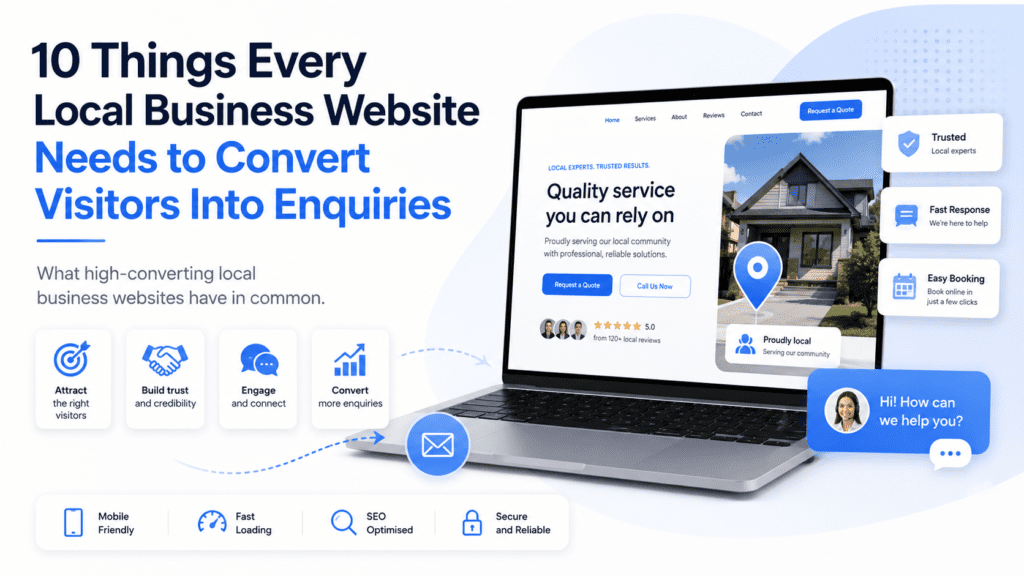
A local business website should do more than sit online and look professional. It should help people understand what you offer, trust your business, and take the next step. That next step may be calling you, sending a WhatsApp message, booking an appointment, requesting a quote, or filling out a contact form.
The problem is that many local business websites are built like online brochures. They have a homepage, a few service descriptions, some images, and a contact page. But they do not guide visitors toward action.
A good local business website is not just about design. It is about conversion. If your website gets visitors but does not generate enquiries, the issue may not be your service. The issue may be that your website is missing the right structure, messaging, and trust elements.
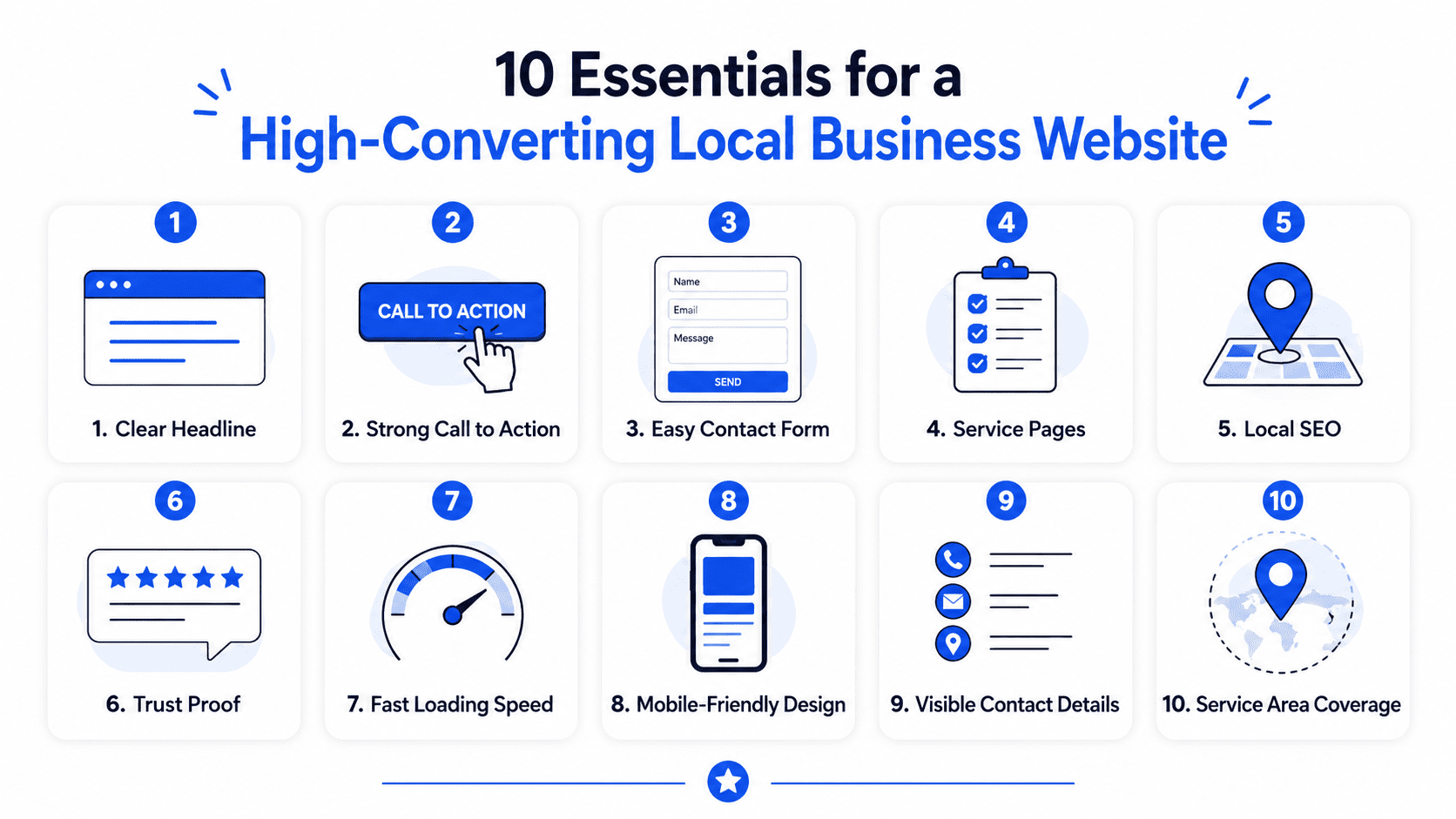
This guide explains the 10 things every local business website needs to convert more visitors into real enquiries.
1. A Clear Local Business Homepage Headline
Your homepage headline is one of the most important parts of your website.
When someone lands on your site, they should understand what your business does within a few seconds. If your headline is vague, generic, or too clever, visitors may leave before they even explore your services.
A weak headline might say: “Your Trusted Partner for Quality Solutions”
That sounds professional, but it does not explain what the business does.
A stronger headline would be: “Reliable Plumbing Services in Kuala Lumpur for Homes and Businesses”
This headline works better because it explains the service, location, and target customer.
A strong local business headline should answer three questions:
- What do you offer?
- Where do you offer it?
- Who is it for?
For example:
- “Affordable Website Design for Small Businesses in Malaysia”
- “Professional Dental Care for Families in London”
- “Same-Day Aircon Repair Services in Singapore”
- “Local Accounting Services for Small Businesses in Manchester”
A clear headline reduces confusion and helps visitors know they are in the right place.
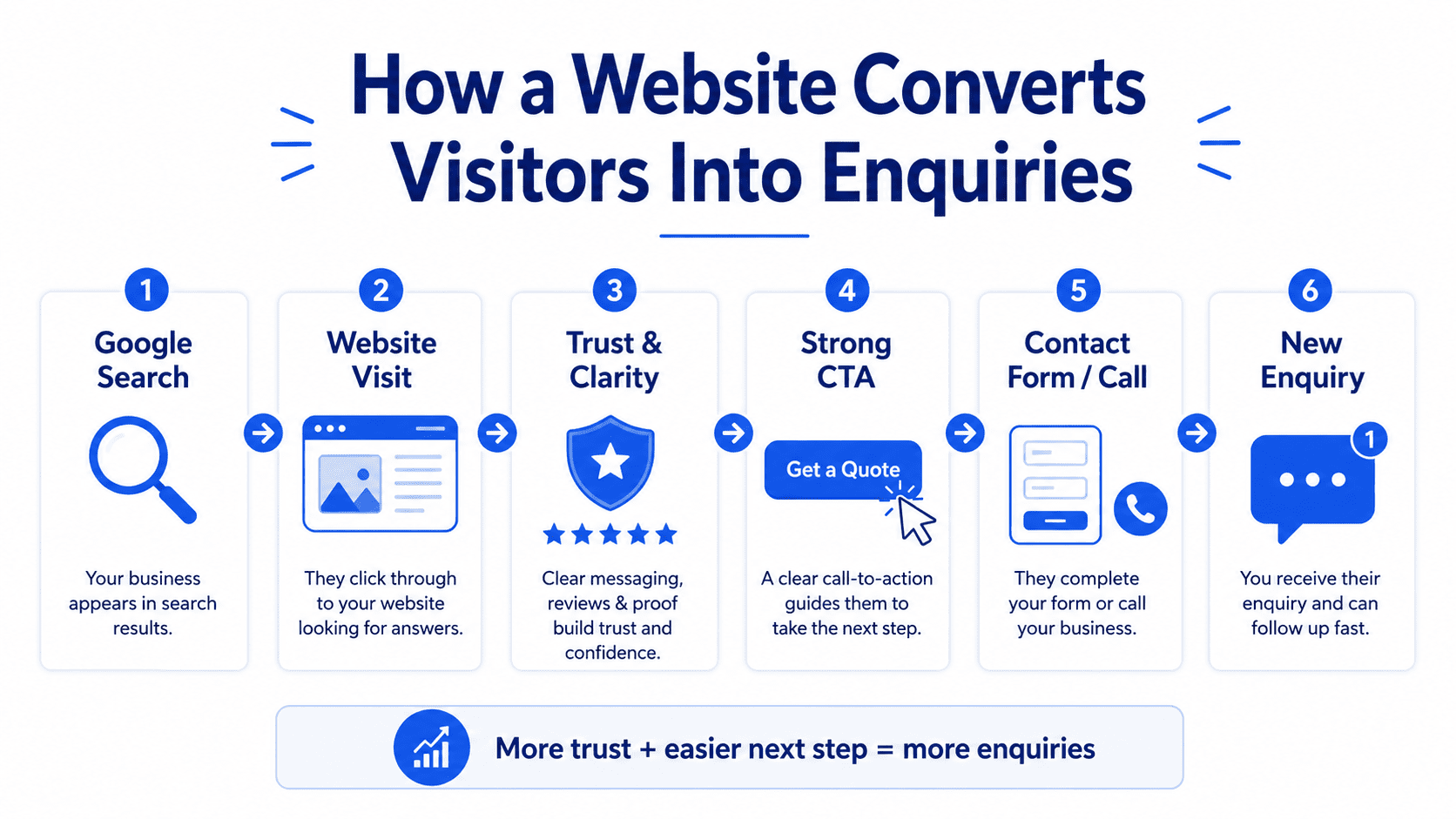
2. A Strong Local Business Call to Action
A call to action, also known as a CTA, tells visitors what to do next. Many local business websites have weak CTAs such as “Learn More” or “Submit.” These may work in some cases, but they are often too generic.
A stronger CTA is specific and action-focused.
Examples include:
- “Request a Free Quote”
- “Book an Appointment”
- “Call Now”
- “Send Us a WhatsApp Message”
- “Get a Free Consultation”
- “Check Availability”
- “Schedule a Site Visit”
Your CTA should appear clearly on important sections of the website, especially:
- Hero section
- Service sections
- Pricing section
- FAQ section
- Contact section
- Footer
- Mobile sticky button
Do not assume visitors will search for your contact page. Make the next step obvious.
3. Easy Local Business Contact Options
A local business website must make it easy for customers to reach you.
If visitors need to click through multiple pages just to find your phone number or contact form, you may lose enquiries.
Important contact options include:
- Phone number
- WhatsApp button
- Contact form
- Email address
- Booking link
- Business address
- Google Maps link
- Operating hours
For mobile visitors, click-to-call and WhatsApp buttons are especially useful. Many local customers want quick answers. They may not want to fill out a long form. They may prefer to call, message, or book directly.
A good local business website should give visitors more than one way to contact you.
4. Local Business Service Pages That Explain Each Offer Clearly
Many local businesses list all services on one page with short descriptions. This is better than nothing, but it may not be enough to convert visitors or rank well on Google. Each main service should ideally have its own dedicated page.
For example,
A cleaning business could have separate pages for:
- House cleaning
- Office cleaning
- Move-in cleaning
- Post-renovation cleaning
- Deep cleaning
A dental clinic could have separate pages for:
- Teeth whitening
- Dental implants
- Braces
- Scaling and polishing
- Emergency dental care
Dedicated service pages help because they allow you to explain each offer in more detail.
A good service page should include:
- What the service is
- Who it is for
- Common problems it solves
- What is included
- Why choose your business
- Pricing guidance if possible
- FAQs
- Testimonials or proof
- Clear CTA
Service pages also help with SEO because people often search for specific services, not just business names.
5. Local SEO Signals
If you serve a specific city, state, or area, your website should make that clear. Local SEO helps your business appear when people search for services near them.
Examples of local search terms include:
- “plumber near me”
- “web designer in Kuala Lumpur”
- “aircon repair Singapore”
- “dentist in London”
- “cleaning company in Petaling Jaya”
Your website should include local SEO signals such as:
- City or area names
- Service area pages
- Local phone number
- Business address
- Embedded Google Map
- Location-based page titles
- Local keywords in headings
- Google Business Profile link
- Customer reviews from local clients
This does not mean stuffing your website with city names unnaturally. The content should still read naturally.
For example: “We provide aircon servicing across Petaling Jaya, Subang Jaya, Shah Alam, and nearby areas.”
This is clear, helpful, and relevant.
6. Trust Proof
People are more likely to contact a business when they feel confident. Your website should show proof that your business is real, reliable, and capable.
Trust proof can include:
- Customer testimonials
- Google reviews
- Case studies
- Before-and-after photos
- Project portfolio
- Client logos
- Industry certifications
- Awards
- Media mentions
- Years of experience
- Team photos
- Real business address
- Clear contact details
For local businesses, reviews are especially powerful. Many customers compare businesses before making a decision. If your competitors show reviews and your website does not, they may look more trustworthy.
Do not just say you are reliable. Show evidence.
7. Clear Pricing or Pricing Guidance
Many local business owners avoid showing prices because every customer is different. That can make sense for custom services. However, giving no pricing guidance at all can create friction.
Visitors may wonder:
- Is this within my budget?
- Is this business expensive?
- Do I need to contact them just to find out?
- Will I waste time asking?
You do not always need to show exact pricing. You can provide pricing guidance instead.
Examples include:
- “A written quotation is available after reviewing your requirements”
- “Managed Website: see current pricing and setup fees”
- “Request a custom quote”
- “Pricing depends on property size and service type”
- “Book a free consultation for an accurate estimate”
Pricing clarity helps qualify leads. It can reduce low-quality enquiries and make serious prospects more comfortable contacting you.
8. Mobile-Friendly Design
Most local searches happen on mobile devices. Someone may be searching while sitting in their car, walking nearby, comparing options at home, or urgently needing a service. If your website is hard to use on mobile, you may lose enquiries.
A mobile-friendly local business website should have:
- Fast loading speed
- Easy-to-read text
- Tap-friendly buttons
- Simple navigation
- Click-to-call button
- WhatsApp button
- Short contact forms
- Clear spacing
- No broken layouts
- No tiny text
- No confusing menus
Your website may look good on desktop, but that is not enough. Always test your website on a phone. Ask yourself:
- Can I understand the offer quickly?
- Can I contact the business easily?
- Are the buttons easy to tap?
- Is the form simple to complete?
- Does the page load quickly?
If the mobile experience is weak, your conversion rate will suffer.
9. Fast Loading Speed
Website speed affects both user experience and conversions. If your website takes too long to load, visitors may leave before they even see your offer.
Slow websites are often caused by:
- Large images
- Too many plugins
- Poor hosting
- Heavy animations
- Unoptimized videos
- Bloated page builders
- Too many third-party scripts
For local businesses, speed is especially important because many visitors are browsing on mobile data. A fast website feels more professional and makes it easier for customers to take action.
To improve website speed:
- Compress images
- Use modern image formats
- Remove unnecessary plugins
- Avoid oversized videos
- Use good hosting
- Reduce heavy scripts
- Keep page layouts clean
- Test performance regularly
A beautiful website that loads slowly can still lose leads.
10. Frequently Asked Questions
A strong FAQ section can improve conversions because it removes hesitation.
Visitors often have questions before they contact a business. If your website answers those questions clearly, they may feel more confident taking the next step.
Useful FAQ topics include:
- Pricing
- Service areas
- Booking process
- Turnaround time
- What is included
- What customers need to prepare
- Payment options
- Guarantees
- Cancellation policy
- Support after purchase
For example, a local website design business could answer:
- “How long does it take to launch my website?”
- “Is hosting included?”
- “Can I use my own domain?”
- “Do you help with SEO?”
- “Can I request changes after launch?”
A helpful FAQ section also supports SEO because it naturally includes the questions customers are searching for.
Bonus: Conversion Tracking
Once your website is live, you should track whether it is actually generating enquiries. Many local businesses do not know which parts of their website are working because they do not measure conversions.
Important actions to track include:
- Form submissions
- Phone button clicks
- WhatsApp clicks
- Booking link clicks
- Quote requests
- Email clicks
- Download requests
- Page visits from Google search
Tracking helps you make better decisions. Instead of guessing, you can see which pages, buttons, and traffic sources are bringing enquiries.
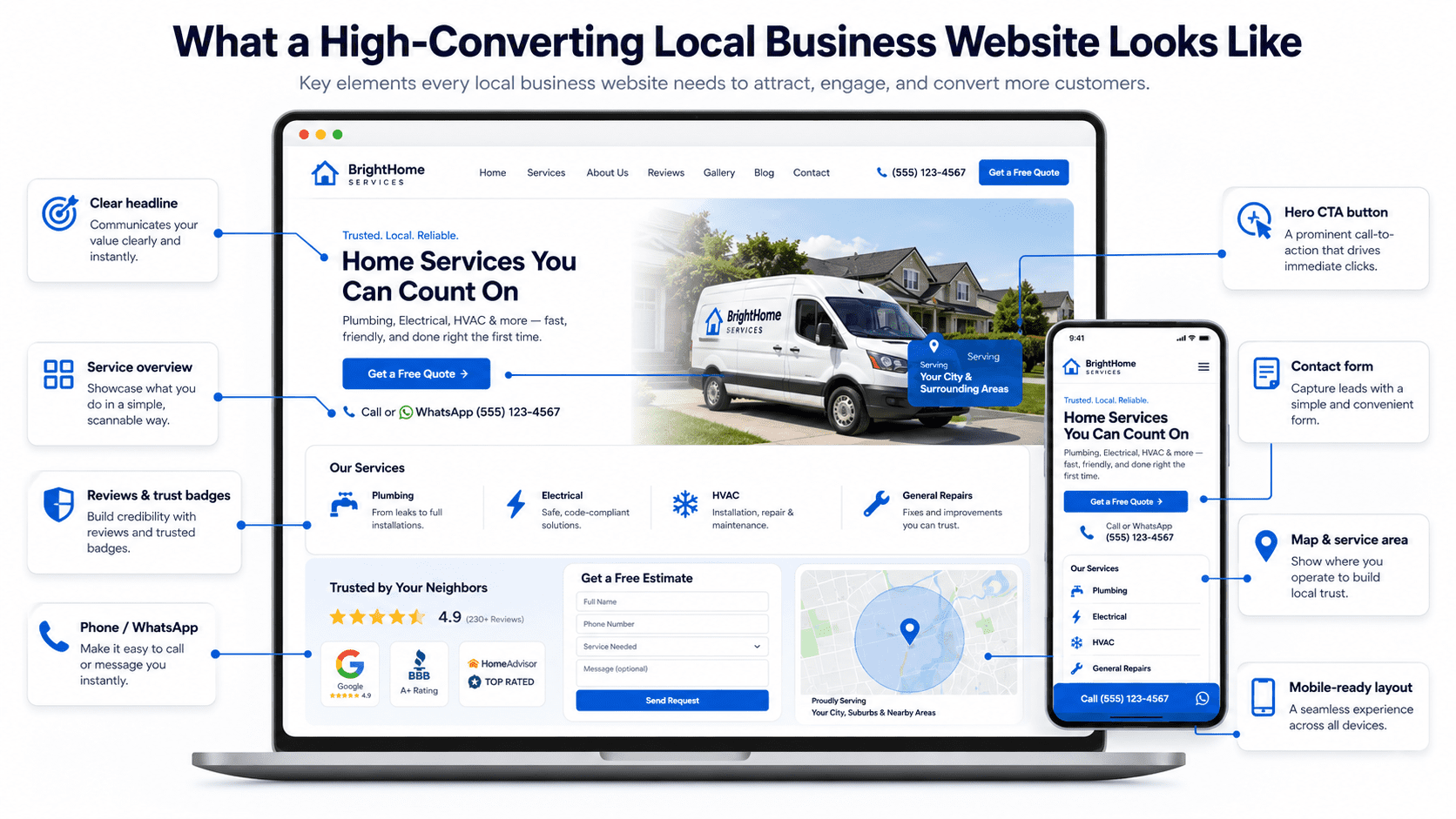
What a High-Converting Local Business Website Looks Like
A strong local business website should guide visitors through a simple journey:
First, it tells them exactly what you offer. Then, it explains why they should trust you.
Next, it shows how your service solves their problem. Finally, it makes it easy to contact you.
A simple homepage structure could look like this:
- Clear headline
- Short explanation of the offer
- Primary CTA
- Trust proof
- Service overview
- Why choose us
- Testimonials or reviews
- Pricing guidance
- FAQs
- Final CTA
- Contact section
This structure works because it follows the way customers make decisions. They need clarity, confidence, relevance, and an easy next step.
Common Mistakes Local Business Websites Make
Many local websites fail to convert because they make avoidable mistakes.
Common mistakes include:
- Vague headline
- No clear CTA
- Hidden phone number
- Long contact forms
- No reviews or testimonials
- Slow mobile experience
- No service pages
- No location keywords
- Weak service descriptions
- No pricing guidance
- Outdated design
- Confusing navigation
- No conversion tracking
Fixing even a few of these issues can improve enquiry rates.
Final Thoughts
A local business website should not only look professional. It should help turn visitors into enquiries. To do that, your website needs clear messaging, strong calls to action, easy contact options, service pages, local SEO, trust proof, pricing guidance, mobile-friendly design, fast loading speed, and helpful FAQs.
These elements work together to make your website more useful, more trustworthy, and more conversion-focused. If your current website is not generating enquiries, it may not need to be completely rebuilt. It may simply need a better structure and clearer customer journey.
The goal is simple: when someone visits your website, they should quickly understand what you do, why they should trust you, and how to contact you.
That is what turns a basic local business website into a lead-generating asset.