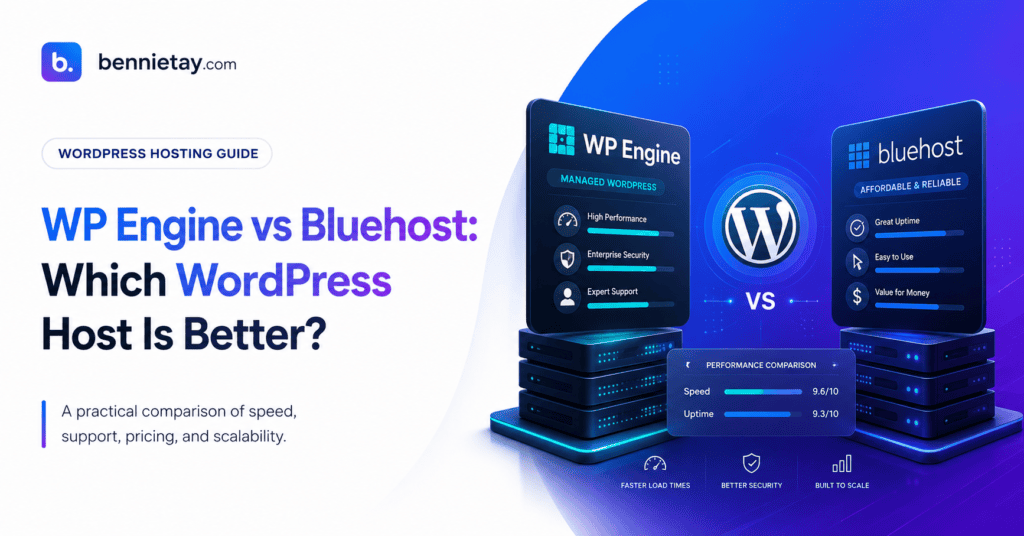
Choosing between WP Engine and Bluehost is not simply a matter of comparing two hosting companies and selecting the one with the lowest monthly price.
Both providers can host WordPress websites, but they are built around different priorities. Bluehost is generally aimed at beginners, bloggers, freelancers, small businesses, and website owners who want an affordable and accessible way to get online. WP Engine takes a more specialised approach, focusing on managed WordPress hosting for businesses, agencies, developers, publishers, ecommerce teams, and organisations that need stronger operational tools.
The better choice depends on how important your website is to your business, how often it changes, how much traffic it receives, and how much technical responsibility you want to manage yourself.
This WP Engine vs Bluehost comparison examines their differences in ease of use, performance, security, backups, support, staging, ecommerce, pricing, and scalability. It also explains which provider may be more suitable for Malaysian businesses and Southeast Asian audiences.
WP Engine vs Bluehost: The Main Difference
The simplest way to understand the comparison is to look at the type of experience each provider offers.
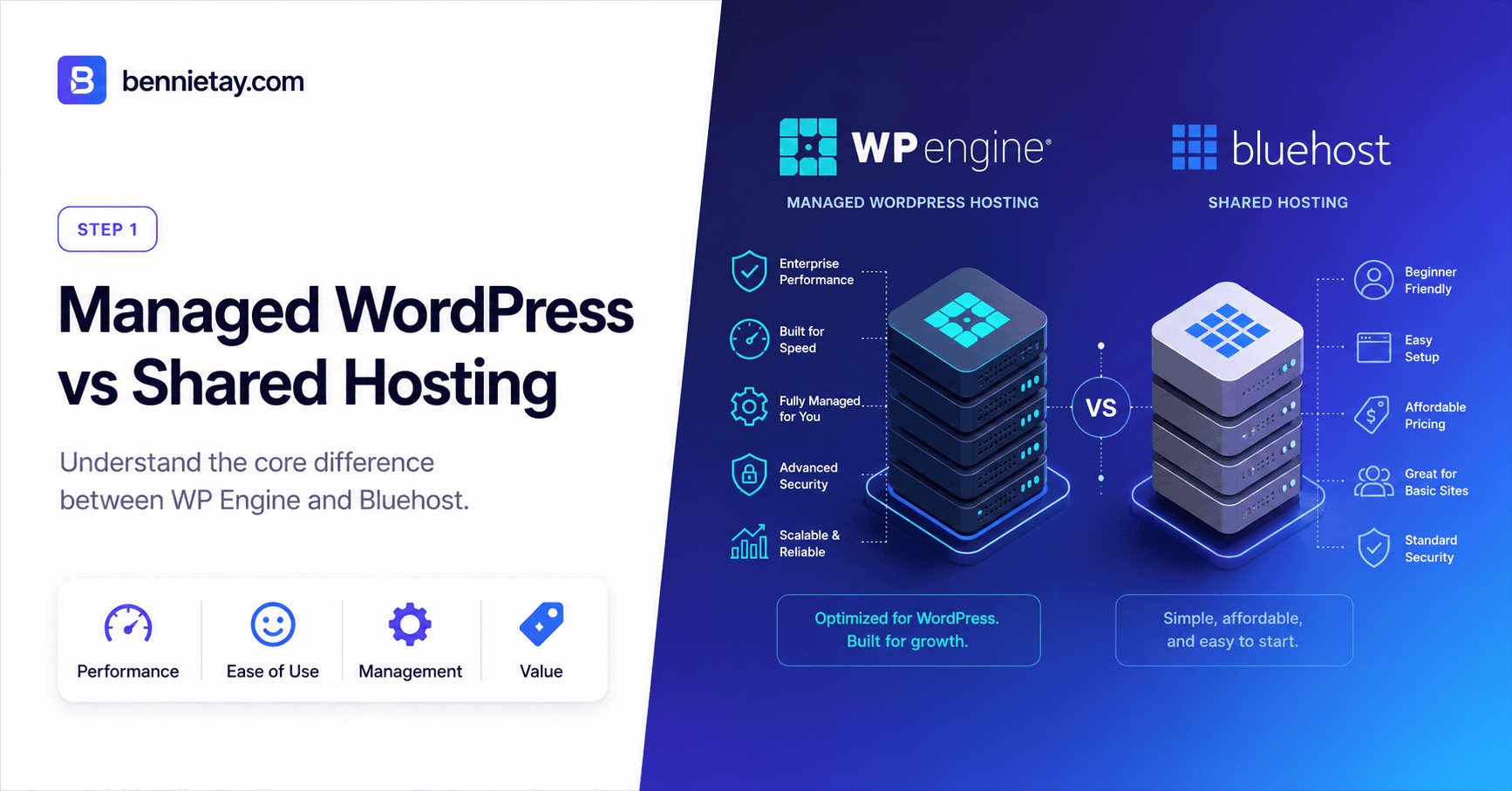
Bluehost is designed to make starting a WordPress website relatively straightforward. Its hosting range includes WordPress packages alongside other products such as ecommerce hosting, VPS solutions, cloud hosting, and general website hosting. This gives customers several starting points and potential upgrade paths.
WP Engine is centred specifically on managed WordPress operations. Rather than selling basic server space alone, it combines hosting with performance controls, backups, staging environments, development tools, security measures, platform management, and WordPress-focused support.
Choose Bluehost when your priority is launching a straightforward website at a lower starting cost.
Choose WP Engine when the website is commercially important and reducing technical work, deployment risk, and recovery time is worth paying more for.
Who Is Bluehost Best For?
Bluehost is likely to appeal most to people building their first WordPress website.
Its guided setup process can help users connect a domain, install WordPress, choose a design, build essential pages, and publish without first understanding server architecture or advanced development workflows.
This makes Bluehost a practical option for personal blogs, portfolios, local service companies, new ecommerce stores, freelancers, consultants, restaurants, tuition centres, property agents, and small businesses that need a professional online presence without a complicated technical setup.
The main advantage is accessibility. A beginner can purchase a plan and start building without assembling several separate hosting services.
However, not every Bluehost package includes the same resources. Storage, backups, security tools, staging access, performance features, email services, support, renewal pricing, and ecommerce capabilities may differ between plans.
Customers should compare the exact package they intend to purchase rather than assuming every Bluehost plan provides the same experience.
Who Is WP Engine Best For?
WP Engine is more likely to suit businesses and professional teams that treat WordPress as an important operational platform rather than a simple collection of public pages.
Its managed WordPress environment is built around consistent performance, recovery tools, controlled updates, development workflows, staging, security, and specialist support.
A company may benefit from WP Engine when its website generates valuable leads, processes transactions, supports a membership community, publishes large volumes of content, or requires frequent development changes.
It may also suit digital agencies managing client websites, marketing teams running regular campaigns, publishers with growing audiences, and ecommerce stores where downtime can directly affect revenue.
The higher price becomes easier to justify when WP Engine reduces work that would otherwise require employee time, developer support, additional plugins, or several separate services.
A small brochure website that changes twice a year may not use enough of these features to justify the premium. A revenue-generating platform with weekly updates may find the additional operational control far more valuable.
Which Host Is Easier to Use?
Ease of use means different things to different users.
For a beginner, an easy platform is one that simplifies domain setup, WordPress installation, page creation, and basic management. Bluehost is generally better aligned with this type of user.
Its WordPress products focus on helping customers move from an empty hosting account to a functioning website with less initial friction. Depending on the selected package, users may also receive website-building tools, managed updates, security options, and setup assistance.
WP Engine can also be easy to use, but its workflow is designed for more structured website management.
Professional users can work with separate development, staging, and production environments. Changes can be created and tested away from the public website before being deployed to the live environment.
This may feel unnecessary for someone creating a simple five-page website. For an agency or internal marketing team, however, it can be far easier than manually creating staging domains, cloning databases, coordinating backups, and moving files through unrelated tools.
Bluehost is therefore the more beginner-friendly choice, while WP Engine provides a more organised experience for professional WordPress operations.
WordPress Management and Platform Control
Both providers make it easier to install and run WordPress, but they take different approaches to management.
Bluehost provides WordPress hosting within a broader hosting ecosystem. Customers usually retain a more conventional relationship with their themes, plugins, settings, and hosting configuration.
This can provide flexibility, although the user may need to take greater responsibility for performance optimisation, backups, plugin management, and security decisions.
WP Engine manages more of the WordPress operating environment. Its platform is designed around predefined caching, updates, backups, security practices, and deployment processes.
This can create a more stable and predictable setup, particularly for teams managing several websites.
The trade-off is that a controlled platform may restrict plugins or server configurations that interfere with its own systems. These restrictions can protect performance and security, but they may be inconvenient when a website depends on a particular unsupported tool.
Bluehost is better suited to users who want a familiar hosting environment with more product variety. WP Engine is more suitable for organisations that prefer a managed platform and are comfortable working within its rules.
WP Engine vs Bluehost Performance
It is tempting to declare one hosting brand universally faster than another. Real website performance is not quite that cooperative.
Speed depends on the selected hosting package, server location, caching, CDN configuration, theme quality, plugin behaviour, database efficiency, image sizes, scripts, traffic levels, and the amount of personalised content.
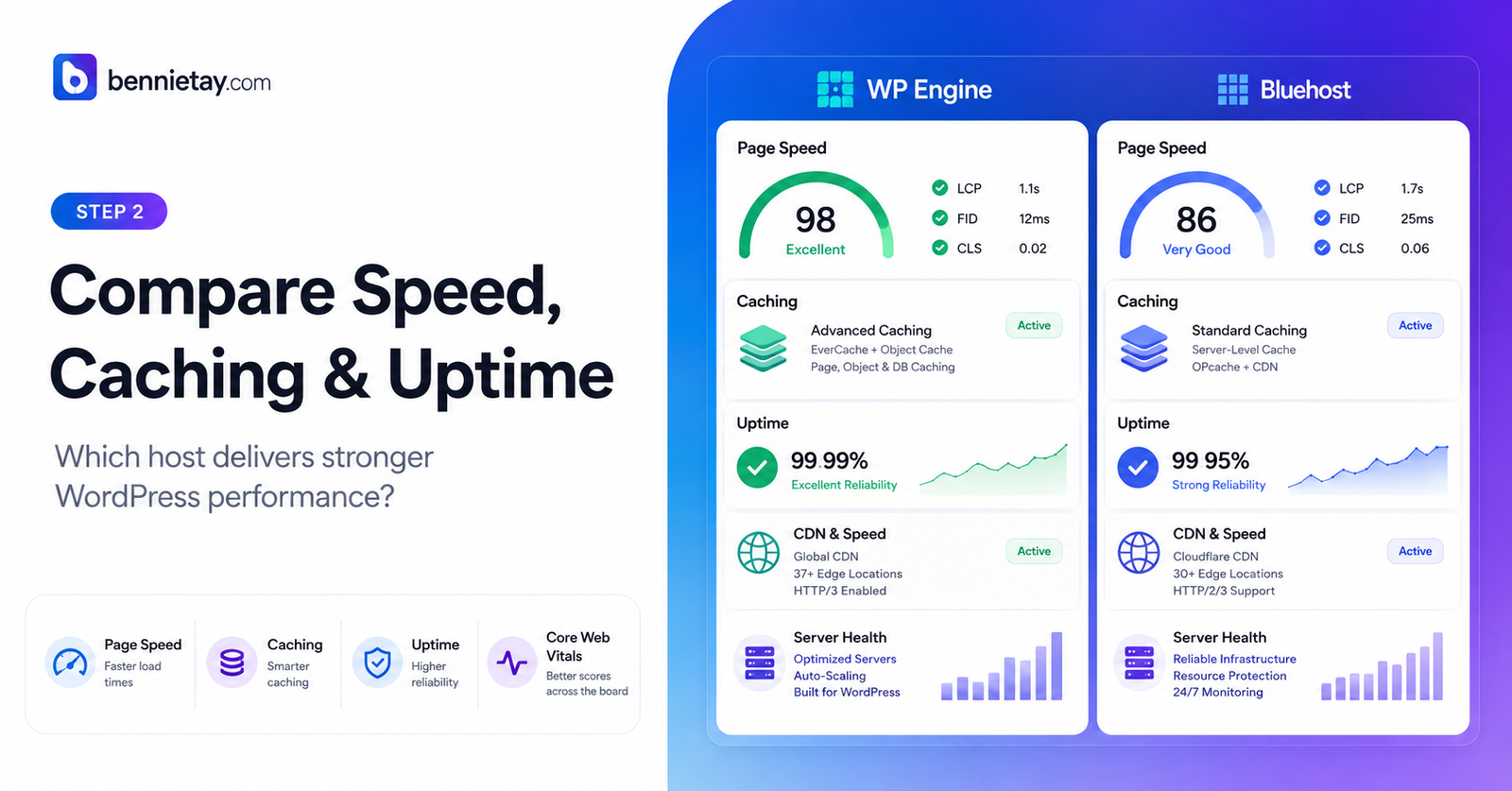
WP Engine has the stronger managed performance proposition. Its platform is designed specifically for WordPress and includes hosting-level optimisation, caching, monitoring, and controlled infrastructure.
This reduces some of the configuration work required to establish a reliable performance foundation.
Bluehost performance depends more heavily on the package selected and how well the website itself is optimised.
A lightweight business website with effective caching and properly sized images may perform well on a reasonably priced Bluehost plan. A complex WooCommerce store or membership platform may need a higher-resource product rather than an entry-level package.
It is also important to compare equivalent plans. WP Engine should not be compared only with Bluehost’s cheapest introductory option when the two packages are expected to support completely different workloads.
WP Engine is generally the stronger choice for managed WordPress performance, but a well-built Bluehost site can still outperform a poorly designed site on premium hosting.
Caching and CDN Capabilities
Caching is one of the most important factors in WordPress performance.
When a public page is not cached, WordPress may need to run PHP, query the database, execute theme and plugin functions, generate the page, and return the finished result for every visitor.
Full-page caching stores that completed result so it can be delivered without repeating the entire process.
WP Engine incorporates platform-level caching into its managed WordPress environment. This reduces reliance on separate caching plugins and allows more optimisation to happen at the hosting layer.
Bluehost also offers caching and performance features, although the tools and configuration may depend on the specific hosting product.
When comparing plans, check whether a CDN is included, whether page caching is automatic, which features require manual activation, and how dynamic areas are handled.
Shopping carts, checkout pages, customer accounts, logged-in sessions, and personalised content must not be publicly cached in the same way as a standard blog post.
A CDN can improve international delivery by serving images, stylesheets, scripts, and cached content from locations closer to visitors. For Malaysian businesses, CDN coverage can be especially important when the main server is located outside Southeast Asia.
Staging and Development Workflows
Staging is one of the clearest differences between WP Engine and Bluehost.
WP Engine structures websites around separate development, staging, and production environments. This allows teams to create changes, test updates, troubleshoot problems, and obtain approval without editing the live site directly.
This workflow is valuable when testing theme changes, plugin updates, new landing pages, PHP versions, checkout modifications, database changes, and code releases.
It is also useful for agencies that need to show work to clients before publishing it.
Bluehost offers staging within parts of its WordPress range, but the availability and depth of the workflow may vary by package.
Basic staging may be sufficient for a small business that makes occasional changes. Professional teams should look more closely at the number of available environments, the ability to copy data between them, deployment controls, backup creation, access permissions, and developer tools.
WP Engine is the stronger option for frequent, structured development work. Bluehost remains suitable when the website is relatively simple and changes are less frequent.
Backups and Website Recovery
A backup feature is useful only when it can restore the website reliably.
When comparing Bluehost and WP Engine, review the backup frequency, retention period, availability of on-demand backups, restoration process, downloadable copies, and support-assisted recovery.
WP Engine places daily backups and restoration tools at the centre of its managed service. This makes recovery a more integrated part of the platform rather than an optional afterthought.
Bluehost backup features vary by product and may depend on the selected plan or additional services.
Regardless of the provider, an important business website should maintain an independent off-site backup. The live website and every recovery copy should not depend entirely on the same hosting account.
A separate backup gives the business another route to recovery if the hosting account, server, or provider-level access becomes unavailable.
Security Features
Both companies manage their hosting infrastructure, but the extent of WordPress-specific security depends on the chosen product.
WP Engine emphasises managed protection, platform monitoring, controlled updates, backups, and WordPress-focused security practices. Its managed environment can reduce certain risks by limiting configurations known to cause performance or security problems.
Bluehost also provides security features across its WordPress products, but customers should confirm what is included in their particular package.
Important areas to review include SSL certificates, malware scanning, malware removal, firewall protection, DDoS protection, login security, two-factor authentication, account controls, update management, and incident support.
Hosting security does not remove the website owner’s responsibilities. Administrators still need strong passwords, controlled user access, trusted plugins, current software, and sensible backup procedures.
Customer Support
Support becomes most important when a site goes offline, checkout fails, or an update damages the live website.
Bluehost serves a broad range of users across several hosting categories. Its support is therefore positioned around general hosting, account management, domains, email, setup, and common WordPress issues.
This may be sufficient for beginners and smaller businesses that need help connecting a domain, installing WordPress, or resolving standard hosting problems.
WP Engine positions its support around managed WordPress customers. This makes it more attractive to teams that want assistance from people familiar with WordPress environments, staging workflows, backups, performance, and platform-specific issues.
Before purchasing either service, confirm the available support channels, operating hours, escalation process, response expectations, migration help, security support, and whether application-level troubleshooting is included.
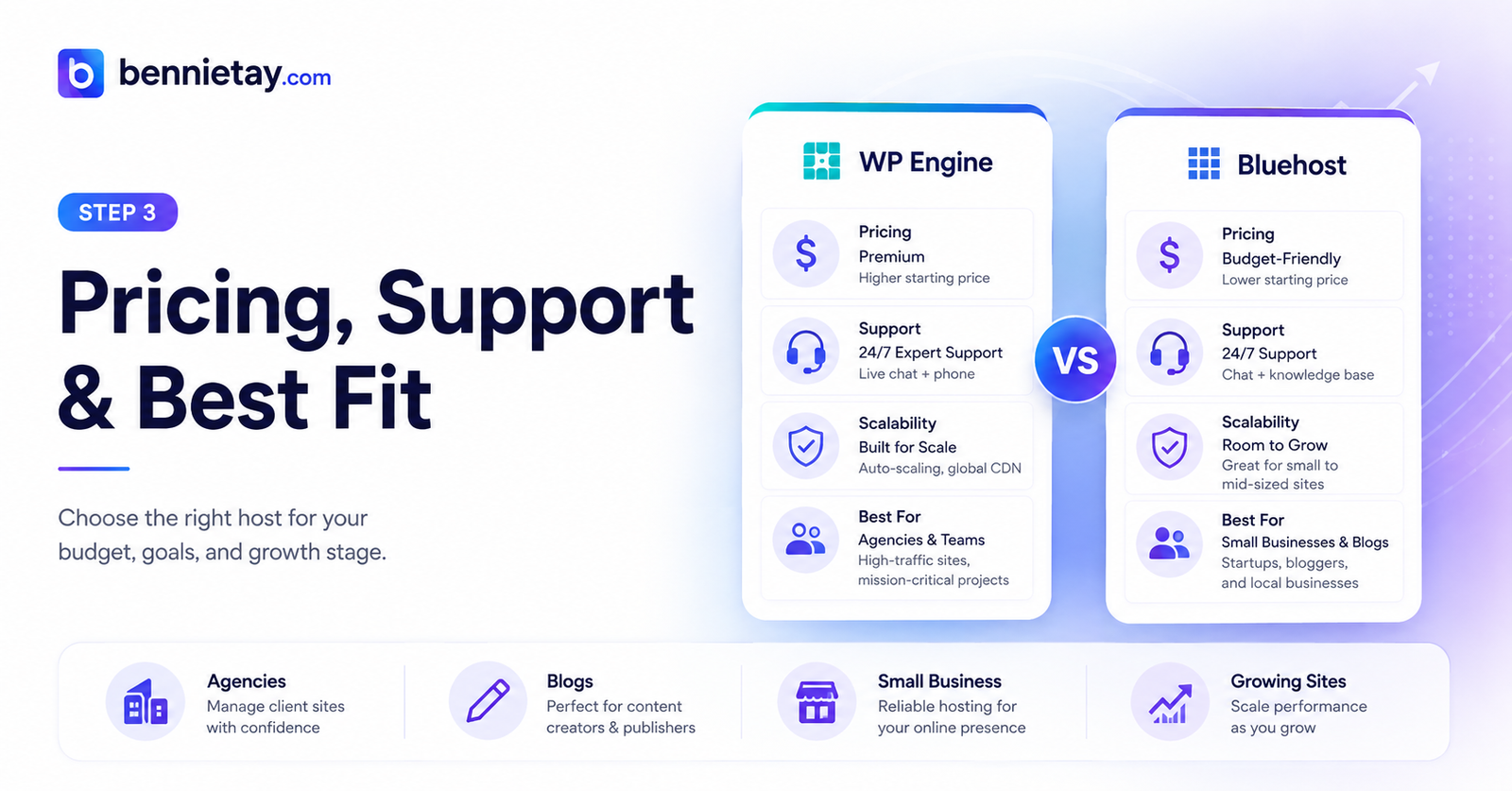
WP Engine has the stronger specialist support proposition. Bluehost may offer better value when the website does not require a highly managed relationship.
Pricing and Total Cost
Bluehost generally has the lower initial price, which makes it appealing to new website owners and budget-conscious businesses.
However, the introductory figure should not be evaluated in isolation. Review the renewal cost, contract period, storage, number of websites, backup tools, security add-ons, domain renewal, email services, migration costs, ecommerce features, and any usage limits.
A low starting price can still represent good value, but only when the long-term package meets the website’s requirements.
WP Engine costs more because it is selling a broader managed service. Its platform may reduce spending on staging tools, backup plugins, performance configuration, security services, monitoring, developer time, and incident recovery.
The premium is valuable only when those capabilities are actually used.
Bluehost wins on entry cost. WP Engine can offer stronger operational value for a website that is important enough to justify managed infrastructure.
WooCommerce and Online Stores
Both providers can support WooCommerce, but store size and business risk should influence the decision.
Bluehost may be a practical starting point for a new ecommerce business, a small catalogue, or a store testing market demand. Its broader hosting range includes ecommerce-focused options that may be more appropriate than a basic WordPress plan.
WP Engine may be better suited to an established store where checkout reliability, staging, recovery, development workflows, and specialist support have direct financial value.
WooCommerce creates more dynamic activity than a standard content website. Cart, checkout, account, inventory, payment, and personalised pages cannot usually be served entirely from public page caches.
This increases PHP processing and database activity.
Do not evaluate ecommerce hosting only by testing the homepage. Test product search, filters, customer accounts, cart updates, checkout, payment processing, transactional email, and peak purchasing periods.
Traffic Growth and Scalability
Neither WP Engine nor Bluehost has one universal traffic capacity.
The number of visitors a website can handle depends on caching, concurrent users, PHP resources, database activity, page size, bot traffic, dynamic sessions, CDN delivery, and the hosting plan’s limits.
WP Engine offers a more managed path for growing WordPress operations. Bluehost provides several hosting categories, allowing customers to move from an entry-level package to more powerful products as requirements increase.
Before choosing a plan, examine visitor allowances, storage, bandwidth policies, resource restrictions, ecommerce support, overage charges, upgrade options, and traffic-spike handling.
Monthly visitor totals are not the only useful measurement. A cached blog receiving thousands of readers may require fewer resources than a store processing hundreds of simultaneous checkout sessions.
WP Engine vs Bluehost for Malaysian Businesses
Malaysian businesses should evaluate both price and regional performance.
The physical location of the server can influence speed, but it is only one part of the delivery chain. CDN coverage, caching, page weight, network routing, and the amount of dynamic processing also affect the experience for visitors in Malaysia and Southeast Asia.
Bluehost may be suitable for a new local business with a limited budget, modest traffic, infrequent updates, and a largely public website.
This can include consultants, freelancers, tuition centres, restaurants, service providers, local retailers, and early-stage companies.
WP Engine may be more suitable when the site generates high-value leads or revenue, downtime has a measurable cost, several people manage the website, campaigns run frequently, and structured development or recovery tools are needed.
Before committing to a long contract, test the website from Kuala Lumpur or another relevant location. Check mobile speed, uncached response time, CDN behaviour, forms, search, login, customer accounts, and checkout.
A fast cached homepage does not prove that every important user journey performs equally well.
Which WordPress Host Should You Choose?
Choose Bluehost when you are launching your first WordPress site, working with a limited starting budget, or building a relatively simple website.
It is also a sensible option when traffic is modest, advanced staging is unnecessary, and you are comfortable managing more optimisation and maintenance yourself.
Choose WP Engine when WordPress plays an important role in revenue, lead generation, publishing, ecommerce, or business operations.
Its higher price may be justified when your team needs managed performance, structured staging, dependable recovery tools, frequent deployments, and WordPress-focused support.
The final decision should be based on the total cost of operating the website, not only the advertised hosting fee.
Final Verdict
Bluehost is the more practical starting choice for beginners, personal projects, small businesses, and budget-sensitive WordPress websites.
WP Engine is the stronger option for agencies, established businesses, professional teams, publishers, and ecommerce websites that benefit from managed operations and structured development workflows.
Neither provider can compensate completely for oversized images, inefficient plugins, poor database queries, unnecessary scripts, weak navigation, or a badly designed conversion journey.
Before changing hosts, audit the website itself. Moving to a more expensive platform may improve the infrastructure, but it will not automatically repair every problem built on top of it.
Choose Bluehost when simplicity and affordability matter most.
Choose WP Engine when the website is business-critical and reducing maintenance, recovery time, and operational risk provides enough value to justify the additional investment.
Frequently Asked Questions
Is WP Engine better than Bluehost?
WP Engine is generally better for organisations that need managed WordPress performance, staging, backups, development workflows, recovery tools, and specialist support. Bluehost is usually more suitable for beginners and smaller websites prioritising affordability.
Is WP Engine faster than Bluehost?
WP Engine provides a stronger managed performance environment, but actual speed depends on the website, plan, server location, caching, CDN, theme, plugins, database, and page weight.
Is WP Engine worth the higher cost?
It may be worth the premium when its managed tools replace developer work, reduce downtime, improve recovery, or make frequent website changes safer. A simple brochure site may not benefit enough to justify the cost.
Is Bluehost suitable for business websites?
Bluehost can be suitable for small and early-stage business websites, particularly when the site is lightweight, properly cached, and does not require extensive dynamic processing.
Which provider is better for WooCommerce?
Bluehost may be a practical starting point for a small or experimental store. WP Engine may be more suitable for an established revenue-generating store that requires stronger staging, recovery, performance management, and specialist support.
Does either host guarantee better SEO?
No hosting provider can guarantee stronger rankings. Hosting can support SEO through speed, stability, uptime, security, and crawlability, but rankings also depend on content, search intent, backlinks, internal linking, mobile usability, and competition.
Which host is better for visitors in Malaysia?
The better option is the provider and plan that delivers the strongest real-world performance for your Malaysian audience. Test CDN delivery, mobile pages, server response time, forms, search, login, and checkout from the region before making a long-term decision.