If your business serves customers in a specific city, town, region, or service area, your website needs more than a nice design. It needs a structure that helps both Google and potential customers understand what you do, where you do it, and why your business is relevant to their search.
Many local businesses want to rank for searches like “web designer in Kuala Lumpur,” “cleaning services in Petaling Jaya,” “dentist near me,” or “aircon repair in Singapore.” But their websites are not set up properly for those searches.
They may have a homepage, a short services page, a contact page, and a few location names placed somewhere in the footer. Then they wonder why competitors are ranking above them. Truly, one of the great mysteries of putting almost no local SEO structure in place and expecting local SEO results.
A strong local SEO website structure helps your business show up for city-based, service-based, and “near me” searches. It also makes your website easier to navigate, easier to understand, and easier to convert into enquiries.
This guide explains how to structure your website to rank for your city or service area, including homepage strategy, service pages, location pages, internal linking, local content, and common mistakes to avoid.
What Is Local SEO Website Structure?
Local SEO website structure is the way your website pages are organized to help your business appear in location-based search results.
If you provide website design services in Malaysia, your website should make it clear that you offer website design, who your service is for, and which locations you serve. If you provide cleaning services across several cities, your website should not rely on one generic services page to rank for every location.
The structure of your website should create a clear map. Your homepage introduces your main business. Your service pages explain what you offer. Your location pages explain where you offer it. Your blog content answers customer questions. Your contact page confirms how people can reach you.
When these pages work together, search engines can better understand your relevance. More importantly, customers can find the information they need without feeling like they are trapped inside a poorly organized digital cupboard.
Why Local SEO Structure Matters
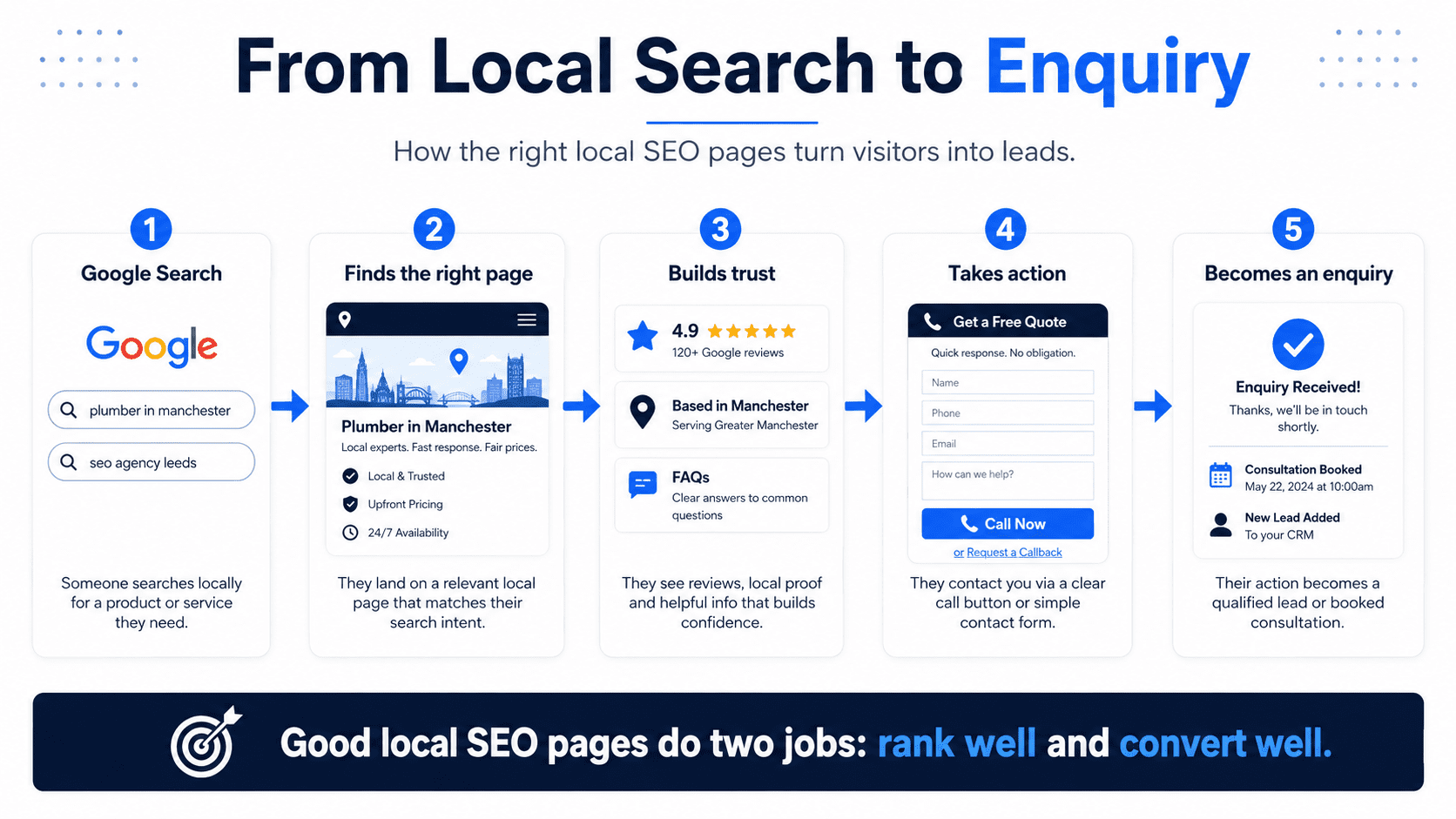
Local customers often search with strong buying intent.
Someone searching for “emergency plumber in Subang Jaya,” “website designer in Kuala Lumpur,” or “cleaning service near me” is usually not casually browsing. They are looking for a provider, comparing options, and may be ready to call or enquire soon.
If your website is properly structured, you have a better chance of appearing for those searches. If your website is vague, thin, or poorly organized, Google may struggle to understand which services and locations your business should rank for.
Local SEO structure helps your business connect services with locations. It also gives you more relevant pages to rank, more helpful pages to send paid traffic to, and more specific pages for visitors to land on.
For example, a visitor searching for “website redesign in Kuala Lumpur” is more likely to respond well to a page specifically about website redesign in Kuala Lumpur than a generic homepage that vaguely says you offer “digital solutions.” Digital solutions, naturally, being the phrase businesses use when they want to say everything and nothing at the same time.
The Best Website Structure for Local SEO
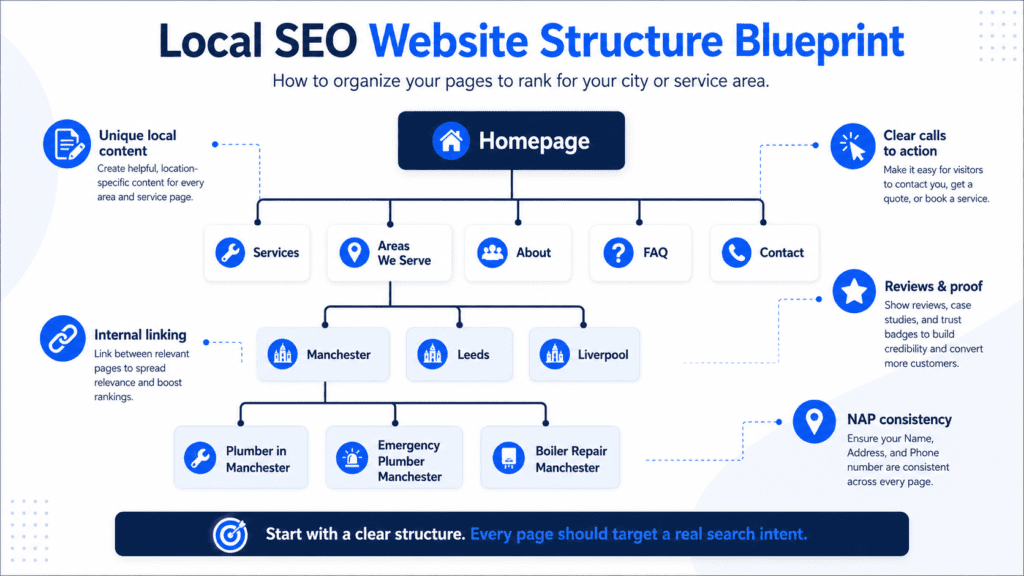
A strong local SEO website is usually organized around two main pillars: services and locations.
Your services show what you offer. Your locations show where you offer them. When these two parts are clearly connected, your website becomes much easier for search engines and visitors to understand.
A local service business may have a structure that includes a homepage, services overview page, individual service pages, service area page, location pages, reviews, blog posts, and a contact page.
For example, a cleaning company may have separate service pages for house cleaning, office cleaning, deep cleaning, and move-in cleaning. It may also have location pages for Petaling Jaya, Subang Jaya, Shah Alam, and Kuala Lumpur.
A website design business may have service pages for monthly website plans, custom website design, website redesign, landing page design, and local SEO website design. It may also have location pages targeting Kuala Lumpur, Singapore, London, Manchester, or other service areas.
The goal is not to create pages for the sake of having more pages. The goal is to create useful, focused pages that match the way customers search.
Your Homepage Should Target Your Main Business and Primary Market
Your homepage should usually focus on your main business category and your primary market.
For example, if you are offering website design for small businesses in Malaysia, your homepage may target that broad phrase. If you are a cleaning company in Petaling Jaya, your homepage may focus on cleaning services in Petaling Jaya.
The homepage should not try to rank for every single service and every single location at once. That usually creates a weak and unfocused page.
A strong local SEO homepage should explain what your business does, who you help, where you operate, why customers should trust you, and what visitors should do next.
For example, a headline like “Website Design for Small Businesses in Malaysia” is much clearer than “Professional Digital Solutions for Modern Brands.” The first headline tells visitors what you do and who it is for. The second sounds like it was generated inside a corporate fog machine.
Your homepage should also link to your main service pages and important location pages. This helps visitors move deeper into your website and helps search engines understand which pages are important.
Your Services Page Should Organize What You Offer
A services page helps visitors understand the different ways your business can help them.
This page should give a clear overview of your core services, but it should not be the only place where your services are explained. If a service is important, it should usually have its own dedicated page.
For example, a website business may include monthly website plans, website redesign, landing page design, custom website design, and website maintenance on the main services page. Each service can have a short explanation and a link to a more detailed page.
The services page acts like a directory. It helps visitors choose the right path.
If your services page only lists service names without explaining the value, it may not be enough. Customers need to understand what each service does, who it is for, and why it matters.
A good services page should make your offer feel clear, not like a menu written by someone who assumes customers can read minds.
Individual Service Pages Help You Rank for Specific Searches
Individual service pages are one of the most important parts of local SEO website structure.
A service page allows you to focus on one offer in detail. This gives search engines a clearer topic to understand and gives visitors more relevant information.
For example, instead of briefly mentioning website redesign on your homepage, you can create a dedicated page for “Website Redesign Services for Small Businesses.” That page can explain the problem, what is included, the benefits, the process, pricing guidance, FAQs, and a clear call to action.
This is much stronger than trying to squeeze every service into one general page.
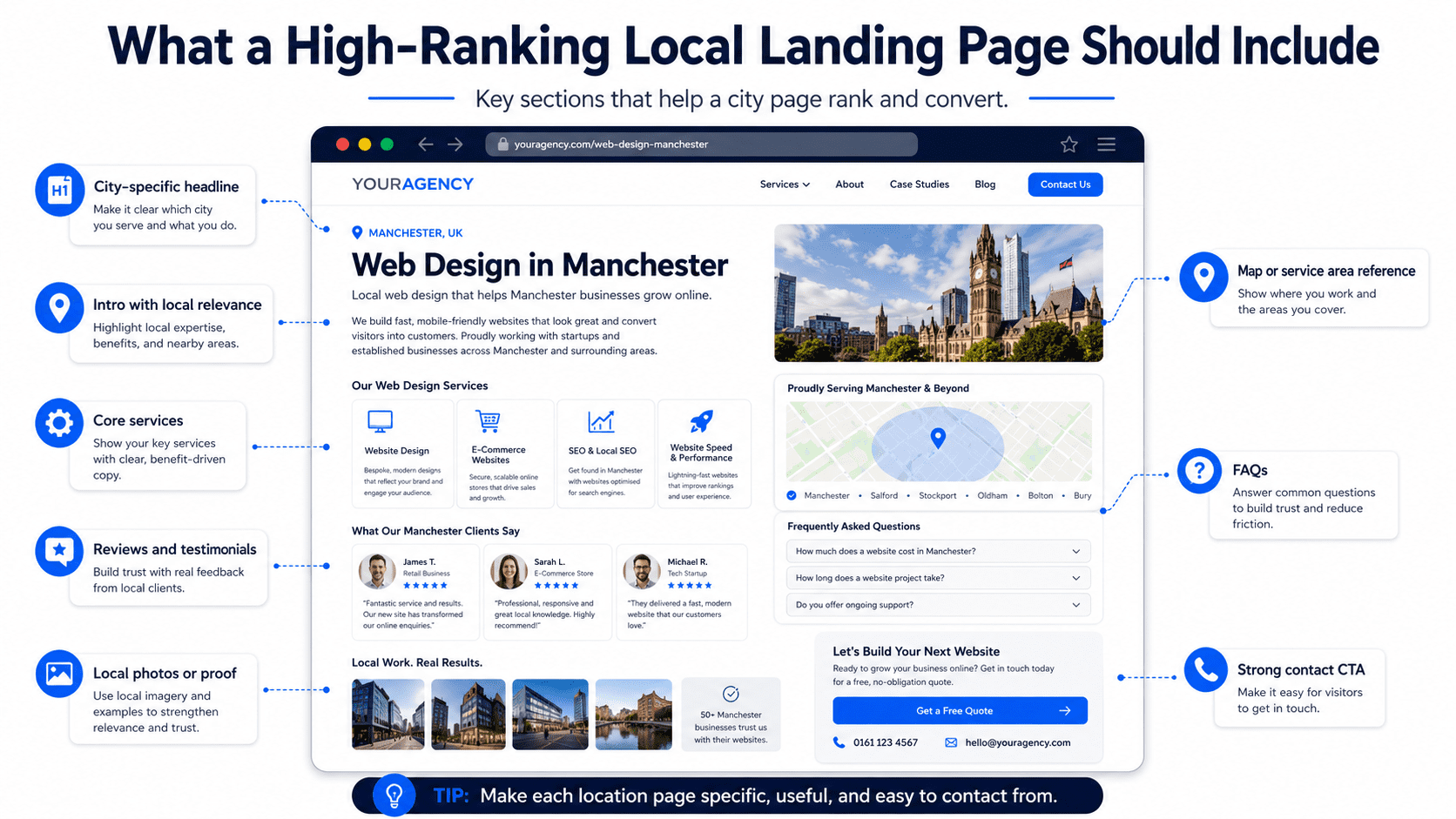
A good service page should explain the specific problem the customer has. It should show how your service solves that problem. It should make the benefits clear. It should include proof, pricing guidance if possible, and common questions.
For local SEO, the page should also mention your service area naturally where relevant. You do not need to repeat the city name in every sentence like the page has developed a location-based nervous condition. Mention the area clearly, naturally, and usefully.
Location Pages Help You Rank for City and Area Searches
Location pages are pages built for specific cities, towns, neighborhoods, or regions you serve.
For example, a website design business may create pages for “Website Design in Kuala Lumpur,” “Website Design in Singapore,” or “Website Design in London.” A cleaning company may create pages for “Cleaning Services in Petaling Jaya,” “Cleaning Services in Subang Jaya,” and “Cleaning Services in Shah Alam.”
Location pages are useful because many customers search by service plus location.
However, location pages must be genuinely helpful. A bad location page simply copies the same content across multiple pages and changes the city name. That is not local SEO. That is copy-paste wearing a fake moustache.
A strong location page should explain the services available in that area, why the service is relevant to customers there, which nearby areas you cover, and how people can enquire. If you have local testimonials, local project examples, or location-specific FAQs, include them.
The page should feel like it was written for real customers in that area, not just for Google.
Service Area Pages Are Useful If You Cover Multiple Locations
If your business serves multiple cities or regions, a service area page can help organize them.
A service area page explains where your business operates and links to important location pages. This is useful for businesses that do not have a physical branch in every location but travel to customers or serve them remotely.
For example, a local service business may have an “Areas We Serve” page that explains its coverage across Kuala Lumpur, Petaling Jaya, Subang Jaya, Shah Alam, and nearby areas.
A website service business may explain that it works with small businesses in Malaysia, Singapore, the UK, and other selected markets because everything is delivered online.
This page gives visitors clarity. It also gives search engines a stronger understanding of your geographic reach.
Should You Create Service Plus Location Pages?
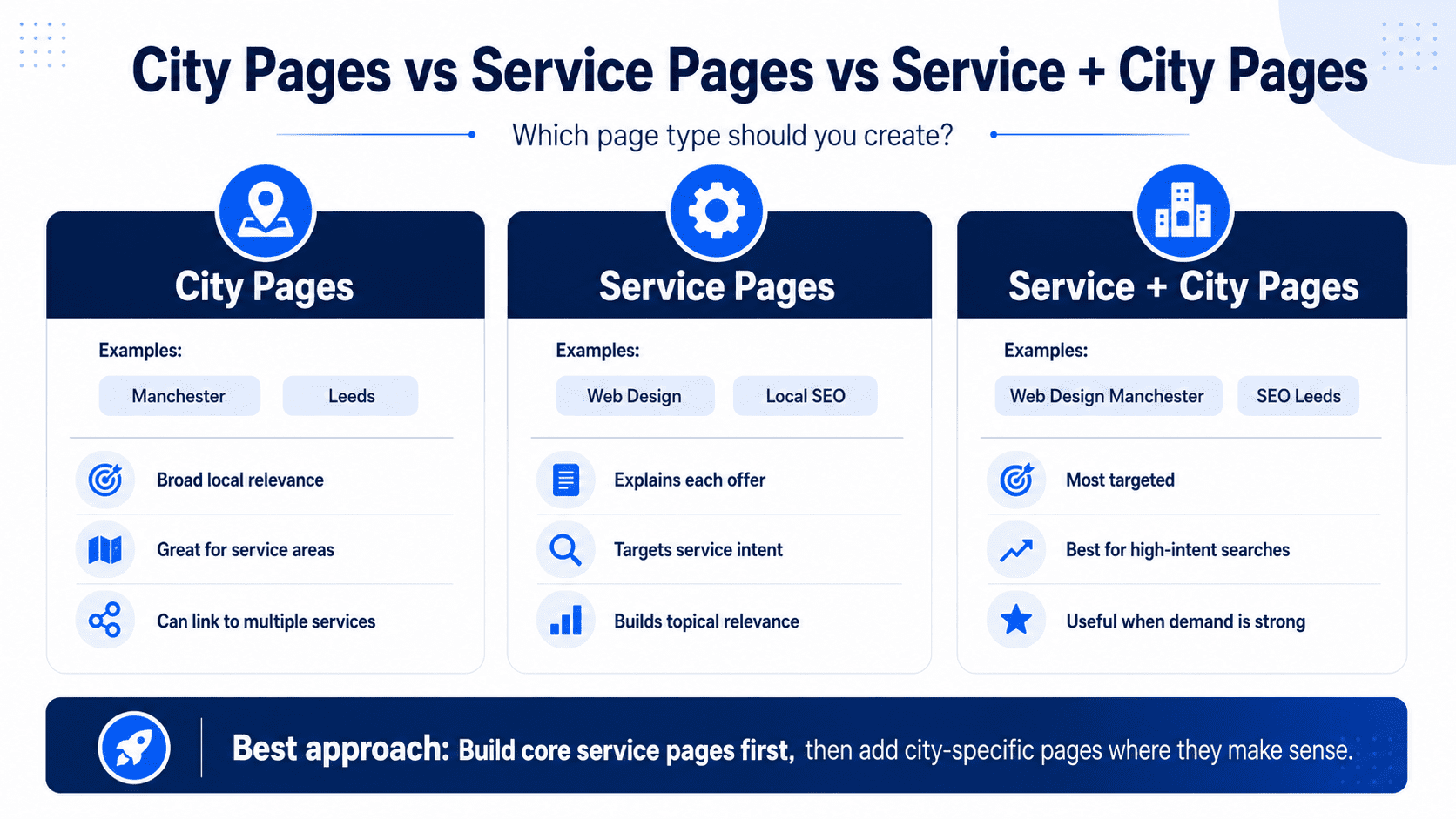
In some cases, it makes sense to create pages that combine both a service and a location.
For example, a business may create pages such as “Website Redesign in Kuala Lumpur,” “Landing Page Design in Singapore,” “Office Cleaning in Petaling Jaya,” or “Aircon Repair in Subang Jaya.”
This can work well when people search for specific services in specific places.
However, you should not create hundreds of thin pages just because you technically can. The internet is already groaning under the weight of pages nobody asked for.
A service plus location page should only exist if there is enough search intent, business value, and useful content to justify it.
If all you can write is the same paragraph with a different city name, the page is probably not ready.
Your Contact Page Should Support Local Trust
Your contact page is not just a form. It is a trust page.
For local businesses, the contact page helps confirm that your business is real, reachable, and relevant to the visitor’s area.
A strong contact page should include your business name, phone number, email address, enquiry form, WhatsApp link if relevant, business address if you have one, operating hours, response time expectation, and service areas.
If you serve customers at their location and do not have a public office, make the service area clear. For example, you can say that you serve customers across Kuala Lumpur, Selangor, and surrounding areas.
If your business works remotely, explain that clearly too. For example, a website service provider can say that website planning, design, review, and support are handled online, making the service available to clients in different cities or countries.
Clear contact details build confidence. Hidden contact details build suspicion. And suspicion is not exactly a conversion strategy.
Reviews and Testimonials Strengthen Local SEO Pages
Reviews help people trust your business before they contact you.
They are especially important for local SEO because local customers often compare several providers before making a decision.
You should include testimonials and review snippets on your homepage, service pages, location pages, and contact page. If possible, make them relevant to the page.
For example, a page about website design in Kuala Lumpur becomes stronger if it includes a testimonial from a Kuala Lumpur business. A cleaning service page becomes stronger if it includes a review from someone who used that specific cleaning service.
Specific testimonials are more powerful than generic praise.
A testimonial like “Great service” is fine, but it does not say much. A stronger testimonial explains what problem the customer had, what the business did, and what improved afterward.
Proof makes your claims more believable. Without proof, your website is just asking visitors to trust you because you typed confidently.
FAQs Help Remove Local Buying Objections
FAQs are useful for both SEO and conversions.
Many local customers have practical questions before they contact a business. They may want to know what areas you serve, how quickly you respond, how much the service costs, whether you offer same-day support, what is included, or how the booking process works.
Adding FAQs to your service pages and location pages helps answer these questions directly.
For example, a location page can answer questions about whether you serve nearby neighborhoods. A service page can answer questions about pricing, process, timeline, and what customers need to prepare.
FAQs also help capture question-based search queries. People often search in natural language, and a clear FAQ section can match those searches.
The trick is to answer real questions, not invent filler questions just to make the page look longer. Google may tolerate many things, but readers have limits.
Blog Content Can Support Local SEO Growth
Blog content helps your website attract visitors earlier in the buying journey.
For local SEO, blog posts can target customer questions, cost-related searches, comparison topics, and location-specific concerns.
A local service business might write articles about how much a service costs in a certain city, how to choose the right service provider, what to expect during an appointment, or common mistakes to avoid before hiring someone.
A website service business might write about small business website costs, website redesign signs, landing pages, local SEO structure, homepage conversion, and website copywriting.
Blog posts should not sit alone. They should link to relevant service pages and location pages.
For example, a blog post about “How Much Does a Small Business Website Cost?” should link to your website plans or website design service page. A blog post about “Local SEO Website Structure” should link to your local SEO website design service or website strategy service.
Otherwise, readers may learn something useful and leave without taking action. Very noble. Not very profitable.
Internal Linking Connects Your SEO Structure
Internal linking is the way pages on your website link to each other.
This is important because it helps search engines understand the relationship between your pages. It also helps visitors move from general information to more specific pages.
Your homepage should link to your main service pages. Your services page should link to individual service pages. Your service pages should link to relevant location pages where appropriate. Your location pages should link back to relevant services. Your blog posts should link to service pages, location pages, and other useful articles.
For example, a blog post about website redesign should link to your website redesign service page. A page about website design in Kuala Lumpur should link to monthly website plans, landing page design, and website redesign if those services are relevant.
Internal links create a clearer website journey. They also help important pages receive more authority within your site.
Without internal links, your pages become isolated little islands. Very peaceful. Terrible for SEO.
Clean URL Structure Helps Users and Search Engines
Your URLs should be simple, readable, and relevant.
A clean URL helps people understand what the page is about before they even open it. It also gives search engines another clue about the page topic.
For example, a service page could use a URL like /services/website-redesign. A location page could use /locations/kuala-lumpur. A high-priority local page could use /website-design-kuala-lumpur.
Avoid messy URLs with random numbers, unclear labels, or keyword stuffing. A URL like /best-cheap-top-website-design-kuala-lumpur-now looks desperate, and not in a charming way.
Choose a URL structure that is simple and consistent. Consistency makes your site easier to manage as it grows.
Page Titles and Meta Descriptions Still Matter
Every important page should have a unique SEO title and meta description.
The SEO title helps search engines and users understand the page topic. The meta description gives a short summary that can encourage people to click from search results.
For example, a homepage title might be “Website Design for Small Businesses in Malaysia.” A service page title might be “Website Redesign Services for Small Businesses.” A location page title might be “Website Design Services in Kuala Lumpur.”
The meta description should explain the value clearly. For a location page, it may say something like: “Professional website design services for small businesses in Kuala Lumpur. Get a clear, mobile-friendly website built to generate more enquiries.”
Good metadata should include the main keyword naturally, but it should still sound human.
Do not stuff keywords like a robot trying to impress another robot. We have enough of that already.
Local SEO Content Should Be Useful, Not Thin
A local SEO page needs enough useful content to stand on its own.
A strong page should explain the service, local relevance, customer problems, what is included, benefits, process, proof, pricing guidance, FAQs, and next steps.
Thin pages rarely perform well because they do not give visitors enough value.
For example, a location page that only says “We provide website design in Kuala Lumpur. Contact us today” is weak. It does not explain who the service is for, what makes it useful, what the customer gets, or why the business is trustworthy.
A better page would explain how the website design service helps small businesses in that market, what is included, how the process works, and how customers can get started.
The page should help a real visitor make a decision.
That is the standard. Annoyingly reasonable.
Google Business Profile Should Match Your Website
Your website should support your Google Business Profile.
If your Google Business Profile lists your main category, services, service areas, phone number, opening hours, and website link, your website should reinforce the same information.
Consistency builds trust.
If your business serves local customers, make sure your website clearly shows your service area and contact details. If you have a physical location, include the correct address and consider embedding a map on your contact or location page.
If you have multiple locations, each location may need its own page with address, hours, contact details, services, photos, reviews, and booking information.
Your Google Business Profile may help people find you. Your website helps them decide whether to contact you.
Common Local SEO Website Structure Mistakes
Many local businesses struggle with SEO because their website structure is too weak.
One common mistake is having only one generic services page. This makes it difficult to rank for specific services. Another mistake is creating location pages that are almost identical except for the city name. That creates thin content and gives visitors very little reason to trust the page.
Some businesses hide their service areas in the footer and expect that to be enough. Others use vague page titles, forget meta descriptions, ignore internal linking, or publish blog posts that do not link to any service pages.
Another major issue is poor mobile experience. Local searches often happen on mobile devices, so your local SEO pages need to load quickly and make it easy for people to call, message, or enquire.
Local SEO is not only about getting found. It is about turning local search traffic into real enquiries.
Example Local SEO Structure for a Website Design Business
A website design or Website-as-a-Service business could structure its site around services, locations, and helpful educational content.
The homepage could target website design for small businesses. The services section could include monthly website plans, custom website design, website redesign, landing page design, local SEO website design, and website maintenance.
The location pages could target key markets such as website design in Malaysia, website design in Kuala Lumpur, website design in Singapore, website design in London, or website design in Manchester.
The blog could support the entire structure with articles about Website-as-a-Service, small business website cost, landing pages, homepage conversion, website copywriting, and local SEO website structure.
This gives the website a clear content ecosystem. Each page has a role. Each topic supports the main business. And each internal link guides visitors toward a service or enquiry.
Amazing what happens when a website is organized like a business asset instead of a folder someone abandoned in 2017.
Local SEO Website Structure Checklist
Before improving your local SEO, review your website structure.
Your homepage should clearly target your main service and primary market. Besides, your main services should have dedicated pages if they are important to your business. Your service area or location pages should be useful, unique, and connected to relevant service pages.
On the other hand, your contact details should be easy to find. Your reviews should appear on important pages. Your blog posts should link to relevant service pages. Your page titles and meta descriptions should be unique. Finally, your site should work well on mobile and load quickly.
Most importantly, every important page should have a clear call to action.
Ranking is helpful. But if the page does not turn visitors into enquiries, you have created a beautifully ranked missed opportunity. A very modern tragedy.
Final Thoughts
Local SEO website structure is one of the most important parts of ranking for your city or service area.
If your website only has a generic homepage and one short services page, it may struggle to rank for specific services and locations. A stronger structure gives search engines more clarity and gives visitors more relevant information.
The best local SEO structure usually includes a clear homepage, dedicated service pages, useful location pages, service area content, reviews, FAQs, internal links, and helpful blog posts.
The goal is not to create more pages for the sake of it.
The goal is to create the right pages for the way customers search.
When your website clearly explains what you do, where you do it, and why customers should trust you, it becomes easier to rank and easier to convert visitors into enquiries.
A properly structured local SEO website does more than bring traffic.
It helps turn local searches into real customers.