One of the most common questions business owners ask before building a website is: how many pages does a small business website really need?
It sounds like a simple question, but the answer depends on your business type, your goals, your services, your budget, and how much information your customers need before they feel ready to contact you.
Some businesses only need a simple one-page website. Others need a more complete website with a homepage, service pages, location pages, pricing, FAQs, case studies, and blog content. The goal is not to build the biggest website possible. The goal is to build the right website for the way your customers make decisions.
A small business website does not need dozens of pages just to look professional. At the same time, it should not be so small that visitors cannot understand your offer, trust your business, or take the next step.
The right number of pages is not about looking bigger. It is about giving potential customers enough information to confidently enquire, book, call, or buy.
The Short Answer
Most small business websites can start with 1 to 5 core pages.
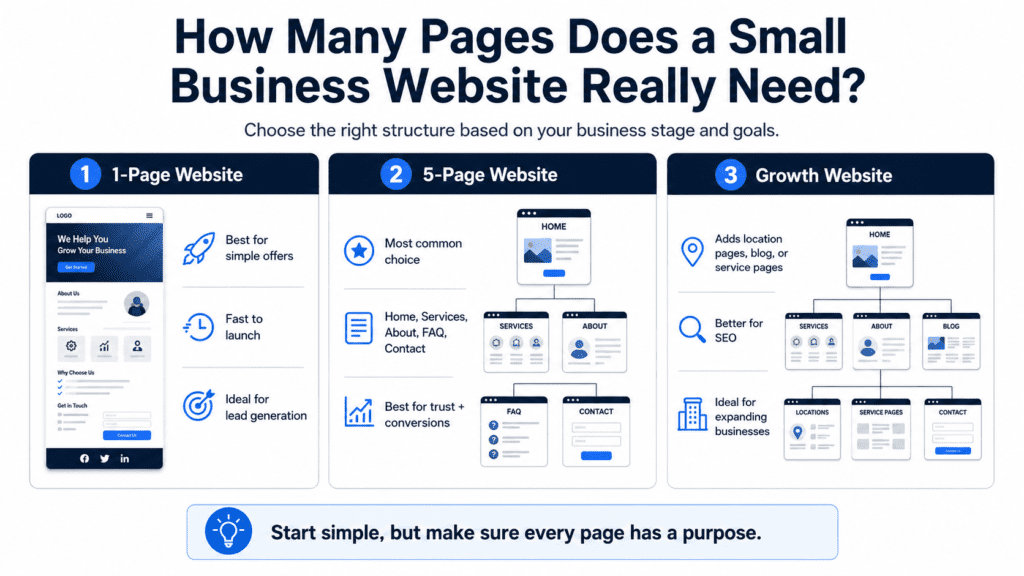
A very simple business may only need a one-page website that explains the offer, shows trust proof, answers common questions, and makes it easy to contact the business.
A more established small business may need a 3-page or 5-page website. This usually includes a homepage, services page, about page, FAQ page, and contact page. That structure gives visitors more space to understand the business without making the website too complicated.
A growing business may need more pages over time. This could include individual service pages, pricing pages, case studies, blog posts, landing pages, and location pages for local SEO.
The better question is not “How many pages should I have?” The better question is: what information does my customer need before they feel ready to contact me?
That is how you decide the right page count.
Why Page Count Matters
Page count affects more than the size of your website.
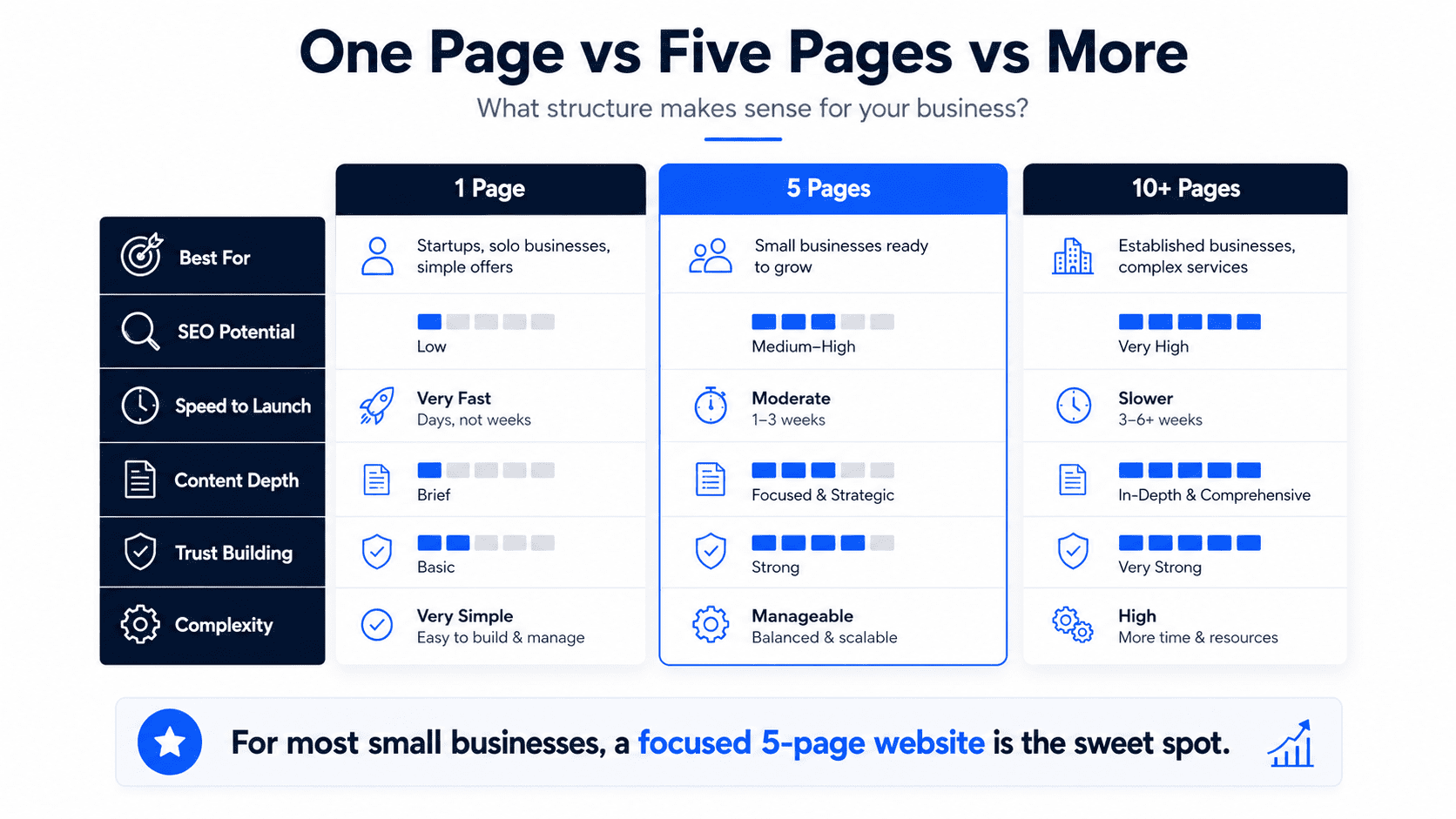
It affects your cost, launch timeline, search engine visibility, customer experience, conversion rate, and long-term website maintenance. A one-page website is usually faster and cheaper to launch, but it gives you less room for SEO and detailed explanations.
A multi-page website gives you more space to explain services, target keywords, build trust, and support different customer journeys. However, it also takes more planning, writing, design, and maintenance.
Both options can work. The problem starts when businesses choose page count for the wrong reason.
A small business does not need more pages just to look established. A messy 20-page website is not better than a clear 5-page website. Congratulations, you have more pages. The customer is still confused.
At the same time, choosing fewer pages just to save money can hurt your website if customers need more information before buying.
Your website should be as simple as possible, but as complete as necessary.
When a One-Page Website Is Enough
A one-page website can be enough for many small businesses, especially at the beginning.
This type of website works well when your offer is simple, your business is new, or your main goal is to launch quickly and start collecting enquiries. Instead of separating information across different pages, everything is placed on one well-structured page.
A strong one-page website can still include the essential sections: a clear hero section, services overview, benefits, about section, testimonials, pricing guidance, FAQs, contact form, WhatsApp button, phone number, and footer.
The key is structure. A one-page website should not feel like random blocks stacked together. It should guide visitors from understanding your offer to trusting your business to taking action.
A one-page website is often a good fit for freelancers, consultants, coaches, personal brands, simple local services, campaign pages, event pages, early-stage startups, and businesses testing a new offer.
For example, a freelance designer may only need one page that explains the service, shows examples, includes testimonials, and invites visitors to book a call. A local cleaning business may start with one page that explains services, areas served, pricing guidance, reviews, and contact details.
A one-page website is not less professional if it is clear, well designed, and conversion-focused.
A bad five-page website is still bad. It simply gives visitors five chances to be disappointed.
When You Need a Multi-Page Website
A multi-page website is usually better when your business has multiple services, multiple customer types, local SEO goals, or a longer buying journey.
If visitors need more information before contacting you, separate pages can help them find exactly what they need. A multi-page website gives your business more space to explain services, show proof, answer questions, and rank for different search terms.
For example, a service business that offers website design, website redesign, landing page design, and website maintenance should not try to explain everything in one small section. Each important service may deserve its own page.
This helps visitors understand the specific service they are interested in. It also helps search engines understand what each page is about.
A multi-page website is especially useful for local businesses, agencies, clinics, law firms, accounting firms, consultants, home service providers, beauty and wellness businesses, B2B companies, and businesses selling higher-value services.
When people are spending more money, comparing providers, or trying to reduce risk, they usually need more information before making a decision.
The Five Core Pages Most Small Businesses Should Consider
For many small businesses, a 5-page website is a strong starting point.
It is not too small, and it is not unnecessarily large. It gives you enough room to explain your business, build trust, answer common questions, and encourage enquiries.
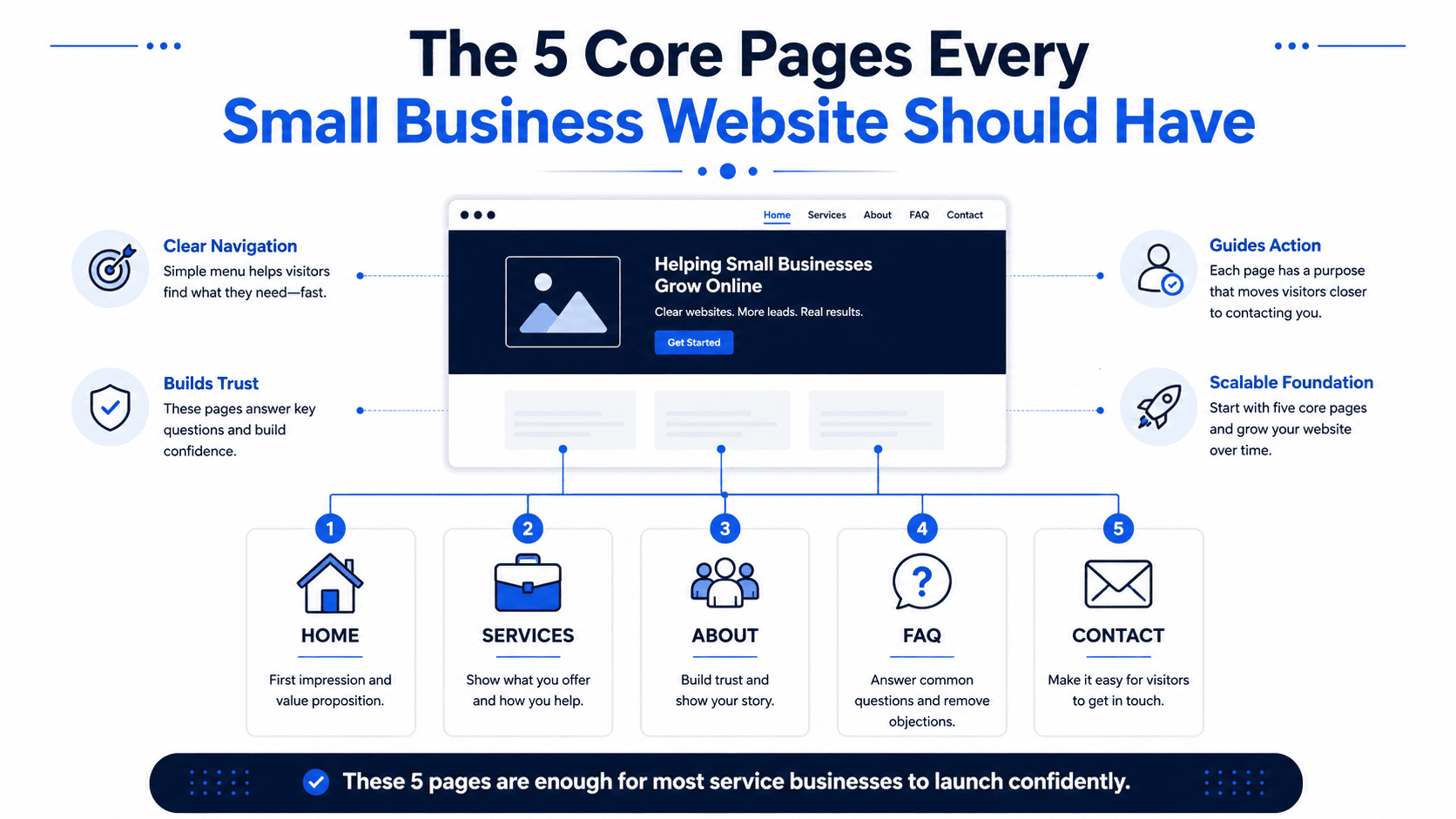
The five core pages are usually the homepage, services page, about page, FAQ page, and contact page.
Homepage
The homepage is the main introduction to your business.
It should quickly explain what you offer, who you help, why customers should trust you, and what visitors should do next. A homepage should not be a vague welcome page. Nobody visits your website hoping to read “Welcome to our website.” They already know they are on a website. Humanity has progressed that far, barely.
A strong homepage should include a clear headline, strong call-to-action buttons, trust indicators, a services overview, benefits, testimonials, FAQs, and easy contact options.
The homepage should guide visitors toward the next step. That may be requesting a quote, booking a consultation, sending a WhatsApp message, viewing website plans, or calling your business.
Services Page
The services page explains what your business provides.
This page is important because many visitors want to know whether you offer the exact service they need. A services page should not only list service names. It should explain what each service does, who it is for, and why it matters.
If your business only offers one clear service, you may not need a separate services overview page. The service can be explained on the homepage or on a dedicated service page.
But if you offer multiple services, a services page helps organize everything clearly. It also gives visitors a simple way to compare your offers before clicking deeper into the service that fits them best.
About Page
The about page helps build trust.
Many business owners treat the about page like a company history archive. That is fine, unless your visitor came to hire you rather than study your founding mythology.
A good about page should explain who you are, who you help, why your business exists, what makes your approach different, and why customers can trust you.
Your experience should be connected to customer value. Instead of only saying you have 10 years of experience, explain how that experience helps customers get better results, avoid mistakes, or feel more confident choosing your business.
The about page is not only about your story. It is about making customers feel safe enough to contact you.
FAQ Page
An FAQ page answers common questions before visitors contact you.
This can reduce hesitation and improve lead quality. People often want to know how much something costs, how long it takes, what is included, how the process works, whether support is available, and what happens after they enquire.
For a website service business, FAQs may cover hosting, domains, revisions, SEO, cancellation, support, ownership, and launch timelines.
FAQs are useful because they remove uncertainty. They also support SEO because many people search using question-based phrases.
A good FAQ page can make visitors feel more informed before they take action.
Contact Page
The contact page should make it easy for visitors to reach you.
This sounds painfully obvious, yet many websites somehow turn contact into a treasure hunt. A visitor should not need to scroll through three pages, decode your footer, and sacrifice a goat to find your phone number.
A good contact page should include a simple enquiry form, phone number, WhatsApp link, email address, booking link, business address if relevant, Google Map if local, operating hours, service areas, and response time expectation.
The form should be short. In most cases, you only need the visitor’s name, email or phone number, service interest, and message. You can collect more details later.
The goal is to start a conversation, not interrogate someone before saying hello.
Should Every Service Have Its Own Page?
In many cases, yes.
If a service is important to your business, has its own search demand, or requires explanation, it should usually have its own page.
A website business, for example, may create separate pages for monthly website plans, custom website design, website redesign, landing page design, website maintenance, and local SEO website design.
A cleaning company may create separate pages for house cleaning, office cleaning, deep cleaning, move-in cleaning, and post-renovation cleaning.
A clinic may create separate pages for general consultation, health screening, vaccination, dental care, and specialist services.
Dedicated service pages are useful because they improve clarity. They allow you to explain one service properly instead of squeezing everything into a short paragraph.
They also help with SEO. Search engines rank pages based on specific relevance. A dedicated service page has a better chance of ranking for a specific service than a general page that briefly mentions many services.
A strong service page should explain the customer’s problem, what the service includes, the benefits, the process, pricing guidance, proof, FAQs, and a clear call to action.
If a service is only a small add-on, it may not need its own page yet. But if it is a main offer, give it the space it deserves.
Do You Need Location Pages?
If your business serves different cities, towns, or service areas, location pages can help your local SEO.
For example, a business may create pages such as “Website Design in Kuala Lumpur,” “Cleaning Services in Petaling Jaya,” “Aircon Repair in Singapore,” or “Accounting Services in Manchester.”
Location pages are useful when people search for your service in a specific area.
However, location pages need to be genuinely useful. Do not create 30 pages where the only difference is the city name. That is not local SEO. That is copy-paste wearing a fake moustache.
A good location page should explain the services available in that area, the local customer needs, the neighborhoods served, relevant testimonials if available, FAQs, and clear contact options.
Location pages should help real visitors make a decision. If the page would be useless to a human, do not expect search engines to throw a parade for it.
Do You Need a Pricing Page?
A pricing page is useful if pricing is a major decision factor for your customers.
Not every business needs to show exact pricing. Some services are custom and depend on scope, timeline, features, or complexity. But even when exact pricing is difficult, pricing guidance can still help.
A pricing page may show packages, starting prices, price ranges, comparison tables, what affects pricing, payment terms, and custom quote explanations.
For example, Bennie Studio separates Managed Website, the Website Growth upgrade, consultant-led Growth Partner and Custom Website projects. Choose the service around your needs; confirm page scope and support before committing.
Pricing clarity helps visitors understand whether your service is within their budget. It also improves lead quality because people know what to expect before enquiring.
When a website gives no pricing guidance at all, visitors may leave because they assume the service is too expensive or not suitable for them.
A little clarity can prevent a lot of silent exits.
Do You Need a Blog?
A blog is not required for every small business, but it is very useful if you want SEO traffic.
Blog posts help answer customer questions and attract people earlier in the buying journey. They are especially useful for businesses that want to rank on Google, build authority, and educate potential customers before they enquire.
A website service business might publish articles about Website-as-a-Service, website costs, landing pages, website redesign, homepage conversion, local SEO, and website copywriting.
A local service business might publish articles about service costs, how to choose a provider, common mistakes, checklists, and signs that a customer needs a specific service.
The important thing is that blog posts should link to relevant service pages. Otherwise, visitors may read your helpful article, feel slightly wiser, and leave forever. Educational, yes. Profitable, not exactly.
A blog should support your customer journey, not exist as a decorative content shelf.
Do You Need Case Study Pages?
Case studies are useful if customers need proof before buying.
They are especially valuable for consultants, agencies, website designers, renovation companies, marketing firms, B2B service providers, coaches, and higher-ticket service businesses.
A case study page can explain the client background, the problem, the solution, the result, and the lesson learned. It can also include screenshots, images, testimonials, or performance improvements.
Even if you cannot share exact numbers, you can still explain the transformation. For example, you might show how a website became clearer, faster, easier to use, or better structured for enquiries.
Case studies help visitors imagine what working with you might look like. They make your claims more believable because they show your work in context.
Page Count by Business Type
Different businesses need different page counts.
A freelancer or solo consultant may only need 1 to 3 pages at the start. If the offer is simple, one strong page may be enough. If the consultant has multiple services or needs to build authority, they may add an about page, case studies, and blog content.
A local service business usually benefits from 3 to 5 pages to start. A homepage, services page, about page, FAQ page, and contact page can provide a solid foundation. Over time, the business can add individual service pages, location pages, reviews, and blog content.
A professional service firm may need 5 to 10 pages because trust and detail matter more. Law firms, accounting firms, clinics, and consultants usually need service pages, team information, FAQs, contact details, and sometimes insight articles or case studies.
An agency or website service business often needs 5 to 10 or more pages because each service may need its own explanation. Pages for monthly website plans, website redesign, landing page design, pricing, case studies, blog content, FAQs, and contact can all support conversion and SEO.
An appointment-based business such as a clinic, salon, or wellness provider may also need multiple pages for services, treatments, pricing, reviews, FAQs, booking, and locations.
An e-commerce business usually needs more pages because product categories, product pages, shipping information, returns, policies, and checkout support all matter.
The point is simple: page count should match the business model.
Page Count by Business Stage
Your business stage also affects how many pages you need.
A new business should usually start simple. A one-page website or a 5-page website is often enough. At this stage, the priority is to look credible, explain the offer clearly, and start collecting enquiries.
A growing business should expand the website based on demand. This may include individual service pages, pricing pages, testimonials, case studies, blog posts, and location pages.
An established business usually needs a stronger website structure. At this stage, the website should support SEO, lead generation, content marketing, sales conversations, and brand credibility. More pages can be useful, but only if each page has a clear purpose.
The website should grow as the business grows. Building too much too early can slow you down. Building too little for too long can limit your visibility and enquiries.
Because naturally, balance is the one thing humans keep trying to rediscover in every industry.
How Many Pages Do You Need for SEO?
If SEO matters, you usually need more than one page.
A one-page website can rank for a narrow topic, especially in a low-competition market. But it is limited because search engines rank individual pages for specific topics.
If you want to rank for different services, locations, questions, and comparison topics, you need separate pages.
For example, instead of trying to rank one page for website design, website redesign, landing pages, website maintenance, and local SEO, it is better to create focused pages for each topic.
The same applies to locations. If your business serves Kuala Lumpur, Petaling Jaya, Subang Jaya, and Singapore, one generic page may not be enough to rank well for each area.
SEO works better when each important page has a clear topic, clear keyword focus, helpful content, and relevant internal links.
More pages are not automatically better. Better-focused pages are better.
How Many Pages Do You Need for Lead Generation?
For lead generation, page quality matters more than page count.
A one-page website can generate leads if the offer is clear, the proof is strong, the CTA is visible, and the contact process is easy.
A 20-page website can fail completely if the messaging is confusing, the pages are thin, and visitors cannot figure out what to do next.
A lead-generating website needs clear messaging, strong calls to action, trust proof, easy contact options, service clarity, mobile-friendly design, fast loading speed, FAQs, pricing guidance, and conversion tracking.
If visitors need more information before enquiring, add pages. If the offer is simple and the visitor can decide quickly, one strong page may be enough.
The right number of pages is the number that supports the customer journey.
The Danger of Having Too Few Pages
A website with too few pages may struggle because it cannot explain enough.
If all your services are squeezed into one short section, visitors may not understand what you offer. Search engines may also struggle to understand your services clearly.
Too few pages can limit SEO visibility, reduce trust, leave customer questions unanswered, and make it harder to show case studies, testimonials, pricing guidance, or location relevance.
If your customers need more detail before contacting you, too few pages can hurt conversions.
A simple website is good. An under-explained website is not.
The Danger of Having Too Many Pages
More pages are not automatically better.
A website with too many weak pages can create confusion. Thin content, duplicate pages, messy navigation, outdated information, and poor internal linking can all hurt user experience and SEO.
Do not create pages just to look bigger. Every page should have a job.
If a page does not help visitors understand, trust, compare, or contact your business, it may not need to exist.
A useful 5-page website is better than a messy 30-page website nobody wants to navigate.
The internet already has enough clutter. Try not to personally sponsor more of it.
A Smart Page Strategy for Small Businesses
The best approach is to start with the essential pages and expand intentionally.
At launch, many businesses can start with a homepage, services page, about page, FAQ page, and contact page. If the business is very simple, one page may be enough.
Once the business starts getting traffic and enquiries, the website can be improved with individual service pages, testimonials, case studies, pricing guidance, and a lead magnet.
When SEO becomes a bigger priority, the business can add blog posts, location pages, comparison articles, service-and-location pages, and industry-specific content.
This approach keeps the website manageable while giving it room to grow.
You do not need to build everything at once. You need to build the right foundation first.
Example One-Page Website Structure
A one-page website should still feel complete.
It can start with a strong hero section that explains the offer and includes a clear CTA. Below that, it should show trust indicators, explain the customer’s problem, present the solution, summarize the services, explain the benefits, show the process, include testimonials, provide pricing guidance, answer FAQs, and end with a contact section.
This structure can work well for simple offers and early-stage businesses because it gives visitors a clear path from interest to action.
Example Five-Page Website Structure
A 5-page website is often a strong starting point for small businesses.
The homepage introduces the business and guides visitors to the next step. The services page explains what the business offers. The about page builds trust. The FAQ page answers common questions. The contact page makes enquiry easy.
This structure gives your website more depth than a one-page site without making it overly complicated.
For many service businesses, this is enough to launch professionally and start generating enquiries.
Example Ten-Page Website Structure
A 10-page website is useful for growing businesses with multiple services or stronger SEO goals.
This type of structure may include a homepage, services overview, three individual service pages, pricing page, about page, case studies page, FAQ page, and contact page.
For local SEO, some of those pages may be replaced or expanded with location pages and reviews.
A 10-page website gives you more space to explain, rank, and convert. But it should only be built when there is enough content and business need to justify it.
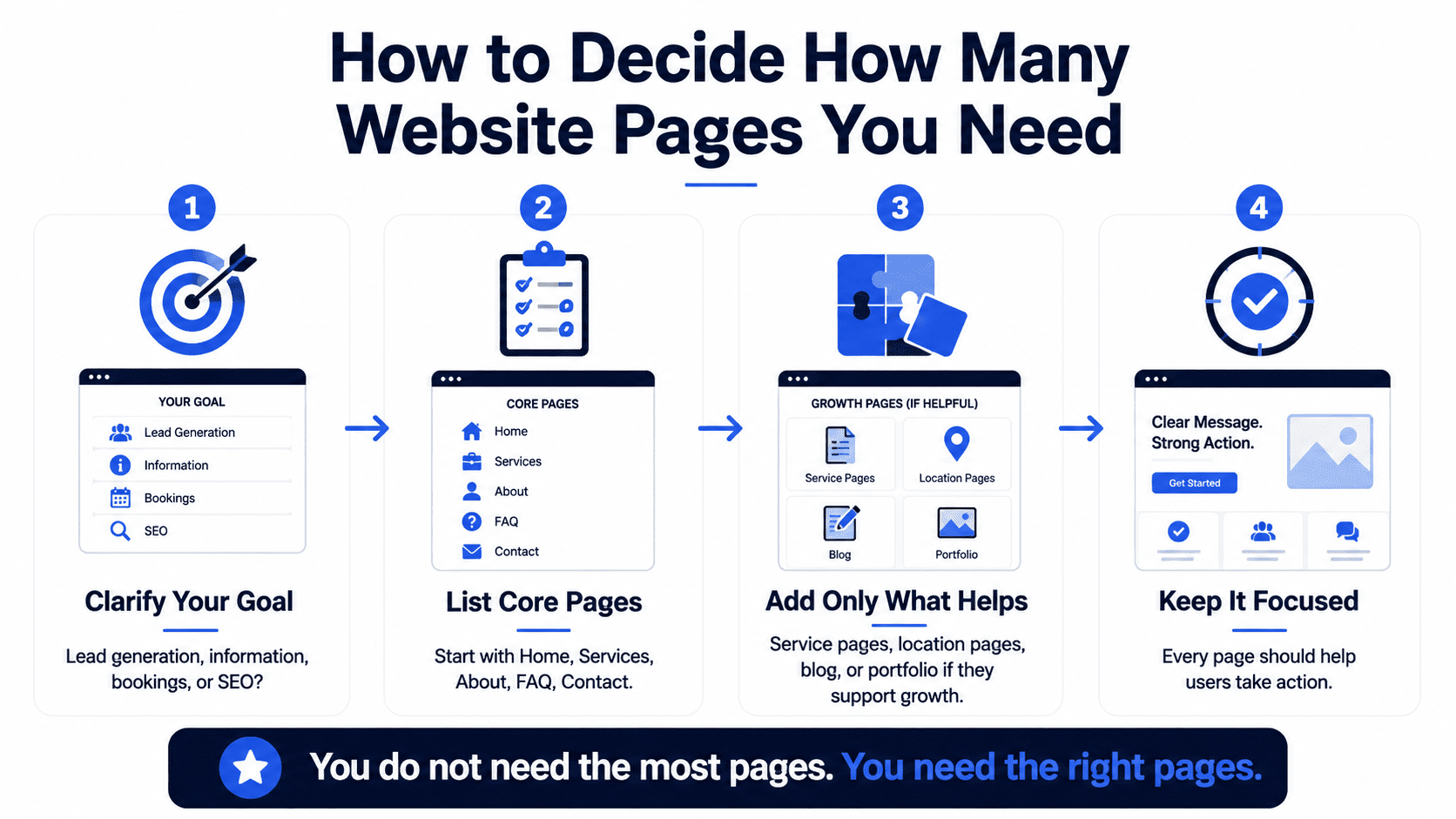
How to Decide How Many Pages You Need
To decide how many pages your website needs, think about your customer’s decision-making process.
If your offer is simple and customers can decide quickly, you can start with fewer pages. If your offer is complex, expensive, location-based, or comparison-heavy, you probably need more pages.
Ask whether your customers search for each service separately. Ask whether you serve multiple locations. Besides, you may ask whether customers need pricing, proof, FAQs, or case studies before they contact you. Ask whether SEO is important to your growth.
If the answer is yes to several of those questions, a multi-page website will likely work better.
If not, a one-page or 5-page website may be enough to start.
Final Thoughts
A small business website does not need a fixed number of pages.
It needs the right number of pages for your business goals, customer journey, and growth stage.
For many small businesses, 1 to 5 pages is enough to start. A one-page website can work well for simple offers and new businesses. A 5-page website is a strong foundation for many service businesses. A growing business may need 10 or more pages to support SEO, services, locations, case studies, and content marketing.
The best approach is to start with the essential pages, then expand based on real business needs.
Do not build pages just to look bigger.
Build pages that help visitors understand your offer, trust your business, and take the next step.
That is what turns a website from a collection of pages into a useful business asset.