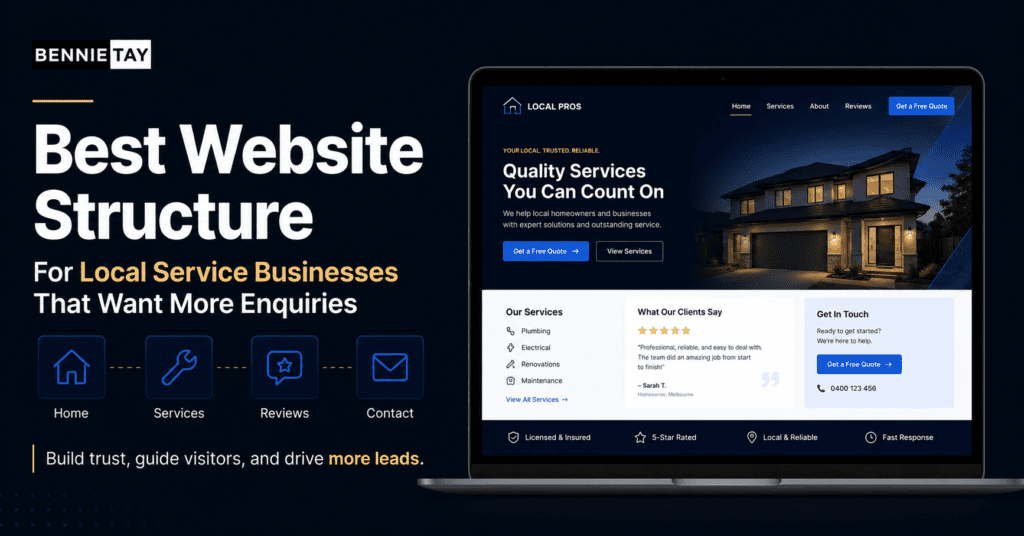
A local service business website should not be built like a company profile.
It should be built like a guided path that helps visitors understand your service, trust your business, and contact you. Whether you run a clinic, beauty salon, tuition centre, renovation company, cleaning service, law firm, accounting firm, fitness studio, repair service, agency, or consulting business, your website structure matters.
Many small business websites fail because they are not structured around how customers make decisions. They have a homepage, an About page, a few services, and a contact form. Technically, that is a website. In the same way that a plastic chair is technically furniture. It exists, but nobody is impressed.
A proper local service business website needs to answer the visitor’s questions in the right order. It needs to show what you offer, where you serve, why you are trustworthy, what the next step is, and how people can enquire easily.
If your website is not getting enough enquiries, the issue may not be your design alone. It may be the structure.
This guide explains the best website structure for local service businesses that want more enquiries, WhatsApp leads, quote requests, and bookings.
Why Website Structure Matters for Local Service Businesses
When someone visits your website, they are usually not there to admire your layout. They are trying to decide whether your business can help them.
A potential customer may have found you through Google, social media, referral, ads, or a WhatsApp link. They may already have a problem. They may be comparing several providers. They may be checking whether your business looks credible enough to contact.
Your website structure should support that decision.
If visitors land on your website and immediately understand what you do, they are more likely to continue reading. If they can see your services clearly, they are more likely to find what they need. If they can see proof, testimonials, case studies, or useful explanations, they are more likely to trust you. If your CTA is visible and simple, they are more likely to enquire.
A weak structure creates friction. Visitors have to search, guess, click around, and work too hard. Most people will not do that. They will leave and choose a competitor whose website explains things more clearly.
A good website structure does not just organize information. It improves the customer journey.
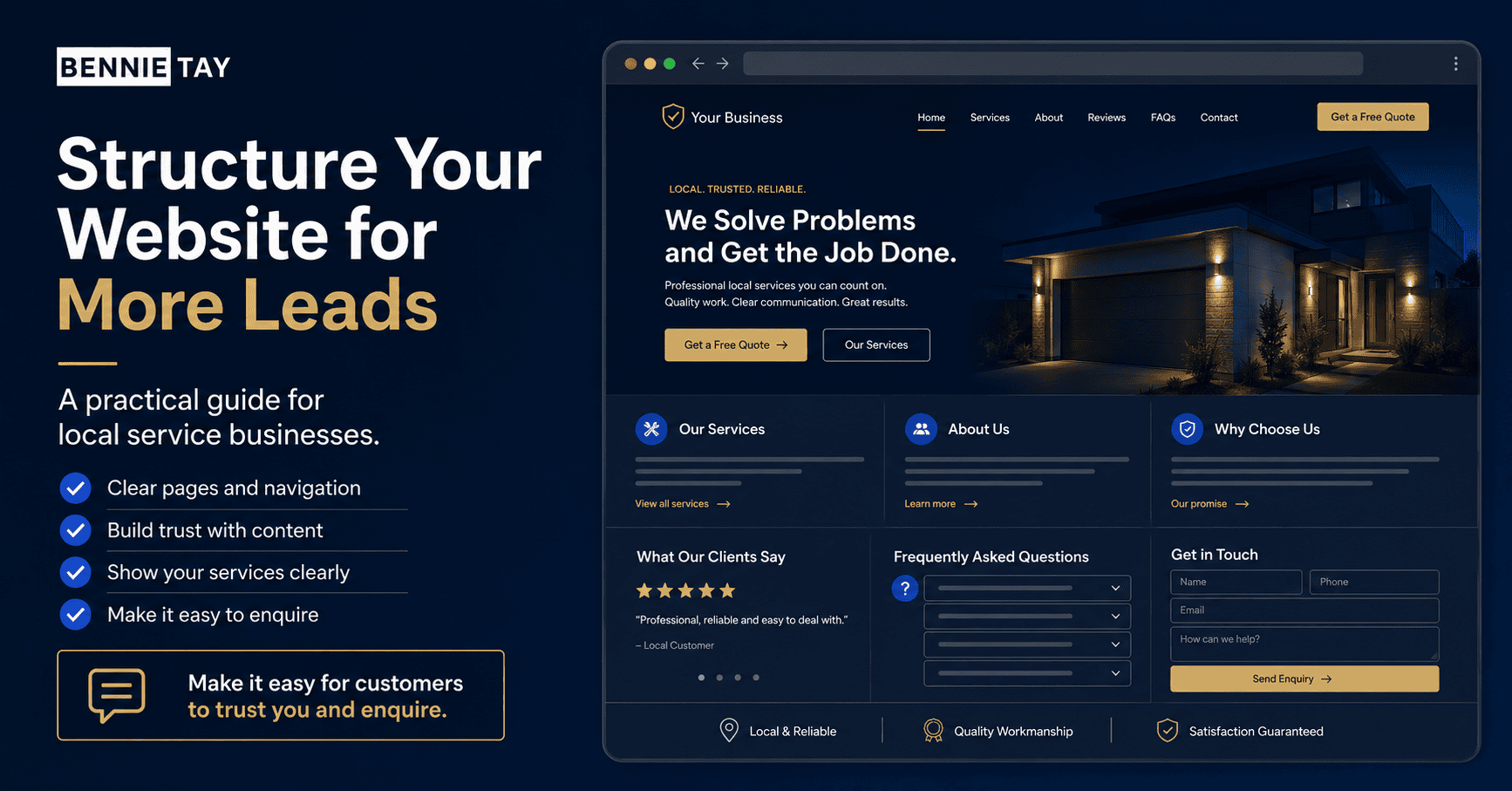
Start With One Clear Website Goal
Before planning your website pages, you need to define the main goal.
For most local service businesses, the goal is to generate enquiries. That could mean WhatsApp messages, phone calls, quote requests, booking form submissions, consultation requests, or walk-in visits.
The website should be structured around that goal.
If you want WhatsApp enquiries, your website should make WhatsApp easy to find and use. If you want appointment bookings, your website should explain the service clearly and guide visitors to book. If you want quote requests, your service pages should give enough detail for visitors to feel ready to ask for pricing.
Many websites fail because they do not have a clear primary action. They offer too many vague options, or they hide the contact path until the very end. A visitor should never wonder what to do next.
Your website goal should shape your homepage, service pages, CTA buttons, contact page, and even blog content.
A website without a clear goal becomes a brochure. A website with a clear goal becomes a lead generation tool.
The Homepage Should Work Like a Business Overview
Your homepage is usually the most important page on your website.
It should not try to say everything, but it should give visitors enough information to understand your business and move deeper into the site.
The first section of the homepage should immediately explain what you do, who you help, and what result you provide. For example, a vague headline like “Professional Solutions for Your Needs” does not help much. It sounds like it was assembled from leftover corporate words.
A stronger headline would be more specific:
“Home Renovation Services in Kuala Lumpur With Clear Planning and Quotation”
Or:
“Website Design for Local Service Businesses That Want More Enquiries”
Or:
“Beauty Salon in Petaling Jaya for Facial Treatments, Waxing, and Skin Care”
The homepage should also show your main services. Visitors should not need to dig through menus to understand what you offer. A simple service overview section can help them choose the service that matches their need and click into the full service page.
After that, the homepage should build trust. This can be done through testimonials, client examples, before-and-after results, Google reviews, industry experience, certifications, process explanation, or case studies. Local service businesses often depend heavily on trust, so this part should not be treated as optional decoration.
The homepage should also explain your process. People are more likely to enquire when they understand what happens next. A simple process section can reduce hesitation and make your service feel easier to buy.
Finally, the homepage should end with a clear CTA. By the time visitors reach the bottom, they should know whether to WhatsApp you, request a quote, book a consultation, or view a package.
Service Pages Should Be Specific, Not Thin
A common mistake local businesses make is placing all services on one page with short descriptions.
This may be acceptable for a very small business with one or two simple services. But if you offer multiple services, each important service should have its own page.
A dedicated service page gives you room to explain the service properly. It also helps with SEO because each page can target a more specific keyword.
For example, a clinic should not only have one page called “Services” with a list of treatments. A better structure may include separate pages for skin consultation, acne treatment, health screening, aesthetic services, or other important services.
A renovation business may need separate pages for kitchen renovation, bathroom renovation, office renovation, house extension, or interior design. A website design business may need separate pages for website design, landing page design, website redesign, monthly website plans, and local SEO pages.
Each service page should answer the questions a customer is likely to ask before enquiring.
What is this service? Who is it for? What problem does it solve? What is included? How does the process work? What should the customer prepare? How can they enquire? What makes your service different?
A thin service page does not build confidence. It leaves too many unanswered questions. If visitors are not sure whether the service is right for them, they may leave instead of asking.
A strong service page acts like a helpful salesperson. It explains, reassures, and guides.
Location Pages Help Local Customers Find You
If your business serves specific areas, location pages can be useful.
Local customers often search with location-based terms. They may search for “clinic in Mont Kiara,” “renovation contractor Kuala Lumpur,” “tuition centre Petaling Jaya,” or “website design Malaysia.” If your website does not clearly mention the areas you serve, you may miss relevant local traffic.
A location page should not be a lazy copy of another page with only the city name changed. Search engines and readers deserve slightly more effort, tragic as that may be for the copy-paste industry.
A useful location page should explain the service in that area, the type of customers you help, relevant local needs, and how people can contact you. It should feel like a real page written for that location, not a fake doorway page.
For example, a renovation company serving Kuala Lumpur could create a page explaining the types of renovation projects commonly handled in KL, the process for requesting a quote, and the areas covered. A website design provider could create location pages for key markets such as Kuala Lumpur, Petaling Jaya, Shah Alam, Subang Jaya, or Malaysia more broadly, depending on the target audience.
Location pages work best when they are connected to your main service pages. This helps visitors move between service intent and local intent.
The About Page Should Build Confidence
The About page is not only for your company history.
For local service businesses, the About page helps visitors decide whether they trust you. People want to know who is behind the business, what experience you have, and whether you seem reliable.
A strong About page should connect your story to the customer’s needs. Instead of only saying when the company started, explain who you help and why your approach matters.
For example, if you run a website design business, your About page could explain that you help small service businesses build websites that are clear, professional, and focused on enquiries. If you run a clinic, explain your care approach, team background, and patient experience. If you run a renovation company, explain your project process, communication style, and commitment to practical design.
The About page should make your business feel real. Add photos if possible. Add founder or team information. Add your values, but make them meaningful. Everyone says they care about quality. Say how that quality shows up in the customer experience.
Trust is not created by declaring yourself trustworthy. It is created by showing enough detail for people to believe you.
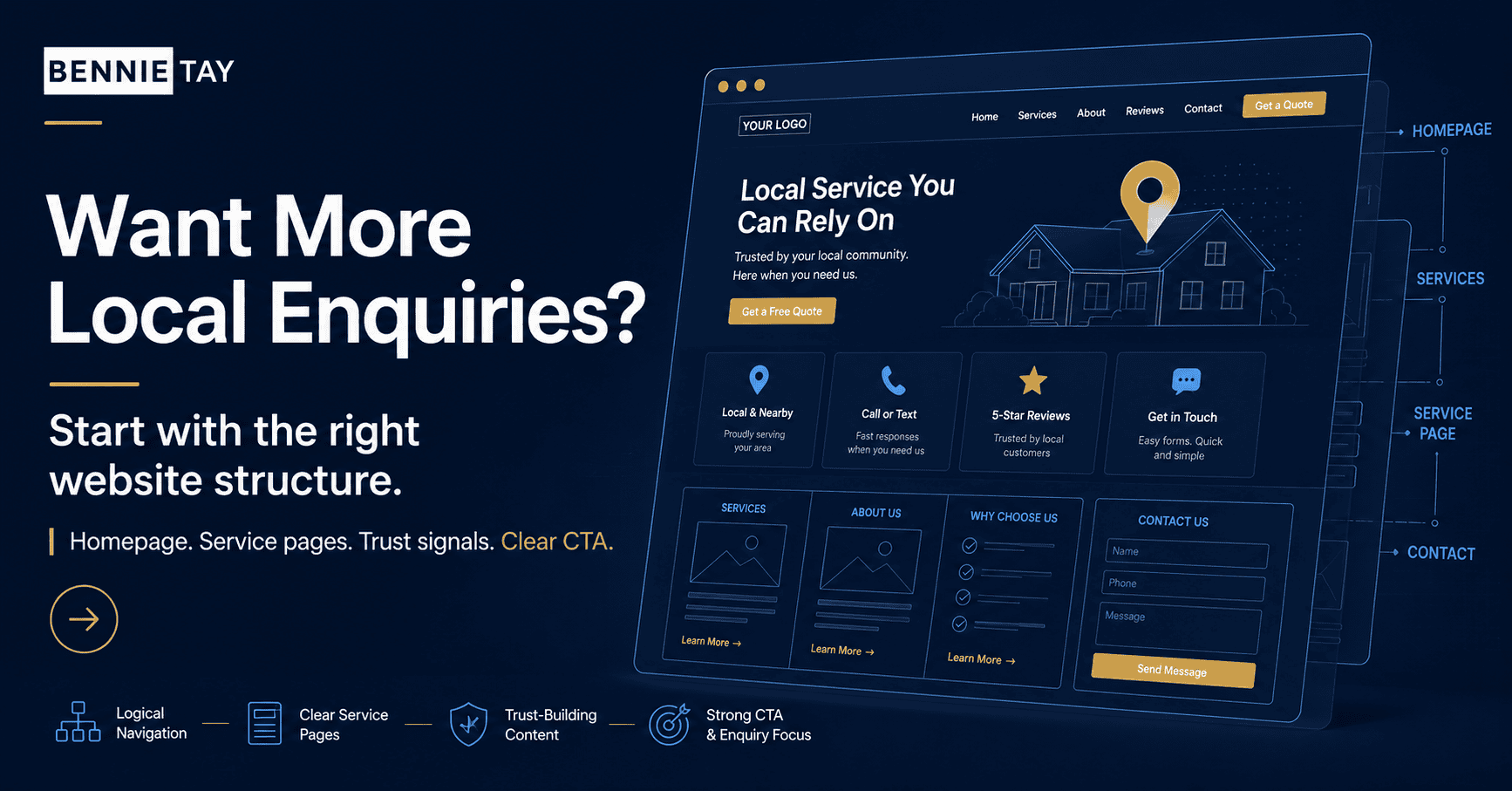
The Contact Page Should Remove Friction
A local service business contact page should be simple and useful.
If someone reaches your contact page, they are probably considering taking action. This is not the time to make things complicated.
The page should show your main contact methods clearly. If WhatsApp is your preferred enquiry channel, make it obvious. If you accept calls, show the phone number. If you use a form, keep it short enough that people are willing to complete it. If customers visit your location, include the address and Google Maps.
A good contact page should also explain what happens after someone submits an enquiry. For example, you can say that you will reply within one business day, review their request, or schedule a consultation. This helps reduce uncertainty.
For quote-based businesses, you can include a short note telling customers what information to provide. This improves enquiry quality. A renovation company may ask for property type, location, and renovation scope. A website designer may ask for business type, current website link, and project goal.
The easier you make the enquiry process, the more likely people are to complete it.
Blog Content Should Support Buyer Questions
A blog can be powerful for local service businesses, but only if it supports the customer journey.
Many businesses publish blog posts randomly because they heard blogging helps SEO. Then they write vague articles that do not connect to their services. This is how the internet becomes a landfill with headings.
A good blog should answer the questions potential customers ask before they enquire.
For a website design business, useful blog topics may include website design pricing, monthly website plans, landing page vs website, why websites do not get leads, and website structure for service businesses.
For a renovation business, useful blog topics may include renovation cost, how to choose a contractor, kitchen renovation ideas, common renovation mistakes, and renovation timeline.
For a clinic, useful topics may include treatment guides, appointment preparation, health screening explanation, and service comparisons.
Each blog post should link to a relevant service page or CTA. If someone reads a post about website redesign, they should be guided to your website redesign service or audit offer. If someone reads a post about clinic treatments, they should be guided toward appointment booking.
Blog content should not sit separately from the business website. It should support the path from question to trust to enquiry.
Navigation Should Be Simple
Your website navigation should help visitors find what they need quickly.
For most local service businesses, the main menu should be simple. A practical structure may include Home, Services, About, Work or Case Studies, Blog, and Contact.
If you offer many services, use a dropdown or service hub page. But do not make the menu too crowded. Too many menu items can overwhelm visitors.
The most important pages should be easy to reach. Your main service pages, contact page, and CTA should be visible. If you rely on WhatsApp enquiries, consider placing a WhatsApp button in the header or as a floating button on mobile.
Navigation is not where you show off everything your business has ever done. It is where you help visitors move toward the information they need.
The best navigation feels almost invisible because it works naturally.
Internal Links Help Visitors Continue the Journey
Internal links are links between pages on your website.
For example, your homepage can link to service pages. Service pages can link to case studies. Blog posts can link to related services. Location pages can link back to main service pages. FAQ sections can link to pricing guides or contact pages.
Internal links help visitors continue exploring your website. They also help search engines understand how your content is connected.
For local service businesses, internal linking is especially useful because your website may contain different types of pages: service pages, location pages, blog posts, case studies, and contact pages. If these pages are not connected, visitors may reach one page and leave without seeing the next relevant step.
A blog post about why websites get traffic but no leads should link to a website audit CTA. A page about monthly website plans should link to website pricing content. A service page about landing pages should link to blog posts about ads and conversion.
Internal links make your website feel like a guided journey instead of a pile of disconnected pages.
Trust Signals Should Appear Across the Website
Trust should not be limited to one testimonial page.
Visitors may enter your website from different pages. Some may land on the homepage. Others may land on a blog post, service page, or location page. Each important page should include some form of trust signal.
Trust signals can include customer reviews, testimonials, case studies, work examples, process explanations, certifications, team photos, media mentions, business registration details, guarantees, or FAQs.
For a local service business, even small trust signals can help. A real photo, a clear process, a specific testimonial, or a detailed FAQ can make the business feel more reliable.
Do not expect visitors to search for proof. Show it where decisions happen.
For example, a service page should include testimonials related to that service. A location page should include local proof if available. A quote request section should reassure visitors about what happens next.
Trust needs to be placed close to action.
The CTA Should Be Clear and Consistent
Your website should have a primary CTA that appears across key pages.
For many local service businesses, this could be “Request a Quote,” “Book an Appointment,” “WhatsApp Us,” “Get a Free Consultation,” or “Request a Free Website Audit.”
The wording should match the action you want visitors to take.
If your CTA is too vague, visitors may not feel motivated. “Learn More” is fine for navigation, but it is weak as a main conversion action. “Submit” is even worse. Submit what? Submit to fate? Submit to the mysterious form gods?
A strong CTA gives visitors a clear reason to click.
For example, “Request a Free Website Growth Audit” is stronger than “Contact Us” because it explains what the visitor gets. “Book a Consultation” is stronger than “Enquire Now” if the business wants appointments. “Get a Renovation Quote” is clearer than “Send Message” for renovation companies.
The CTA should appear in the hero section, service pages, after trust sections, after FAQs, and at the bottom of important pages.
The goal is not to pressure people. The goal is to make the next step obvious when they are ready.
A Practical Website Structure for Local Service Businesses
A strong local service business website can start with a simple structure.
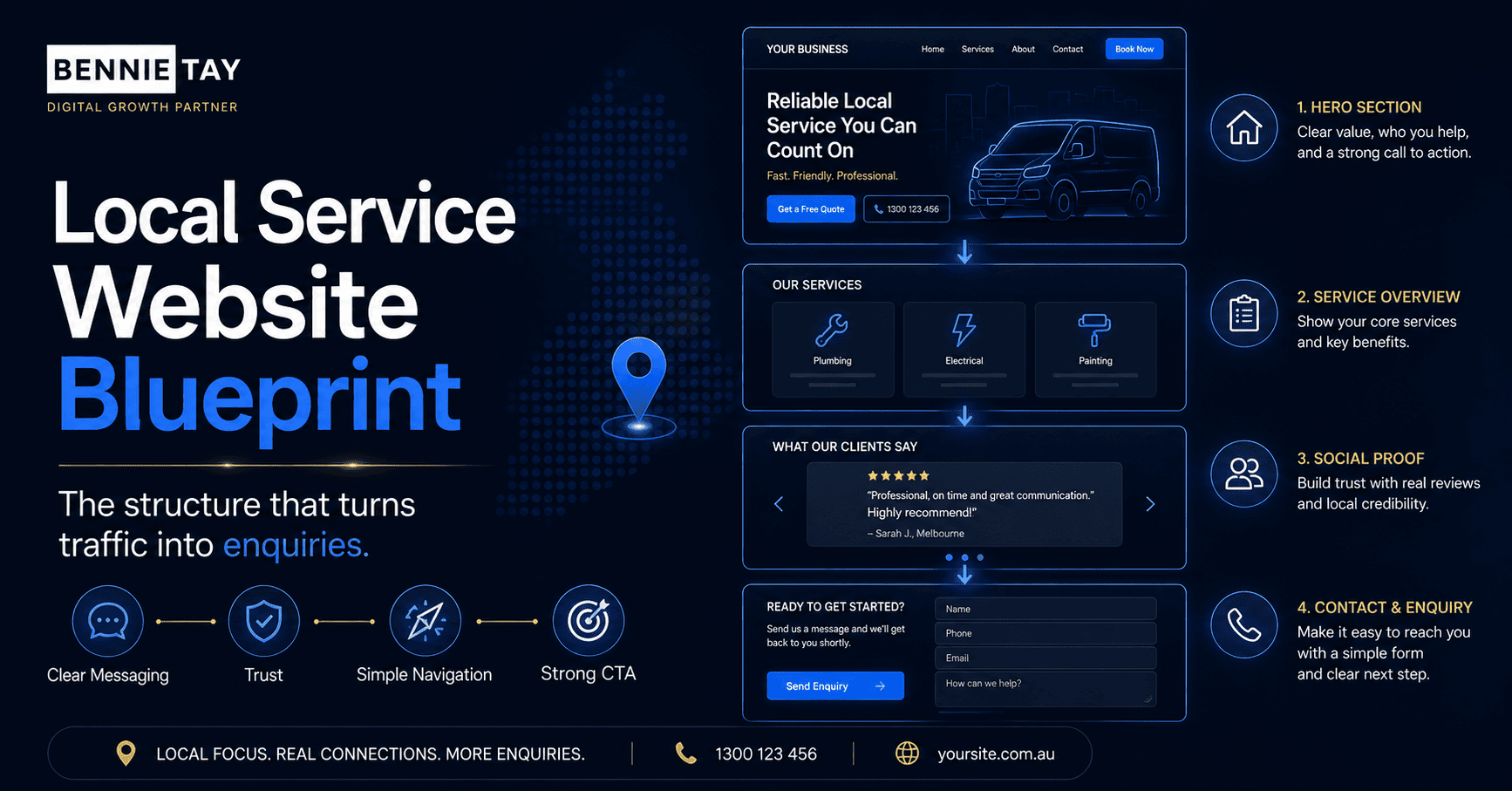
The homepage introduces the business and guides visitors to the right service. The service pages explain each offer in detail. The About page builds trust. The Work or Case Studies page proves capability. The Blog answers buyer questions and supports SEO. The Contact page makes enquiry simple. Location pages help capture local search demand where relevant.
This structure is simple, but effective.
The mistake is not having too few pages. The mistake is having pages with no purpose.
Every page should help the visitor do one of three things: understand, trust, or act.
If a page does not help with any of those, it may not need to exist.
Final Thoughts
The best website structure for a local service business is not complicated. It is clear.
Your website should explain what you do, show who you help, build trust, answer customer questions, and guide visitors toward enquiry.
A strong structure usually includes a clear homepage, detailed service pages, a trust-building About page, useful blog content, easy contact options, and local SEO pages where relevant. It should also include strong internal links, visible CTAs, and trust signals across key pages.
If your website is not getting enough enquiries, do not only blame traffic. Review the structure. Check whether visitors can understand your offer quickly. Check whether your service pages answer enough questions. Check whether your CTA is visible. Check whether trust signals appear before the visitor is asked to act.
A local service business website should not be a passive brochure. It should be a practical lead generation system.
When your website is structured properly, visitors do not have to guess. They understand what you offer, why they should trust you, and how to contact you.
That is how a website starts turning traffic into enquiries.