Before you spend money on ads, your website needs to be ready.
This sounds obvious, but many small businesses do the opposite. They run Facebook Ads, Google Ads, Instagram campaigns, TikTok promotions, Pinterest pins, or LinkedIn outreach before checking whether their website can actually convert visitors into enquiries.
The result is predictable. People click the ad, land on the website, get confused, hesitate, and leave. The business owner then says the ads are not working. Sometimes that is true. But often, the bigger problem is not the ad. The problem is the website.
Paid traffic can bring people to your website, but it cannot fix unclear messaging, weak service pages, hidden contact buttons, poor mobile design, missing trust signals, or a confusing enquiry process.
If your website is not ready, ads will only send more people into a broken journey. It is like paying to bring guests to a shop where the lights are off, the salesperson is missing, and the door says “maybe contact us somehow.” Bold strategy. Mostly tragic.
This checklist will help you review your small business website before you spend money on ads, so your traffic has a better chance of turning into leads.
Why Your Website Must Be Ready Before Ads
Ads are not magic. They are traffic tools.
A good ad can attract attention and bring the right people to your website. But once visitors arrive, your website has to do the next job. It must explain your offer, build trust, answer questions, and make enquiry easy.
For small businesses and service providers, this is especially important because customers usually need confidence before they take action. They may compare several providers. They may check your website before sending a WhatsApp message. They may want to know your services, pricing direction, location, process, and credibility.
If your website does not answer those questions, visitors may leave even if the ad was good.
This is why website conversion should come before ad spending. A weak website makes every click more expensive because fewer visitors become leads. A stronger website improves the value of every visitor because more people understand what you offer and know what to do next.
Before increasing your ad budget, make sure the website can support the traffic.
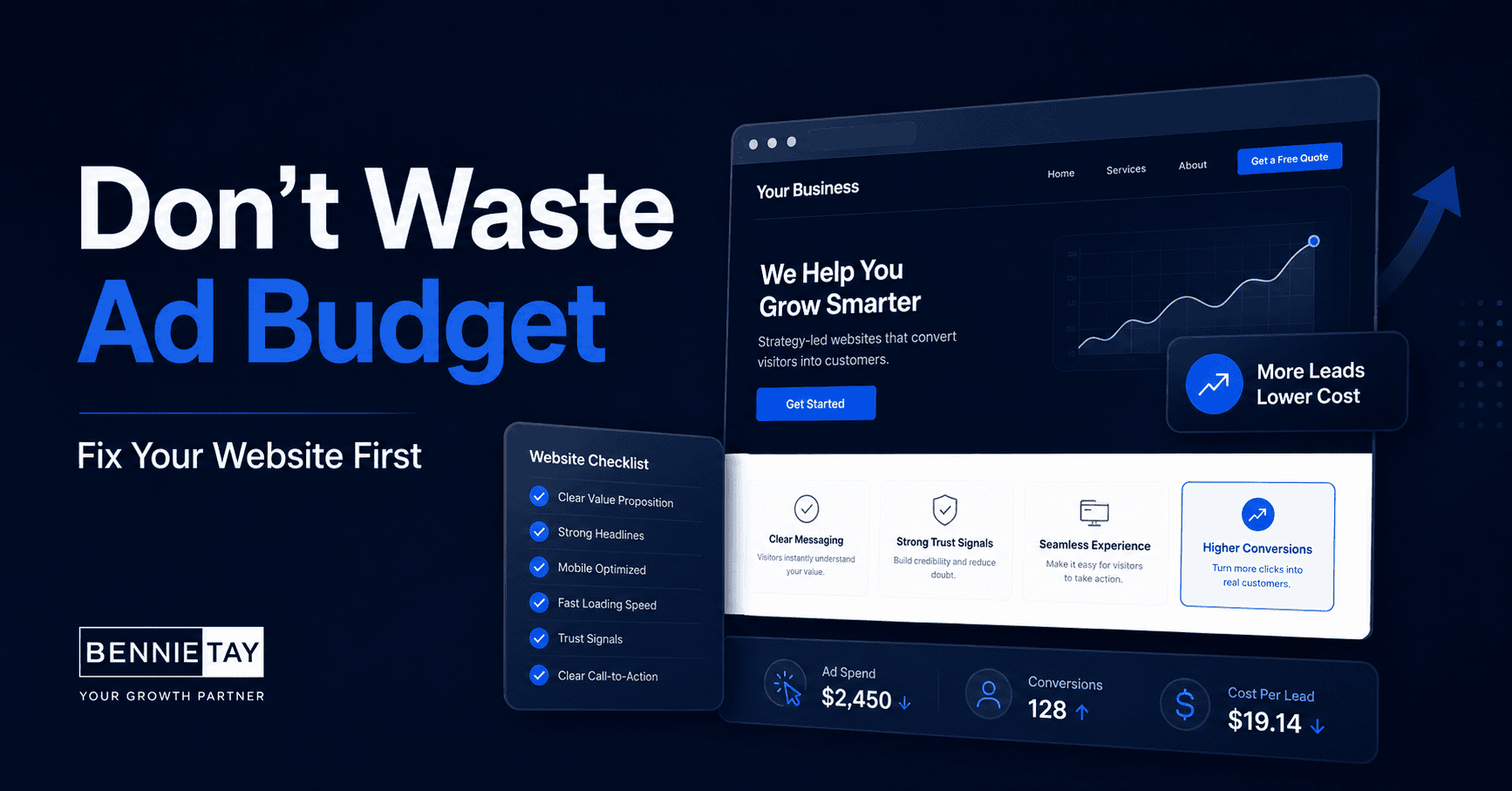
Check Whether Your Website Message Is Clear
The first thing to review is your website message.
When someone lands on your homepage or landing page, they should understand what your business does within a few seconds. They should know who you help, what problem you solve, and what action they should take next.
Many small business websites use vague headlines such as “Your Trusted Partner,” “Quality Solutions for Your Business,” or “We Help You Grow.” These phrases sound safe, but they do not explain anything specific.
A better headline is clear and direct. A clinic might say, “Skin and Aesthetic Clinic in Kuala Lumpur With Easy Appointment Booking.” A renovation company might say, “Home Renovation Services in Klang Valley With Clear Quotation and Project Planning.” A website design business might say, “Website Design for Small Businesses That Want More Enquiries.”
The message should tell visitors they are in the right place. If they have to scroll too much to understand what you do, the website is already creating friction.
Before running ads, ask someone unfamiliar with your business to look at your homepage for five seconds. Then ask them what your business offers. If they cannot answer clearly, your message needs work.
Make Sure the Page Matches the Ad
One common mistake is sending ad traffic to a page that does not match the ad message.
For example, if your ad promotes a free website audit, visitors should land on a page that clearly explains the audit, who it is for, what they will receive, and how to request it. Do not send them to a general homepage and expect them to search for the offer.
If your ad promotes a specific service, such as landing page design, the visitor should land on a landing page or service page about that exact service. If your ad promotes a clinic treatment, the landing page should discuss that treatment, not just the clinic in general.
The closer the landing page matches the ad, the easier it is for visitors to continue the journey.
A mismatch creates confusion. Confusion lowers conversions. And then everyone blames the algorithm, because apparently the algorithm is now responsible for every bad decision on earth.
Before spending money on ads, check whether each campaign has a relevant landing page. If every ad goes to the homepage, you may be wasting potential leads.
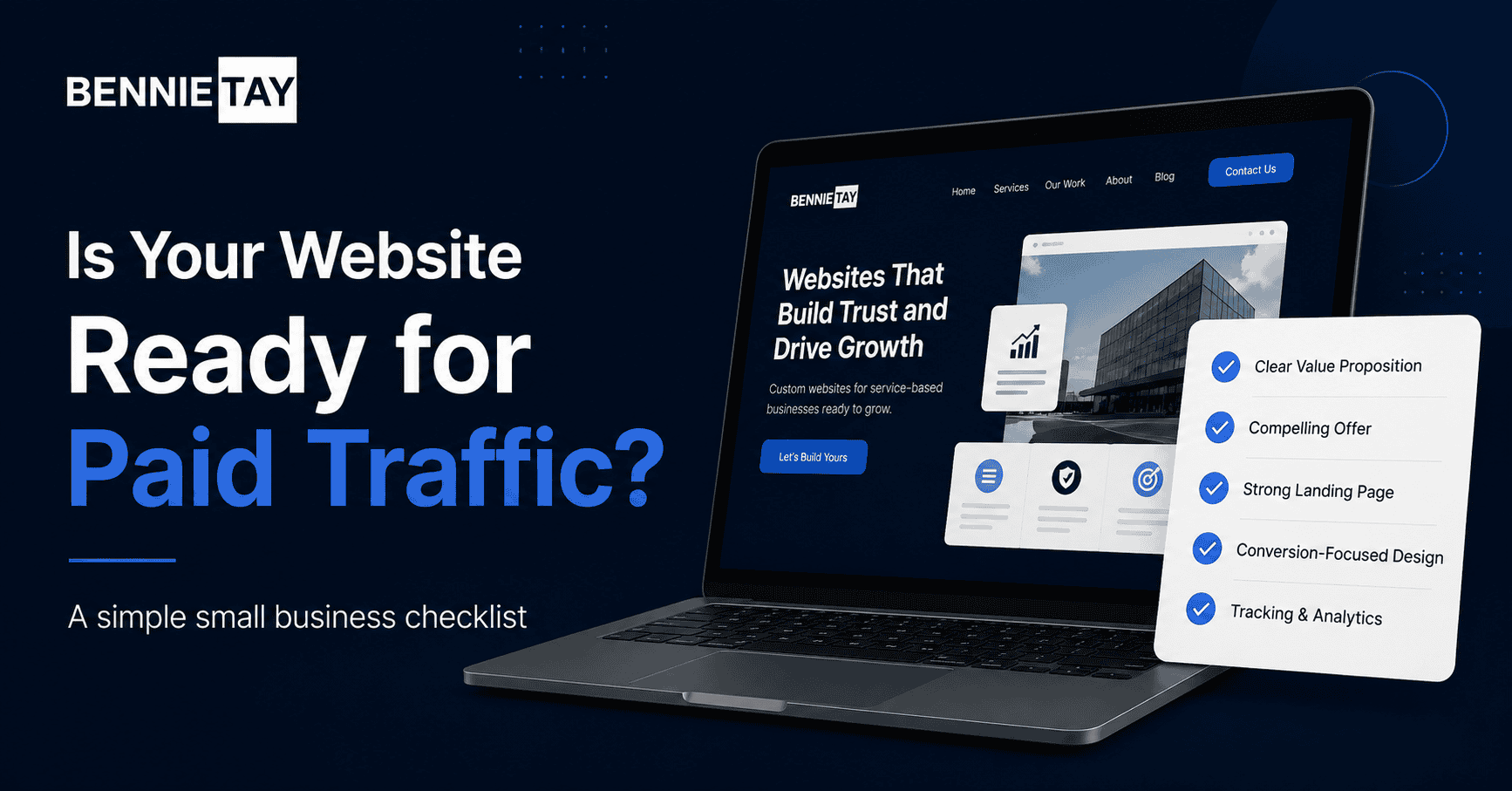
Review Your Call-to-Action
Your website needs a clear call-to-action.
A CTA tells visitors what to do next. For a small business, this may be requesting a quote, booking a consultation, sending a WhatsApp message, filling in a form, calling your team, or viewing a package.
Weak CTAs are vague. “Learn More” may be fine for internal navigation, but it is not always strong enough as a main action. “Submit” is even weaker. It sounds like the visitor is surrendering to a form.
A better CTA is specific. “Request a Free Website Audit,” “Get a Quote,” “Book a Consultation,” “WhatsApp Us for Advice,” or “Schedule an Appointment” all tell the visitor exactly what action they are taking.
Your CTA should appear near the top of the page, after important sections, and again near the bottom. This does not mean you need to spam buttons everywhere. It means visitors should always have a clear next step when they are ready.
Before running ads, check whether your CTA is visible, specific, and easy to use on mobile.
Check Your Mobile Experience
Most ad traffic will include mobile visitors. If your website is difficult to use on mobile, you may lose leads quickly.
A mobile website should load quickly, display text clearly, and make buttons easy to tap. The visitor should not need to pinch, zoom, fight with menus, or scroll through huge empty sections just to find the contact button.
For Malaysian small businesses, mobile experience is even more important because many enquiries happen through WhatsApp. If someone clicks your ad from their phone and wants to contact you, the WhatsApp button should be obvious.
Your mobile page should also keep the most important message near the top. The headline, short explanation, and CTA should be visible without forcing the visitor to work too hard.
Before spending on ads, open your website on your phone and behave like a first-time visitor. Try to understand the offer, find the CTA, and send an enquiry. If the process feels annoying to you, it will feel worse to a real visitor who has no reason to be patient.
Build Trust Before Asking for Enquiries
People do not enquire only because your service exists. They enquire when they trust you enough to take the next step.
Before running ads, your website should include trust signals. These can be testimonials, reviews, client logos, portfolio examples, case studies, before-and-after examples, certifications, founder information, business details, process explanation, or FAQs.
Trust signals matter because ad visitors may not know you. Unlike referral traffic, paid traffic is often colder. These visitors may be seeing your business for the first time. Your website needs to quickly prove that you are real, credible, and relevant.
If your website has no proof, visitors may hesitate. They may wonder whether your business is active, whether your service is reliable, or whether you can actually deliver.
Even if you do not have many testimonials yet, you can still build trust through clarity. Explain your process. Show your work. Add detailed answers to common questions. Use real photos where possible. Include your business location or service area. Make your contact information easy to find.
Trust is not built by saying “we are trusted.” It is built by giving people reasons to believe you.
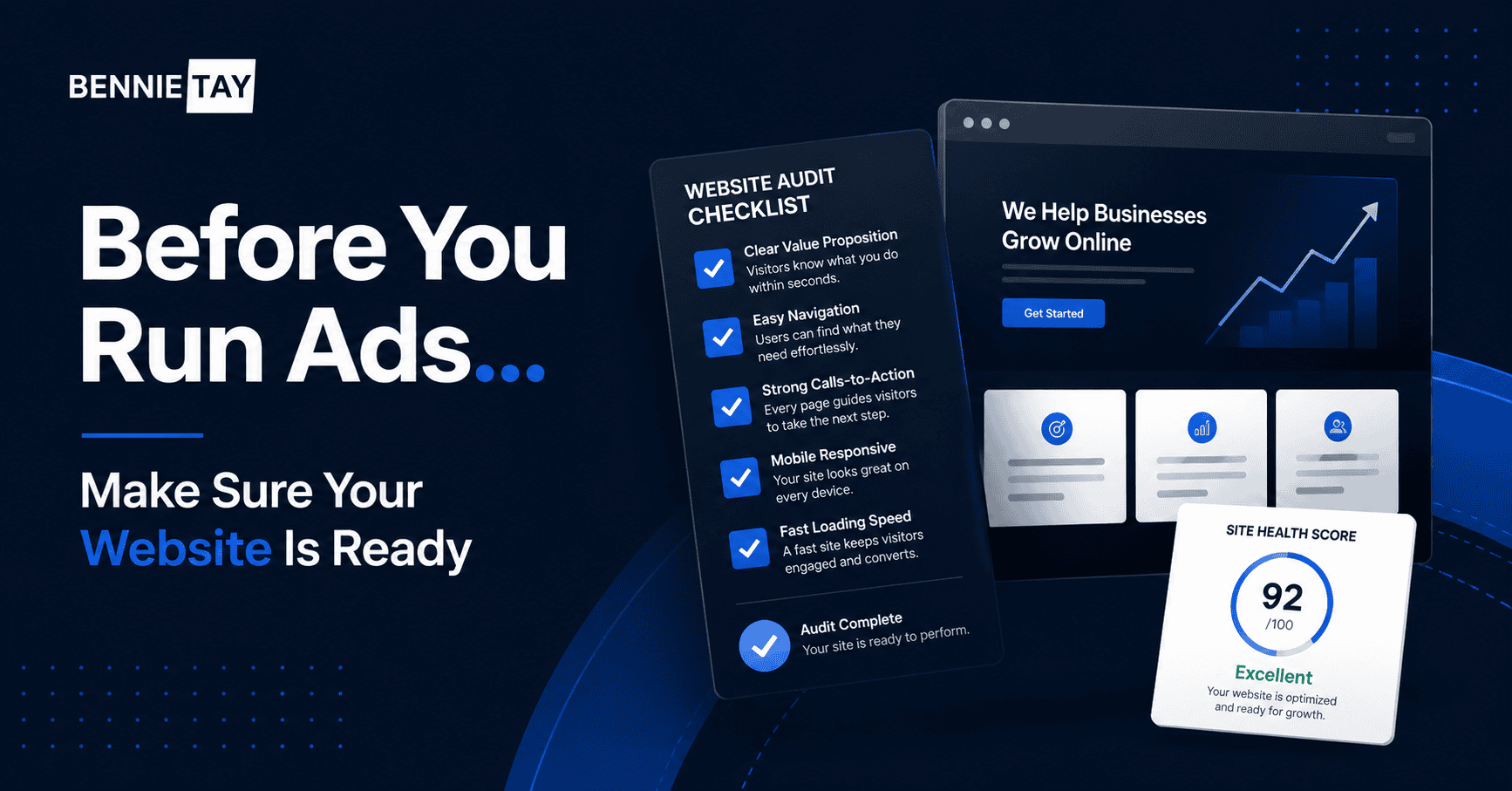
Make Your Service Offer Easy to Understand
Before running ads, review whether your service is explained clearly enough.
A visitor should not need to guess what is included, who the service is for, or why they should choose it. If your service page only has a short paragraph, it may not be enough to convert paid traffic.
Paid visitors are often impatient. They clicked because something caught their attention. Now your page needs to continue the conversation. It should explain the problem, the service, the benefits, the process, and the next step.
For example, if you offer website design, do not only say that you build professional websites. Explain whether the website includes copywriting, mobile design, SEO setup, WhatsApp integration, hosting, maintenance, or revisions. Explain who the service is best for and what outcome the business can expect.
If you offer renovation services, explain the project types, consultation process, quotation process, timeline expectations, and what customers should prepare. If you run a clinic, explain the service, appointment flow, suitability, and common concerns.
A clear offer reduces hesitation. A vague offer makes visitors leave and continue comparing.
Check Whether the Contact Process Is Simple
Your contact process should be easy.
If visitors need to fill in a long form, create an account, search for your contact details, or wait for a slow page to load, many will give up.
A good enquiry process feels simple and natural. If WhatsApp is your main channel, the WhatsApp button should be visible. If you use a form, the form should only ask for necessary information. If you want calls, the phone number should be tap-friendly on mobile.
You should also explain what happens after the enquiry. A short line such as “We usually reply within one business day” or “Send us your website link and we will review it” can reduce uncertainty.
For quote-based businesses, it helps to guide visitors on what information to provide. For example, a website audit form can ask for business type, website link, and main issue. A renovation enquiry form can ask for property type, location, and renovation scope.
The goal is to make enquiry feel easy, not like applying for a government permit in a maze.
Add Pricing Guidance Where Possible
Many small businesses avoid showing pricing because every project is different. That is understandable.
However, if visitors have no pricing guidance at all, some may leave because they do not know whether your service is within their budget.
You do not always need to show exact prices. You can show starting prices, package ranges, example project ranges, or explain what affects the cost. This helps visitors understand whether they are a good fit before enquiring.
For example, a website design business can explain the difference between a basic website, a small business website, and a custom website. A renovation business can explain that cost depends on property size, materials, scope, and design complexity. A consultant can explain package types or consultation starting points.
Pricing guidance can improve lead quality. It helps filter out people who are not ready and gives serious buyers enough confidence to contact you.
Before spending on ads, consider whether your page gives enough price context for visitors to take the next step.
Make Sure Your Website Loads Fast Enough
Website speed matters because visitors are impatient.
If your landing page loads slowly, some visitors will leave before they even see your offer. This is especially painful when you are paying for every click. Nothing says “excellent marketing” like paying for traffic that abandons ship before the page appears.
Your website does not need to be technically perfect, but it should load smoothly on mobile and desktop. Large images, heavy scripts, unnecessary animations, poorly configured hosting, and bloated plugins can slow the website down.
Before running ads, test your website on mobile data, not only on fast office WiFi. If the page feels slow, simplify it. Compress images, reduce unnecessary effects, and keep the landing page focused.
A faster website gives visitors fewer reasons to leave.
Connect Your Analytics and Tracking
Before spending money on ads, make sure you can measure what happens.
At minimum, you should know how many people visit your website, which pages they visit, and whether they take action. If you are running ads, you should also track conversions such as form submissions, WhatsApp clicks, phone clicks, booking actions, or thank-you page visits.
Without tracking, you are guessing. And while guessing is a popular human tradition, it is not a great marketing method.
Tracking helps you understand whether the issue is traffic quality, landing page performance, CTA placement, or enquiry flow. If many people visit but few click the CTA, the page may not be persuasive enough. If many people click the form but do not submit, the form may be too long or confusing. If visitors leave quickly, the page may not match the ad or may load too slowly.
Measurement helps you improve instead of blindly increasing budget.
Prepare the Right Landing Page
Not every ad should go to your homepage.
A homepage is useful for general business introduction, but a dedicated landing page is often better for campaigns. A landing page can focus on one offer, one audience, and one action.
For example, if you are promoting a free website audit, the landing page should focus only on that audit. It should explain who it is for, what problems it helps identify, what the visitor gets, and how to request it.
If you are promoting monthly website plans, the landing page should explain the monthly model, who it suits, what is included, and how to start.
A good landing page removes distractions. It does not try to explain every service your business offers. It keeps the visitor focused on the campaign goal.
Before running ads, decide whether your homepage is enough or whether you need a dedicated landing page.
Review the Whole Journey, Not Just the Page
The website is only one part of the lead journey.
After someone submits a form or sends a WhatsApp message, what happens next? Do they get a quick reply? Is the response clear? Do you have a follow-up process? Do you send a proposal, booking link, audit result, or quotation?
If the website generates enquiries but your follow-up is slow or unclear, leads may still be lost.
Before spending heavily on ads, prepare the full journey. Make sure someone is ready to respond. Prepare message templates. Decide how to qualify leads. Know what information you need from prospects. Create a simple next step after the first conversation.
A strong website can generate leads, but your follow-up turns those leads into customers.
Final Thoughts
Before you spend money on ads, make sure your website is ready to convert.
Paid traffic can bring visitors, but your website must explain your offer, build trust, guide action, and make enquiry easy. If the website is unclear, slow, weak on mobile, lacking trust signals, or missing strong CTAs, ads will only expose the problem faster.
For small businesses, this matters because every ad click costs money. You do not need a perfect website before advertising, but you do need a clear and functional one.
Start by checking your message, CTA, mobile experience, trust signals, service explanation, contact flow, pricing guidance, loading speed, and tracking. Then decide whether you need a dedicated landing page for your campaign.
A good ad sends people to your website. A good website turns more of those people into enquiries.
Before increasing your ad budget, fix the website journey first.
CTA: Request a Free Website Growth Audit and find out whether your website is ready for ads, enquiries, and lead generation.