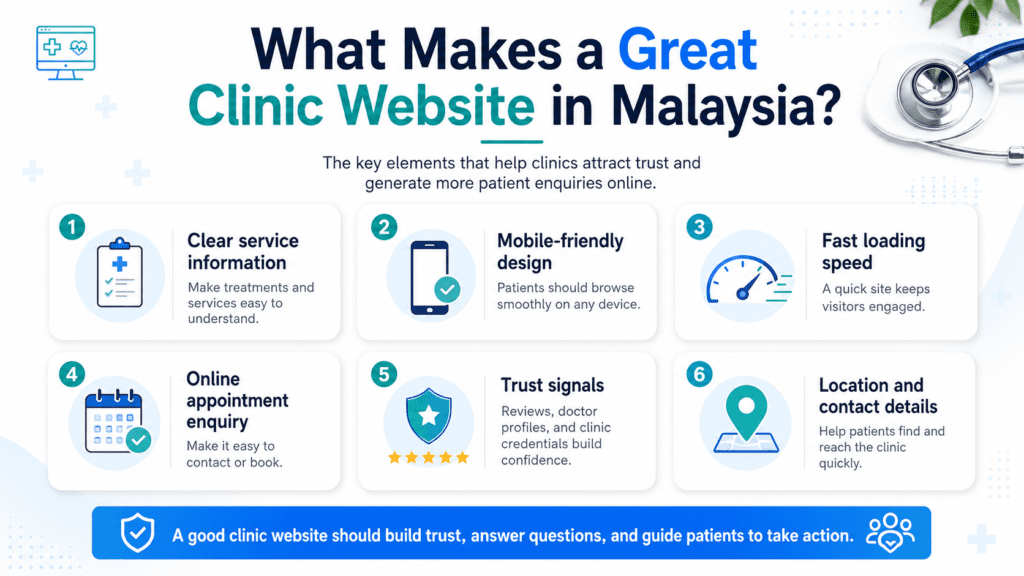
When people need a clinic today, many of them do not immediately walk into the nearest one. They search online first.
They may search for a general practitioner near them, a dental clinic, an aesthetic clinic, a women’s health clinic, a physiotherapy centre, a skin clinic, or a specialist service. Before they make an appointment, they often want to know what services are available, whether the clinic looks trustworthy, where it is located, how to contact the team, and whether other patients have had a good experience.
This is why a clinic website is no longer just a digital brochure. For many healthcare businesses, the website has become an important part of patient trust and enquiry generation.
A well-designed clinic website helps patients understand your services before they contact you. It reduces uncertainty. It makes your clinic look more established. It supports your Google presence. It gives visitors an easy way to book, call, or send a WhatsApp message.
A weak clinic website does the opposite. It may look outdated, feel incomplete, load slowly, or make it difficult for patients to find the information they need. When that happens, visitors may leave and contact another clinic instead.
This article explains what the best clinic websites in Malaysia should include, how clinic website design affects patient enquiries, and how healthcare businesses can build a website that supports trust, local SEO, and appointment bookings.
Why Clinics Need a Professional Website
A clinic website is often one of the first places patients go before they decide whether to contact you. Even if they discover your clinic through Google Maps, Facebook, Instagram, a referral, or a signboard, many people still check the website to confirm whether the clinic looks credible.
This is especially true for services that require trust. Healthcare decisions are personal. Patients want to feel that they are dealing with a professional, reliable, and well-managed clinic. If the website looks outdated or unclear, it can create doubt even before the patient speaks to anyone.
A professional website helps your clinic make a stronger first impression. It gives patients a central place to understand your services, learn about your doctors or practitioners, check your location, read your FAQs, and contact your team. It also helps your clinic appear more serious compared to competitors who only rely on social media or directory listings.
For clinics that want to grow, a website also supports marketing. If you run Google Ads, Facebook Ads, Instagram campaigns, TikTok content, or local SEO efforts, your website becomes the place where interested visitors land. If the website is not designed properly, your marketing traffic may not convert into enquiries.
A clinic website should not only look nice. It should help patients move from interest to action.
What Patients Look for on a Clinic Website
Patients usually visit a clinic website with practical questions in mind. They want to know what the clinic treats, whether the service is suitable for their condition, where the clinic is located, what the opening hours are, how to make an appointment, and whether they can trust the clinic.
They may also want to know who the doctors or practitioners are. For some clinic types, this is very important. A patient choosing a dental clinic, aesthetic clinic, physiotherapy centre, fertility clinic, or specialist medical service may want to understand the practitioner’s background before booking.
Patients also care about convenience. If they are browsing from their phone, they want quick access to WhatsApp, call buttons, map directions, and appointment forms. They do not want to scroll through confusing pages or search for basic contact details.
This means the website should be built around the patient’s decision-making journey. The homepage should quickly explain what the clinic offers. Service pages should provide enough detail without overwhelming readers. Contact options should be easy to find. Trust signals should appear throughout the website, not only on one hidden page.
A good clinic website answers the patient’s questions before they need to ask.
The Biggest Mistake Clinics Make With Website Design
One of the biggest mistakes clinics make is treating the website like a company profile instead of a patient enquiry system.
A typical clinic website may have a homepage, about page, services page, and contact page. On the surface, this seems complete. But when you look closer, the content may be too general. The homepage may simply say that the clinic provides quality healthcare. The services page may list treatment names without explaining what they are for. The contact page may include a form, but there may be no strong reason for patients to use it.
This type of website may technically exist, but it does not help patients make a decision.
A patient does not only need to know that you offer a service. They need to understand whether the service is relevant to them, what they can expect, how to prepare, whether an appointment is needed, and how to contact the clinic easily.
Another common mistake is hiding important information. Opening hours, clinic location, WhatsApp number, doctor information, appointment process, and parking details should not be difficult to find. These details may seem small, but they affect whether a visitor decides to contact you.
A clinic website should be simple, clear, and action-focused. It should not make patients work hard to understand the next step.
The Homepage Should Build Trust Quickly
The homepage is usually the most important page on a clinic website because it creates the first impression.
When a patient lands on the homepage, they should immediately understand what type of clinic you are, who you help, and what action they can take next. The first section should not be vague. Instead of saying something generic like “Your Trusted Healthcare Partner,” the website should explain the clinic’s main value clearly.
For example, a general clinic may focus on accessible family healthcare. A dental clinic may focus on comfortable dental care for families and working adults. An aesthetic clinic may focus on doctor-led skin and aesthetic treatments. A physiotherapy centre may focus on helping patients recover from pain, injury, or movement issues.
The homepage should also make contact easy. A visible “Book Appointment,” “WhatsApp Us,” or “Call Clinic” button should appear near the top of the page, especially on mobile. Many clinic visitors are not browsing for fun. They may already need help. If they are ready to contact you, the website should not slow them down.
A strong homepage usually includes a short introduction, key services, reasons to choose the clinic, doctor or team information, patient testimonials, location details, FAQs, and a final appointment call to action. The page does not need to be complicated. It needs to be clear and reassuring.
Service Pages Should Be Specific
Many clinic websites make the mistake of placing all services on one page with short descriptions. This may be acceptable for a very simple clinic, but it is usually not ideal for SEO or patient understanding.
Specific service pages are more useful because they allow each treatment or service to be explained properly. They also give search engines clearer information about what the clinic offers.
For example, a dental clinic may need separate pages for dental checkups, teeth whitening, braces, dental implants, wisdom tooth removal, and children’s dentistry. An aesthetic clinic may need separate pages for acne treatment, pigmentation treatment, skin consultation, laser treatment, facial contouring, or anti-aging treatments. A general clinic may create pages for health screening, vaccination, minor procedures, women’s health, child healthcare, and chronic disease management.
Each service page should answer the questions patients are likely to ask. What is the service for? Who is it suitable for? What problems does it help with? What should the patient expect during the visit? How can they make an appointment?
This type of content is helpful for patients and better for SEO. Instead of trying to rank one general page for many different searches, your website can have focused pages that match specific patient needs.
For AI search visibility, specific pages also help answer engines understand your clinic’s expertise more clearly.
Local SEO Is Important for Clinics
Clinic website design should include local SEO because most patients search based on location.
A patient is unlikely to search only for “clinic.” They may search for phrases like “clinic near me,” “dental clinic in Shah Alam,” “aesthetic clinic in Kuala Lumpur,” “family clinic in Petaling Jaya,” or “physiotherapy centre in Subang Jaya.” If your website does not include clear location signals, it may be harder for search engines to understand where your clinic serves patients.
Local SEO does not mean stuffing the city name into every sentence. It means naturally including your location in the right places. Your clinic name, address, service area, map embed, contact details, page titles, headings, and service pages should all support local relevance.
A clinic with multiple branches should have separate location pages for each branch. Each location page should include the branch address, opening hours, phone number, WhatsApp link, map directions, nearby landmarks, available services, and appointment CTA.
This is especially helpful for patients who are comparing clinics in a specific area. A clear location page can help them understand whether your clinic is convenient for them.
Local SEO is not only about ranking. It is also about removing friction for patients.
Mobile-Friendly Design Is Critical
A clinic website must work well on mobile because many patients search using their phones.
When someone is looking for a clinic, they may be doing it during a short break, while travelling, or when they need help quickly. If the website loads slowly, the text is too small, the buttons are hard to tap, or the contact information is hidden, they may leave immediately.
Mobile-friendly clinic website design should focus on clarity. The homepage should be easy to scan. Service pages should use readable paragraphs. Buttons should be large enough to tap. WhatsApp and call options should be easy to access. The appointment form should be simple and not too long.
For clinics, mobile experience directly affects enquiries. If a patient can easily read your service information and contact you from their phone, they are more likely to take action.
A beautiful desktop design is not enough. The mobile version must be treated as a priority, not an afterthought.
WhatsApp and Appointment Flow Should Be Simple
In Malaysia, WhatsApp is one of the most important enquiry channels for clinics. Many patients prefer to send a quick message before booking. They may want to ask about availability, pricing range, doctor schedule, service suitability, or appointment slots.
Because of this, your website should make WhatsApp contact simple and natural. A WhatsApp button should appear in key places such as the homepage hero section, service pages, doctor profile pages, and contact section.
The message should also be clear. Instead of using only “Contact Us,” the website can use more specific calls to action such as “Book an Appointment,” “Ask About This Treatment,” “Check Available Slots,” or “Speak to Our Clinic Team.”
The appointment flow should also be simple. If you use a form, do not make it too long. Ask only for the information needed to respond properly. A long form can reduce enquiries because patients may not want to fill in too many fields before speaking to the clinic.
The best enquiry flow is one that feels easy. Patients should feel that contacting the clinic is the natural next step.
Trust Signals Matter in Healthcare Website Design
Trust is one of the most important elements in clinic website design.
Patients want to know that they are choosing a reliable clinic. They want to feel safe. They want to know who will be treating them. They want to understand the clinic’s experience, professionalism, and approach.
Trust signals can include doctor profiles, practitioner qualifications, clinic photos, patient testimonials, reviews, awards, media features, professional memberships, treatment explanations, FAQs, and clear contact details.
Real photos are especially valuable. Stock photos may make a website look clean, but they do not always build strong trust. When possible, clinics should use real photos of the clinic interior, reception area, treatment rooms, doctors, and team members. This helps patients feel more familiar before they visit.
Doctor or practitioner profiles should also be clear. They do not need to be overly long, but they should include relevant qualifications, areas of focus, experience, languages spoken, and consultation approach where appropriate.
A clinic website should reduce uncertainty. The more comfortable patients feel before contacting you, the more likely they are to enquire.
Content Should Be Helpful, Not Overcomplicated
Healthcare content needs to be clear and responsible. A clinic website should explain services in a way that patients can understand without making the content too technical.
Patients do not always know medical terms. If a service page is filled with complex language, visitors may feel confused. On the other hand, if the content is too vague, they may not get enough information to make a decision.
The best approach is to write in simple, helpful language. Explain what the service is, who it is commonly suitable for, what patients can expect, and when they should contact the clinic for advice.
This type of content is useful for both SEO and GEO. Search engines can understand the page topic clearly, and AI answer engines can extract helpful answers from the content. More importantly, real patients can read the page and feel more informed.
Clinic websites should avoid making exaggerated claims. The content should build confidence through clarity, not pressure.
Blog Content Can Help Clinics Attract More Patients
A clinic website should not only have service pages. Blog content can also help attract patients who are searching for information before choosing a clinic.
For example, a dental clinic can publish articles about when to see a dentist, what to expect during teeth whitening, how to care for braces, or common causes of tooth pain. An aesthetic clinic can write about acne scars, pigmentation, skin consultation, and what to know before choosing aesthetic treatments. A general clinic can publish content about health screening, vaccinations, flu symptoms, child health, or chronic disease monitoring.
The purpose of clinic blog content is not to replace medical consultation. It is to educate patients and guide them toward booking an appointment when they need professional advice.
Blog articles can also support SEO by targeting long-tail keywords. Many patients do not immediately search for a clinic name. They search for symptoms, treatment questions, or service comparisons. Helpful blog content allows your clinic to appear earlier in the patient journey.
For GEO, blogs should include direct answers, clear headings, FAQs, and concise explanations. This helps AI tools understand the content and potentially reference your clinic’s expertise.
A Clinic Website Should Support Paid Ads
Many clinics use Facebook Ads, Instagram Ads, or Google Ads to promote services. But paid ads only work well when the landing page supports the campaign.
If someone clicks an ad about a specific service, they should land on a page about that service. Sending all ad traffic to the homepage may reduce conversions because visitors need to search for the relevant information themselves.
For example, if an aesthetic clinic runs an ad for acne scar consultation, the landing page should focus on acne scar treatment or consultation. If a dental clinic runs an ad for teeth whitening, the visitor should land on a teeth whitening page. If a physiotherapy centre runs an ad for back pain treatment, the landing page should speak directly to people experiencing back pain.
A good clinic landing page should explain the service, address common concerns, show trust signals, include clear contact options, and make booking easy.
This is where website design and marketing need to work together. The website should not only exist. It should support the campaigns that bring traffic to it.
What Makes a Clinic Website SEO-Friendly?
An SEO-friendly clinic website has clear structure, useful content, and technical foundations that help search engines understand the website.
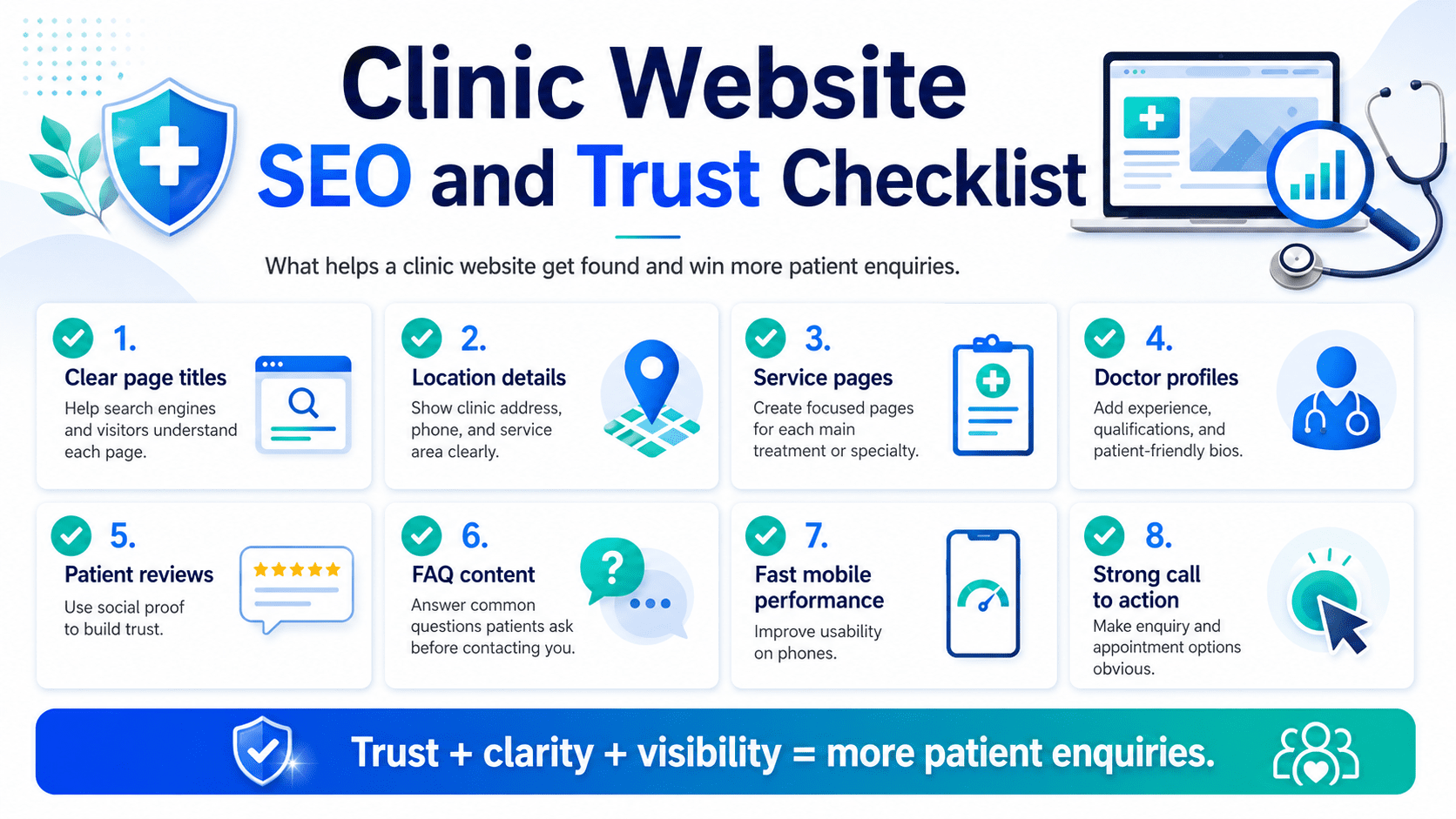
The website should have properly written page titles and meta descriptions. Each page should focus on a clear topic. The headings should be organized logically. The URLs should be clean. Images should be optimized. The website should load quickly and work well on mobile.
The content should also match what patients are searching for. A general service page may not be enough. Clinics should consider creating focused pages for main services, conditions, treatments, locations, and FAQs.
Internal linking is also important. Related blog articles should link to service pages. Service pages should link to appointment sections. Location pages should link to relevant services. This helps both visitors and search engines move through the website.
SEO is not about adding keywords randomly. It is about building a website that is useful, organized, and easy to understand.
What Makes a Clinic Website GEO-Friendly?
A GEO-friendly clinic website is written and structured in a way that generative AI search engines can understand and summarize.
AI search tools often look for clear explanations, direct answers, topic authority, structured sections, and useful FAQs. If your website content is vague or too thin, it is less likely to be useful for AI-generated answers.
To make a clinic website more GEO-friendly, the content should answer specific questions directly. For example, instead of only saying “We provide dental services,” a dental clinic page should explain what the service is, who it is for, what patients can expect, and how they can book.
The website should also include clear entity information. This means the clinic name, location, services, practitioner information, contact methods, and areas served should be easy to identify.
FAQs are especially useful for GEO because they provide direct question-and-answer content. AI tools can easily understand and summarize them.
A GEO-friendly website is not written only for algorithms. It is written clearly enough that both humans and AI systems can understand the expertise, service relevance, and next steps.
Recommended Pages for a Clinic Website
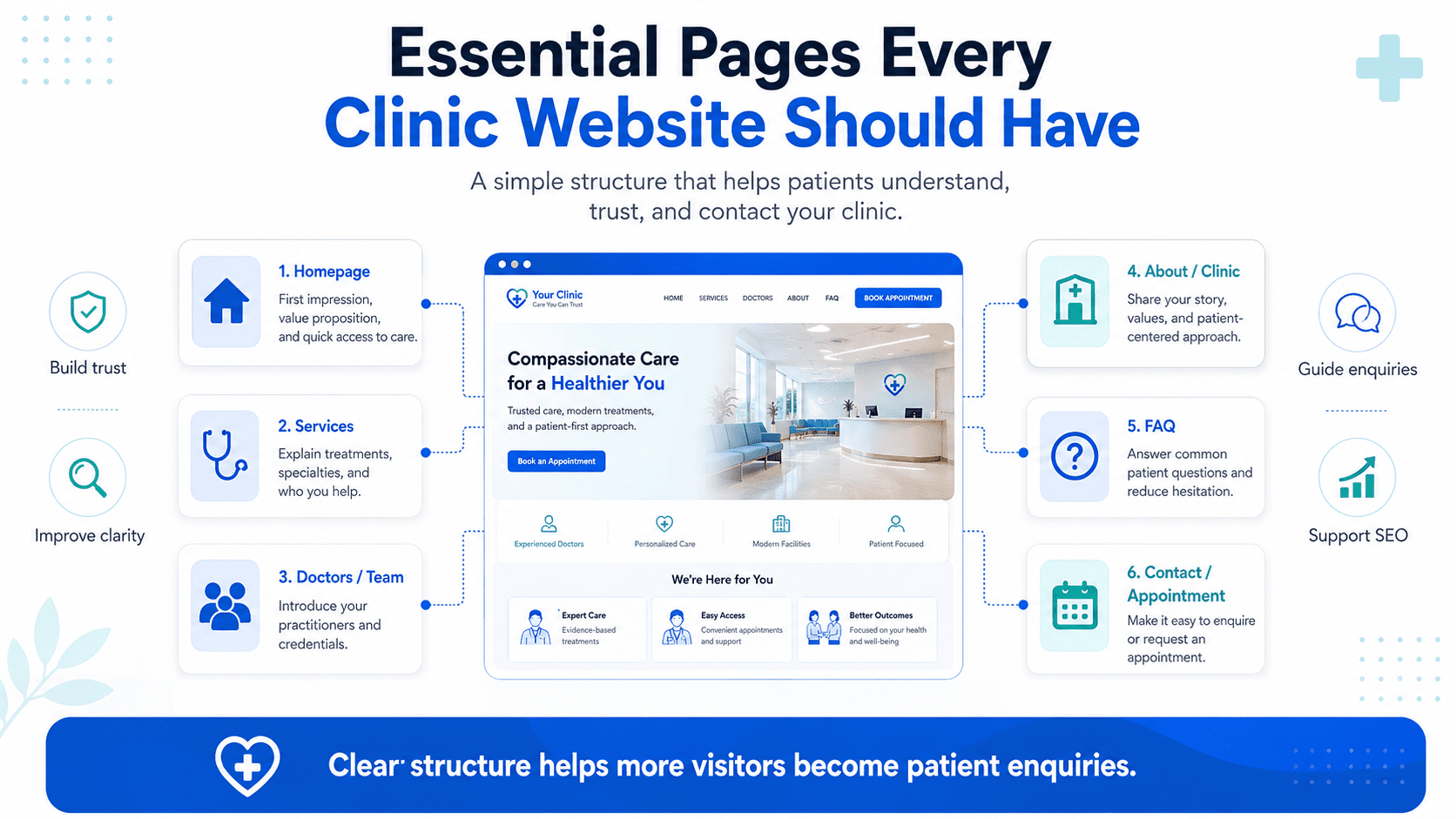
A clinic website should usually include a homepage, about page, doctor or team page, services page, individual service pages, location page, contact page, FAQ page, and blog section.
The homepage should introduce the clinic and guide visitors to the most important services. The about page should explain the clinic’s background and approach. The doctor or team page should build trust by showing who patients will meet. The service pages should explain treatments clearly. The location page should help local patients find and contact the clinic. The FAQ page should answer common concerns. The blog should support education and SEO.
For clinics with multiple services or locations, the website structure becomes even more important. A well-organized website helps patients find the right information without feeling overwhelmed.
The goal is not to create many pages for the sake of it. The goal is to create pages that match patient needs and search intent.
Website Design for Different Types of Clinics
Different types of clinics need different website strategies.
A general medical clinic may need to focus on convenience, location, opening hours, family healthcare, common treatments, vaccination, health screening, and easy contact. The website should help patients quickly understand when they can visit and how to make an appointment.
A dental clinic website should focus on trust, comfort, treatment explanation, before-and-after examples where appropriate, doctor profiles, and patient education. Dental patients may feel nervous, so the website should make the experience feel clear and reassuring.
An aesthetic clinic website needs strong visual trust and careful content. Patients want to understand the treatment options, practitioner experience, safety approach, and expected consultation process. The website should feel premium but still clear and responsible.
A physiotherapy clinic website should focus on pain points, recovery goals, treatment approach, conditions treated, practitioner experience, and appointment booking. Visitors may be searching because they are already experiencing discomfort, so the content should be easy to understand.
A specialist clinic website may need deeper explanation, stronger practitioner profiles, and more educational content. Patients may compare options carefully before booking, so trust-building content becomes even more important.
The best clinic website is not one-size-fits-all. It should match the type of clinic and the decision-making process of its patients.
How a Clinic Website Turns Visitors Into Enquiries
A clinic website turns visitors into enquiries by reducing doubt and making action easy.
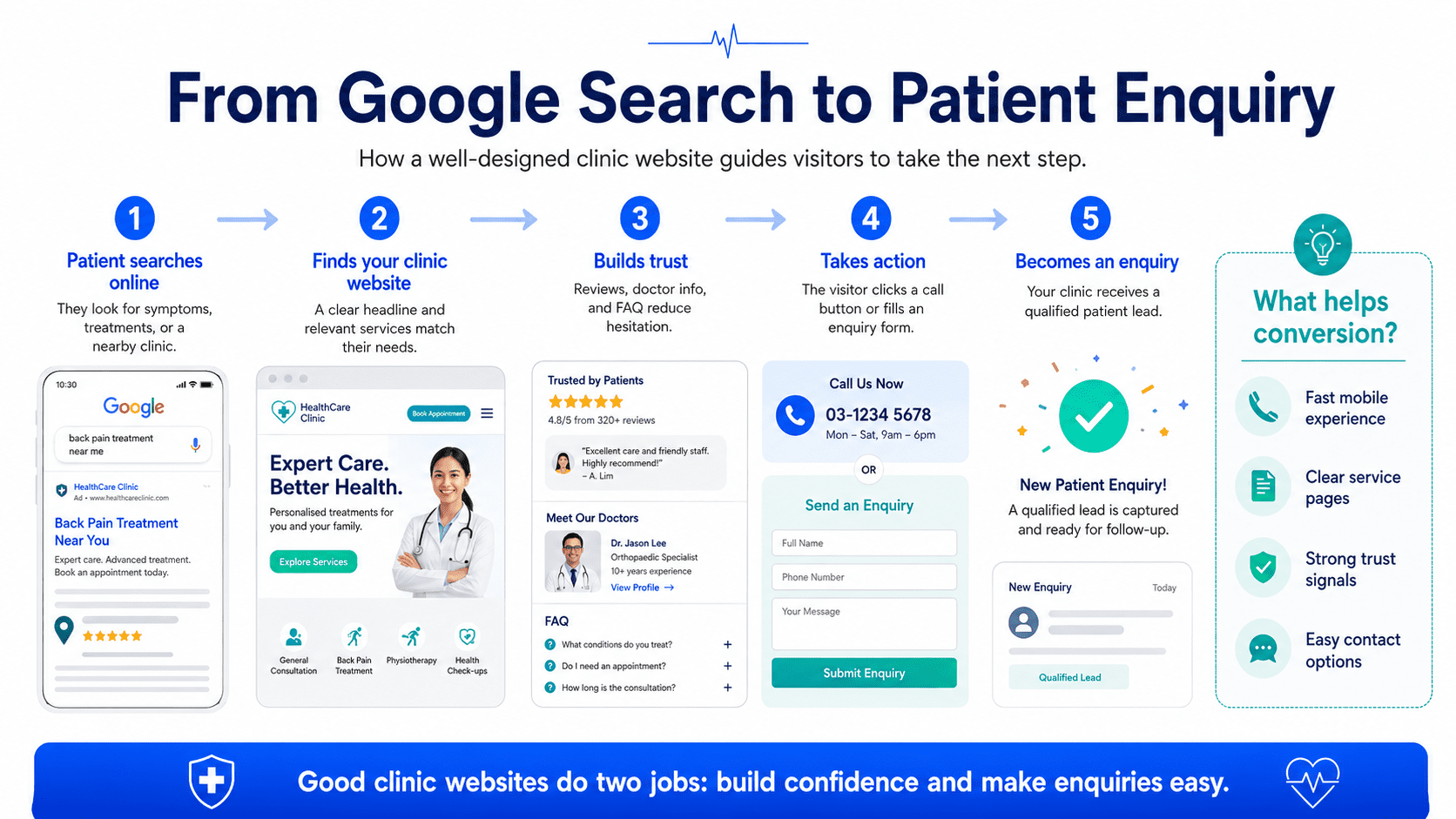
First, the website needs to attract the right visitors through SEO, local search, social media, ads, or referrals. Then, it needs to give those visitors enough information to understand the clinic’s services. After that, it needs to build trust through design, content, photos, profiles, reviews, and clear communication. Finally, it needs to provide a simple next step.
If any part of this journey is weak, enquiries may drop. A clinic may get traffic but few bookings because the service pages are unclear. Another clinic may have good content but poor mobile design. Another may have strong visuals but no clear appointment button.
Good website design connects all these parts. It does not rely on one element alone. It combines structure, copywriting, SEO, trust signals, mobile design, and conversion flow.
That is why a clinic website should be treated as a patient enquiry system, not just a design project.
Final Thoughts
The best website design for clinics in Malaysia is not only about having a modern look. It is about building a website that helps patients understand your services, trust your clinic, and contact you easily.
A strong clinic website should be clear, professional, mobile-friendly, locally optimized, and built around patient needs. It should include useful service pages, visible contact options, trust signals, doctor or team information, FAQs, and helpful content that supports both SEO and AI search visibility.
For clinics, the website plays an important role in the patient journey. It can influence whether someone books an appointment or chooses another provider.
If your clinic website is outdated, unclear, difficult to use, or not generating enquiries, it may not be doing its job. A better website can help your clinic look more credible, attract more local patients, and turn more visitors into appointment requests.
Need a Clinic Website That Generates More Patient Enquiries?
At Bennie Tay, we help clinics and service businesses build professional, conversion-focused websites designed to attract visitors, build trust, and turn more traffic into enquiries.
Whether you need a clinic website, landing page, local SEO page, or website redesign, the goal is simple: create a website that helps patients understand your services and contact you with confidence.
Request a Free Website Growth Audit to find out how your clinic website can be improved for SEO, local visibility, and patient enquiries.
FAQ
What should a clinic website include?
A clinic website should include a clear homepage, service pages, doctor or practitioner profiles, clinic photos, contact details, opening hours, location map, WhatsApp or appointment buttons, patient FAQs, and trust signals such as testimonials or reviews.
Why is website design important for clinics?
Website design is important for clinics because patients often check the website before deciding whether to contact the clinic. A professional website builds trust, explains services clearly, and makes it easier for patients to book an appointment.
How can a clinic website get more patient enquiries?
A clinic website can get more enquiries by using clear service pages, strong calls to action, mobile-friendly design, local SEO, WhatsApp buttons, appointment forms, trust signals, and helpful content that answers patient questions.
Is SEO important for clinic websites?
Yes. SEO helps clinic websites appear when patients search for services online. Local SEO is especially important because many patients search for clinics near their area.
What is local SEO for clinics?
Local SEO for clinics means optimizing the website so search engines understand the clinic’s location, services, contact details, and service area. This can help the clinic appear for searches related to specific treatments and locations.
Should a clinic website have WhatsApp integration?
Yes. In Malaysia, many patients prefer to contact clinics through WhatsApp. A visible WhatsApp button can make it easier for visitors to ask questions or book appointments.
What makes a clinic website GEO-friendly?
A GEO-friendly clinic website includes clear explanations, direct answers, structured service pages, FAQs, location information, practitioner details, and helpful content that AI search engines can understand and summarize.
How many pages should a clinic website have?
A simple clinic website may start with five to seven pages, but a stronger website should include individual service pages, location pages, doctor profiles, FAQs, and blog content to support SEO and patient education.
Can a clinic website help with Google Ads or Facebook Ads?
Yes. A clinic website can support ads by giving visitors a focused landing page that explains the promoted service and makes booking easy. This can improve enquiry rates from paid traffic.
How often should clinics update their website?
Clinics should update their website whenever services, opening hours, doctor schedules, contact details, pricing guidance, or promotions change. Publishing helpful blog content regularly can also support SEO and patient