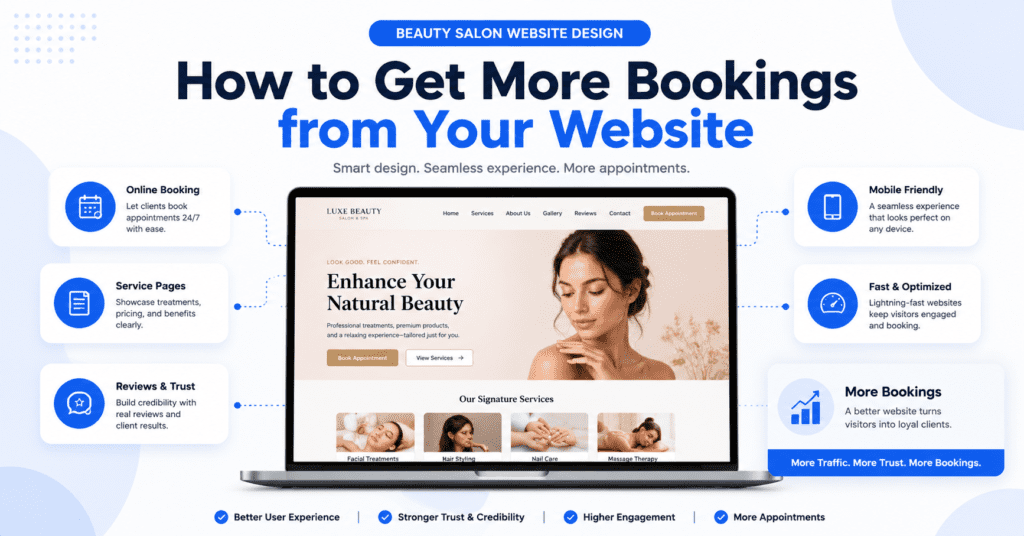
A beauty salon website should do more than look pretty.
For many salon owners, the website becomes one of the first places potential customers visit before making a booking. They may discover your salon through Google, Instagram, Facebook, TikTok, Rednote, word of mouth, or WhatsApp. But before they decide to book, they often want to see what services you offer, where you are located, whether your salon looks trustworthy, what your customers say, and how easy it is to make an appointment.
This is why beauty salon website design needs to be both attractive and practical.
A nice-looking website can help create a good first impression, but design alone will not bring bookings if the website is unclear, slow, hard to use on mobile, or missing important information. Your website should help customers understand your treatments, feel confident about your salon, and take action without confusion.
Many beauty businesses rely heavily on social media. That is useful, but social media alone is not enough. Posts can disappear quickly, information can be scattered, and new customers may find it difficult to understand your full range of services.
A website gives your salon a more organised and professional online presence. It allows you to present your services, results, promotions, reviews, location, and booking options in one place.
For beauty salons, spas, wellness studios, nail salons, hair salons, facial centres, lash studios, brow studios, and aesthetic-related service businesses, a well-designed website can support trust and bring more enquiries.
The goal is simple. Your website should help people find your salon, trust your service, and book an appointment.
Why Beauty Salons Need a Professional Website
Beauty is a trust-based business.
Customers are not only choosing based on price. They want to know whether your salon is clean, professional, experienced, and suitable for their needs. They want to see your work, read customer feedback, understand your services, and feel confident before making a booking.
Social media can help with visibility, but a website gives your brand more authority.
When a potential customer searches your salon name or compares you with another salon nearby, a professional website can make your business look more established. It shows that your salon is serious, organised, and easy to contact.
A website also gives you more control over the customer journey. On social media, customers may get distracted by other posts, messages, ads, or competitor content. On your website, you can guide them through your services, proof, pricing guidance, FAQs, and booking options in a more focused way.
For local salons, a website can also help with Google search. People often search for services such as facial treatment near me, nail salon in Petaling Jaya, hair salon Kuala Lumpur, beauty salon Rawang, spa in Subang, or lash extension Selangor. A properly structured website gives your salon a better chance of being found by people who are already looking for your service.
That is the real value of a beauty salon website. It does not only make your business look better. It helps turn online attention into real bookings.
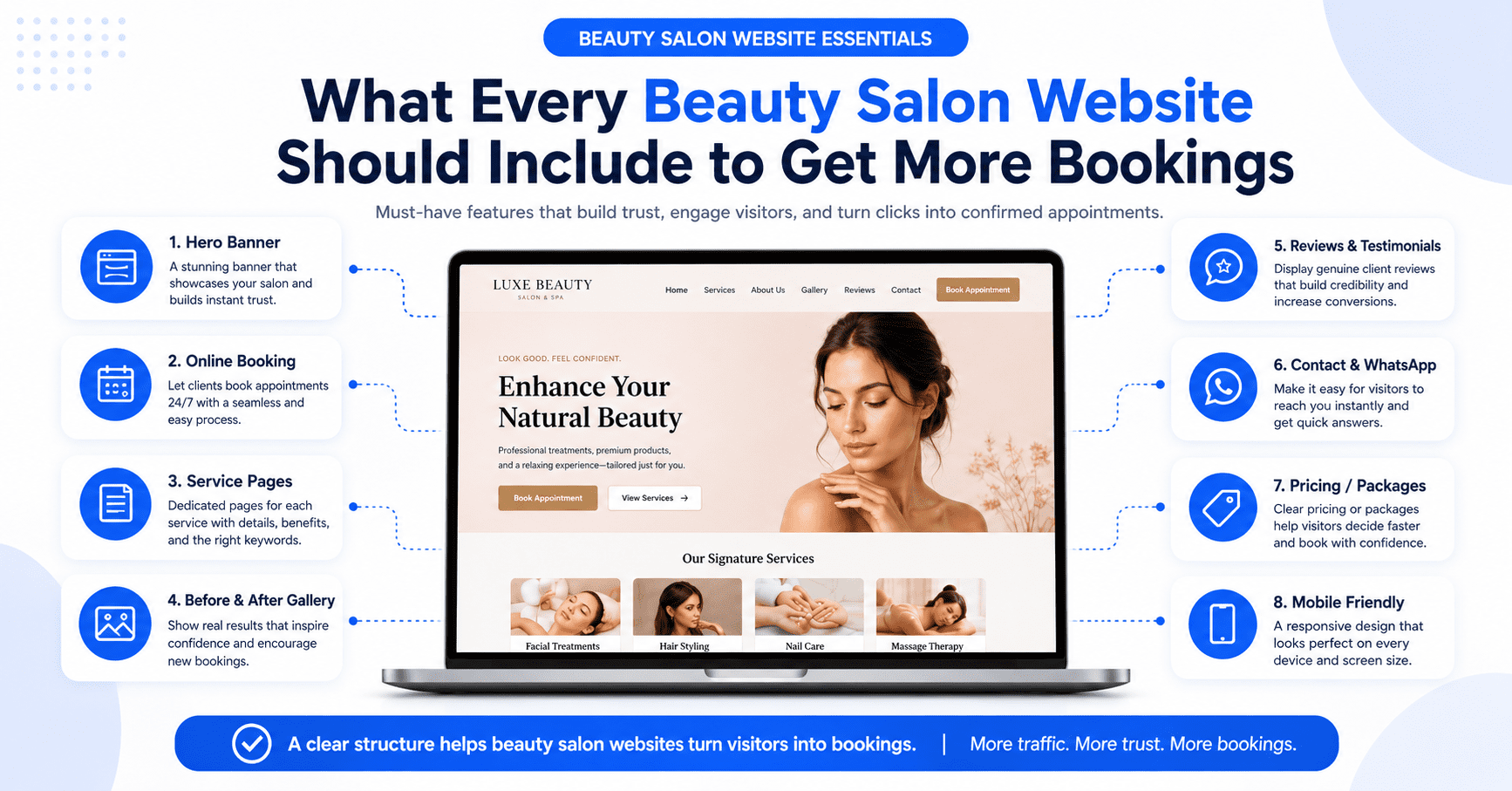
Your Homepage Should Make the Offer Clear
The homepage is usually the most important page on your salon website.
When visitors land on it, they should quickly understand what your salon offers, where you are located, who you serve, and how to book. They should not need to scroll too far or guess what your business is about.
Many salon websites use general phrases such as “Relax, refresh, and renew” or “Your beauty, our passion.” These lines may sound pleasant, but they do not always explain enough.
A clearer homepage message would be more specific. For example, a facial salon may say that it provides personalised facial treatments for women in Petaling Jaya. A nail salon may highlight gel manicure, nail art, and bridal nails. A beauty studio may focus on lash, brow, and skin treatments in Kuala Lumpur.
Clear does not mean boring. It means the visitor immediately understands whether your salon is relevant to them.
The first section of your homepage should include your main service category, your location, and a strong booking call-to-action. For example, “Book a Facial Appointment,” “WhatsApp Us for Available Slots,” or “View Our Treatment Menu.”
Your homepage should also show your most important services, customer reviews, salon photos, results if suitable, and reasons customers choose you. It should feel warm, professional, and easy to navigate.
A beauty salon website should create desire, but it should also remove uncertainty.
Service Pages Should Explain More Than the Treatment Name
Many salon websites list services without enough explanation.
For example, they may show a menu with facial, manicure, pedicure, waxing, hair treatment, massage, lash extension, or brow shaping, but provide very little detail about what each service includes.
This can make it harder for new customers to decide.
A good service page should explain the treatment in simple language. It should help customers understand who the service is suitable for, what they can expect, how long it usually takes, and how to book.
This does not mean you need to write too much or use complicated terms. The content should be clear and easy to scan.
For example, a facial treatment page can explain the type of skin concern it is designed for, the general process, estimated session duration, aftercare reminders, and how to make an appointment. A nail service page can explain the difference between classic manicure, gel manicure, extensions, and nail art. A lash page can explain available styles, appointment duration, maintenance, and touch-up timing.
Detailed service pages also help with SEO. If all your services are only listed on one short page, Google may not understand each service clearly. Dedicated pages give your website more chances to rank for specific searches.
A beauty salon in Malaysia may benefit from separate pages for its main services, especially if those services are popular, profitable, or frequently searched.
Photos and Visual Proof Matter
Beauty customers want to see results.
A salon website without strong visuals may struggle to build confidence. People want to know what your salon looks like, what kind of work you do, and whether your style matches what they want.
Real photos are usually better than relying only on stock images. Stock photos can make a website look polished, but they may not show your actual quality, environment, or customer experience.
Your website should include real photos where possible. This may include your salon interior, treatment rooms, service areas, tools, team, product displays, and completed work.
For services such as hair, nails, lashes, brows, makeup, facial, or body treatments, before-and-after or result photos can be powerful when used responsibly and honestly. They should be realistic, clear, and presented in a way that does not overpromise.
Visual proof helps visitors imagine the experience before they book.
If your salon has a strong Instagram or Rednote presence, the website can also feature selected gallery images or link visitors to your social profile. However, the website should still contain enough visual proof on its own.
A potential customer should not need to leave your website just to feel confident about your work.
Reviews and Testimonials Build Trust
Customer reviews are one of the strongest trust signals for beauty businesses.
When someone is considering a new salon, they often want to know what other customers experienced. Was the service good? Was the salon clean? Was the staff friendly? Did the result look nice? Was the booking process easy?
Your website should include real testimonials or review highlights. These can come from Google reviews, Facebook reviews, screenshots with permission, or written feedback from customers.
Good testimonials do not need to sound perfect. In fact, natural customer language often feels more believable. A simple review that says the staff was patient, the treatment was comfortable, or the result lasted well can be more persuasive than a generic statement.
Reviews should appear on important pages, not only hidden on one testimonial page. For example, your homepage can include a few strong reviews. Your service pages can show reviews related to that specific treatment.
If your salon has many Google reviews, mention this clearly and link visitors to your Google Business Profile where appropriate.
Trust is especially important for first-time customers. A beautiful design may attract attention, but reviews help reduce hesitation.
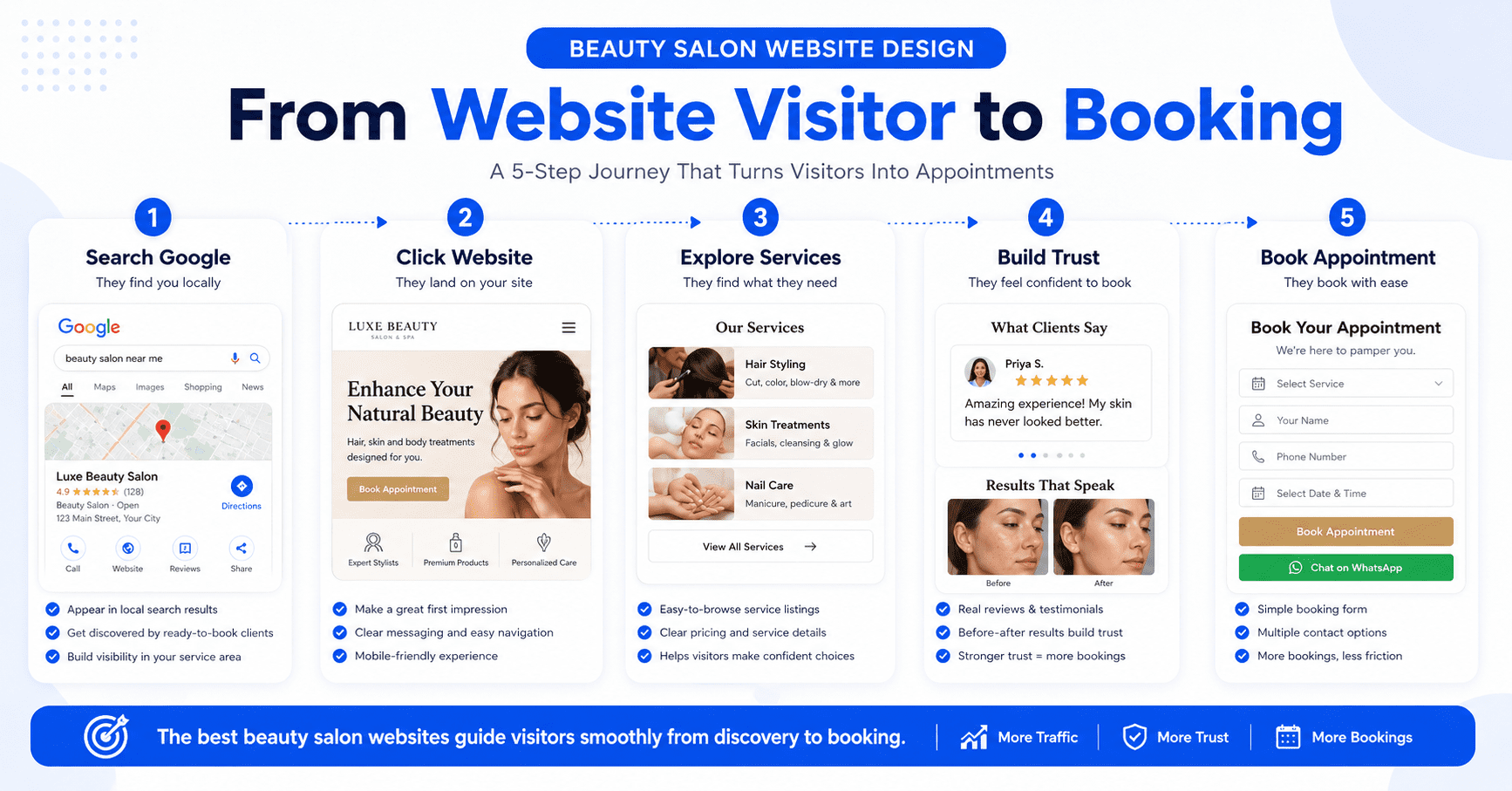
Booking Should Be Simple and Visible
A beauty salon website should make booking easy.
Many potential customers are ready to take action after viewing your services or photos, but they may give up if the next step is unclear.
Your booking option should be visible throughout the website. It can be a WhatsApp button, online booking form, phone call button, or booking system. The best option depends on how your salon manages appointments.
In Malaysia, WhatsApp is often one of the easiest booking channels because customers are comfortable using it. A clear WhatsApp button can help visitors ask about available slots, treatment details, pricing, and promotions.
The wording of your call-to-action matters. Instead of a generic “Contact Us,” use clearer phrases such as “WhatsApp Us to Book,” “Ask for Available Appointment Slots,” “Book Your Salon Visit,” or “Reserve Your Treatment Time.”
A simple booking form can also work well. It should ask only for the important details, such as name, phone number, preferred service, preferred date, and message. Long forms may discourage customers from completing the enquiry.
If your salon uses an online booking system, make sure it is mobile-friendly and easy to complete. A complicated booking process can reduce conversions.
The goal is to make booking feel natural and effortless.
Mobile Design Is Critical for Beauty Salon Websites
Most people will visit your salon website from their phone.
They may click from Instagram, TikTok, Google Maps, WhatsApp, Facebook, Rednote, or search results. This means your mobile website experience may matter more than your desktop design.
A mobile-friendly salon website should load quickly, display photos nicely, and make booking buttons easy to tap. The text should be readable, the menu should be simple, and the page should not feel crowded.
Beauty websites often use many images, but large unoptimised images can slow the website down. This can frustrate visitors and make them leave. The website should look visual without becoming heavy.
The most important information should be easy to access on mobile. This includes your services, location, opening hours, pricing guidance if available, reviews, and booking button.
For a salon, mobile design should feel smooth and pleasant. The browsing experience should match the quality of your brand.
If your website is difficult to use on a phone, you may be losing bookings without realising it.
Local SEO Can Help Nearby Customers Find You
Beauty salons usually serve customers within a specific area.
This makes local SEO important.
People often search for beauty services based on location. They may search for terms such as beauty salon near me, facial salon in Kuala Lumpur, nail salon Petaling Jaya, hair treatment Subang, lash extension Selangor, or spa Rawang.
Your website should clearly show where your salon is located and which areas you serve. Your address, phone number, opening hours, map, and business name should be accurate and consistent with your Google Business Profile.
Location should be included naturally in your website content. For example, your homepage can mention that your salon is located in a specific city or neighbourhood. Your contact page can include directions, parking information, nearby landmarks, or shopping mall details if relevant.
If your salon has multiple branches, each location should have its own page with unique information. This helps customers find the right branch and helps search engines understand your locations.
Local SEO also works better when your website has service-specific pages. For example, a page about facial treatments in Petaling Jaya is more focused than a general salon page with all services listed together.
The goal is not to stuff keywords. The goal is to make your website useful and location-relevant.
Pricing Guidance Can Improve Enquiries
Many salon owners are unsure whether they should display pricing on their website.
There is no single answer. Some salons prefer to show full prices, while others prefer to provide pricing after consultation because treatment needs may vary.
However, giving some pricing guidance can help customers feel more confident.
If you hide all pricing, some potential customers may hesitate because they are worried about cost. They may leave and look for another salon that provides clearer information.
You do not always need to show every exact price. You can show starting prices, package ranges, consultation-based pricing, or explain that pricing depends on treatment type and condition.
For example, you may write that facial treatments start from a certain range, or that customised packages are available after skin consultation. A nail salon may show a menu for basic manicure, gel manicure, pedicure, and nail art add-ons.
Clear pricing guidance can also improve lead quality. Customers who enquire already have a better idea of what to expect, which can save time for your team.
Transparency helps build trust, especially for first-time customers.
Promotions Should Not Overpower the Brand
Promotions can help generate bookings, but they should be used carefully on your website.
Some salon websites focus too heavily on discounts. Every section shows a promotion, flash sale, package deal, or limited-time offer. This may create short-term enquiries, but it can also make the brand feel less premium.
Your website should balance promotion with trust.
Instead of only saying “50% off,” explain the value of the treatment, who it is suitable for, and why customers should choose your salon. Promotions should support the booking decision, not replace proper service explanation.
If you run seasonal campaigns, create dedicated landing pages. For example, you may have a page for bridal beauty packages, festive facial promotions, new customer trial packages, or special spa packages.
A dedicated landing page can focus on one offer and one action. This is useful if you are running ads from Facebook, Instagram, TikTok, or Google.
Your homepage should remain clear and professional, while campaign pages can be more focused on specific promotions.
Your Website Should Match Your Salon Brand
Beauty salon website design should reflect the feeling of your brand.
A luxury spa should not look the same as a trendy nail studio. A family-friendly hair salon should not look the same as a premium aesthetic studio. A facial centre focused on calm and care should not look the same as a bold makeup studio.
Your website colours, fonts, images, spacing, and writing style should match the experience customers can expect from your salon.
A premium salon may use a clean, elegant, minimal design with soft colours and refined visuals. A youthful beauty studio may use more vibrant colours, bold images, and trend-driven content. A wellness spa may use calming visuals, warm tones, and slower-paced copy.
Brand consistency helps customers feel that your salon is professional and intentional.
However, beauty website design should not become too decorative at the expense of usability. The website still needs to be easy to read, easy to navigate, and easy to book.
Good design supports the customer journey. It should not distract from it.
Content Should Answer Customer Questions
Customers often have questions before booking a beauty treatment.
They may want to know how long the treatment takes, whether booking is required, what they should prepare, whether there is downtime, how long results may last, what aftercare is needed, or whether the treatment is suitable for them.
Your website should answer common questions clearly.
This can be done through service page content, FAQ sections, blog posts, or booking instructions. The more helpful your website is, the more confident customers may feel before contacting you.
For example, a lash studio may explain how long lash extensions usually last and when touch-ups are recommended. A nail salon may explain the difference between gel polish and extensions. A facial salon may explain how to choose a suitable treatment and why consultation may be needed.
Helpful content also supports SEO because people often search for answers before choosing a salon.
The goal is not to replace a consultation. The goal is to educate customers enough so they feel comfortable taking the next step.
Blog Content Can Support Beauty Salon SEO
A salon blog can help attract customers when the topics are chosen properly.
The best blog topics answer real customer questions. For example, a facial salon can write about how to choose a facial treatment, what to do before a facial, how often to go for facial treatment, or common skincare mistakes. A nail salon can write about gel manicure care, nail art trends, or how to make manicure last longer. A hair salon can write about hair treatment options, scalp care, colouring maintenance, or wedding hair preparation.
These articles can help your website rank for more search terms. They also build trust because they show your salon understands customer concerns.
Blog content should link naturally to your service pages. For example, an article about facial preparation can link to your facial treatment page. An article about bridal beauty planning can link to your bridal package page.
This helps visitors move from learning to booking.
For SEO, consistency matters. A website that publishes helpful beauty content regularly can become more visible over time.
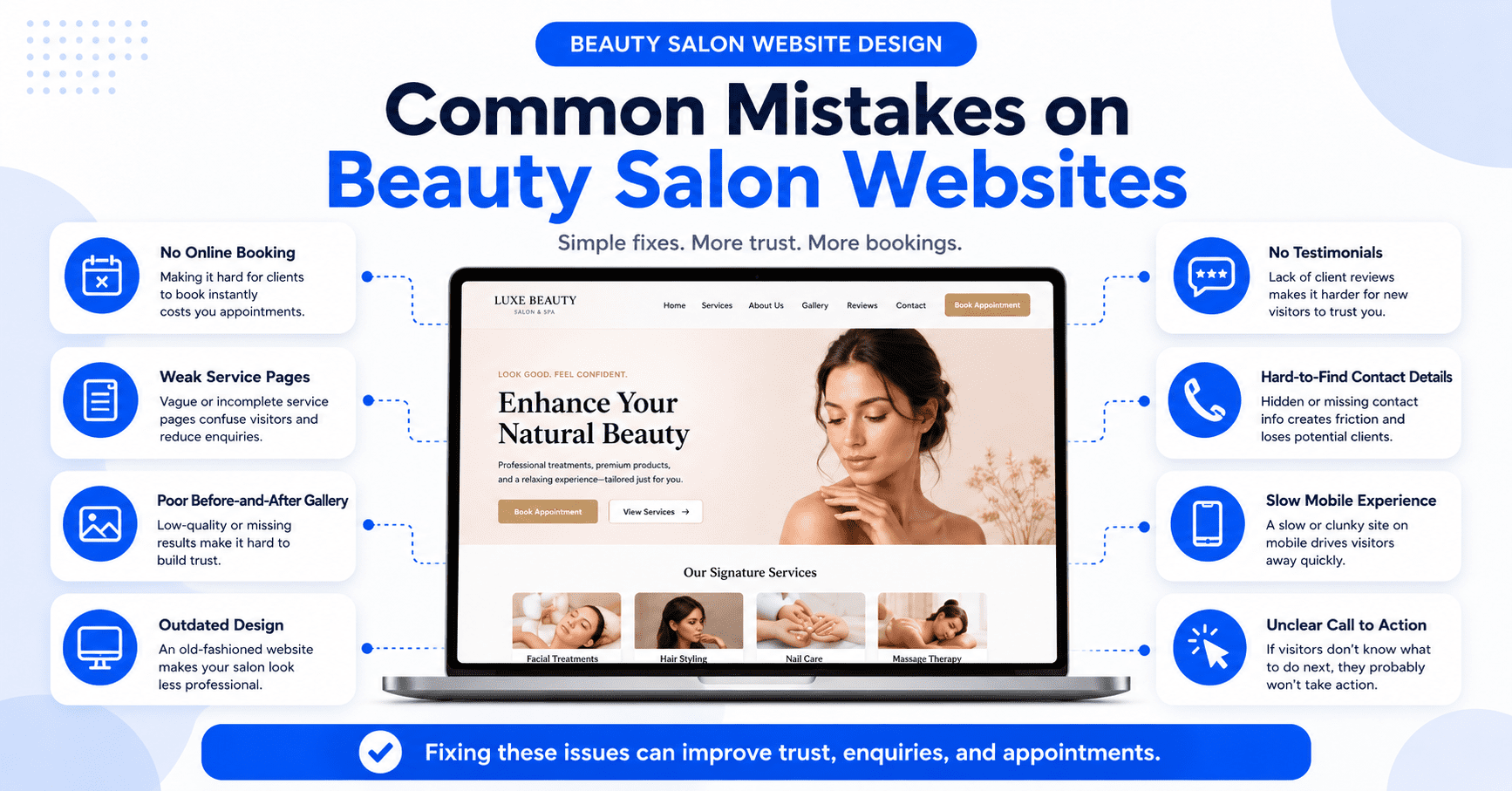
Common Mistakes in Beauty Salon Website Design
One common mistake is relying only on visuals and ignoring the message. A salon website may look beautiful, but if visitors cannot understand the services, pricing, location, or booking process, it will not convert well.
Another mistake is using too many stock images. Stock photos may look polished, but they can feel generic. Real salon photos and actual work examples usually build stronger trust.
Some salon websites also hide the booking button. Customers should not need to search for how to contact you. The booking CTA should be visible and repeated naturally.
Another mistake is not optimising for mobile. A beauty website may look impressive on desktop, but if it loads slowly or feels messy on a phone, most visitors may leave.
Many salons also do not create separate service pages. This makes the website weaker for SEO and less helpful for customers who want specific treatment information.
Another issue is outdated information. Old promotions, wrong opening hours, outdated prices, broken links, or inactive forms can make the salon look careless.
A beauty salon website should be reviewed regularly to keep information accurate and useful.
How a Website Supports Beauty Salon Marketing
Your website can support all your other marketing channels.
When you post on Instagram, TikTok, Facebook, Rednote, or Pinterest, interested people can visit your website to learn more. When someone finds you on Google, your website helps turn that search into a booking. When a customer refers a friend, your website gives the new person a place to check your services and trust signals.
Your website can also support paid advertising. Instead of sending ad traffic to your homepage, you can create landing pages for specific offers such as facial trial packages, bridal beauty packages, lash extensions, hair treatment, or nail promotions.
A landing page is more focused than a normal page. It is built around one campaign and one action, which can improve enquiry quality.
Your website also helps collect leads. Even if someone does not book immediately, they may submit an enquiry, ask on WhatsApp, download a guide, or join your promotion list.
A good salon website connects your marketing together. It becomes the place where attention turns into action.
Final Thoughts: A Beauty Salon Website Should Turn Interest Into Bookings
A beauty salon website should be attractive, but it should also be clear, practical, and conversion-focused.
Customers should quickly understand what you offer, where your salon is located, why they should trust you, and how to book. Your website should show your services clearly, display real proof, work well on mobile, support local SEO, and make the appointment process simple.
For beauty businesses in Malaysia, this is especially important because customers often compare salons before deciding. They may check your website, social media, reviews, photos, and location before making contact.
If your website is unclear or outdated, you may lose customers before they ever message you.
A strong website helps your salon look more professional and makes it easier for customers to take the next step.
It should not just sit online. It should help your beauty business get found, trusted, and booked.
Need a Website That Helps Your Salon Get More Bookings?
If your salon depends on bookings, enquiries, and customer trust, your website should be built with those goals in mind.
At Bennie Tay, we help beauty salons and service businesses build conversion-focused websites designed to improve trust, support local SEO, and make bookings easier.
Whether you need a new salon website, a redesign, service pages, booking landing pages, or a monthly website plan, the goal is simple:
Build a website that helps customers discover your salon, trust your service, and book with confidence.
FAQ: Beauty Salon Website Design
What should a beauty salon website include?
A beauty salon website should include a clear homepage, service pages, real photos, customer reviews, location details, opening hours, WhatsApp or booking CTA, mobile-friendly design, basic SEO setup, and simple contact options.
Why does a beauty salon need a website?
A website helps a beauty salon build trust, organise service information, support Google search visibility, and make it easier for customers to book appointments. It also gives the salon a more professional online presence beyond social media.
Is WhatsApp useful for salon bookings?
Yes, WhatsApp is useful for many salons in Malaysia because customers often prefer quick and direct communication. A visible WhatsApp button can make it easier for customers to ask questions and book appointments.
Should a salon show prices on its website?
A salon can show full prices, starting prices, package ranges, or consultation-based pricing. Some pricing guidance can help customers feel more confident and improve enquiry quality.
How can a beauty salon website rank on Google?
A salon website can improve Google visibility through local SEO, clear service pages, location information, Google Business Profile alignment, helpful blog content, fast loading speed, and mobile-friendly design.
Is a monthly website plan suitable for beauty salons?
Yes, a monthly website plan can be suitable for salons that want a professional website with lower upfront cost, ongoing support, maintenance, and updates.