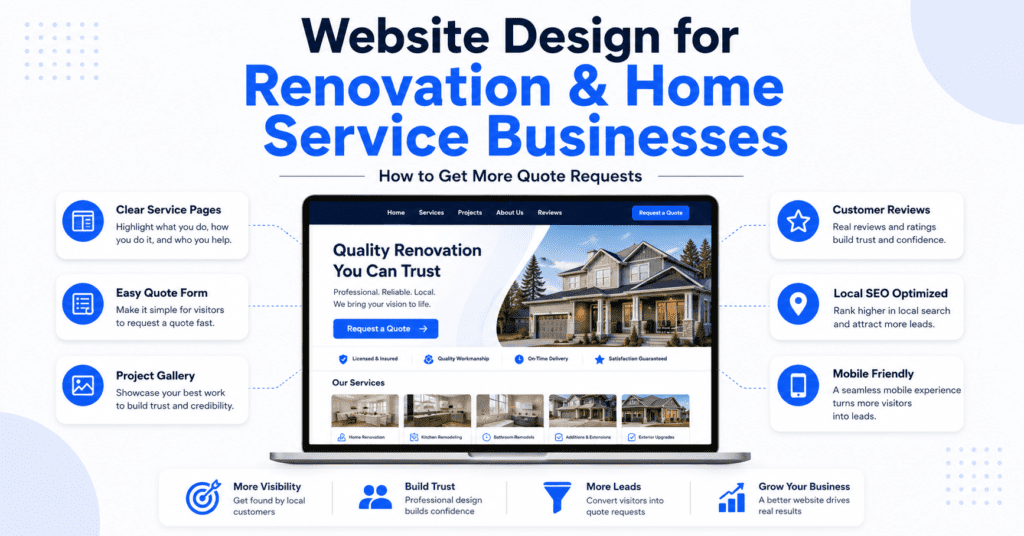
A website for a renovation company or home service business should do more than show your company name and contact number.
For many customers, your website is the place where they decide whether your business looks reliable enough to contact. They may be planning a renovation, looking for a contractor, comparing cleaning services, searching for repair help, or trying to find someone they can trust to work inside their home or property.
That means your website needs to build confidence quickly.
Home service customers are often careful. They want to know whether your business is experienced, whether your work quality is good, whether you serve their area, whether you can handle the type of job they need, and whether it is easy to request a quotation.
A weak website can make a good business look less professional than it really is. An unclear website can cause potential customers to leave and contact another provider. A slow or outdated website can create doubt before the customer even speaks to you.
A strong home service website does the opposite. It helps people understand what you do, trust your work, view your previous projects, and request a quote with less hesitation.
This guide explains how renovation companies, contractors, repair services, cleaning companies, pest control businesses, air conditioning services, landscaping businesses, and other home service providers can build a website that generates more enquiries and quote requests.
Why Home Service Businesses Need a Strong Website
Home service businesses depend heavily on trust.
Customers are not only buying a product. They are inviting someone to repair, improve, clean, install, or work on their home, office, shop, or property. This creates a higher level of concern compared to a simple online purchase.
Before contacting you, customers may want to see your previous work, understand your process, read reviews, check your service area, and compare you with other providers. If your website does not answer these questions clearly, they may feel unsure.
A professional website helps reduce that uncertainty.
It gives your business a place to present your services properly. It also gives customers a reason to believe that you are serious, organised, and experienced.
For renovation and home service businesses, your website can also support your other marketing channels. If someone finds you through social media, referrals, Google search, ads, or a business directory, they may still visit your website before enquiring. Your website becomes the page that confirms whether they should take the next step.
A website does not replace word of mouth or referrals. It strengthens them.
When someone recommends your business, a good website helps the referred customer feel more confident before reaching out.
Your Homepage Should Explain What You Do Immediately
The homepage is usually the first page potential customers see.
Within a few seconds, visitors should understand what service you provide, who you help, where you operate, and how to request a quote.
Many home service websites are too vague. They use general statements like “Your trusted partner for quality service” or “Professional solutions for your home.” These lines sound acceptable, but they do not explain enough.
A better homepage message is specific.
For example, a renovation company should clearly state that it provides home renovation, kitchen renovation, bathroom renovation, office renovation, or commercial renovation services. A cleaning company should make it clear whether it handles house cleaning, post-renovation cleaning, office cleaning, or deep cleaning. An air conditioning service should mention installation, servicing, repair, and maintenance if those are core services.
Clear messaging helps customers know immediately whether they are in the right place.
The top section of your homepage should also include a direct call-to-action. This can be “Request a Free Quote,” “WhatsApp Us for a Site Visit,” “Book an Inspection,” or “Send Us Your Project Details.”
The goal is simple. Do not make visitors work hard to understand your business. Make it obvious.
Your Website Should Show Real Work
For renovation and home service businesses, proof matters.
Customers want to see the type of work you have done before. They want to know whether your quality matches what they need. They may also want to see whether you have handled projects similar to theirs.
This is why project photos, before-and-after images, case studies, and work galleries are important.
A renovation company should show completed projects. A cleaning business can show before-and-after results. A landscaping company can show outdoor transformations. A repair service can show examples of common problems fixed. A contractor can show different project stages to demonstrate capability.
Real photos are usually stronger than stock images. Stock images may make a website look polished, but they do not prove your actual work. Customers can usually sense when a website feels too generic.
Your portfolio does not need to be perfect at the beginning. Even a small collection of real project photos can help build trust. Over time, you can keep adding more examples.
The best project sections do not only show photos. They also explain what the customer needed, what work was done, and what the final outcome looked like.
This helps potential customers imagine what you can do for them.
Service Pages Should Be Clear and Specific
Many home service websites place all services on one short page.
This may seem convenient, but it often makes the website weaker. Customers may not get enough information, and search engines may not understand each service clearly.
A stronger website gives important services their own dedicated pages.
For example, a renovation company may have separate pages for home renovation, kitchen renovation, bathroom renovation, office renovation, and commercial renovation. A cleaning company may have separate pages for house cleaning, office cleaning, move-in cleaning, post-renovation cleaning, and deep cleaning. An air conditioning business may have pages for aircond installation, servicing, repair, and chemical cleaning.
Each service page should explain the service properly. It should help customers understand what is included, who the service is suitable for, how the process works, and how to request a quote.
This is useful for both customers and SEO.
When each service has its own page, your website has a better chance of appearing for specific searches. It also gives visitors more confidence because they can find the exact service they need.
Thin service descriptions rarely convert well. A short list of services may not be enough to persuade someone to contact you, especially if the job involves money, time, and trust.
A good service page should make the customer feel, “This company understands what I need.”
The Quote Request Process Should Be Easy
The main conversion goal for most home service websites is a quote request.
That means the website should make the quotation process easy to start.
Some customers may prefer to call. Some may prefer WhatsApp or messaging. Others may prefer filling in a form. Your website should support the most common contact method for your type of business.
The quote request form should not be too complicated. If you ask too many questions too early, visitors may abandon it. At the same time, you need enough information to understand the enquiry.
A simple quote form may ask for the customer’s name, contact number, service needed, property type, location, preferred timing, and short project details. For renovation or larger jobs, you may also allow customers to upload photos or describe their requirements.
For many home service businesses, messaging can work well because customers often want to send photos, ask quick questions, or check availability. In that case, your website should make the message button visible and easy to tap on mobile.
The call-to-action should be clear. Instead of using a generic “Contact Us,” use wording that matches the customer’s intent, such as “Request a Renovation Quote,” “Book a Site Visit,” “Ask About Repair Availability,” or “Get a Cleaning Estimate.”
The easier the first step feels, the more likely people are to enquire.
Trust Signals Can Increase Quote Requests
Customers often hesitate before contacting a home service provider because they worry about reliability.
They may have heard stories about poor workmanship, late delivery, unclear pricing, unfinished jobs, or bad communication. Your website needs to reduce those fears.
Trust signals help with this.
Customer reviews are one of the strongest trust signals. If past customers have given positive feedback, show it clearly on your website. Reviews that mention punctuality, quality, cleanliness, communication, pricing transparency, or professionalism can be especially helpful.
Project examples also build trust because they show real work. A clear process can also help because customers like to know what will happen after they enquire. For example, explain whether you will review their details, arrange a site visit, provide a quote, confirm scope, schedule the work, and complete the project.
If your business has licences, certifications, insurance, warranties, years of experience, supplier partnerships, or safety practices, these should be mentioned where relevant.
Trust is built through details. A website that explains things clearly often feels more reliable than one that only makes big claims.
Instead of saying “We are the best,” show why customers can trust you.
Local Search Visibility Matters for Home Services
Most home service businesses serve specific locations.
Customers often search for service providers near them because they want someone available, convenient, and familiar with the area.
This is why local SEO is important.
Your website should clearly mention the areas you serve. This can include cities, neighbourhoods, districts, or service zones. The information should appear naturally across the website, especially on your homepage, service pages, contact page, and location pages if you use them.
For example, a contractor serving multiple areas can create useful service-area pages that explain what services are available in each area. However, these pages should not be copied and pasted with only the location name changed. Each page should include useful details, project examples, common needs in that area, or service availability.
Your website should also be consistent with your Google Business Profile. Business name, address, phone number, opening hours, and service categories should match as much as possible.
Local search traffic can be valuable because these visitors often have stronger intent. They are not just browsing. They are actively looking for help.
A properly structured website gives your business a better chance of being found when customers search for services in your area.
Mobile Experience Is Critical
Many customers will visit your website from a phone.
They may be searching while at home, at work, at a property site, or right after noticing a problem. A leaking pipe, broken air conditioner, pest issue, cleaning need, or renovation enquiry often starts from a mobile search.
If your website is difficult to use on mobile, you may lose leads.
The mobile version should load quickly, show your services clearly, and make contact buttons easy to tap. Visitors should not need to zoom in, scroll endlessly, or search for your phone number.
Your quote button should be visible. Your service pages should be easy to read. Your project photos should load properly. Your form should be simple to complete from a phone.
For home service businesses, speed matters. Customers may be comparing several providers at once. If your website feels slow or confusing, they may move on quickly.
A simple, fast, mobile-friendly website is often more effective than a website with too many animations or complicated effects.
The goal is not to impress people with fancy design. The goal is to help them contact you easily.
Pricing Guidance Can Help Qualify Leads
Many home service providers hesitate to show pricing because every project is different.
This is understandable. Renovation, repair, cleaning, installation, and maintenance work often depend on site condition, size, materials, labour, urgency, and scope.
However, giving some pricing guidance can still be useful.
You do not need to show fixed prices for every service. You can show starting prices, estimated ranges, package examples, or explain what affects the final quote.
For example, a renovation company can explain that pricing depends on property size, material selection, design complexity, and project scope. A cleaning company may show package prices based on property size. A repair service may explain inspection fees, labour charges, or common price ranges.
Pricing guidance helps reduce low-quality enquiries. It also helps serious customers understand what to expect before contacting you.
When there is no pricing information at all, some visitors may hesitate because they worry the service will be too expensive. Others may enquire without any idea of budget, which can waste time for both sides.
Transparent pricing guidance does not mean you must give exact quotes online. It means you help customers understand how pricing works.
A Good Website Should Explain Your Process
Customers like to know what happens next.
This is especially true for renovation and home service work, where the customer may need to schedule time, prepare the property, compare quotes, or coordinate with family members, tenants, staff, or building management.
Your website should explain your process in simple terms.
For example, you can explain that the customer sends an enquiry, your team reviews the details, you arrange a call or site visit, you provide a quotation, the customer confirms the scope, and the work is scheduled.
For renovation projects, you may explain the steps from consultation to measurement, design discussion, quotation, material selection, work schedule, renovation, inspection, and handover.
For cleaning or repair services, the process may be shorter. But even then, explaining it helps customers feel more comfortable.
A clear process makes your business look organised. It also reduces repetitive questions because customers already know what to expect.
When customers understand the process, they are more likely to take the first step.
Website Content Should Answer Real Customer Questions
A strong home service website should answer the questions customers already have in mind.
They may want to know how long the work takes, whether a site visit is needed, whether you serve their area, whether you handle small jobs, whether you provide warranty, whether you bring your own tools, whether you clean up after the work, or whether you can provide an urgent appointment.
If your website answers these questions, visitors feel more informed and confident.
This can be done through service page content, FAQ sections, project case studies, or blog articles.
For example, a renovation company can write about renovation timelines, budgeting, common renovation mistakes, and how to prepare for a site visit. A cleaning company can write about deep cleaning, post-renovation cleaning, move-in cleaning, and how to choose the right package. A repair service can write about warning signs, maintenance tips, and when to call a professional.
Helpful content builds trust before the customer contacts you.
It also supports SEO because many customers search for answers before hiring a provider.
Landing Pages Can Improve Campaign Results
If you run ads, do not always send traffic to your homepage.
A homepage is usually general. It introduces the whole business. But an ad campaign often focuses on one service, one problem, or one offer.
A landing page can perform better because it is more focused.
For example, a renovation company running ads for kitchen renovation should send visitors to a kitchen renovation landing page, not the homepage. A cleaning company promoting move-in cleaning should send traffic to a move-in cleaning page. An air conditioning service offering chemical cleaning should send visitors to a dedicated service page.
A good landing page keeps the message focused. It explains the service, shows proof, answers common questions, and asks the visitor to request a quote.
This can improve lead quality because the visitor lands on a page that matches exactly what they clicked.
For home service businesses, landing pages are especially useful for seasonal campaigns, urgent services, promotional packages, or high-demand services.
Common Mistakes in Home Service Website Design
One common mistake is using a generic website that does not show real work. Customers want proof, especially for renovation and contractor services. A website with only stock photos may not build enough confidence.
Another mistake is making the service information too thin. A short list of services does not explain enough. Customers need details before they feel ready to enquire.
Some businesses also hide their contact options. The phone number, quote button, or messaging option should be easy to find, especially on mobile.
Another mistake is ignoring local SEO. If your website does not clearly explain where you operate, you may miss out on local searches.
Many home service websites also fail to explain the process. This creates uncertainty. Customers may not know whether they should call, send photos, request a site visit, or wait for a quote.
A website should remove friction, not create it.
The best home service websites are clear, practical, trustworthy, and easy to contact.
Final Thoughts: A Home Service Website Should Build Trust and Generate Enquiries
A good website for a renovation or home service business should not only look professional.
It should help customers understand your services, see your work, trust your business, and request a quote easily.
Your website should answer the questions customers care about. It should show proof, explain your process, support local search, work well on mobile, and guide visitors toward enquiry.
For home service businesses, trust is everything. Customers want to feel safe before they let someone work on their property. Your website plays an important role in building that confidence.
If your current website is not bringing quote requests, the problem may not be traffic alone. It may be unclear messaging, weak service pages, missing proof, poor mobile experience, or a difficult enquiry process.
A better website can help turn more visitors into real business opportunities.
It should help your business get found, trusted, and contacted.
Need a Website That Helps Your Home Service Business Get More Quotes?
If your business depends on quote requests, site visits, bookings, or service enquiries, your website should be built around those goals.
At Bennie Tay, we help service businesses build conversion-focused websites designed to improve trust, explain services clearly, and generate more enquiries.
Whether you run a renovation company, cleaning business, repair service, contractor business, landscaping service, or other home service company, the goal is simple:
Build a website that helps customers understand your work, trust your business, and request a quote.
FAQ: Website Design for Home Service Businesses
What should a home service website include?
A home service website should include a clear homepage, detailed service pages, project photos, customer reviews, service area information, quote request form, contact buttons, mobile-friendly design, and basic SEO setup.
Why do renovation companies need project photos?
Project photos help potential customers see the quality of your work. Before-and-after images, completed projects, and case studies can build trust and make customers more comfortable requesting a quote.
Should a contractor website show prices?
A contractor website does not always need fixed prices, but pricing guidance can help. You can show starting prices, estimated ranges, or explain what affects the final quote.
How can a home service website get more quote requests?
A home service website can get more quote requests by improving messaging, showing real work, adding reviews, making contact options visible, creating detailed service pages, improving mobile experience, and supporting local SEO.
Is SEO important for home service businesses?
Yes. Many customers search online for local service providers. SEO helps your website appear when people search for your services in your target areas.
Should home service businesses use landing pages?
Yes. Landing pages are useful for specific services, promotions, or ad campaigns. They keep the message focused and can improve enquiry quality.