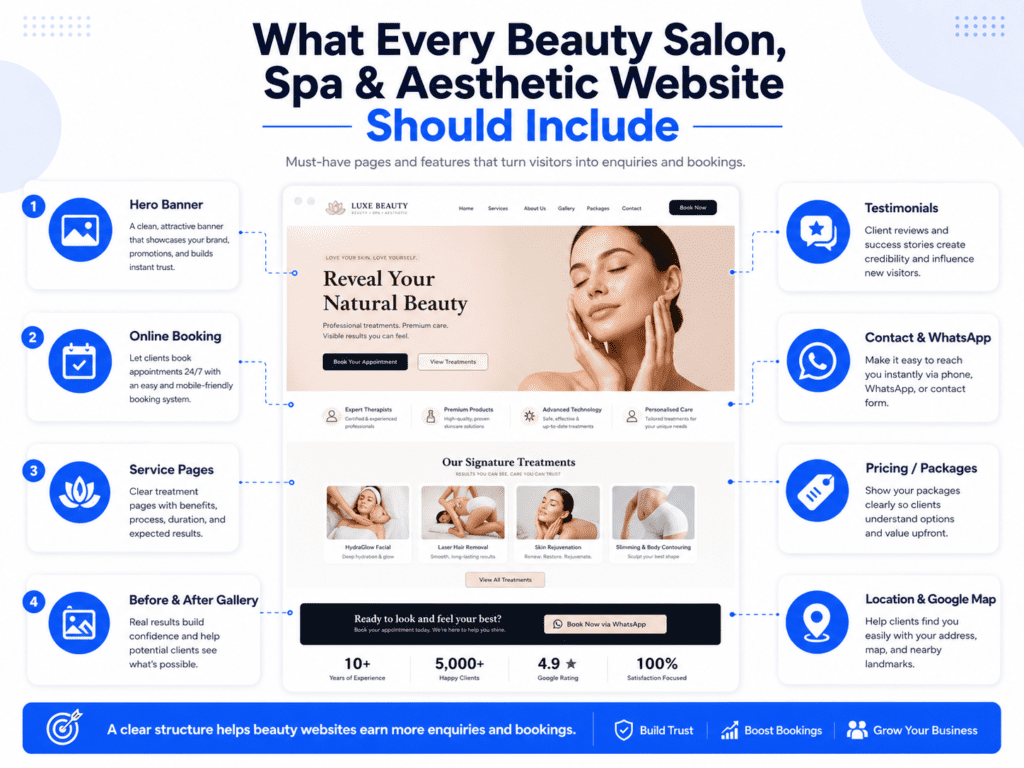
Beauty salons, spas, and aesthetic businesses depend heavily on trust. Customers want to feel comfortable before they book. They want to know what services you provide, what the experience is like, whether your business looks professional, and whether other customers are happy with the results.
In the past, many beauty businesses relied mainly on Instagram, Facebook, referrals, and walk-in customers. These channels still matter, but they are no longer enough on their own. Customers now compare businesses online before making a decision. They may discover you through social media, but many will still check your website to confirm whether your business is established, credible, and suitable for them.
This is where website design becomes important.
A well-designed website can help a beauty salon or spa turn casual visitors into real enquiries. It can explain your services better than a short social media caption. It can show your location, pricing guidance, booking options, customer reviews, treatment details, portfolio, and FAQs in one organized place.
A weak website can do the opposite. If the website looks outdated, loads slowly, lacks clear information, or makes booking difficult, potential customers may leave and choose another salon or spa that feels more polished and trustworthy.
For beauty and wellness businesses, the website is not just an online brochure. It is part of the customer experience before the customer even walks through your door.
Why Beauty Businesses Need a Proper Website
A beauty business needs a website because customers often want more information before they book.
Someone looking for a facial, hair treatment, massage, eyebrow service, manicure, skin consultation, or aesthetic treatment may not make a decision immediately. They may compare several providers. They may check photos, reviews, location, price range, service details, and booking process. If your business only has scattered information across social media posts, it becomes harder for them to decide.
Social media is useful for discovery, but a website is better for clarity. Instagram and Facebook are fast-moving platforms. A customer may see one post but miss your service details, location, opening hours, or booking instructions. A website gives you a stable place where all important information can be organized properly.
A professional website also helps your business look more established. This matters because beauty and wellness services are personal. Customers want to feel that they are choosing a business that is clean, professional, responsive, and serious about customer care.
If your competitors have clear websites and your business only has a social media page, you may still get enquiries, but you may lose customers who want more reassurance before booking.
A good website does not replace your social media. It supports it. Your social media can attract attention, while your website helps convert that attention into bookings.
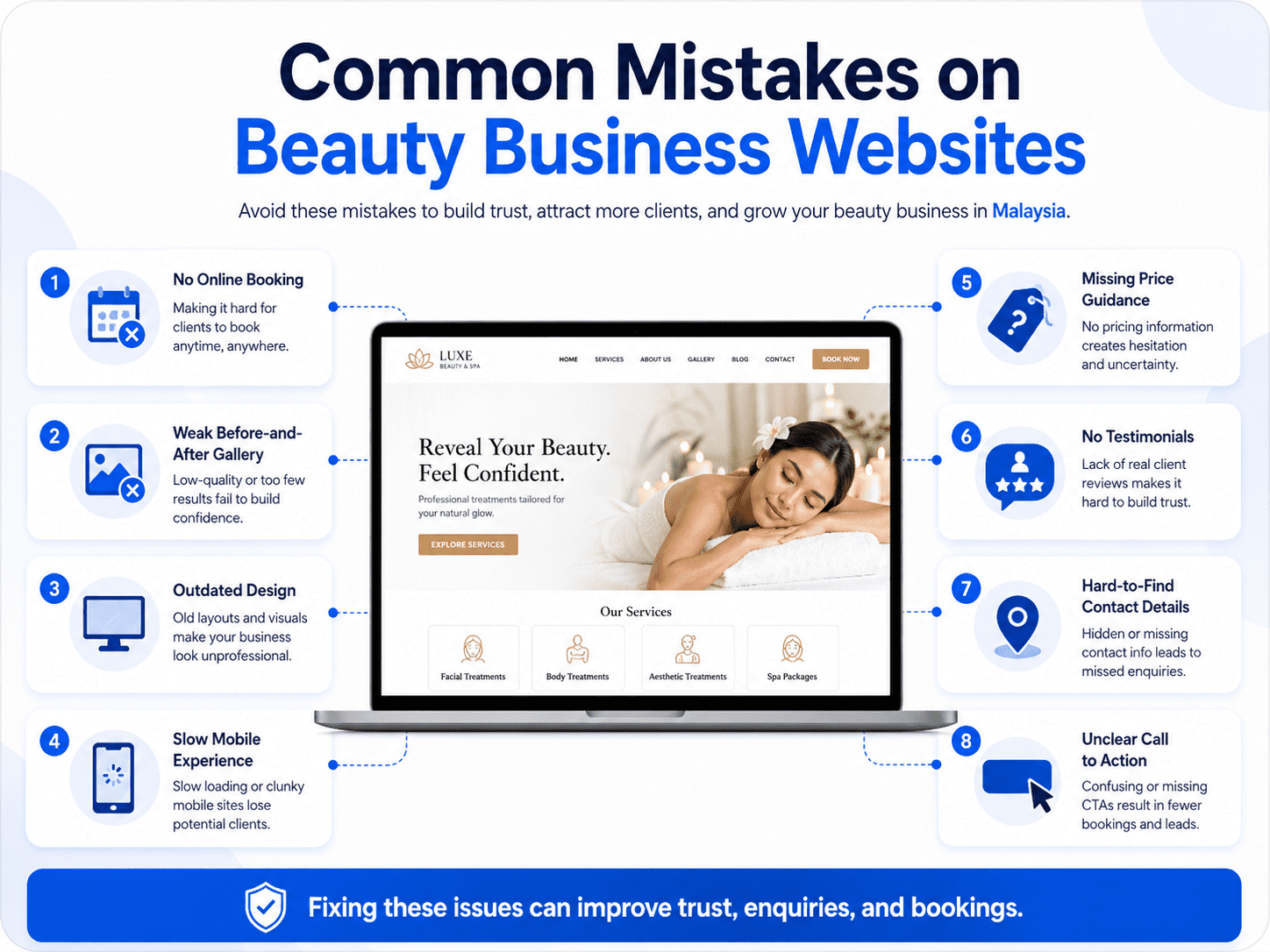
What Customers Look for Before Booking
Most customers do not visit a beauty salon or spa website just to browse. They usually have a reason. They may be looking for a specific service, comparing options, checking whether the location is convenient, or trying to understand what to expect before making a booking.
The first thing they want to know is whether you provide the service they need. If someone is searching for facial treatment, scalp treatment, waxing, manicure, massage, brow shaping, bridal makeup, or body spa services, they want to see that information clearly.
The second thing they want to know is whether your business looks trustworthy. This is where visuals matter. Real photos of your salon, treatment rooms, products, team, or customer results can help create confidence. A polished layout and clear writing also make the business feel more professional.
The third thing customers look for is convenience. They want to know your location, opening hours, booking method, parking information, WhatsApp number, and whether an appointment is required. If they have to search too hard for this information, they may leave.
The fourth thing they look for is reassurance. They may have questions about the treatment process, duration, aftercare, suitability, or what happens during their first visit. A website that answers these questions well can reduce hesitation and increase enquiries.
The best beauty salon websites are built around these customer questions. They do not only show what the business offers. They help the customer feel ready to act.
The Homepage Should Create Confidence Immediately
The homepage of a beauty salon or spa website should make a strong first impression. It does not need to be overly fancy, but it must feel clean, professional, and easy to understand.
When someone lands on the homepage, they should quickly understand what type of business you are, what services you offer, who you serve, where you are located, and how they can book. If the first section is too vague, visitors may not continue scrolling.
A weak homepage headline may say something like “Welcome to Our Beauty Centre.” That does not tell the customer much. A stronger headline would be more specific, such as “Professional Facial and Beauty Treatments in Kuala Lumpur” or “Relaxing Spa Treatments Designed for Busy Women and Working Professionals.” The wording should match your actual business and target customers.
The homepage should also include a clear booking action near the top. For Malaysian beauty businesses, WhatsApp is often one of the most effective enquiry channels. A button such as “Book via WhatsApp,” “Ask About Our Treatments,” or “Check Available Slots” can work better than a general “Contact Us.”
After the first section, the homepage should guide visitors through your main services, customer reviews, treatment experience, business story, location, and booking process. The page should feel natural, not overloaded. The goal is to make the visitor think, “This looks professional, I understand what they offer, and I know how to book.”
Service Pages Should Not Be Too Thin
Many beauty business websites make the mistake of listing all services on one page with short descriptions. This may seem simple, but it often limits SEO and gives customers too little information.
A stronger approach is to create individual pages for your main services. For example, a beauty salon may have separate pages for facial treatments, eyebrow services, hair treatments, manicure and pedicure, bridal makeup, and waxing. A spa may have pages for massage, body scrub, aromatherapy, couple spa packages, foot spa, and wellness treatments. An aesthetic business may have pages for skin consultation, acne care, pigmentation care, hydration treatments, or non-invasive beauty services.
Each service page should explain the service in a way that helps customers decide whether it is right for them. The page can describe what the service is, who it is suitable for, how long it usually takes, what customers can expect during the appointment, and how to book.
This does not mean the content needs to be overly technical. In fact, beauty service pages should be easy to read. Customers want useful information, not complicated wording. A good service page makes the service feel clear, approachable, and trustworthy.
From an SEO perspective, individual service pages also help Google understand your business better. A page focused on facial treatment in Shah Alam has a better chance of matching that search intent than a general services page with only one short paragraph.
From a GEO perspective, detailed service pages help AI search engines understand what your business offers and summarize your services more accurately.
Local SEO Is Important for Salons and Spas
Beauty salons and spas are local businesses. Most customers search based on location because they want somewhere nearby or convenient.
They may search for phrases like “beauty salon near me,” “facial treatment in Petaling Jaya,” “spa in Kuala Lumpur,” “hair salon in Shah Alam,” “eyebrow threading near me,” or “massage spa in Subang Jaya.” If your website does not clearly show your location and service area, you may miss valuable local traffic.
Local SEO starts with clear business information. Your website should include your full business name, address, phone number, WhatsApp link, opening hours, map location, and nearby area references where appropriate. If you serve customers from surrounding areas, the content can naturally mention those areas without forcing the keywords.
For example, a salon in Subang Jaya may attract customers from USJ, Sunway, Puchong, and Petaling Jaya. A spa in Kuala Lumpur may attract customers from Bangsar, Mont Kiara, Cheras, Ampang, and KLCC depending on the location. These references should be written naturally and only when relevant.
If your business has more than one branch, each branch should have its own location page. Each location page should include the address, opening hours, map, available services, branch photos, and booking link. This makes it easier for both customers and search engines to understand each location.
Local SEO is not just about rankings. It is about making your business easier to find and easier to choose.
Your Website Should Make Booking Easy
A beauty salon or spa website should make booking as simple as possible.
Many potential customers are ready to enquire, but they do not want a complicated process. If they have to fill in a long form, create an account, or search for your contact number, they may delay the booking or choose another provider.
For many Malaysian beauty businesses, WhatsApp is the most natural booking tool. Customers are comfortable asking questions there. They may want to check available slots, ask about service duration, confirm the price range, or share what they are looking for before booking.
Your website should support this behavior. A WhatsApp booking button should be visible on the homepage, service pages, pricing section, and contact page. The button text should be specific. “Book Appointment,” “Check Available Slot,” or “Ask About This Treatment” usually feels more action-focused than “Contact.”
If you use an online booking system, the website should make the process smooth. The booking page should be easy to use on mobile. Customers should be able to choose services, time slots, and contact details without confusion.
A good booking flow reduces friction. The easier it is to book, the more likely visitors are to become customers.
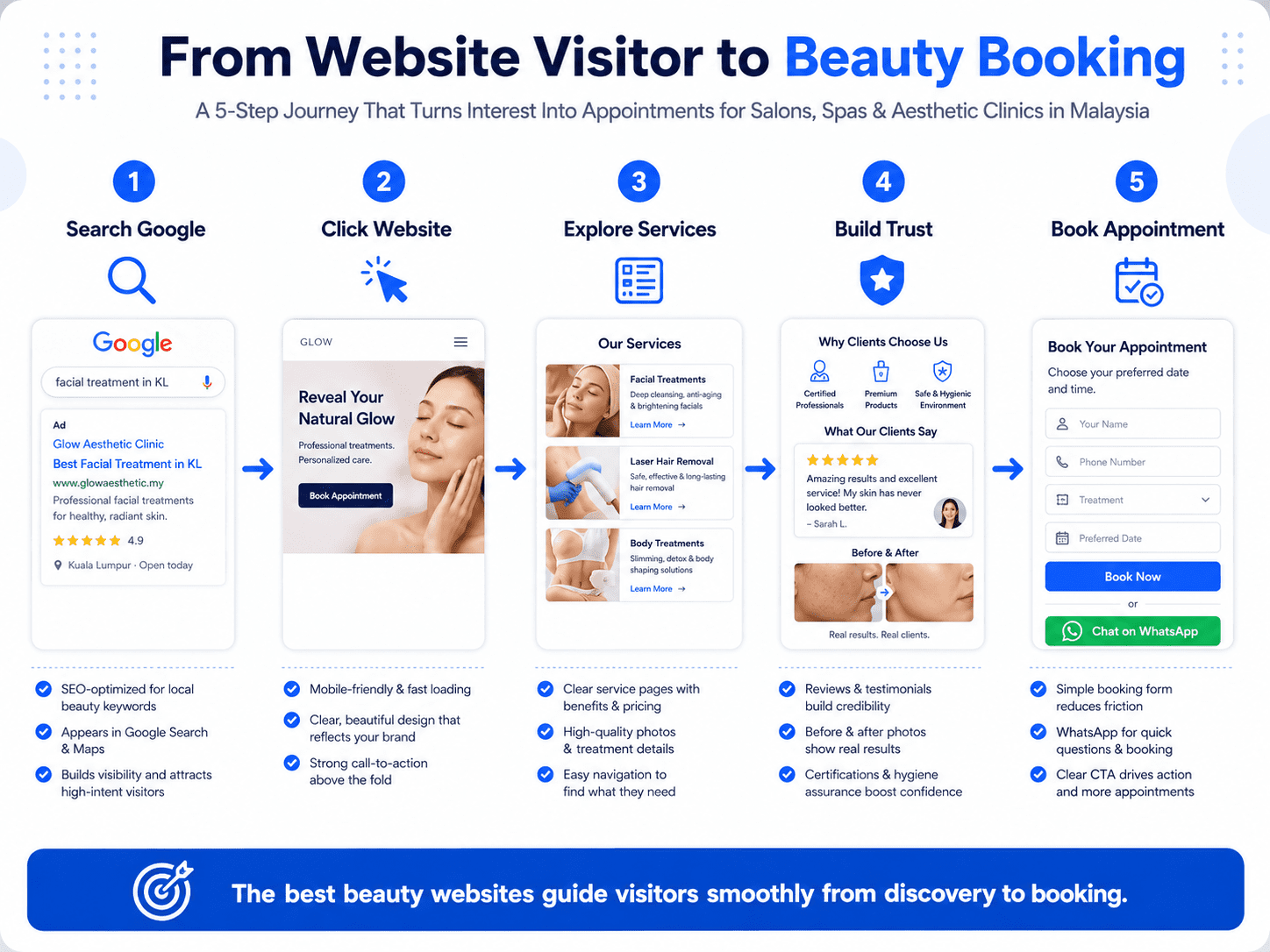
Real Photos Build More Trust Than Generic Stock Images
Visuals are extremely important for beauty and spa websites. Customers want to see the environment, style, and experience before they book.
Generic stock photos can make a website look neat, but they do not always build strong trust. Real photos are usually more powerful because they show what customers can actually expect. Photos of your salon interior, treatment rooms, reception area, team, tools, product shelves, and service environment can make the business feel more real.
If your business provides services where portfolio photos are appropriate, you can also show examples of your work. For example, a hair salon can show hair colour, styling, or treatment examples. A nail salon can show manicure designs. A makeup artist can show bridal or event makeup looks. A brow studio can show shaping results where allowed and appropriate.
The important point is to keep the visuals honest, professional, and relevant. The website should not create unrealistic expectations. It should help customers feel comfortable with the quality and style of your service.
Image quality matters too. Blurry, dark, or messy photos can weaken trust. You do not always need a luxury photoshoot, but you should use bright, clean, well-composed images that reflect your brand properly.
Testimonials and Reviews Should Be Easy to Find
Reviews are one of the strongest trust signals for beauty businesses.
Many customers want to know whether other people had a good experience before they book. They may check Google reviews, Facebook reviews, Instagram comments, or customer testimonials. Your website should bring some of this proof into the page instead of making visitors search elsewhere.
Testimonials should be placed naturally throughout the website. The homepage can include a few strong reviews. Service pages can include testimonials related to that service. The booking section can include a short trust reminder before the call to action.
Good testimonials do not need to be overly dramatic. Simple, specific feedback often feels more believable. For example, a customer may mention that the staff explained the treatment clearly, the environment felt comfortable, the booking process was easy, or they were happy with the service experience.
If you have many Google reviews, you can mention your review rating where accurate. If you have customer photos or user-generated content, you can include them with permission.
Trust is built through repeated reassurance. Reviews help visitors feel that other customers have already chosen you and had a positive experience.
Pricing Guidance Can Improve Enquiries
Many beauty businesses are unsure whether to show prices on their website. There is no single answer because it depends on your service type and pricing model.
For simple services, showing prices can make booking easier. Customers often want to know the price before they contact you. If the price is hidden, some may hesitate. Clear pricing can also reduce low-quality enquiries from people who are not a good fit.
For services where the price depends on consultation, condition, package, or customization, you may not need to show exact pricing. However, you can still provide guidance. For example, you can mention “from RM___,” “consultation required,” or “package options available.” This helps set expectations without locking every service into one price.
A website that gives no pricing information at all may create uncertainty. Visitors may assume the service is too expensive or may contact multiple providers just to compare. A little pricing clarity can improve trust and make enquiries more serious.
If you prefer not to display full pricing, your website should still explain how customers can get a quote or consultation. The call to action can invite them to WhatsApp your team for package details or appointment availability.
Content Should Feel Reassuring, Not Pushy
Beauty and wellness website copy should feel warm, clear, and professional. It should not sound too aggressive.
Customers may already feel unsure before booking a service. They may wonder whether the treatment is suitable, whether the team is experienced, whether the place is clean, or whether the result will match their expectations. Your content should help reduce that uncertainty.
A pushy website may use too many exaggerated claims, heavy discounts, or urgent sales messages. This can sometimes create the opposite effect, especially for services that require trust.
A better approach is to explain your services clearly, show your experience, answer common questions, and guide visitors toward making a booking when they are ready. Good website copy should feel like a helpful consultation, not a hard sell.
For example, instead of saying “Best facial treatment with guaranteed results,” a more natural approach would explain who the treatment is suitable for, what the session includes, and how customers can speak with the team before booking.
This style works better for both humans and AI search engines because the content is clearer, more specific, and less exaggerated.
Mobile Design Can Directly Affect Bookings
Most beauty salon and spa customers will visit your website from their phones. This means mobile design is not a small detail. It can directly affect the number of enquiries you receive.
A good mobile website should be easy to read, quick to load, and simple to navigate. The text should not be too small. The buttons should be easy to tap. The WhatsApp or booking button should be visible. Service pages should not feel crowded.
Customers browsing on mobile often scan quickly. They may not read every word at first. This is why your website should use clear headings, natural spacing, short paragraphs, and direct calls to action.
The mobile homepage should quickly show your main services, location, trust signals, and booking option. A visitor should not need to scroll endlessly before understanding what you offer.
If you run ads on Facebook, Instagram, TikTok, or Google, mobile design becomes even more important. Most ad traffic will likely come from mobile users. If your landing page is slow or confusing, you may waste your advertising budget.
A website that looks good on desktop but performs poorly on mobile is not enough for a beauty business.
Your Website Should Support Social Media Traffic
Beauty businesses often get attention from social media. Instagram, Facebook, TikTok, and Rednote can help people discover your brand, see your work, and become interested in your services.
However, social media traffic still needs somewhere to go. If someone clicks your profile link, they should land on a website or landing page that helps them take the next step.
A strong beauty business website can act as the central hub for your social media traffic. Instead of sending customers to a confusing link page, you can send them to a focused booking page, service page, promotion page, or homepage.
For example, if you post about facial treatments, the link can lead to your facial treatment page. If you promote a spa package, the link can lead to a spa package landing page. If you share customer transformations or portfolio content, the link can lead to a gallery or booking page.
This creates a smoother journey from interest to enquiry. Social media creates awareness. Your website helps convert that awareness into action.
Blog Content Can Help Beauty Businesses Rank
Blog content can help beauty salons and spas attract people who are searching for advice before booking.
A facial salon might publish articles about how to choose the right facial, what to expect during a first facial appointment, how often to book a facial, or how to prepare for a skin consultation. A spa might write about different types of massage, how to choose a spa package, or what to expect during a first visit. A hair salon might create content around hair treatment, scalp care, hair colouring, or pre-event styling.
These articles help capture customers earlier in their decision-making process. Not everyone searches directly for “book facial now.” Some people start with questions. If your website answers those questions well, they may begin to trust your business before they are ready to book.
For SEO, blog posts help target long-tail keywords. These are more specific search phrases that may have lower competition but stronger intent. For example, “best facial for dry skin in Malaysia” or “how to choose a spa package for couples” can attract readers who are already interested in a service.
For GEO, blog posts should include clear answers, natural headings, and helpful explanations. AI search engines prefer content that is structured and easy to summarize. A blog that directly answers common customer questions can improve your visibility across both traditional search and AI search experiences.
What Makes a Beauty Website GEO-Friendly?
A GEO-friendly website is structured so generative AI search engines can understand your business clearly.
This matters because more people are using AI tools to ask questions and compare services. Instead of only typing keywords into Google, users may ask tools like ChatGPT, Gemini, or Perplexity for recommendations, explanations, or service comparisons.
To improve GEO visibility, your website should explain your services clearly and directly. Each page should answer real customer questions. Your business information should be easy to identify. Your service area, location, booking methods, and expertise should be stated clearly.
FAQs are especially helpful because they match the way people ask questions. For example, a beauty salon website can answer questions such as “How do I choose the right facial?”, “Should I book a consultation first?”, “How often should I visit a salon?”, or “Can I book through WhatsApp?”
The content should also show topical depth. Instead of having one thin service page, your website should have useful pages for your main services, location, booking process, pricing guidance, and customer concerns.
GEO is not about writing for robots. It is about making your website clear enough that both people and AI systems can understand what you offer and when you are relevant.
What Makes a Beauty Website SEO-Friendly?
An SEO-friendly beauty website has a clear structure, focused pages, useful content, and strong local relevance.
Each important service should have its own page. The page title should include the service and, where appropriate, the location. The headings should explain the topic clearly. The content should be written for customers, not just for search engines. The website should also include internal links between related pages.
For example, a page about facial treatments can link to skin consultation, acne care, hydration facial, pricing guidance, and booking. A spa package page can link to massage services, couple spa packages, gift vouchers, and booking. A hair treatment page can link to scalp care, hair colouring, and consultation.
Images should also be optimized with descriptive file names and alt text. This helps search engines understand the visuals and improves accessibility.
Local SEO should be included throughout the website in a natural way. Your location, service area, and map should be clear. If you have a Google Business Profile, the website should match your business details consistently.
A beauty website that combines useful content, strong service pages, and local relevance has a better chance of attracting customers who are actively searching.
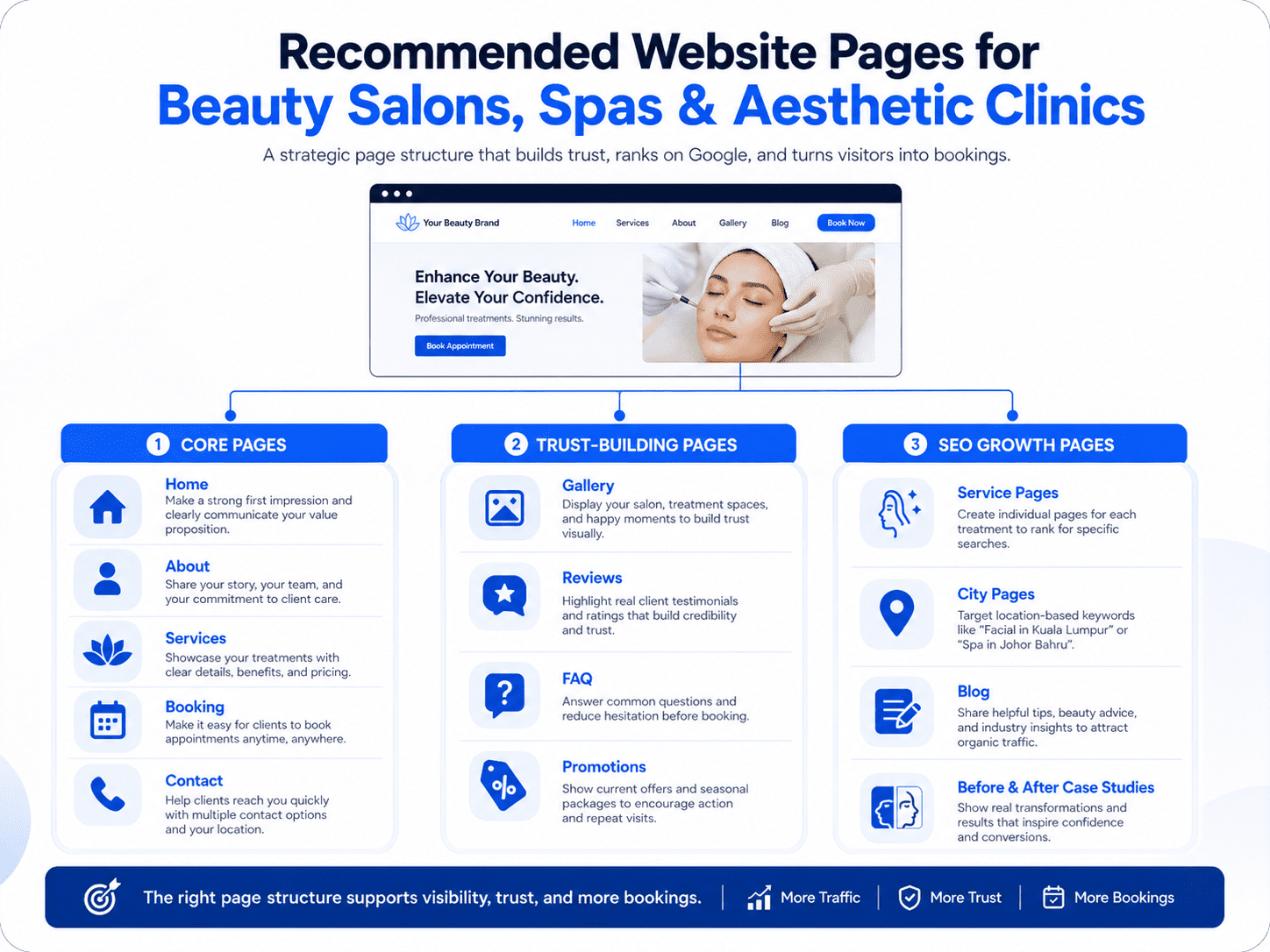
Recommended Pages for a Beauty Salon or Spa Website
A good beauty salon or spa website should include several important pages.
The homepage should introduce your business, highlight your main services, show trust signals, and guide visitors to book. The about page should tell your story, explain your approach, and make the business feel more personal. The services page should give an overview of what you offer, while individual service pages should explain each main service in detail.
The website should also include a gallery or portfolio page if visuals are important to your business. This is especially useful for hair salons, nail salons, makeup artists, brow studios, and beauty services where customers want to see examples of your work.
A reviews or testimonials section can help build trust. A contact page should include your location, opening hours, WhatsApp link, phone number, map, and booking instructions. A blog section can support SEO and educate customers.
If your business has multiple branches, each branch should have its own location page. This improves local SEO and helps customers choose the most convenient branch.
The goal is not to create unnecessary pages. The goal is to create the pages customers need before they feel ready to book.
How a Website Turns Beauty Visitors Into Bookings
A beauty website turns visitors into bookings by creating a smooth decision-making journey.
First, the website needs to attract the right visitor through Google, social media, ads, referrals, or local search. Then it needs to quickly show that the business offers the service the visitor is looking for. After that, it needs to build trust through visuals, reviews, explanations, and clear business information. Finally, it needs to make booking easy.
If any part of this journey is weak, conversions can drop. A website may have beautiful visuals but unclear service descriptions. Another website may have strong service pages but no obvious booking button. Another may have good traffic but poor mobile experience.
Good website design connects everything together. It helps customers move naturally from curiosity to confidence, and from confidence to enquiry.
For beauty salons, spas, and aesthetic businesses, this can make a real difference. A better website can help turn existing social media attention, Google searches, and word-of-mouth referrals into more actual bookings.
Final Thoughts
The best website design for beauty salons, spas, and aesthetic businesses in Malaysia is not only about looking beautiful. It is about helping customers understand your services, trust your business, and book with confidence.
A strong website should be clear, mobile-friendly, locally optimized, visually trustworthy, and easy to use. It should explain your services in natural language, show real proof, support WhatsApp enquiries, and answer the questions customers commonly ask before booking.
For beauty businesses, your website is part of the customer experience. It shapes how people see your brand before they ever visit your salon or spa. If your website feels professional and helpful, customers are more likely to take the next step.
If your current website is outdated, unclear, slow, or not generating enquiries, it may be time to improve it. A better website can help you attract more local customers, convert more social media traffic, and build a stronger online presence.
Need a Website for Your Beauty Salon, Spa, or Aesthetic Business?
At Bennie Tay, we help small businesses build professional, conversion-focused websites designed to attract visitors, build trust, and turn more traffic into enquiries.
Whether you run a beauty salon, spa, aesthetic business, wellness studio, or local service business, your website should do more than look nice. It should help customers understand your services and book with confidence.
Request a Free Website Growth Audit to find out how your website can be improved for SEO, local visibility, AI search visibility, and customer enquiries.
FAQ
What should a beauty salon website include?
A beauty salon website should include a clear homepage, service pages, real photos, customer reviews, location details, opening hours, WhatsApp or booking buttons, pricing guidance where suitable, FAQs, and a contact page.
Why do beauty salons need a website?
Beauty salons need a website because customers often compare services online before booking. A website helps explain your services, build trust, support local SEO, and make it easier for customers to enquire.
Is social media enough for a beauty business?
Social media is useful for attracting attention, but it should not be the only online presence. A website gives your business a more organized and professional platform where customers can find service details, reviews, location information, and booking options.
How can a spa website get more bookings?
A spa website can get more bookings by having clear service pages, real photos, customer testimonials, mobile-friendly design, visible WhatsApp buttons, simple booking steps, and local SEO content.
What is local SEO for beauty salons?
Local SEO for beauty salons means optimizing your website so customers in your area can find your business when searching for services such as facial treatment, hair salon, spa, massage, manicure, or beauty services near them.
Should a beauty salon website show prices?
A beauty salon website can show prices if the services are fixed and easy to explain. If pricing depends on consultation or package selection, the website can provide price guidance and invite customers to enquire through WhatsApp.
What makes a beauty website SEO-friendly?
A beauty website is SEO-friendly when it has clear service pages, useful content, local keywords, optimized images, clean URLs, proper headings, mobile-friendly design, and internal links between related pages.
What makes a beauty website GEO-friendly?
A beauty website is GEO-friendly when it provides clear answers, detailed service explanations, location information, FAQs, booking details, and structured content that AI search engines can understand and summarize.
Should my salon website have WhatsApp booking?
Yes. In Malaysia, many customers prefer WhatsApp because it is fast and convenient. A visible WhatsApp booking button can make it easier for visitors to ask questions and book appointments.
How often should a beauty business update its website?
A beauty business should update its website whenever services, prices, promotions, opening hours, team members, photos, or booking details change. Publishing helpful blog content regularly can also support SEO and customer trust.