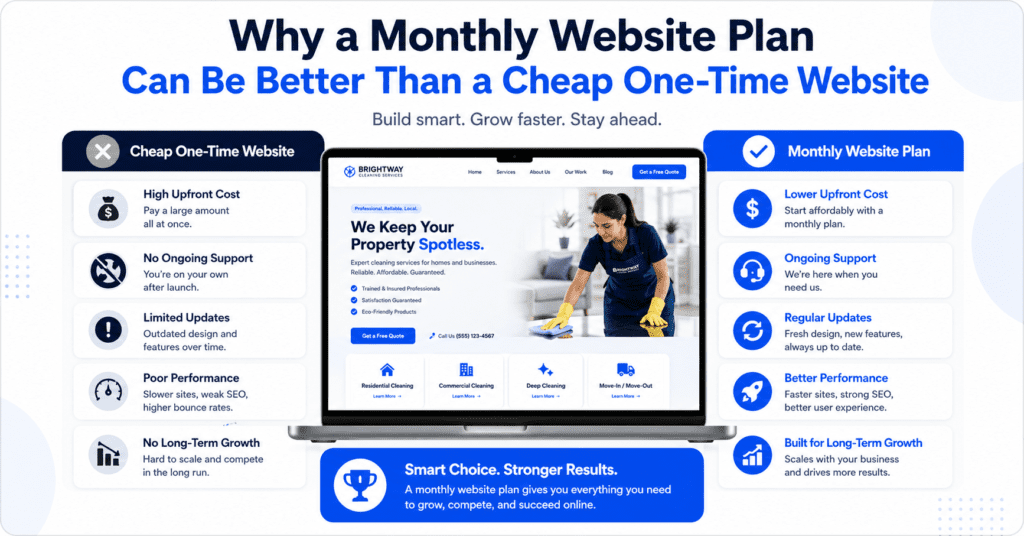
A cheap one-time website sounds attractive at first.
You pay once. The website gets built. It goes live. No monthly commitment. No ongoing fee. And no complicated subscription. For a small business owner trying to control cost, that can feel like the smart choice.
And sometimes, it is.
If your business only needs a simple online profile, has no major website goals, and you are comfortable managing updates yourself, a cheap one-time website can be enough. Not every business needs an expensive custom website or a long-term service plan.
But there is a problem many small businesses discover too late.
The website is not finished just because it has gone live.
After launch, your website still needs hosting, security, backups, content updates, technical support, speed checks, form testing, SEO improvements, and occasional fixes. Your business may change. Your services may change. Or your prices may change. Your customers’ expectations may change. Google may change. Your competitors may improve their websites.
A cheap one-time website often solves the first problem: getting online.
A monthly website plan solves a different problem: staying online, staying updated, and keeping the website useful after launch.
That difference matters.
For many SMEs in Malaysia, a monthly website plan can be a better option than a cheap one-time website because it provides ongoing support, lower upfront cost, maintenance, updates, and a clearer way to keep the website working as a business tool.
This article explains why a monthly website plan can be better than a cheap one-time website, when it makes sense, when it does not, and what small business owners should check before choosing either option.
What Is a Cheap One-Time Website?
A cheap one-time website is usually a low-cost website package where you pay a fixed amount upfront for the website to be designed and launched.
It may include:
- A homepage
- A few basic pages
- Mobile responsive layout
- Contact form
- WhatsApp button
- Basic design template
- Domain and hosting setup
- Simple SEO title and description
- Short revision period
This type of package is common among freelancers, small web design providers, and budget website agencies. It is often aimed at startups, small businesses, home-based businesses, consultants, coaches, local service providers, and SMEs that need a website quickly.
A cheap one-time website can be useful if your goal is simple. For example, you may only need a website to show customers that your business exists, display your services, and let people contact you.
The issue is not the one-time model itself. The issue is what happens when the website is cheap because important work has been removed.
A low-cost website may exclude:
- Copywriting
- Proper SEO structure
- Ongoing support
- Maintenance
- Security updates
- Backups
- Website speed optimisation
- Content updates
- Analytics setup
- Conversion planning
- Future improvements
That is where the hidden cost begins.
The website may be cheap upfront, but expensive later if it does not generate enquiries, cannot be updated easily, breaks after launch, or needs to be rebuilt because it was not planned properly.
What Is a Monthly Website Plan?
A monthly website plan is a subscription-based website service.
Instead of paying a larger upfront fee to build a website once, you pay a monthly fee for the website and related services. This model is often called Website-as-a-Service.
A monthly website plan may include:
- Website design and setup
- Hosting
- SSL certificate
- Domain support
- Website maintenance
- Backups
- Security updates
- Technical support
- Content changes
- Basic SEO setup
- Analytics setup
- Contact forms
- WhatsApp integration
- Ongoing improvements
The main difference is continuity.
With a cheap one-time website, the provider’s main job is usually to deliver the website.
With a monthly website plan, the provider’s role continues after launch.
This matters because a business website is not a poster. It is a live digital asset. It needs attention, updates, and care. Yes, apparently even websites require maintenance now, because nothing in business is allowed to simply behave.
A monthly website plan is designed for business owners who want a website without managing the technical side themselves.
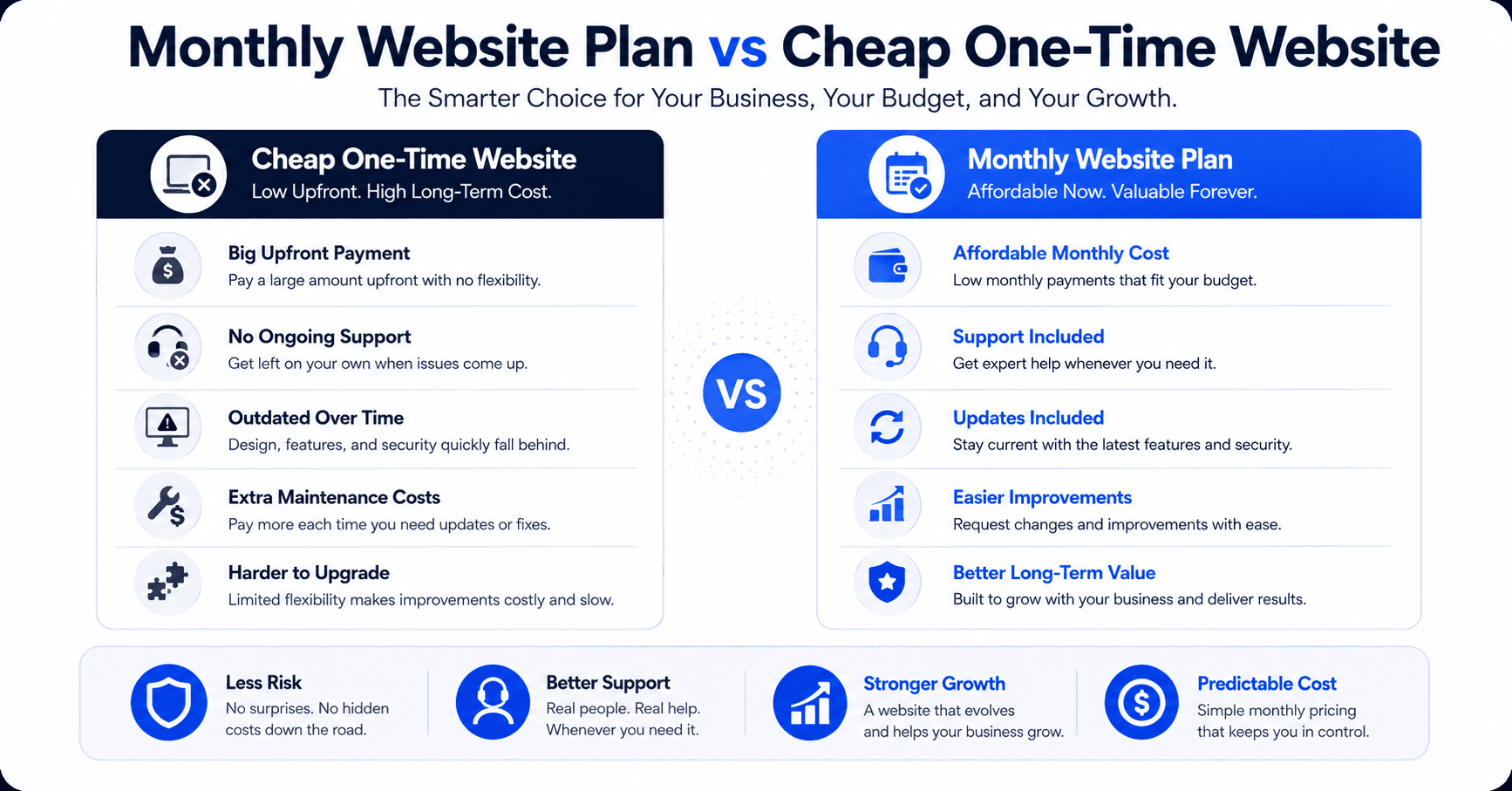
The Core Difference: Delivery vs Ongoing Support
The real difference between a cheap one-time website and a monthly website plan is not just payment style.
It is the service model.
A cheap one-time website is usually focused on delivery.
The provider builds the website, launches it, and completes the project. If you need future changes, maintenance, SEO, or support, you may need to pay separately.
A monthly website plan is focused on ongoing service.
The provider builds the website, launches it, and continues to manage or support it as long as the monthly plan is active.
In simple terms:
- A cheap one-time website helps you get online.
- A monthly website plan helps you stay updated and supported online.
For SMEs, this distinction is important. Many small businesses do not fail online because they cannot launch a website. They fail because the website becomes outdated, unsupported, unclear, slow, or ineffective after launch.
Why Cheap One-Time Websites Often Become a Problem
A cheap one-time website can be a good starting point, but it often creates problems when the business expects more from it.
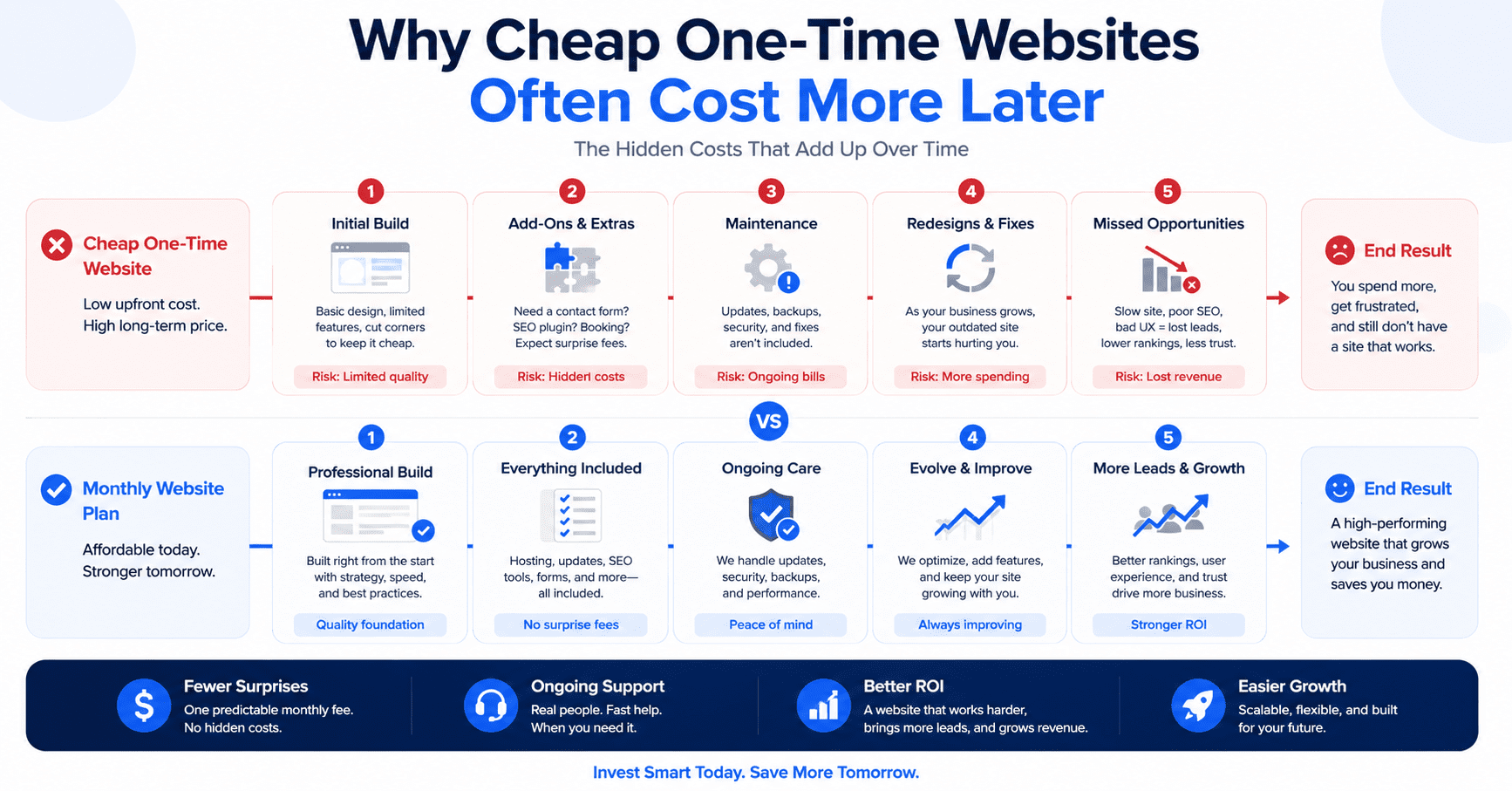
Here are the common issues.
1. There Is No Support After Launch
Many cheap website packages include limited support after launch. Once the website is approved and live, the project is considered complete.
That sounds fine until something goes wrong.
Common post-launch issues include:
- Contact form not sending enquiries
- Website loading slowly
- Mobile layout problems
- Broken links
- Images not displaying properly
- Outdated content
- Plugin or system errors
- Security warnings
- Hosting renewal confusion
- Domain expiry issues
When there is no support included, every issue becomes your problem.
You either fix it yourself, find another provider, or pay the original provider separately. For business owners who are not technical, this becomes frustrating quickly.
A monthly website plan is often better because support is part of the service. If something needs fixing, you have someone to contact.
2. Maintenance Is Not Included
A website needs maintenance.
This is especially true if it is built on a content management system like WordPress, where themes, plugins, and system files may need regular updates.
Maintenance may include:
- Software updates
- Plugin updates
- Security patches
- Backup checks
- Spam protection
- Form testing
- Speed monitoring
- Broken link checks
- Compatibility checks
A cheap one-time website may not include any of this after launch.
The website may work fine at first, then slowly become outdated or vulnerable. Small problems build up quietly until something breaks.
A monthly website plan usually includes maintenance, which helps keep the website stable and secure.
This is one of the biggest reasons monthly plans can be better for SMEs. Business owners do not need to remember technical maintenance. The provider handles it.
3. Content Becomes Outdated
Small businesses change often.
You may add a new service, change your pricing, update your packages, hire new team members, complete new projects, collect new testimonials, or change your opening hours.
If your website is not updated, customers may get the wrong information.
Outdated content can hurt trust.
For example:
- A clinic promotes an old package that is no longer available.
- A consultant lists services they no longer offer.
- A contractor has no recent project photos.
- A beauty salon shows outdated pricing.
- A training provider still displays last year’s programme.
- A company lists an old address or phone number.
These small issues make your business look neglected.
A cheap one-time website often does not include regular updates. You may need to pay for every change or learn to update the website yourself.
A monthly website plan may include content updates, making it easier to keep the website fresh and accurate.
4. SEO Is Usually Too Basic
Many cheap website packages say “SEO included,” but this often means very basic setup.
It may include a page title, meta description, and maybe a few headings. That is useful, but it is not a full SEO strategy.
To compete on Google, your website may need:
- Keyword research
- Service page structure
- Location-based pages
- Proper internal linking
- Helpful content
- Fast loading speed
- Mobile optimisation
- Search-friendly URLs
- Image optimisation
- Blog strategy
- Ongoing updates
A cheap one-time website usually does not include all of this.
That means your website may go live but struggle to rank.
A monthly website plan can be better if it includes ongoing SEO support, content updates, or gradual page improvements. Even if full SEO is not included, a provider that stays involved can help improve the site over time.
SEO is not a one-time switch. It is more like exercise, except Google judges you and your competitors keep showing up.
5. The Website May Not Be Built for Conversion
A website should not only look nice. It should help visitors take action.
That action may be:
- Calling your business
- Sending a WhatsApp message
- Filling a form
- Booking an appointment
- Requesting a quote
- Viewing your packages
- Downloading a brochure
- Visiting your store
Cheap one-time websites often focus on putting pages online quickly. They may not include proper conversion planning.
A conversion-focused website needs:
- Clear headline
- Strong service explanation
- Trust elements
- Testimonials
- FAQs
- Clear calls to action
- Simple contact options
- Good page flow
- Benefits, not just features
- Mobile-friendly enquiry process
Without these, the website may look finished but fail to produce leads.
A monthly website plan can be better because the provider can continue improving the website after launch. Headlines can be adjusted. FAQs can be added. Testimonials can be uploaded. Service pages can be improved. Landing pages can be created.
A website should become stronger over time, not remain frozen on launch day like a digital fossil.
6. Hidden Costs Appear Later
A cheap one-time website may look affordable because many items are excluded.
After launch, you may realise you still need to pay for:
- Hosting renewal
- Domain renewal
- SSL certificate
- Business email
- Maintenance
- Backups
- Security tools
- Content updates
- Extra pages
- SEO services
- Plugin licenses
- Speed optimisation
- Technical fixes
- Website migration
- Redesign work
None of these costs are unusual. The problem is when they were not clearly explained before you paid.
A monthly website plan can be better because many recurring items are bundled into one monthly fee. This makes budgeting easier and reduces surprise costs.
Predictable cost is valuable for SMEs because cash flow is already hard enough without websites inventing side quests.
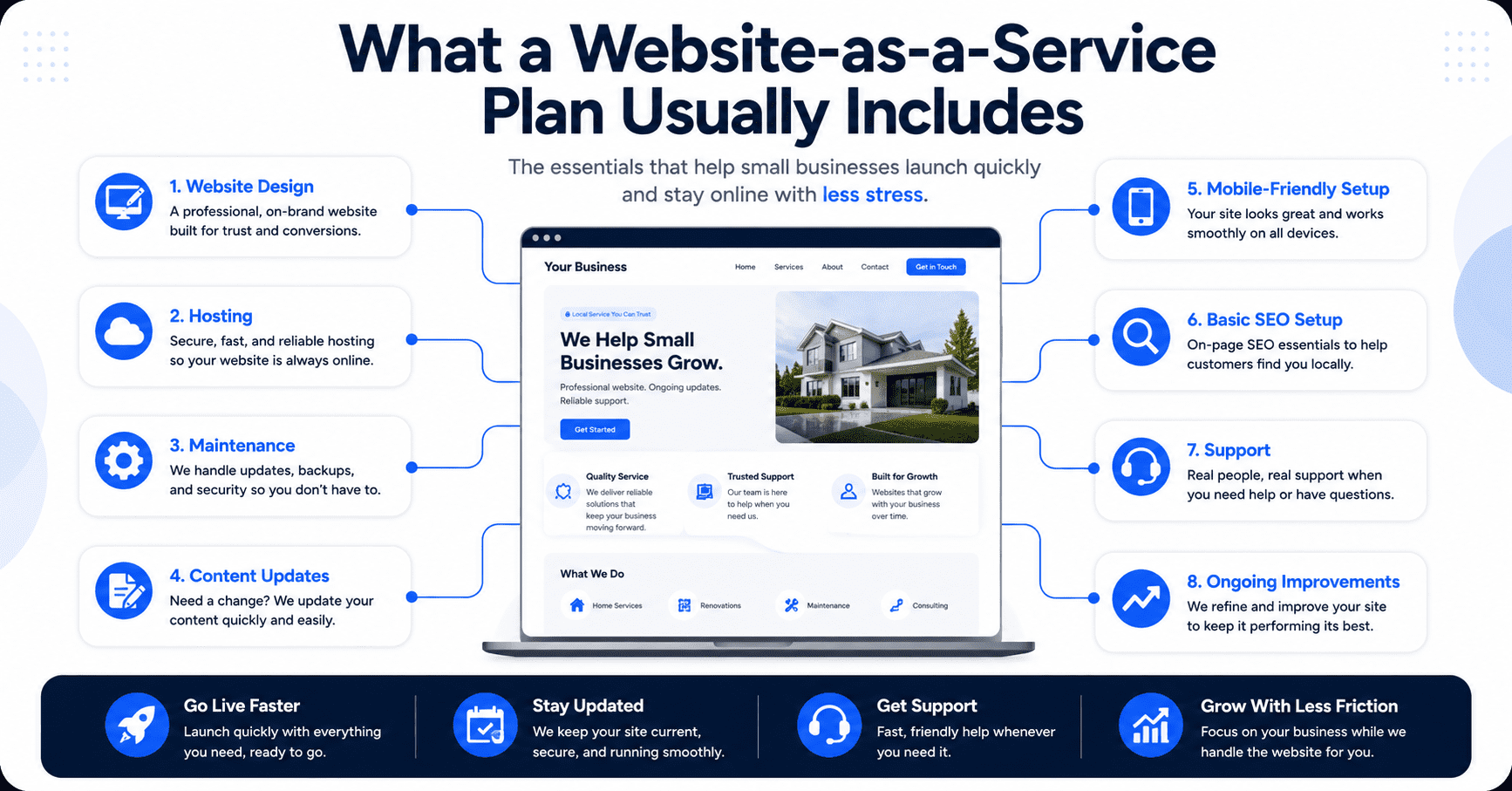
Why a Monthly Website Plan Can Be Better
Now let us look at the main advantages of a monthly website plan.
1. Lower Upfront Cost
A monthly website plan usually requires less upfront payment than a traditional website build.
This is useful for small businesses that need a website but do not want to spend several thousand ringgit at once.
Instead of delaying the project until you have a bigger budget, you can launch sooner and spread the cost over time.
This is especially helpful for:
- New businesses
- Solo founders
- Local service providers
- Consultants
- Coaches
- Clinics
- Beauty salons
- Contractors
- Freelancers
- Small agencies
- Home-based businesses
Lower upfront cost does not mean the monthly plan is always cheaper long term. But it can be more manageable for cash flow.
For SMEs, that matters.
2. Maintenance Is Handled for You
With a monthly website plan, maintenance is usually part of the service.
That means the provider may handle:
- Updates
- Backups
- Security checks
- Technical fixes
- Hosting issues
- SSL checks
- Form testing
- Website monitoring
This reduces the burden on the business owner.
You do not need to understand technical details or worry about whether something has been updated. You have a provider responsible for keeping the website running.
For many SMEs, this alone makes monthly plans worth considering.
3. Content Updates Are Easier
A monthly website plan often includes minor content updates.
This may include:
- Updating text
- Replacing images
- Adding testimonials
- Uploading project photos
- Updating pricing
- Changing contact details
- Adding FAQs
- Updating service descriptions
- Adding campaign sections
This is valuable because business information changes.
A website that stays updated feels more trustworthy. It also supports better SEO and better conversion.
If every small change requires a separate quotation, many business owners delay updates. Eventually, the website becomes outdated.
Monthly plans make updates part of the ongoing process.
4. You Get Ongoing Support
Support is one of the strongest advantages of a monthly website plan.
If something breaks, you know who to contact. If you need a change, there is a process. Or if you are unsure about something, there is someone responsible.
This is important for small businesses without internal marketing or technical staff.
A cheap one-time website may leave you alone after launch. A monthly plan gives you a continuing relationship with the provider.
That ongoing support can save time, stress, and lost leads.
5. The Website Can Improve Over Time
A website does not need to be perfect on day one.
In fact, it is often better to launch a strong basic version first, then improve it based on real business needs.
A monthly website plan supports this approach.
Over time, you can add:
- New service pages
- Blog articles
- Location pages
- Case studies
- Portfolio items
- Landing pages
- Testimonials
- Better calls to action
- New forms
- Campaign pages
This helps your website grow with your business.
A cheap one-time website may remain unchanged because every improvement requires a new cost or project.
Monthly plans make continuous improvement easier.
6. Better for Business Owners Who Are Not Technical
Not every business owner wants to manage a website dashboard.
Some do not want to learn WordPress. Some do not want to touch hosting. And some do not want to resize images, update plugins, fix forms, or read error messages written like ancient curses.
A monthly website plan is better for business owners who want a done-for-you solution.
You focus on your business. The provider handles the website.
That does not mean you should ignore the website completely. You should still review content, provide updates, and track performance. But you do not need to become the technical person.
7. Predictable Monthly Cost
A monthly website plan makes cost easier to manage.
Instead of separate bills for hosting, maintenance, updates, support, and technical fixes, you pay one monthly fee.
This helps with budgeting.
For small businesses, predictable cost is often better than sudden expenses.
A cheap one-time website may look cheaper upfront, but unexpected costs can appear later. A monthly plan makes the ongoing cost clearer.
8. Better Accountability
With a one-time build, the provider may not have much involvement after launch unless you pay for more work.
With a monthly plan, the provider continues to serve you.
That creates more accountability.
The provider has a reason to keep the website working, respond to support requests, and maintain the relationship.
This does not mean every monthly provider is good. Some are painfully average, because the internet continues to produce mediocrity at scale. But the model itself encourages ongoing service instead of one-time delivery.
When a Cheap One-Time Website Still Makes Sense
A monthly website plan is not always the better choice.
A cheap one-time website may still make sense if:
- You only need a very simple online presence
- You have a limited budget
- You do not need frequent updates
- You can manage the website yourself
- You understand hosting and maintenance
- You do not need ongoing support
- Your website is not a major lead source
- You want to avoid monthly commitments
- You have internal marketing or technical help
For example, a freelancer who only needs a basic portfolio may not need a monthly plan. A business with a marketing team may prefer to own and manage the site directly. A company with custom technical needs may require a one-time custom build instead.
The point is not that cheap one-time websites are always bad.
The point is that they are often incomplete for SMEs that need ongoing support and growth.
When a Monthly Website Plan Is the Better Choice
A monthly website plan is usually better if:
- You want lower upfront cost
- You need ongoing support
- You do not have technical staff
- You want hosting and maintenance included
- You need regular content updates
- You want predictable monthly expenses
- You want to improve the website over time
- You prefer a managed service
- You want your website to support lead generation
- You do not want to deal with technical problems
This model works especially well for service-based SMEs.
Examples include:
- Clinics
- Consultants
- Coaches
- Beauty salons
- Contractors
- Tuition centres
- Accounting firms
- Legal firms
- Agencies
- Interior designers
- Home service providers
- Local businesses
- Professional service providers
These businesses often need credibility, trust, search visibility, and easy enquiry flow. A monthly plan can help maintain and improve those areas over time.
Monthly Website Plan vs Cheap One-Time Website: Simple Comparison
| Factor | Cheap One-Time Website | Monthly Website Plan |
|---|---|---|
| Upfront cost | Lower than custom build, but still paid upfront | Usually lower upfront |
| Ongoing cost | Separate or self-managed | Included in monthly fee |
| Maintenance | Often not included | Usually included |
| Support | Limited after launch | Ongoing support |
| Content updates | Usually extra | Often included |
| SEO improvement | Usually limited | Can be improved over time |
| Ownership | Usually clearer if agreed properly | Depends on provider terms |
| Flexibility | Depends on platform and access | Depends on plan |
| Best for | Simple online presence | Managed business website |
| Main risk | Website gets neglected | Long-term cost or lock-in |
The right choice depends on what you expect the website to do.
If you only want a basic online profile, a cheap one-time website may be enough.
If you want a website that stays updated, supported, and useful, a monthly website plan may be better.
What to Check Before Choosing a Monthly Website Plan
Before signing up for a monthly website plan, ask these questions:
- What is included in the monthly fee?
- Is there a setup fee?
- How many pages are included?
- Is hosting included?
- Is SSL included?
- Is the domain included?
- Who owns the domain?
- Who owns the website content?
- Who owns the website design?
- Can I edit the website myself?
- Are content updates included?
- How many update requests are allowed each month?
- Is maintenance included?
- Are backups included?
- Is security included?
- Is SEO included?
- What support response time is provided?
- Is there a contract period?
- What happens if I cancel?
- Can I move the website later?
The cancellation question is especially important.
A monthly plan should make your life easier, not trap your business inside unclear terms.
What to Check Before Choosing a Cheap One-Time Website
If you decide to choose a cheap one-time website, make sure you check the scope carefully.
Ask:
- What pages are included?
- Is mobile responsive design included?
- Is copywriting included?
- Is basic SEO included?
- Is hosting included?
- Is domain included?
- Who owns the domain?
- Will I get admin access?
- Are backups included?
- Is security setup included?
- How many revisions are included?
- What support is included after launch?
- How much do future changes cost?
- Can the website be expanded later?
- Can I move the website to another provider?
If the provider cannot answer clearly, be careful.
A cheap one-time website can still be a good choice if the scope is transparent and the website is built properly.
The danger is not cheap pricing. The danger is unclear value.
The Real Cost Is Not Just the Website Price
Many business owners focus only on the build cost.
But the real cost of a website includes what happens after launch.
A website that costs less upfront may become expensive if:
- It does not bring enquiries
- It damages trust
- It is hard to update
- It is not mobile-friendly
- It has no SEO foundation
- It breaks often
- It needs to be rebuilt
- It has no support
- It becomes outdated quickly
A monthly website plan may cost more over time, but it can deliver more value if it keeps the website maintained, updated, and useful.
The better question is not “Which option is cheaper?”
The better question is “Which option gives my business a website that actually works?”
That is the question SMEs should care about.
A Practical Way to Decide
Choose a cheap one-time website if your goal is simply to get online and you are comfortable managing the website later.
Choose a monthly website plan if you want ongoing support, lower upfront cost, maintenance, updates, and a website that can improve over time.
And choose a custom one-time website build if you need advanced features, full ownership, complex integrations, or a unique website experience.
For many small businesses, the best choice is not the cheapest website. It is the website model that matches their stage of growth.
If your website is only a simple reference point, keep it simple.
If your website is expected to generate leads, build trust, support ads, and help customers choose you, then ongoing support matters.
A website that does nothing after launch is not a bargain. It is just a quiet expense.
Final Thoughts
A monthly website plan can be better than a cheap one-time website because it solves the problems that usually appear after launch.
A cheap one-time website may help your business get online quickly, but it often leaves you responsible for maintenance, updates, support, security, SEO, and future improvements.
A monthly website plan gives you a managed website service. It can include hosting, maintenance, support, backups, security, content updates, and ongoing improvements. For many SMEs, that makes the website easier to manage and more useful over time.
This does not mean monthly plans are always better. If you want full ownership, have technical support, or only need a very simple website, a one-time website may be enough.
But if you want your website to stay updated, supported, and aligned with your business, a monthly website plan may be the smarter choice.
The real value of a website is not just how much it costs to build.
The real value is whether it helps your business look credible, attract enquiries, and grow without becoming another technical headache.
A cheap website that sits untouched for years can cost more than it saves.
A well-managed monthly website plan can give small businesses something more useful: a website that keeps working after launch.
FAQ: Monthly Website Plan vs Cheap One-Time Website
Is a monthly website plan better than a cheap one-time website?
A monthly website plan can be better if you need ongoing support, maintenance, updates, hosting, backups, and technical help. A cheap one-time website may be enough if you only need a simple online presence and can manage it yourself.
Why do small businesses choose monthly website plans?
Small businesses choose monthly website plans because they reduce upfront cost, include ongoing support, simplify maintenance, and make it easier to keep the website updated.
Is a cheap one-time website bad?
Not always. A cheap one-time website can be useful for simple needs. It becomes a problem when it has poor structure, weak SEO, no support, no maintenance, and limited ability to grow.
What does a monthly website plan usually include?
A monthly website plan may include website design, hosting, SSL, maintenance, backups, security updates, content changes, technical support, basic SEO setup, contact forms, and ongoing improvements.
Does a monthly website plan cost more long term?
It can cost more over time compared with a one-time website, but it may also include more ongoing value such as maintenance, support, updates, and technical management.
Do I own my website with a monthly website plan?
It depends on the provider. Some monthly plans include ownership, while others work more like a rental model. Always ask what happens if you cancel and whether you can move the website later.
What is the biggest risk of a cheap one-time website?
The biggest risk is that the website may be neglected after launch. Without maintenance, updates, support, and SEO improvements, the website can become outdated or ineffective.
What is the biggest risk of a monthly website plan?
The biggest risk is unclear ownership or cancellation terms. Before signing up, check whether you can keep, export, or transfer the website if you stop paying.
Is a monthly website plan good for SMEs in Malaysia?
Yes, it can be a good option for SMEs in Malaysia that want lower upfront cost, ongoing support, maintenance, and a professional website without managing technical tasks themselves.
How do I choose between both options?
Choose based on your business needs. If you want a simple online profile and can manage the website yourself, a cheap one-time website may be enough. If you want ongoing support, updates, and a managed website, a monthly website plan is usually better.