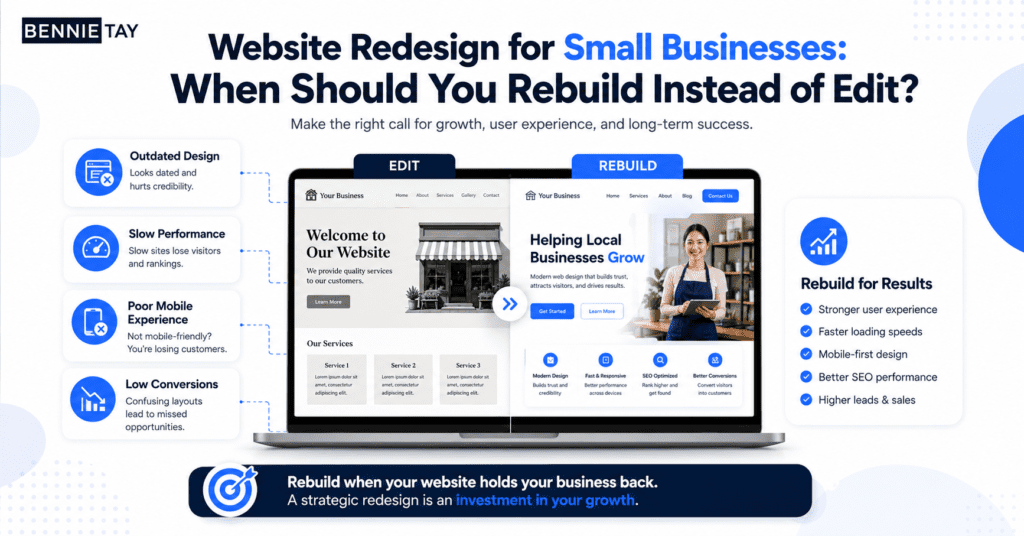
Many small business owners know their website needs improvement, but they are not sure whether they should make a few edits or rebuild the whole website.
This is a common situation.
Maybe the website was built years ago when the business was smaller. Maybe the design no longer matches the quality of the service. Or maybe the website still gets traffic but very few enquiries. Maybe customers keep asking questions that should already be answered on the site. Maybe the website looks fine on desktop but feels messy on mobile. Or maybe the business has changed so much that the old website no longer explains the current offer properly.
At first, it may feel easier to just edit the existing website. Change the homepage text. Add a few photos. Update the service list. Replace the contact form. Adjust some colours. These changes may help if the problem is small.
But sometimes the issue is deeper. If the website structure is weak, the message is unclear, the pages are not built for SEO, or the user experience is confusing, small edits may not fix the real problem. In that case, a full website redesign or rebuild may be the better option.
For small businesses, this decision matters because a website is not just a digital brochure. It can influence how customers see your business, whether they trust you, and whether they decide to contact you. If your website is not helping your business grow, it may be quietly costing you opportunities.
This article explains when a small business should redesign its website, when simple updates are enough, and how to rebuild your website in a way that improves SEO, AI search visibility, trust, and lead generation.
What Is a Website Redesign?
A website redesign is the process of improving or rebuilding a website so it performs better for the business and its visitors.
Some redesigns are mainly visual. This may include changing the layout, colours, fonts, images, and overall design style. A visual refresh can help when the website looks outdated but the structure and content are still strong.
Other redesigns go deeper. They may involve rewriting the website copy, changing the page structure, improving SEO, rebuilding the mobile experience, updating the call-to-action flow, improving loading speed, adding landing pages, or changing the entire website platform.
A proper website redesign should not start with design alone. It should start with understanding what is not working. If the website is not generating enquiries, the problem may be the message, offer, structure, traffic source, trust signals, or user journey. If the website is hard to update, the problem may be the platform or backend setup. And if the website does not rank on Google, the issue may be SEO structure and content depth.
A redesign should solve the right problem. Otherwise, the business may spend money on a nicer-looking website that still does not perform.
Website Redesign vs Website Update
Not every website problem requires a full redesign.
A website update is usually smaller. It may involve changing text, replacing photos, adding a new section, updating prices, fixing a broken link, adding a WhatsApp button, improving a contact form, or publishing a new blog post.
A website redesign is bigger. It usually involves rethinking the website’s structure, design, content, user experience, and conversion flow.
For example, if your website only has outdated team photos, you probably need an update. If your service description is slightly old, you may only need to rewrite that section. If your contact number has changed, that is a simple fix.
But if your homepage does not explain your business clearly, your service pages are too thin, your website loads slowly, your mobile version is difficult to use, and visitors are not enquiring, then small edits may not be enough.
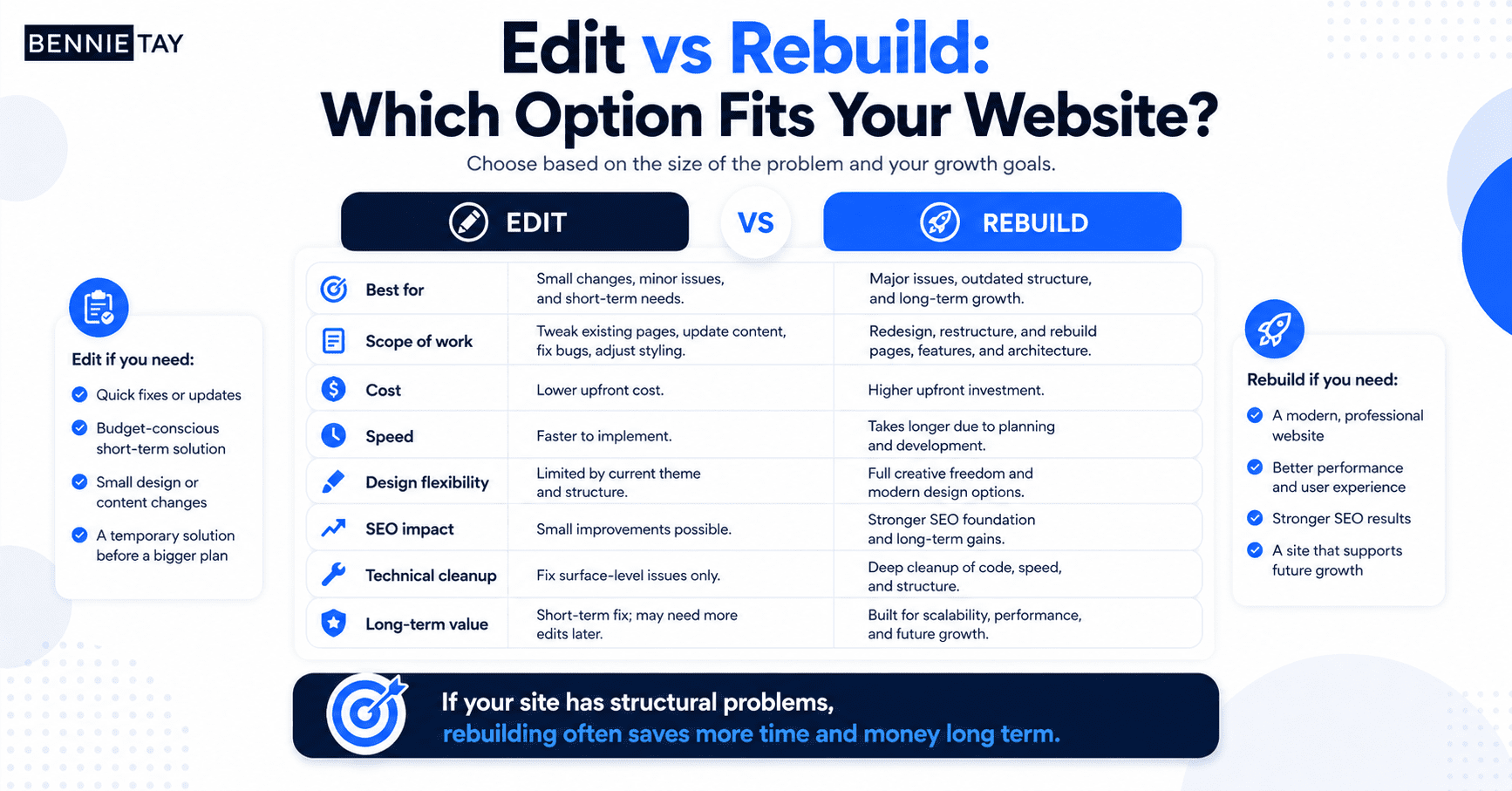
The difference comes down to whether the problem is surface-level or structural.
A surface-level problem can be edited. A structural problem usually needs a redesign.
Signs Your Website Needs a Redesign
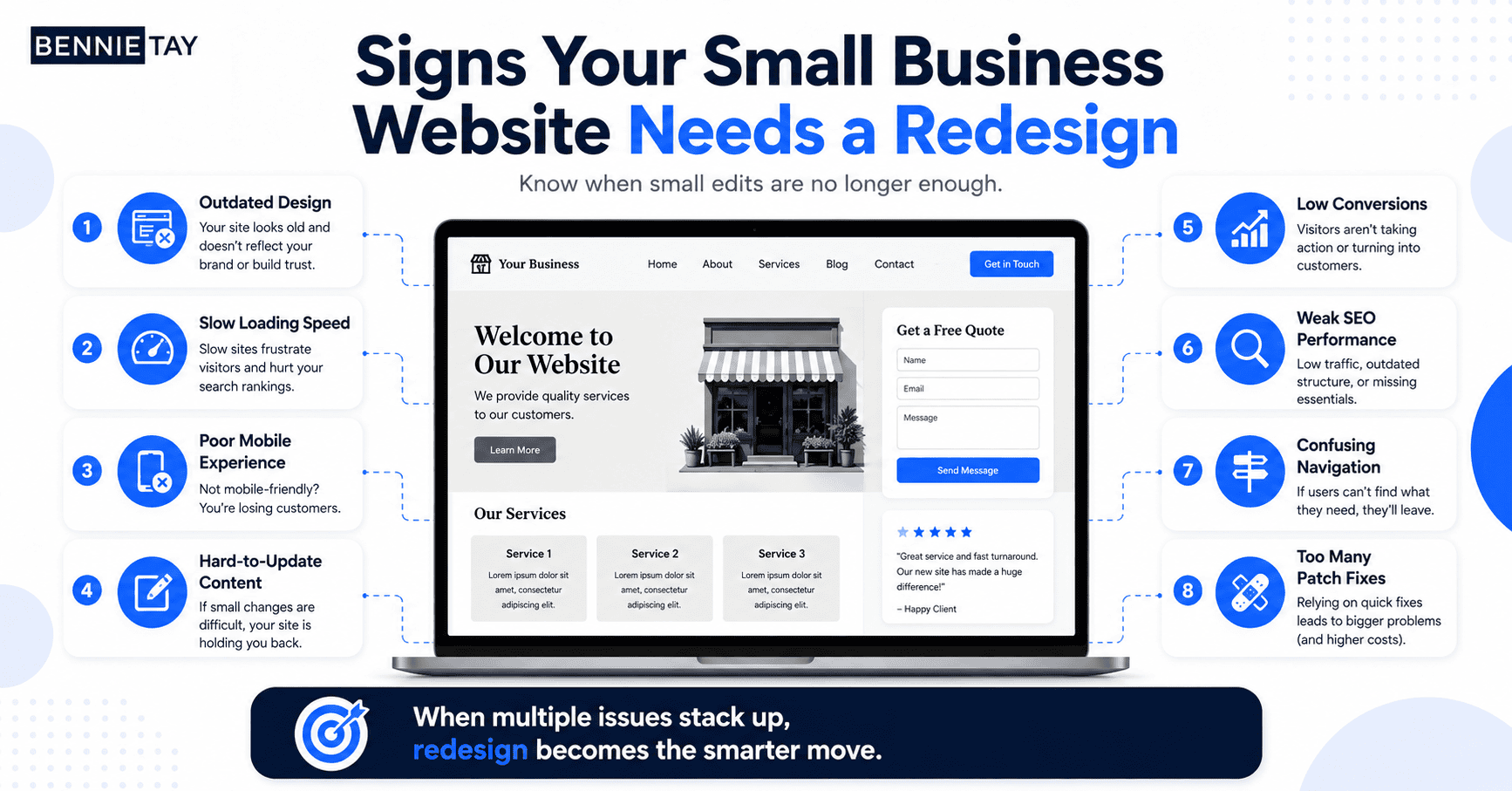
One of the clearest signs that your website needs a redesign is that it no longer represents your business properly.
Small businesses change over time. You may have started with one service and later expanded into several offers. You may now serve a different type of customer. Your pricing may have changed. Your business may have become more professional, more specialized, or more premium. If your website still reflects the old version of your business, it can create a mismatch.
Another sign is poor enquiry performance. If people visit your website but do not contact you, something may be wrong with the message, layout, trust signals, or call to action. Traffic alone is not enough. Your website should help visitors understand your offer and take the next step.
An outdated design is also a common reason to redesign. Customers make quick judgments online. If your website looks old, messy, or incomplete, they may assume your business is less professional than your competitors.
Mobile problems are another major warning sign. Many customers browse on their phones. If your website is hard to read, slow to load, or difficult to navigate on mobile, you may lose enquiries before people even understand your offer.
You may also need a redesign if your website is difficult to update. If every small change requires technical help, or if the backend feels confusing, your website may slow down your marketing. A modern website should be easier to manage, especially for small businesses that need to update services, promotions, blogs, and landing pages.
When Simple Website Edits Are Enough
Sometimes you do not need a full redesign. Simple edits may be enough if the website foundation is still strong.
For example, if the layout is still clean, the website works well on mobile, the pages load quickly, and visitors are still enquiring, then you may only need content updates. You can refresh the homepage message, add new testimonials, update service details, improve the call-to-action wording, or add new portfolio examples.
Simple edits are also enough when the business has only changed slightly. If you added one new service, opened a new branch, changed opening hours, or updated pricing, you do not need to rebuild everything.
A small conversion improvement may also be possible without a full redesign. For example, adding a clearer WhatsApp button, improving the contact form, changing the headline, or adding stronger testimonials can sometimes improve enquiries quickly.
The key is to look at the website honestly. If the website is already clear, fast, mobile-friendly, and aligned with your business, then updates may be enough. But if the website has multiple issues across design, content, structure, SEO, and conversion, editing small pieces may only delay the bigger fix.
When a Full Website Rebuild Is Better
A full website rebuild is usually better when the current website is holding the business back at a deeper level.
If the website structure is confusing, rebuilding may be better than trying to patch it. For example, if all your services are squeezed into one page, your blog has no clear direction, your navigation is messy, and your calls to action are inconsistent, it may be easier to rebuild the website properly.
A rebuild is also better if your website is built on an outdated platform or theme. Old website setups can create problems with speed, security, editing, mobile design, and future growth. You may be able to patch some issues, but the site may still feel unstable or hard to improve.
If your business has repositioned, a full redesign is often necessary. For example, if you used to provide general services but now want to target clinics, salons, contractors, consultants, or small businesses, your website needs to reflect that new positioning clearly.
A rebuild is also useful when SEO needs to be improved from the ground up. If the current website has weak page structure, poor URLs, thin content, duplicate pages, missing metadata, and no internal linking strategy, a full redesign can create a better foundation.
The same applies to conversion. If your website was built only to look nice but not to generate leads, you may need to rebuild it as a proper lead-generation website.
Your Website Looks Outdated Compared to Competitors
Design is not everything, but it still matters.
Customers compare businesses quickly. If your competitors have modern, clean, mobile-friendly websites and yours looks old or unfinished, you may lose trust before the customer contacts you.
An outdated website can create the impression that your business is not active, not professional, or not keeping up with customer expectations. This may not be true, but online perception matters.
For small businesses, a redesign can help reposition the business. It can make your brand feel more credible, established, and easier to trust. This is especially important for services where customers are comparing several options, such as website design, clinics, beauty salons, contractors, coaches, consultants, gyms, agencies, and professional services.
A modern website does not need to be overly fancy. It needs to be clean, readable, well-structured, and aligned with your business identity. A simple but professional website is often better than a design that tries too hard with animations and effects.
The goal is to make the visitor feel that your business is credible enough to contact.
Your Website Is Not Generating Enquiries
A website that does not generate enquiries may need more than a design refresh.
Many small business websites fail because they do not guide visitors toward action. They provide information, but they do not create a clear path from interest to enquiry.
This can happen when the homepage message is vague, the service pages are too general, the call-to-action buttons are weak, the contact form is hidden, or the website does not explain why customers should choose the business.
For example, a website may say “We provide professional services” without explaining the specific problem solved. A visitor may understand what the business does but still not feel enough reason to contact them.
A redesign can fix this by rebuilding the website around conversion. This means creating clearer headlines, stronger service pages, better trust signals, visible WhatsApp or enquiry buttons, simple forms, and a more logical customer journey.
If your website gets visitors but not leads, the issue may not be traffic. The issue may be conversion.
A conversion-focused redesign can help turn more of your existing traffic into enquiries before you spend more money on ads or SEO.
Your Website Message Is Unclear
Clear messaging is one of the most important parts of website performance.
Visitors should quickly understand what your business does, who it helps, and why it matters. If they need to read several sections before understanding your offer, the website is not doing its job.
Many small business websites use vague language because they want to sound professional. Phrases such as “innovative solutions,” “trusted partner,” “quality services,” and “one-stop provider” are common, but they often say very little.
A strong website message is specific. It explains the customer problem and the business outcome clearly.
For example, instead of saying “We help businesses grow online,” a stronger message could be “We build conversion-focused websites that help small businesses turn visitors into enquiries.” This is clearer because it explains the service, target audience, and result.
If your current website does not communicate your value clearly, a redesign can help reposition the entire business. It can make your homepage, service pages, and calls to action work together instead of feeling disconnected.
Good design attracts attention, but clear messaging creates understanding.
Your Website Is Weak on Mobile
A website that is weak on mobile is a serious problem.
Many customers will visit your website from their phone. They may come from Google, Facebook, Instagram, TikTok, LinkedIn, WhatsApp, Rednote, or a referral link. If the mobile version is hard to use, you may lose them quickly.
Mobile issues can include text that is too small, buttons that are hard to tap, images that load slowly, sections that feel cramped, forms that are difficult to complete, or menus that are confusing.
A website may look acceptable on desktop but still perform poorly on mobile. This is why a redesign should always consider mobile first.
For small businesses, mobile experience directly affects enquiries. If a customer is ready to contact you but cannot easily find the WhatsApp button, call button, or enquiry form, they may leave.
A mobile-friendly redesign should make the website easier to scan, read, and act on. The most important information should appear early. Calls to action should be visible. Pages should load quickly. The layout should feel natural on a phone.
A business website that does not work well on mobile is not fully functional.
Your Website Loads Too Slowly
Slow websites lose customers.
When a page takes too long to load, visitors may leave before they even see your offer. This is especially costly if you are paying for traffic through Facebook Ads, Google Ads, TikTok Ads, or other campaigns.
Website speed can be affected by large images, too many plugins, outdated themes, poor hosting, unnecessary scripts, heavy animations, or messy website code.
A slow website also affects trust. Visitors may not think about speed in technical terms, but they feel the frustration. If the website is slow, the business can feel less professional.
A redesign can improve speed by rebuilding the site with a lighter structure, optimized images, better hosting, cleaner design, and fewer unnecessary features.
For SEO, speed also matters because search engines care about user experience. A slow website may struggle to perform well compared to faster, more usable websites.
A good redesign should not only focus on how the site looks. It should also improve how the site feels.
Your Website Is Not Built for SEO
A website redesign is often needed when the current site has poor SEO structure.
Many small business websites were built without search strategy. They may have only a few pages, thin content, unclear headings, missing meta descriptions, generic URLs, no internal links, and no blog strategy.
This makes it harder for Google to understand what the business offers. It also limits the number of searches the website can appear for.
For example, if a business offers website design, landing pages, Website-as-a-Service, website redesign, and local SEO pages, but all of these are only mentioned briefly on one page, the website may not have enough depth to rank for each service.
A better SEO structure would create focused pages for each main service. It may also include blog articles that answer customer questions, location pages for local visibility, and internal links that connect related topics.
A redesign gives you the chance to rebuild the website around search intent. Instead of adding keywords randomly, you can create a structure that helps visitors and search engines understand the business clearly.
SEO should not be added at the end. It should be part of the redesign plan from the beginning.
Your Website Is Not Ready for GEO and AI Search
Search behaviour is changing. People are no longer only using traditional search engines. Many are also asking AI tools for advice, comparisons, recommendations, and explanations.
This is where GEO, or Generative Engine Optimization, becomes important.
A GEO-friendly website is easy for AI search engines to understand. It has clear service descriptions, helpful answers, structured content, FAQs, location information, and enough detail to explain what the business does.
If your website is vague or thin, AI systems may not understand your expertise clearly. A homepage with generic marketing phrases does not give much useful information. A website with clear service pages, case studies, FAQs, and helpful blog content gives AI tools more context.
A redesign can improve GEO by restructuring your content around real questions and answers. For example, your website can explain what your service includes, who it is for, how the process works, what problems it solves, what areas you serve, and what customers should do next.
This also helps real human visitors. GEO-friendly content is usually clearer, more specific, and more useful.
A website that is easy for AI to understand is often easier for customers to understand too.
Your Business Has Changed but the Website Has Not
Businesses evolve. Your website should evolve with the business.
Maybe you started as a general freelancer but now offer a more professional service package. Maybe you used to serve anyone but now want to focus on clinics, salons, contractors, coaches, or local service businesses. Or maybe you added monthly website plans, landing pages, local SEO pages, or website audits. Maybe your pricing, process, and target customers have changed.
If your website still reflects the old version of your business, it can confuse visitors.
A redesign can help align your website with your current direction. It can update the positioning, service pages, pricing structure, portfolio, testimonials, and call-to-action flow.
This is especially important when you are trying to attract better clients. If your website looks like it was built for your old market, it may not appeal to the customers you want now.
Your website should represent where your business is going, not only where it used to be.
Your Website Is Hard to Update
A website should support your marketing, not slow it down.
If every small change is difficult, your website becomes a problem. You may avoid updating service pages, posting blogs, adding testimonials, changing prices, or creating landing pages because the backend is too hard to use.
For small businesses, this can limit growth. Marketing changes quickly. You may need to promote new services, launch campaigns, publish content, update offers, or add location pages. If your website cannot support these changes easily, you may fall behind.
A redesign can make the website easier to manage. This may involve moving to a better platform, improving the content management system, simplifying page templates, or setting up reusable sections.
For businesses that want to publish blog content regularly, run ads, or improve SEO, an easy-to-update website is important.
A website is not a one-time project. It should be a flexible business asset.
Your Website Does Not Have Strong Trust Signals
Trust is a major factor in whether visitors contact a business.
If your website does not show proof, visitors may hesitate. They may wonder whether your business is experienced, reliable, or suitable for them.
Trust signals can include testimonials, Google reviews, portfolio examples, case studies, client logos, project photos, before-and-after results, certifications, media mentions, team photos, business address, and clear process explanations.
A redesign can help place these trust signals in the right parts of the website. Instead of hiding all testimonials on one page, they can appear near service sections and calls to action. Portfolio examples can be connected to relevant services. Case studies can show how your business solves real problems.
For service businesses, trust signals are especially important because customers often need to speak with you before buying. The more trust your website builds, the easier it becomes for visitors to enquire.
A website that only talks about your services but shows no proof may struggle to convert.
Your Website Has Too Many Unfocused Pages
Some websites grow messy over time.
You may have added pages, sections, blog posts, landing pages, and service descriptions without a clear plan. Over time, the website becomes harder to navigate. Visitors do not know where to go. Search engines may struggle to understand the structure. Some pages may overlap or compete with each other.
A redesign can clean up the website architecture.
This means deciding which pages are necessary, which pages should be combined, which pages should be removed, and which pages should be improved. It also means creating a clearer navigation structure so visitors can find what they need quickly.
For SEO, this is important because a well-organized website can perform better than a messy one. Search engines can understand page relationships more easily. Visitors can move from blog posts to service pages more naturally.
A website redesign is not only about adding more. Sometimes it is about removing confusion.
How to Plan a Website Redesign Properly
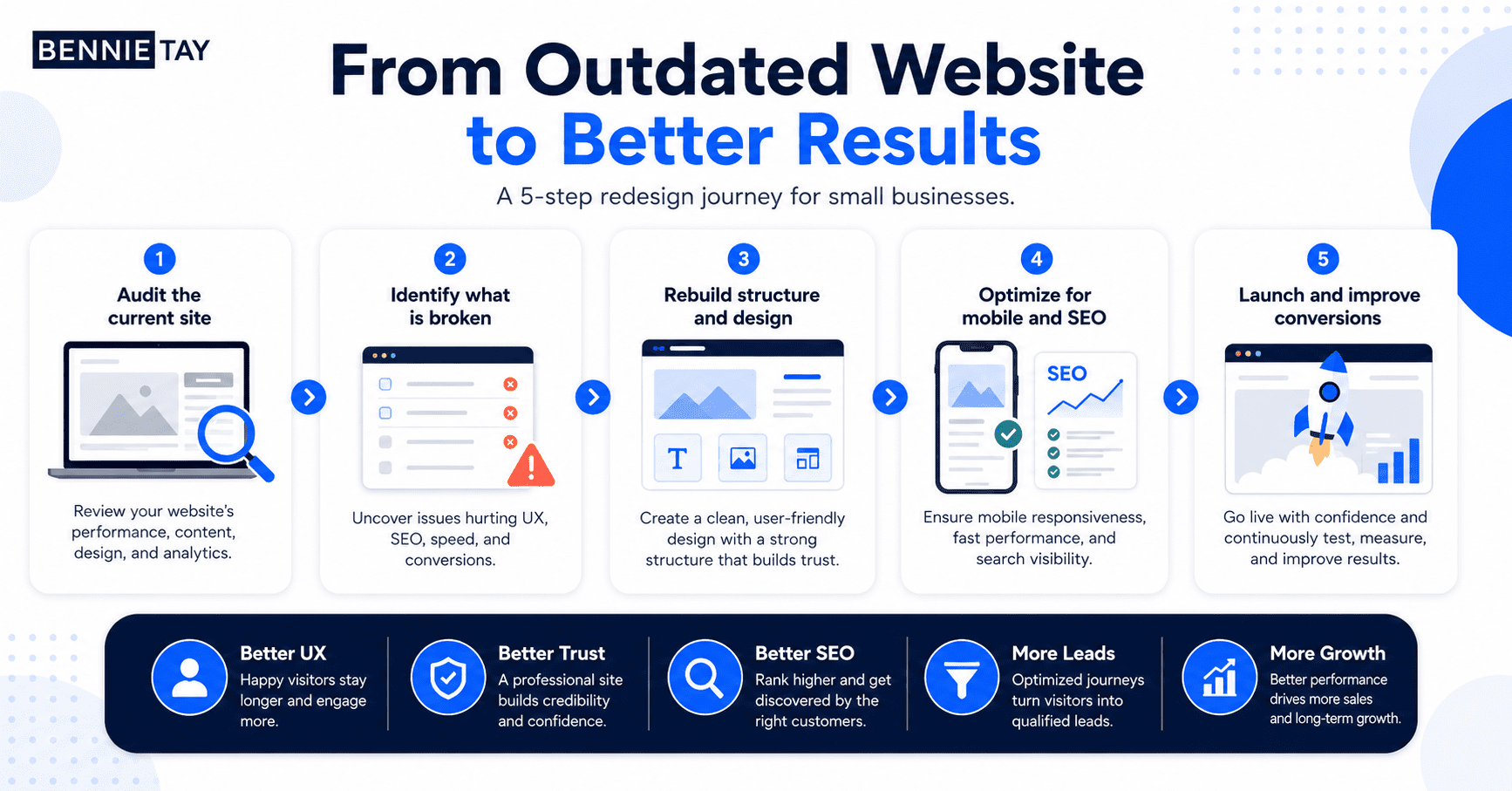
A good website redesign should start with strategy, not visuals.
Before changing the design, you should understand the website’s goal. Do you want more enquiries, better SEO, stronger brand trust, more bookings, more quote requests, better ad conversions, or a clearer explanation of your services?
Once the goal is clear, review the current website. Look at which pages get traffic, which pages generate enquiries, where visitors drop off, what content is outdated, and what information is missing.
Then plan the new structure. Decide which pages are needed, what keywords each page should target, what the homepage should communicate, and what the main call to action should be.
After that, work on copywriting. The words should explain the business clearly, address customer problems, show value, and guide visitors toward action.
Only then should the visual design be finalized. Good design should support the message, not cover up weak content.
A redesign without strategy may look better but still fail to generate results.
Website Redesign and SEO Migration
If your existing website already has some Google traffic, you need to be careful during a redesign.
Changing pages, URLs, titles, or content without planning can hurt SEO. Pages that used to rank may disappear. Broken links may appear. Search engines may struggle to understand the new structure.
This is why SEO migration is important.
Before redesigning, identify the pages that currently receive traffic or have backlinks. Decide which pages should be kept, improved, redirected, or removed. If URLs change, proper redirects should be set up. Metadata, headings, internal links, and content should be reviewed carefully.
A redesign should protect existing SEO value while improving the website for future growth.
For small businesses, this step is often overlooked. But if your website already gets organic traffic, careless redesign can cause rankings to drop.
A proper redesign should improve SEO, not damage it.
How a Redesign Can Improve Conversions
A conversion-focused redesign can help turn more visitors into leads.
This usually involves improving the homepage message, making calls to action clearer, adding trust signals, simplifying navigation, improving mobile design, making forms easier, and placing enquiry buttons in better locations.
For Malaysian small businesses, WhatsApp integration can also improve conversions. Many visitors prefer to ask questions through WhatsApp instead of filling in a form. A redesign can add service-specific WhatsApp buttons, pre-filled messages, and stronger enquiry sections.
A redesign can also improve landing pages. If you run Facebook Ads or Google Ads, dedicated landing pages can help convert paid traffic better than a general homepage.
The goal is to reduce friction. Visitors should understand what you offer, believe that you can help, and know exactly what to do next.
A good redesign does not only create a nicer website. It creates a smoother customer journey.
What Pages Should Be Included in a Redesigned Small Business Website?
A redesigned small business website should usually include a clear homepage, about page, services overview page, individual service pages, portfolio or case studies, testimonials, blog, FAQ, and contact page.
The homepage should explain the business and guide visitors toward the main action. The about page should build credibility. The services overview page should show what you offer, while individual service pages should go deeper into each service.
A portfolio or case study section helps show proof. Testimonials build trust. A blog supports SEO and customer education. An FAQ page helps answer common questions and improve GEO. The contact page should make it easy for visitors to enquire.
For local businesses, location pages may also be useful. For businesses running ads, dedicated landing pages should be created. And for businesses using WhatsApp, each important page should have a relevant WhatsApp CTA.
The right structure depends on the business, but the website should always be built around clarity, trust, and action.
Common Website Redesign Mistakes
One common mistake is redesigning only for appearance. A website can look better but still fail if the copy, structure, and conversion flow are weak.
Another mistake is ignoring SEO. If you remove pages, change URLs, or rewrite content without a plan, you may lose existing search visibility.
Some businesses also copy competitor websites too closely. Inspiration is fine, but your website should reflect your own positioning, services, process, and customers.
Another mistake is making the website too complicated. Too many animations, sections, popups, or design effects can distract visitors and slow down the site.
Some redesigns also fail because the call to action is unclear. The website may look beautiful, but visitors still do not know whether to book, call, WhatsApp, request a quote, or fill in a form.
A good redesign should be simple, strategic, and focused on business outcomes.
How to Know Whether the Redesign Worked
A website redesign should be measured after launch.
You can look at enquiry volume, WhatsApp clicks, form submissions, call clicks, booking requests, organic traffic, keyword rankings, bounce rate, time on page, and conversion rate.
However, numbers alone are not enough. Lead quality also matters. A redesigned website should ideally attract better-fit enquiries, not only more random traffic.
You should also pay attention to customer feedback. Are visitors understanding your service more easily? Are enquiries more specific? Or are people asking better questions? Are sales conversations easier because the website already explains your offer?
A website redesign is successful when it improves clarity, trust, traffic quality, and enquiry flow.
The website should also be easier for you to use as a business owner. If you can publish content, update pages, add testimonials, and launch campaigns more easily, that is also a meaningful improvement.
Final Thoughts
A small business should redesign its website when the current site no longer supports the business properly.
Simple edits are enough when the website foundation is still strong and only minor updates are needed. But if the website is outdated, unclear, slow, weak on mobile, poor for SEO, difficult to update, or not generating enquiries, a full redesign may be the better decision.
A website redesign should not only be about making the site look modern. It should improve the way your business communicates, builds trust, attracts traffic, and converts visitors into enquiries.
For small businesses, your website can be one of your most important sales and marketing assets. If it is not helping customers understand your value and contact you with confidence, it may be time to rebuild it properly.
A better website can help you look more credible, improve search visibility, support ads, increase WhatsApp enquiries, and turn more visitors into real business opportunities.
Need Help Redesigning Your Website?
At Bennie Tay, we help small businesses redesign websites that are outdated, unclear, or not generating enough enquiries.
Whether you need a full website rebuild, improved service pages, better website copy, landing pages, local SEO pages, or a conversion-focused redesign, the goal is simple: create a website that helps your business look credible, explain your offer clearly, and turn more visitors into enquiries.
Request a Free Website Growth Audit to find out whether your website needs a few improvements or a complete redesign.
FAQ
When should a small business redesign its website?
A small business should redesign its website when the current site looks outdated, does not generate enquiries, performs poorly on mobile, loads slowly, has unclear messaging, is hard to update, or no longer reflects the business properly.
What is the difference between a website update and a website redesign?
A website update usually involves small changes such as text, images, contact details, or minor layout adjustments. A website redesign is a bigger improvement that may involve changing the structure, design, copywriting, SEO, user experience, and conversion flow.
Should I redesign my website if it is not getting leads?
Yes, if your website gets traffic but does not generate enquiries, a redesign may help. The issue may be weak messaging, poor calls to action, lack of trust signals, bad mobile experience, or unclear service pages.
Can website redesign improve SEO?
Yes. A redesign can improve SEO if it includes better page structure, keyword-focused service pages, clean URLs, internal linking, faster loading speed, mobile-friendly design, and helpful content.
Can website redesign hurt SEO?
Yes, if it is done carelessly. Removing pages, changing URLs, deleting content, or ignoring redirects can hurt rankings. A proper redesign should include SEO migration planning.
How often should a small business redesign its website?
There is no fixed timeline, but many businesses review their website every two to three years. A redesign may be needed sooner if the business changes, the website performs poorly, or competitors have stronger online presence.
What should be included in a website redesign?
A website redesign should include strategy, updated page structure, improved copywriting, modern design, mobile optimization, SEO setup, faster loading speed, trust signals, clear calls to action, and better enquiry flow.
Is it better to edit my existing website or rebuild it?
Editing is better if the website foundation is strong and only minor changes are needed. Rebuilding is better if the website has deeper problems with structure, SEO, mobile usability, speed, messaging, or conversions.
What makes a website redesign GEO-friendly?
A GEO-friendly redesign includes clear service descriptions, structured content, FAQs, location information, direct answers, and helpful explanations that AI search engines can understand and summarize.
How can I know if my redesigned website is working?
You can measure performance through enquiries, WhatsApp clicks, form submissions, call clicks, organic traffic, keyword rankings, conversion rate, lead quality, and customer feedback.