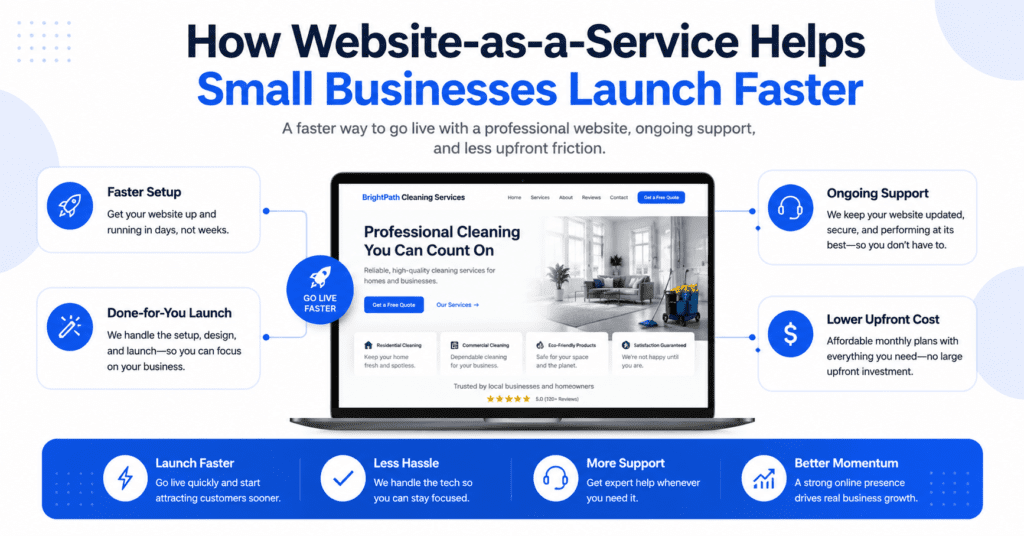
For many small businesses, building a website takes much longer than expected.
At the beginning, it sounds simple. Choose a web designer, provide your logo, send some company information, approve a design, and launch the website. Easy enough.
Then reality arrives, wearing a project timeline.
The business owner does not have the content ready. The designer needs clarification. The homepage direction changes. The service pages are unclear. The photos are outdated. The hosting is not set up. The domain is registered under someone else’s account. The contact form needs testing. The mobile layout needs fixing. The copy sounds too generic. The website is almost ready, but “almost” somehow lasts three weeks.
This is why many small business website projects get delayed.
Website-as-a-Service helps solve this problem by turning website creation into a more structured, managed, and repeatable process. Instead of treating every small business website like a large custom project from zero, Website-as-a-Service gives businesses a faster path to launch through ready frameworks, monthly plans, managed hosting, built-in maintenance, and ongoing support.
For small businesses, this matters.
A website that launches faster can support enquiries faster. It can help sales conversations faster. It can make the business look credible faster. Or it can give customers a proper place to learn about your services instead of relying only on social media, WhatsApp, or a half-forgotten Facebook page from 2019.
Website-as-a-Service is not only about cheaper pricing or monthly payment. One of its biggest advantages is speed.
This article explains how Website-as-a-Service helps small businesses launch faster, why traditional website projects often take longer, and what business owners should look for when choosing a managed monthly website plan.
What Is Website-as-a-Service?
Website-as-a-Service, often shortened to WaaS, is a subscription-based website model where a business pays a monthly fee for a managed website solution.
Instead of paying a large one-time fee for website design and then managing everything separately after launch, the business subscribes to a website plan that may include design, hosting, SSL, maintenance, backups, technical support, updates, and sometimes content changes or SEO support.
A Website-as-a-Service plan may include:
- Website design and setup
- Mobile responsive layout
- Hosting
- SSL certificate
- Domain connection
- Basic SEO setup
- Contact forms
- WhatsApp button
- Website maintenance
- Security updates
- Backups
- Technical support
- Content updates
- Future improvements
The exact scope depends on the provider.
The main idea is simple: the website is delivered as an ongoing service, not just a one-time project.
For small businesses, this can make the launch process faster because many technical, design, and operational parts are already prepared by the provider.
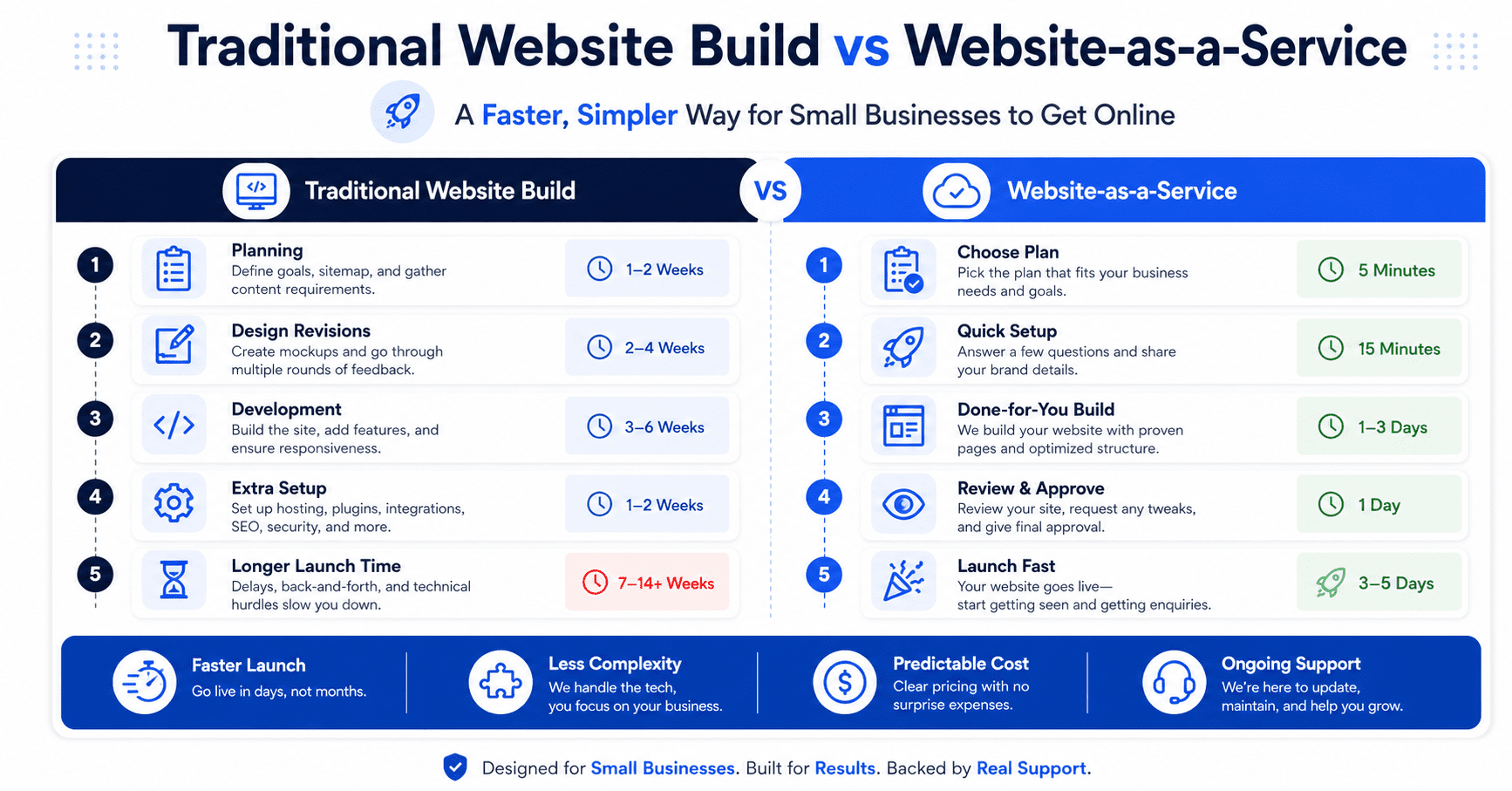
Why Traditional Website Projects Often Take Too Long
Before understanding why Website-as-a-Service can launch faster, it helps to understand why traditional website projects often slow down.
A one-time website project usually starts from a custom quotation and project scope. This can be useful for complex websites, but for many small businesses, it creates unnecessary delay.
Common reasons traditional website projects take longer include:
- Unclear website goals
- Slow quotation process
- Too many custom decisions
- Business owner does not know what content to prepare
- No ready page structure
- No copywriting support
- Delayed image collection
- Hosting or domain confusion
- Multiple rounds of design revision
- No clear launch checklist
- Poor communication between business and provider
- Technical setup handled separately
- SEO and tracking added late
- No standard approval process
Many small business owners also underestimate how much input a website project needs.
A website provider may ask for:
- Company background
- Service details
- Photos
- Testimonials
- Logo files
- Brand colours
- Contact details
- Pricing or package information
- FAQs
- Target audience
- Competitor references
- Preferred design style
- Domain access
- Hosting access
That is already a lot for a small business owner who is also handling sales, customers, staff, operations, suppliers, and the daily circus of running a business.
When there is no structured process, the website gets delayed.
Website-as-a-Service helps by reducing the number of decisions, simplifying the process, and giving small businesses a clearer path from signup to launch.
How Website-as-a-Service Helps Businesses Launch Faster
Website-as-a-Service speeds up website launch because it is built around repeatable systems.
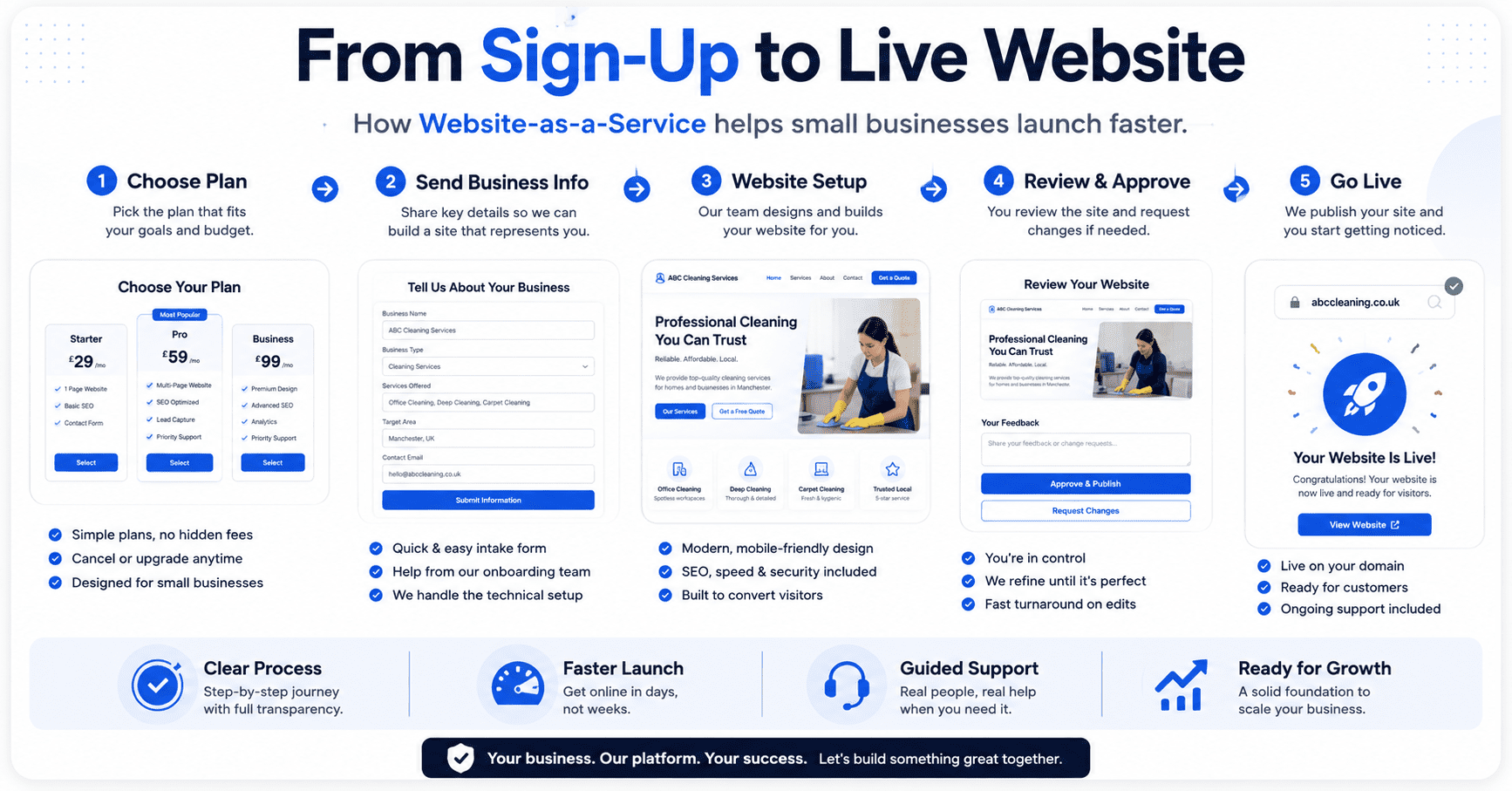
The provider usually has standard plans, ready structures, technical setup, design frameworks, and support processes already in place.
Here is how it helps.
1. Clear Packages Reduce Decision Time
One of the first reasons Website-as-a-Service is faster is that it usually comes with clear monthly packages.
Instead of starting with a long custom proposal, the business can choose a plan that fits its needs.
For example:
- Basic website plan for a simple online presence
- Business website plan for SMEs needing several pages
- Lead generation website plan for service businesses
- E-commerce or advanced plan for more complex needs
A clear package makes it easier for business owners to decide.
They can quickly understand:
- How many pages are included
- What services are included
- What the monthly cost is
- Whether hosting is included
- Whether maintenance is included
- Whether updates are included
- What support is provided
This reduces the back-and-forth that often delays traditional website projects.
Instead of waiting for multiple custom quotations, the business can start with a defined plan and move into setup faster.
Clarity speeds up decisions. Vague quotations slow everything down, because apparently humans enjoy turning simple purchases into archaeological investigations.
2. Ready Website Structures Save Planning Time
A common delay in website projects is page structure.
Many business owners know they need a website, but they do not know what pages or sections should be included.
Should the website have one services page or separate service pages? Should pricing be shown? Or should testimonials appear on the homepage? Should there be an FAQ? Should the About page focus on company history or customer trust? Or should the homepage start with a banner, problem statement, or service overview?
These decisions matter, but they can also slow the project.
A good Website-as-a-Service provider already has proven website structures for different business types.
For example, a service business website may follow this structure:
- Homepage
- About page
- Services page
- Individual service sections
- Testimonials
- FAQ
- Contact page
A consultant website may include:
- Hero section
- Problem statement
- Services
- Process
- Client results
- About the consultant
- Booking call section
- FAQ
A clinic website may include:
- Services
- Doctors or team profile
- Opening hours
- Location
- Patient FAQs
- Booking or enquiry form
These ready structures reduce planning time.
The business does not need to invent everything from scratch. The provider can guide the structure based on what usually works.
This helps the website move faster from idea to layout.
3. Template-Based or Framework-Based Design Speeds Up Build Time
Website-as-a-Service often uses pre-built design frameworks or customisable templates.
That does not mean the website has to look generic.
A template or framework simply gives the provider a starting point. The colours, images, copy, sections, layout, and branding can still be adjusted for the business.
This speeds up the design process because the provider does not need to create every layout from zero.
For small businesses, this is usually a good thing.
Most SMEs do not need a completely custom-designed website with unusual layouts, advanced animations, or experimental user experience. They need a professional, clean, mobile-friendly website that explains their services and helps customers contact them.
A good website framework can provide:
- Strong homepage structure
- Service sections
- Trust sections
- Testimonials
- FAQs
- Contact forms
- Mobile responsive layouts
- Clear call-to-action sections
This allows the website to be built faster while still looking professional.
The key is proper customisation. A good Website-as-a-Service provider should adapt the design to your business, not just paste your logo onto a recycled template and call it innovation.
4. Content Guidance Reduces Delays
Content is one of the biggest reasons websites get delayed.
Many business owners do not have their website content ready. They may have a company profile, a brochure, old social media captions, or rough notes. But they often do not have clear website copy.
A proper Website-as-a-Service process can speed this up by giving content guidance.
This may include:
- Content collection forms
- Page-by-page prompts
- Service description templates
- FAQ prompts
- About section guidance
- Testimonial request formats
- Image checklist
- Call-to-action recommendations
Instead of asking the business owner to “send content,” the provider can guide exactly what is needed.
For example, for each service page, the provider may ask:
- What service do you provide?
- Who is it for?
- What problem does it solve?
- What is included?
- What is the process?
- What makes your service different?
- What should customers do next?
This makes content preparation much easier.
Some Website-as-a-Service plans may also include copywriting or copy improvement. This helps businesses launch faster because the provider can turn rough information into clear website content.
Without copy support, many websites get stuck waiting for business owners to write content. And business owners often delay writing because writing about your own business is somehow harder than doing the actual work.
5. Technical Setup Is Already Managed
A traditional website project can slow down when technical setup is handled separately.
The business may need to arrange:
- Domain registration
- Hosting purchase
- DNS setup
- SSL certificate
- Website installation
- Email setup
- Backup configuration
- Security settings
- Analytics tools
- Search Console setup
For a non-technical business owner, this can be confusing and time-consuming.
Website-as-a-Service usually includes managed technical setup.
The provider already has hosting, deployment, maintenance, backup, and security processes ready. This reduces technical delays.
The business does not need to coordinate between domain provider, hosting provider, developer, email provider, and whoever still remembers the login password.
A managed setup helps the website move faster to launch because the provider controls the technical environment.
This also reduces mistakes.
When one provider handles the setup, there is less risk of missing SSL, incorrect DNS records, broken forms, or hosting mismatch.
6. Mobile Responsive Design Is Built Into the Process
Mobile responsiveness should not be treated as a final adjustment. It should be part of the design from the beginning.
Website-as-a-Service providers usually build around mobile-ready layouts because they use proven frameworks or templates.
This helps launch faster because mobile design does not need to be rebuilt from scratch after the desktop version is approved.
A good mobile-ready website should have:
- Readable text
- Proper spacing
- Clear buttons
- Fast-loading images
- Simple menu
- Easy contact options
- Forms that work on mobile
- WhatsApp or call button
Many small business customers browse from their phones. If the mobile version is weak, the website is not ready.
By using mobile-responsive structures from the start, Website-as-a-Service reduces revision time and helps the website go live faster.
7. Built-In Lead Capture Features Reduce Extra Work
Small business websites usually need simple lead capture features.
These may include:
- Contact form
- WhatsApp button
- Click-to-call button
- Quote request form
- Booking link
- Google Maps
- Email link
- Newsletter form
In a traditional website project, these features may need to be discussed, quoted, built, tested, and revised.
With Website-as-a-Service, common lead capture features are often already part of the package.
This saves time.
For example, if the provider already includes a WhatsApp button and standard enquiry form, the business does not need to request these separately.
The website can launch faster with the basic conversion tools already in place.
This is important because a website without lead capture is not very useful. It may look nice, but it gives visitors no clear next step. A beautiful website with no enquiry path is just decoration with hosting fees.
8. Standard Launch Checklist Avoids Last-Minute Chaos
Many website launches are delayed because the final checklist is unclear.
Before launch, someone needs to check:
- Page content
- Mobile layout
- Contact form
- Links
- Images
- Page speed
- SEO titles
- Meta descriptions
- Sitemap
- Analytics
- Search Console
- SSL
- Domain connection
- Backup setup
- Browser compatibility
- Thank-you messages
- WhatsApp links
If the provider does not follow a proper launch checklist, problems appear at the last minute.
Website-as-a-Service providers usually have a repeatable launch process. This helps avoid unnecessary delay.
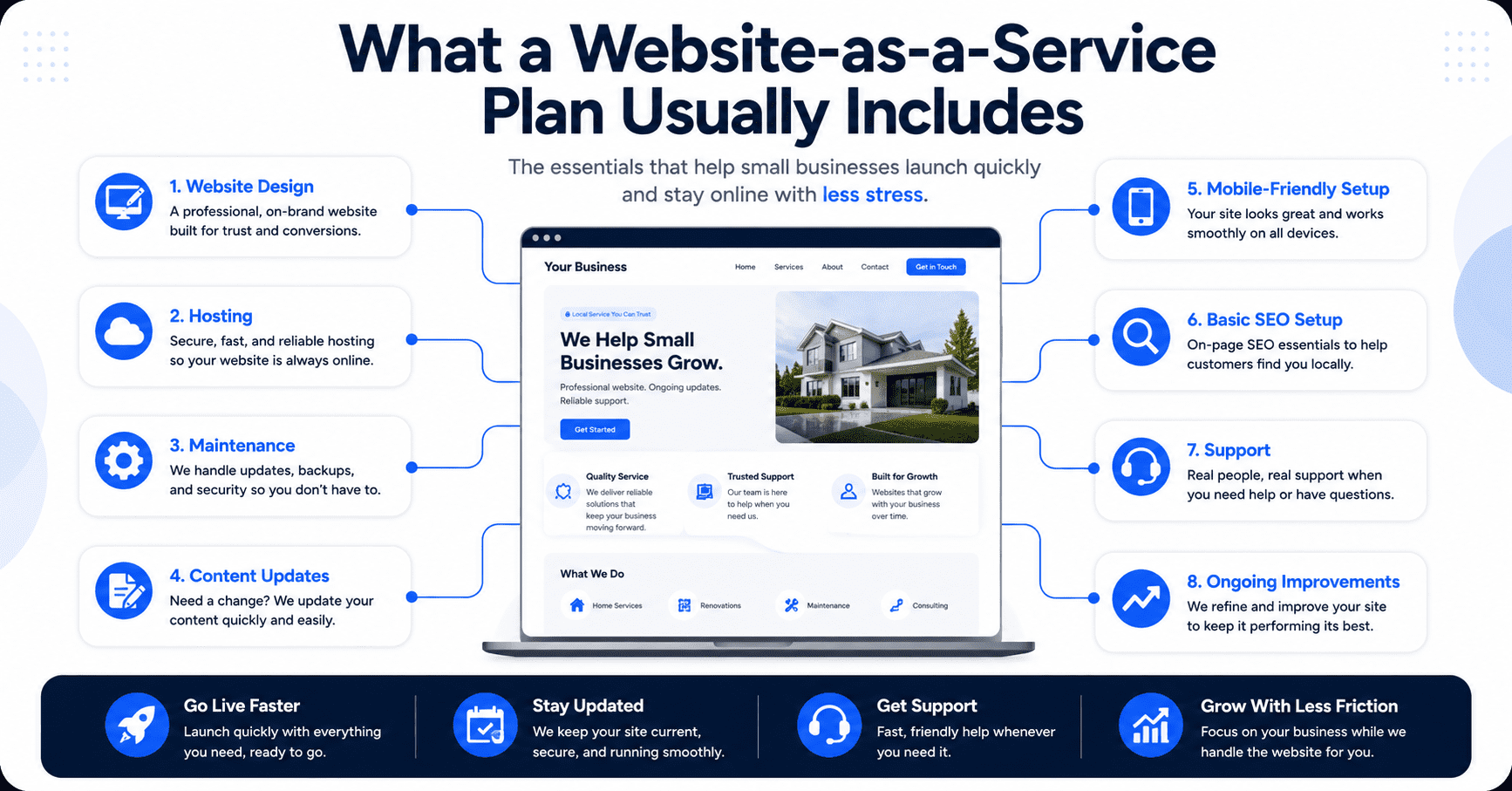
A standard launch checklist makes sure the important items are completed before the website goes live.
This is especially helpful for small businesses that do not know what to check.
The provider guides the launch instead of expecting the business owner to identify every technical issue.
9. Ongoing Support Removes the Pressure to Get Everything Perfect on Day One
One reason traditional website projects take too long is the pressure to finalise everything before launch.
Since the project ends after delivery, business owners often feel they must perfect every section, every image, every word, and every detail before going live.
That creates delays.
Website-as-a-Service changes the mindset.
Because support and updates are ongoing, the business can launch a strong first version and improve it over time.
This is useful because not every decision needs to be perfect on day one.
You can launch with:
- Core service pages
- Clear contact options
- Basic trust elements
- Main business information
- Essential SEO setup
Then improve later by adding:
- More testimonials
- Case studies
- Blog articles
- New service pages
- Better FAQs
- Landing pages
- Updated photos
- Stronger calls to action
This makes launch faster because the website does not need to be treated as a once-in-five-years project.
It can evolve.
For small businesses, this is practical. Launch first with a solid foundation. Improve based on real business needs.
10. Faster Launch Means Faster Market Testing
A faster website launch helps small businesses test their offer sooner.
Once your website is live, you can start using it for:
- Google Business Profile traffic
- Facebook ads
- Instagram bio link
- WhatsApp sharing
- Sales follow-up
- Email signatures
- Local SEO
- Referral credibility
- Brochure QR codes
- Business card links
- Customer enquiries
This is important because many small businesses do not know exactly what customers will respond to until they put the offer in front of the market.
A website helps test:
- Which services attract enquiries
- Which messages work
- Which locations bring traffic
- Which FAQs customers ask
- Which calls to action get clicks
- Whether customers prefer WhatsApp, form, or phone call
Website-as-a-Service helps businesses launch faster so they can start learning faster.
A delayed website teaches nothing. It just sits in draft mode, quietly collecting excuses.
11. Monthly Plans Help Businesses Avoid Overbuilding
Traditional website projects sometimes become slow because businesses try to include too much from the beginning.
They want every page, every feature, every integration, every animation, every possible future idea, and maybe a customer portal “just in case.”
This can delay launch and increase cost.
Website-as-a-Service helps small businesses start with what they need now.
A practical first version may include:
- Homepage
- Services
- About
- Contact
- Testimonials
- FAQ
- WhatsApp button
- Basic SEO
- Tracking setup
This is enough for many businesses to start marketing and collecting enquiries.
Future features can be added later if needed.
This prevents overbuilding.
For SMEs, overbuilding is dangerous because it wastes time and budget before the business has validated what customers actually need.
A faster launch with a simpler website is often better than a complex website that takes months and still does not bring leads.
12. Provider Experience Speeds Up Common Decisions
Website-as-a-Service providers usually work with many similar small businesses. This experience helps speed up decisions.
For example, they may already know:
- What pages a service business usually needs
- Where to place WhatsApp buttons
- How to structure a homepage
- What trust sections improve enquiries
- What FAQs customers usually need
- How to write service sections
- How to set up lead forms
- What mobile layout works best
- What technical settings are required
This reduces guesswork.
Instead of starting from a blank page, the provider can guide the business based on proven patterns.
This is valuable for small business owners who do not build websites often.
You may know your business very well, but you may not know how to structure a website. That is normal. Nobody expects a clinic owner, contractor, tutor, or consultant to also become a web strategist. Humanity already has enough unpaid job scopes.
What Types of Small Businesses Benefit Most?
Website-as-a-Service is especially useful for small businesses that need a professional website quickly but do not want to manage the technical side.
It works well for:
- Consultants
- Coaches
- Clinics
- Beauty salons
- Contractors
- Tuition centres
- Accounting firms
- Legal firms
- Interior designers
- Home service providers
- Agencies
- Freelancers
- Local service businesses
- Professional service providers
- Startups
- Small B2B companies
These businesses usually need credibility, clear service information, easy enquiry flow, and ongoing updates.
They may not need a fully custom website from day one. They need a fast, professional, managed website that can grow.
When Website-as-a-Service May Not Be Fast Enough
Website-as-a-Service helps many small businesses launch faster, but it is not always the right fit.
It may not be suitable if your business needs:
- Complex custom features
- Advanced customer dashboard
- Marketplace system
- Custom booking logic
- Large e-commerce catalogue
- Complex payment rules
- Multi-vendor system
- Deep API integrations
- Custom software development
- Highly unique brand experience
In these cases, a custom website project may be better, even if it takes longer.
Website-as-a-Service is strongest for managed business websites, lead generation websites, service websites, and SME online presence projects.
It is not always the best option for complex software platforms.
What to Prepare to Launch Faster With Website-as-a-Service
Even with Website-as-a-Service, the business still needs to provide key information.
To launch faster, prepare:
- Logo
- Brand colours, if available
- Business name
- Contact details
- WhatsApp number
- Email address
- Business location
- Service list
- Short description of each service
- Customer testimonials
- Project photos or product images
- Team photos, if relevant
- FAQs
- Existing domain details, if any
- Social media links
- Google Business Profile link
- Preferred call to action
The more prepared you are, the faster the provider can complete the website.
But the advantage of Website-as-a-Service is that you do not need to prepare everything perfectly. A good provider can guide, structure, and improve the content with you.
What to Check Before Choosing a Website-as-a-Service Provider
Before choosing a provider, ask these questions:
- How fast can the website be launched after I provide the required information?
- What do I need to prepare?
- Is copywriting included?
- Is hosting included?
- Is SSL included?
- Is basic SEO included?
- Are content updates included after launch?
- How many pages are included?
- Is mobile responsive design included?
- Are backups and security included?
- What support is included?
- What happens if I cancel?
- Who owns the domain?
- Who owns the content?
- Can the website be expanded later?
- Are landing pages included?
- What is not included?
Do not only ask how fast the website can launch. Ask what is included in that launch.
A fast website is only useful if it is clear, professional, mobile-friendly, and ready to support real customers.
Fast but messy is not efficiency. It is just chaos with a deadline.
Final Thoughts
Website-as-a-Service helps small businesses launch faster by simplifying the entire website process.
Instead of starting from zero, businesses can use ready website structures, clear monthly plans, managed technical setup, mobile-ready design frameworks, built-in lead capture, content guidance, launch checklists, and ongoing support.
This reduces delays caused by unclear scope, missing content, technical setup, design revisions, and post-launch uncertainty.
For small businesses and SMEs, speed matters.
The faster your website launches, the faster you can use it for enquiries, marketing, sales conversations, Google visibility, social media traffic, and customer trust.
A traditional one-time website build can still be the right option for businesses that need full customisation or advanced functionality. But for many small businesses that need a professional website quickly, Website-as-a-Service offers a more practical path.
The best website is not always the biggest or most expensive one.
Often, the best website is the one that launches quickly, communicates clearly, works on mobile, captures enquiries, and can improve over time.
Website-as-a-Service makes that possible by turning the website from a slow one-time project into a managed, ongoing service.
And for small businesses that need to move fast, that can make all the difference.
FAQ: Website-as-a-Service and Faster Website Launch
How does Website-as-a-Service help small businesses launch faster?
Website-as-a-Service helps small businesses launch faster by using clear packages, ready website structures, managed hosting, mobile-responsive frameworks, content guidance, built-in lead capture, and standard launch processes.
Is Website-as-a-Service faster than a traditional website build?
It is often faster for standard small business websites because the provider already has systems, templates, hosting, and maintenance workflows in place. However, complex custom websites may still require a traditional development project.
Can a Website-as-a-Service website still look professional?
Yes. A Website-as-a-Service website can look professional if the provider customises the design, structure, images, copy, and branding properly. Faster launch does not have to mean poor quality.
What type of businesses benefit from Website-as-a-Service?
Website-as-a-Service is useful for consultants, clinics, salons, contractors, agencies, freelancers, coaches, tuition centres, local service providers, startups, and SMEs that need a professional website without managing technical work.
Does Website-as-a-Service include hosting?
Many Website-as-a-Service plans include hosting as part of the monthly fee. However, you should always confirm what type of hosting is included and whether there are renewal or performance limits.
Does Website-as-a-Service include website maintenance?
Most Website-as-a-Service plans include some level of maintenance, such as updates, backups, security checks, and technical support. The exact scope depends on the provider.
What should I prepare before starting a Website-as-a-Service plan?
Prepare your logo, contact details, service list, business description, photos, testimonials, FAQs, social media links, and domain details if you already have one.
Can I improve the website after launch?
Yes. One of the advantages of Website-as-a-Service is that the website can be improved over time through content updates, new pages, testimonials, FAQs, landing pages, and SEO improvements.
Is Website-as-a-Service suitable for e-commerce websites?
It can be suitable for simple e-commerce websites, depending on the provider. However, complex e-commerce stores with advanced inventory, payment, shipping, or integration needs may require a custom website project.
What should I ask before choosing a Website-as-a-Service provider?
Ask what is included, how fast the website can launch, whether copywriting is included, what support is provided, who owns the domain and content, what happens if you cancel, and whether the website can be expanded later.