Your business is based in Petaling Jaya, but you also serve customers in Subang Jaya, Shah Alam, Puchong and Kuala Lumpur.
Should your website have a separate page for each area?
Potentially, yes.
A useful service-area page can help potential customers understand whether you serve their location, what you provide there and how to contact you. But there is an important difference between creating genuinely useful local pages and publishing 30 almost identical pages where only the city name changes.
Google’s current spam policies specifically warn against pages targeted at different cities or regions that are substantially similar and mainly funnel visitors toward the same destination. This is described as doorway abuse.
So the goal is not:
Create as many location pages as possible.
The goal is:
Create useful pages for locations that genuinely matter to your customers.
If you serve customers across Malaysia, here is how to build service-area pages that support local SEO without turning your website into a keyword-stuffing exercise.
What Is a Service Area Page?
A service area page is a website page focused on a particular geographical area that your business genuinely serves.
For example, a renovation contractor based in Petaling Jaya might have pages such as:
- Renovation Contractor in Petaling Jaya
- Renovation Contractor in Subang Jaya
- Renovation Contractor in Shah Alam
A cleaning company might create:
- Office Cleaning Services in Kuala Lumpur
- Office Cleaning Services in Petaling Jaya
- Office Cleaning Services in Puchong
These pages can help visitors answer an important question:
“Does this company actually provide this service in my area?”
They can also give you space to explain location-specific services, projects, logistics, testimonials, coverage and frequently asked questions.
The important word is specific.
A useful local page should provide something that would still be valuable even if Google did not exist.
Google’s current people-first content guidance encourages website owners to create content primarily for visitors, provide original and useful information, demonstrate real experience and make sure someone leaves the page feeling they have learned enough to achieve their goal.
Service Area Page vs Location Page: What’s the Difference?
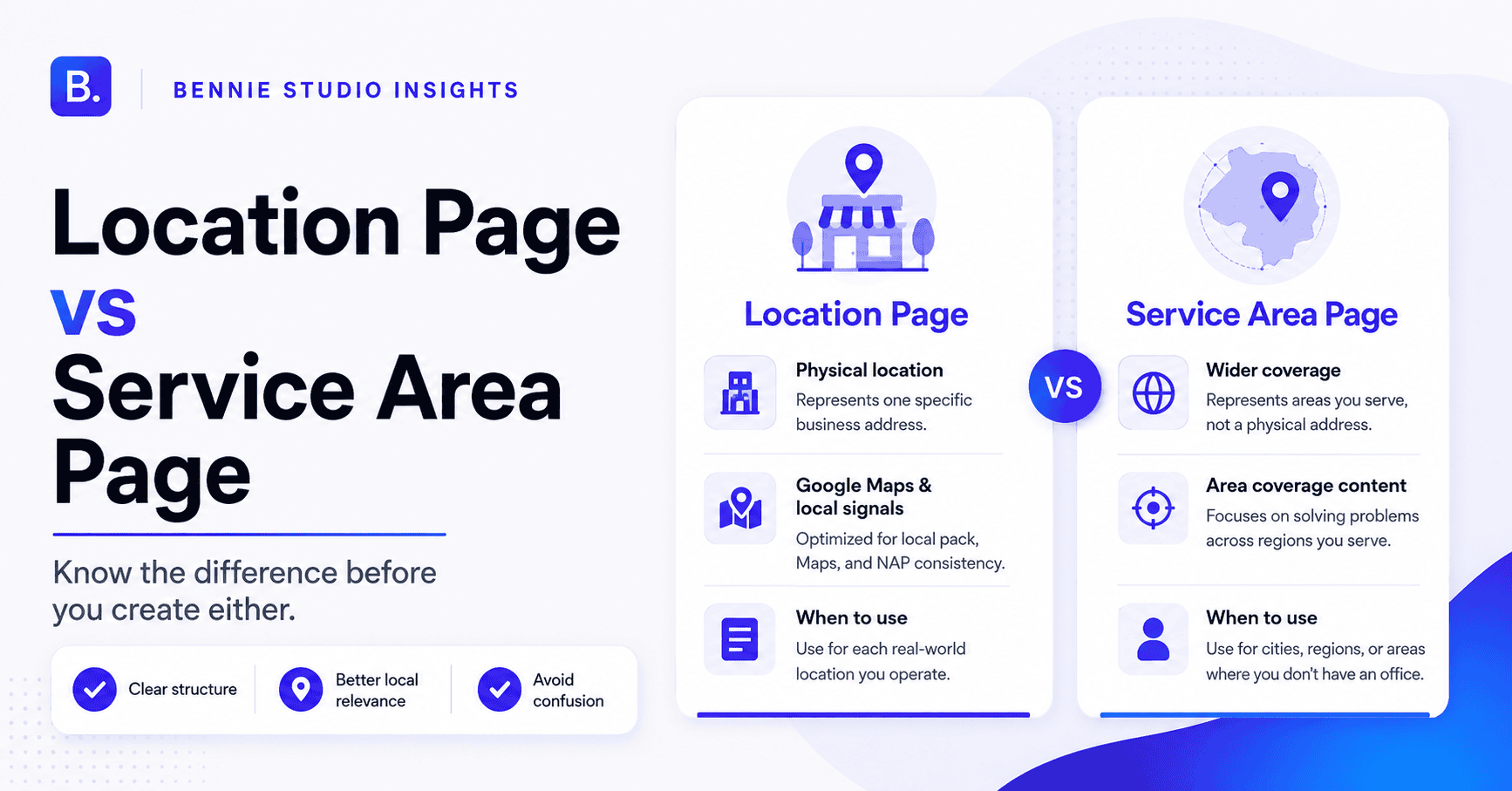
These two page types are related but not identical.
Location Page
A location page normally represents a real business branch or office.
For example:
Bennie Studio – Kuala Lumpur Office
The page may contain:
- address
- opening hours
- telephone number
- map
- staff
- photographs
- services available at that location
Service Area Page
A service area page represents an area where you provide services even though you may not have an office there.
For example:
Website Design Services in Shah Alam
You may serve businesses in Shah Alam without operating a physical Shah Alam office. Do not create fake branch addresses simply to appear more local.
Google’s Business Profile guidelines require businesses to accurately represent real-world locations and prohibit using virtual offices as locations unless the location meets Google’s specific eligibility requirements.
If you travel to customers instead of serving them at your business address, Google treats you differently from a storefront business.
Who Should Create Service Area Pages?
Service-area pages make the most sense for businesses whose customers care about geography.
Examples include:
- renovation contractors
- plumbers
- electricians
- air-conditioning companies
- cleaning companies
- pest-control businesses
- movers
- landscaping businesses
- tuition centres
- childcare businesses
- photographers
- event service providers
- professional service firms serving defined local markets
Imagine someone searching:
office cleaning company Petaling Jaya
The location clearly matters. A useful Petaling Jaya service page therefore makes sense. Compare that with a fully online software company serving customers worldwide.
Creating 100 pages titled:
Software Company Shah Alam
Software Company Bangi
Software Company Kajang
may offer very little genuine value if the service is identical regardless of location. Create local pages because location affects the customer’s decision, not because somebody discovered a spreadsheet containing Malaysian town names.
How Many Service Areas Should You Target?
Start with the areas that genuinely produce business.
Do not begin by asking:
How many pages can we create?
Ask:
Where do we actually serve customers?
Look at:
- existing customer locations
- enquiry records
- delivery or travel capability
- sales territories
- Google Search Console queries
- Google Analytics
- Google Business Profile
- strategic expansion areas
Prioritise locations where there is both business relevance and enough local information to build a useful page.
For Google Business Profile specifically, Google currently allows service-area and hybrid businesses to define up to 20 service areas, using cities, postal codes or other supported geographical areas. Google also recommends keeping the overall coverage reasonably close to the business, generally within about two hours’ driving time, although exceptions may apply to some businesses.
Your website can cover your genuine market more broadly, but the same principle is useful:
Be realistic about where you actually operate.
What Should a Good Service Area Page Include?
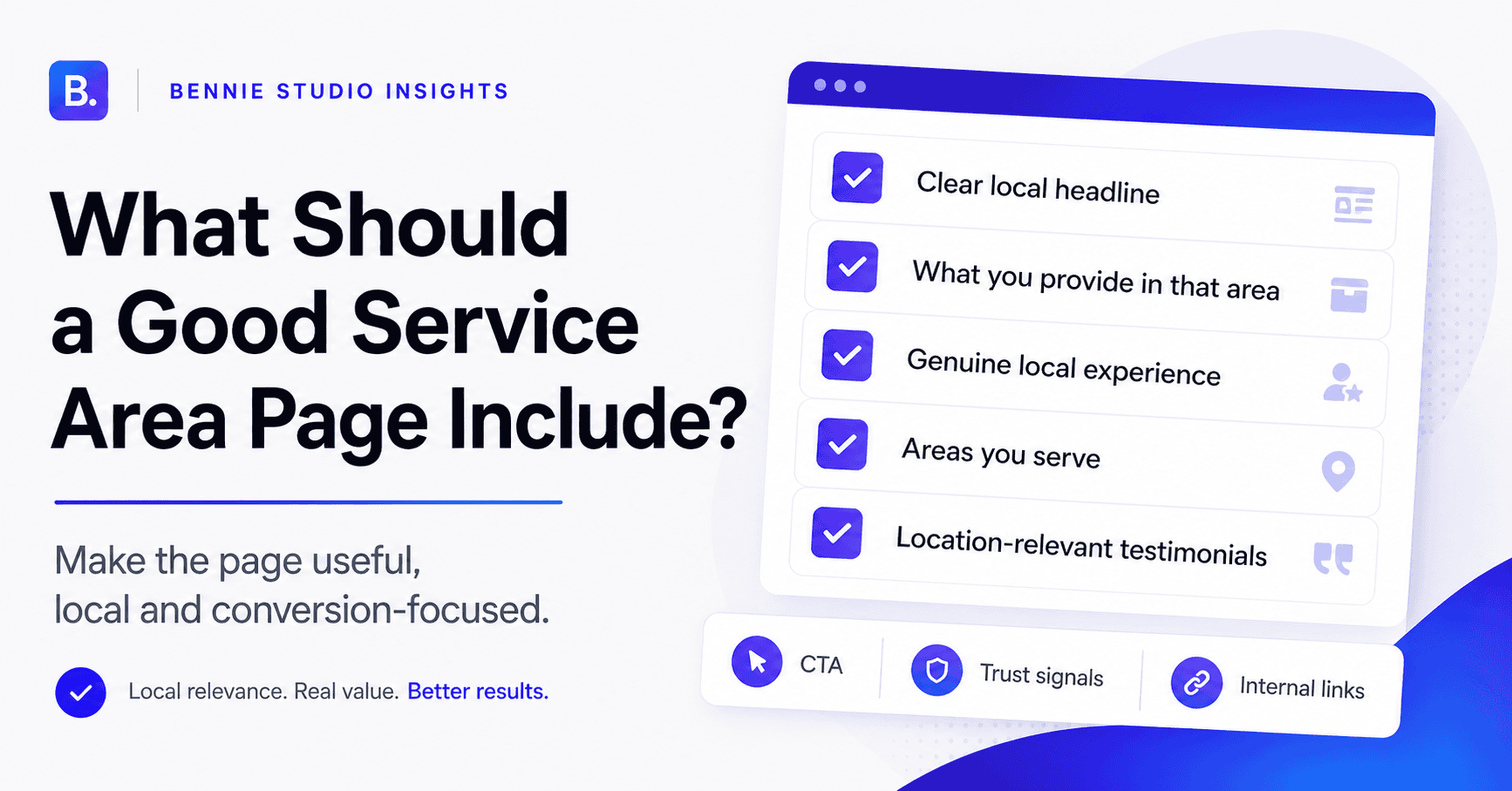
This is where most local pages either become genuinely useful or collapse into SEO wallpaper. I would normally include the following.
1. A Clear Local Headline
Your H1 should make the service and location obvious.
For example:
Office Cleaning Services in Petaling Jaya
or:
Renovation Contractor Serving Subang Jaya Homes
Do not write:
BEST #1 AFFORDABLE PROFESSIONAL TRUSTED RENOVATION CONTRACTOR SUBANG JAYA MALAYSIA
Besides looking like your keyboard has suffered an SEO-related emergency, it does not improve clarity.
Google’s Search Essentials recommend using words people would naturally use to find the content and placing them in prominent locations such as the title and main heading. Use the keyword naturally. Then move on.
2. Explain What You Actually Provide in That Area
Do not jump immediately into a history of the suburb. Someone looking for an electrician in Shah Alam probably does not need a paragraph explaining when Shah Alam became the capital of Selangor. Instead, explain your service.
For example:
We provide commercial electrical maintenance and installation services for offices, retail units and industrial properties across Shah Alam.
Then expand on the relevant services. This makes the page about the customer’s problem rather than the keyword.
3. Include Genuine Local Experience
This is one of the easiest ways to differentiate location pages. If you have completed projects in the area, show them.
For example:
Recent renovation projects in Subang Jaya have included condominium kitchen renovations, landed-property extensions and office refurbishments.
You might include:
- project photographs
- neighbourhoods served
- case studies
- client testimonials
- project types
- local business examples
This gives the page information another city page cannot simply copy.
It also demonstrates real experience, which aligns with Google’s recommendation to create content showing genuine first-hand knowledge rather than mass-produced search-engine-first pages.
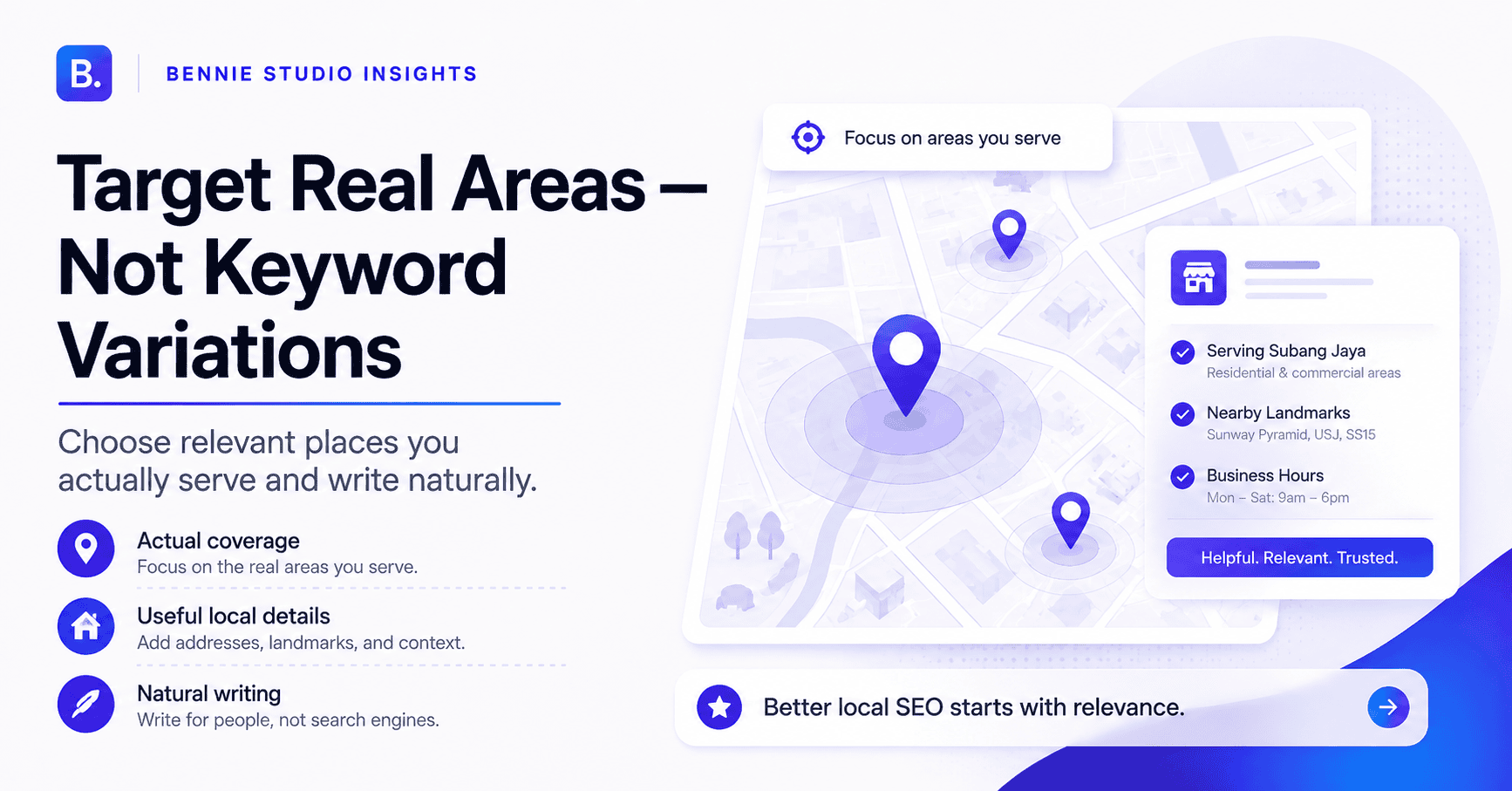
4. Mention Specific Areas You Serve
Within a larger city page, you can mention relevant neighbourhoods naturally.
For example, a Petaling Jaya page might explain that you commonly serve customers around:
- SS2
- Damansara
- Kelana Jaya
- Bandar Utama
- Ara Damansara
Only mention locations you genuinely serve. Do not insert 80 neighbourhood names into the footer in microscopic text and call it local SEO. The page should remain readable.
5. Add Location-Relevant Testimonials
If you have customer feedback from that service area, use it.
For example:
“The team completed our office renovation in Subang Jaya while we continued operating from another section of the premises.”
A location-specific testimonial is stronger than copying the same generic review across every page. If you do not have one yet, use relevant company-wide testimonials rather than inventing local proof. Authenticity beats localisation theatre.
6. Explain Your Local Process
Location can affect how your service works.
For example, a renovation contractor might explain:
- Initial discussion
- Site visit in Petaling Jaya
- Measurement and requirements
- Proposal
- Project planning
- Renovation
- Handover
A mobile service company might explain response areas or appointment arrangements.
A professional service provider might offer consultations remotely and in person. This gives the visitor practical information rather than another paragraph containing the city’s name.
7. Include a Useful FAQ
Local FAQs are particularly useful when questions genuinely vary by area.
For example:
Do you provide renovation services throughout Subang Jaya?
Explain your actual coverage.
Can you visit my property before providing a quotation?
Explain your site-visit process.
Do you serve condominiums as well as landed homes?
Answer clearly.
How long does it take to arrange a site visit?
Provide realistic expectations.
Do you charge extra to travel to this area?
Explain if relevant. FAQs should answer genuine customer questions.
They are not a place to create increasingly strange keyword variations such as:
Is your renovation contractor Subang Jaya renovation service the best renovation contractor service in Subang Jaya?
Nobody talks like this. Neither should your website.
8. Use a Clear Local CTA
The page should end with an obvious next action.
For example:
Need Office Cleaning in Petaling Jaya?
Tell us your premises type, approximate size and preferred cleaning schedule, and our team will advise on the next step.
Request a Quote →
Or:
WhatsApp Us About Your Property →
Make the CTA relevant to the service.
Do not simply use:
Submit
The visitor should know what happens after clicking.
What Makes Service Area Pages Unique Enough?
This is the most important part of the strategy.
Suppose you create pages for:
- Petaling Jaya
- Subang Jaya
- Shah Alam
- Puchong
If 95% of every page is identical and you simply swap the city name, there is very little reason for four pages to exist.
Google’s spam policy specifically identifies substantially similar pages targeting different cities or regions and funneling visitors onward as a doorway-abuse pattern. Instead, vary the content based on reality.
A strong page might contain different:
- customer examples
- case studies
- photographs
- neighbourhoods
- service considerations
- FAQs
- testimonials
- project types
- logistical information
You do not need every sentence to be unique for the sake of uniqueness. Basic business information can naturally repeat.
The important question is:
Does this page give someone in this location a meaningful reason to read it?
If yes, you are moving in the right direction.
How Long Should a Service Area Page Be?
There is no magic word count.
Google explicitly states in its current content guidance that it does not have a preferred word count that publishers need to hit. A useful local page might need 700 words. Another might need 1,500. Write enough to answer the visitor’s questions properly.
Do not take a 500-word useful page and inflate it to 2,000 words because somebody declared that “Google likes long content.” Google likes useful results. People generally do too. A rare moment of alignment.
Should Every Service Have Every Location Page?
Usually not.
Imagine a company with:
10 services × 20 locations = 200 pages
Technically, you can create them. Strategically, you probably should not unless there is genuine value in every combination. Instead, prioritise combinations people actually care about.
For example:
Renovation Contractor Petaling Jaya
may deserve a strong local page.
Then inside that page you can explain:
- home renovation
- kitchen renovation
- office renovation
- bathroom renovation
You do not automatically need:
- Kitchen Renovation Petaling Jaya
- Bathroom Renovation Petaling Jaya
- Bedroom Renovation Petaling Jaya
- Kitchen Cabinet Renovation Petaling Jaya
unless those topics genuinely deserve standalone pages. Build a clear website hierarchy instead of manufacturing pages simply to occupy search results.
How Does Google Business Profile Fit In?
Your website and Google Business Profile should support each other.
For eligible service-area businesses, Google allows you to define the cities, postal codes or other areas you serve. If you do not serve customers at your business address, Google instructs you to hide the address and use your service area instead.
You can also list eligible services within your Business Profile, which can help customers understand what the business offers.
Make sure your website and profile are consistent about:
- business name
- phone number
- location
- services
- operating areas
- opening hours
If you have only one genuine business location, do not create multiple fake Google Business Profiles for every area you serve.
Google states that service-area businesses generally use one profile for the whole service area unless they operate genuinely separate eligible locations with separate staff and service areas.
Should You Add Local Business Schema?
Structured data can help Google understand information about a local business.
Google’s current LocalBusiness structured-data documentation supports information such as business details, opening hours and other location-related properties. Google recommends validating structured data and checking pages through Search Console after implementation.
However, schema does not transform a weak page into a strong local SEO page. Think of structured data as helping machines understand information that already exists.
It does not replace:
- useful content
- genuine location relevance
- clear services
- good internal linking
- customer proof
Do the fundamentals first.
How Should Service Area Pages Link Together?
Build a logical hierarchy.
For example:
Home
→ Renovation Services → Areas We Serve → Petaling Jaya → Subang Jaya → Shah Alam Each location page can link to relevant services. Relevant service pages can also link back to important areas.
This helps visitors navigate naturally and gives search engines a clear structure to crawl. Avoid hiding your service-area pages where no human visitor would ever discover them. If they are genuinely useful pages, make them part of the website.
Frequently Asked Questions
Do service area pages help local SEO?
They can support a local SEO strategy when the pages genuinely explain services available in particular areas and provide useful information for local visitors. Creating large numbers of nearly identical location pages purely to target search queries is a different matter and can fall into patterns Google describes as doorway abuse.
How many service area pages should I create?
There is no universal number. Start with the areas you genuinely serve and where customers have a meaningful reason to search locally. Quality is more important than producing dozens of pages at once.
Can I create a page for a city where I don’t have an office?
Yes, a website can explain that you provide services in an area without claiming you have an office there. Be transparent about whether it is a physical location or simply an area you serve.
Can I use the same content for every location page?
Some information will naturally overlap, but each page should provide meaningful location-specific value. Avoid pages where practically everything is duplicated except the location name.
Should I create a Google Business Profile for every service area?
Not unless you operate separate eligible business locations.
Google’s guidelines say service-area businesses generally have one profile representing their genuine business location and coverage, with additional profiles permitted only when separate locations meet Google’s requirements.
Should service area pages include maps?
A map can be useful when you have an actual office or physical location. For pure service areas, it may be more useful to explain your coverage and relevant neighbourhoods without implying that you have an office where none exists.
Create Local Pages for Customers, Not Just Keywords
A good service-area page should answer:
Do you serve my area?
What services can I get here?
Have you worked with customers nearby?
How does the process work?
How do I request a quote or consultation?
If the page can answer those questions, it has a reason to exist.
If its only purpose is to repeat:
“Professional affordable trusted service in [CITY]”
with a different city inserted each time, you do not really have a local content strategy. You have mail merge.
At Bennie Studio, local business websites are structured around real services, locations and customer journeys rather than mass-produced location pages. The objective is to build a website that makes it easier for nearby customers to find the right information and take the next step.
Explore Managed Website Growth Plans →
Already serving several locations but unsure how your website should be structured?
Get a Free Website Growth Audit →