Someone in Petaling Jaya searches for “accountant near me.” Another person searches “renovation contractor PJ.” A parent looks for “tuition centre Subang Jaya,” while a business owner searches “office cleaning Kuala Lumpur.”
In every case, Google has to decide which businesses are relevant to the search, which are close enough to be useful and which appear credible enough to show prominently.
Google describes local ranking around three main factors: relevance, distance and prominence.
Relevance reflects how closely your business matches the search. Distance considers how far the business is from the searcher or the location used in the query. Prominence relates to how established or well known the business appears, including signals such as reviews and links.
You cannot control where every potential customer is standing when they search.
You can control how clearly your website and business communicate what you do, where you operate, why customers should trust you and what they should do next.
That is the foundation of local SEO.
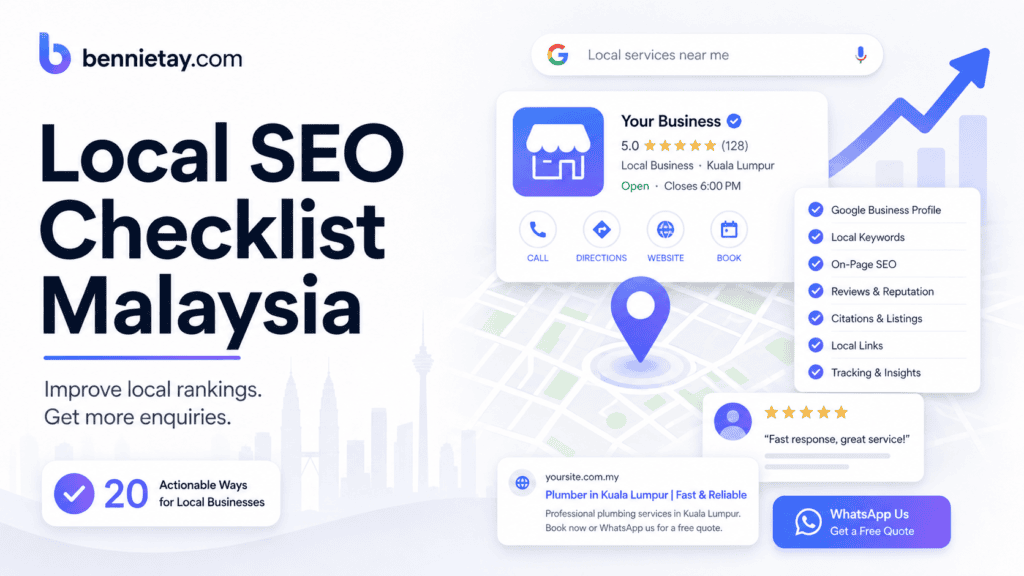
If you run a Malaysian local or service-area business, use this 20-point checklist to identify the biggest gaps in your current setup.
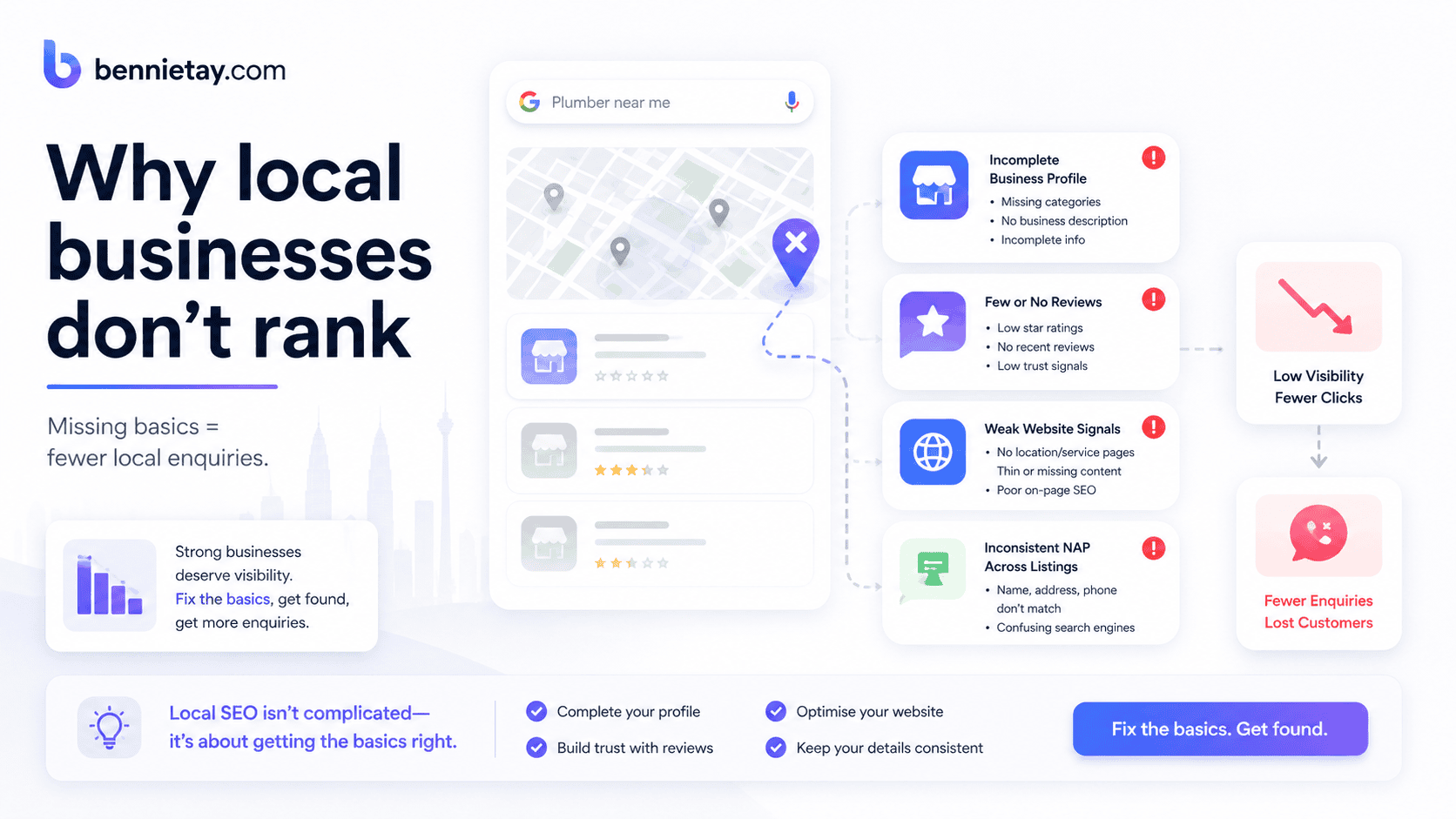
1. Make Your Homepage Immediately Explain the Business
Your homepage should not force visitors to decode vague marketing language.
Within the first few seconds, they should understand what you provide, who you serve and where you operate.
A headline such as:
Professional Solutions You Can Trust
says very little.
A stronger version might be:
Commercial Cleaning Services for Offices in Kuala Lumpur & Petaling Jaya
The second version immediately establishes the service and location.
Clear positioning helps customers decide whether they are in the right place and gives search engines stronger context about your business.
2. Target Searches With Commercial Intent
Do not optimise only for broad keywords because they have impressive search volume.
Focus on phrases potential customers might use when they actually need your service.
Examples include:
- accountant Petaling Jaya
- renovation contractor Kuala Lumpur
- tuition centre Subang Jaya
- office cleaning Shah Alam
- aircon servicing near me
- bookkeeping services Malaysia
These searches combine service and local intent.
A smaller number of highly relevant visitors can be considerably more valuable than a large amount of traffic from people who were never likely to become customers.
3. Build a Strong Page for Every Important Service
If your business provides several major services, do not squeeze all of them into one generic Services page.
An accounting practice, for example, might create separate pages for:
- bookkeeping
- payroll
- corporate tax
- management accounts
- company secretarial services
Each page can explain the service in depth, answer questions and target a specific customer need.
A useful service page should cover what is included, who the service is for, how the process works, pricing guidance where appropriate, FAQs and a clear next step.
4. Create Location Pages for Genuine Branches
If your business operates genuine branches, create useful pages for important locations.
A tuition centre with branches in Petaling Jaya and Subang Jaya could have separate pages containing the relevant address, opening hours, telephone number, photographs, teaching team, facilities, courses and enquiry information.
This helps customers evaluating a particular branch and gives search engines more accurate geographical context.
Do not create fictional offices purely for SEO.
Your website should make your real business easier to discover, not manufacture an imaginary Malaysian property empire.
5. Build Service-Area Pages Carefully
Some businesses travel to customers rather than operating a branch in every location they serve.
A renovation company based in Petaling Jaya might regularly work in Subang Jaya, Shah Alam, Puchong and Kuala Lumpur.
Useful service-area pages can explain that coverage.
For example:
Home Renovation Services in Subang Jaya
A strong page could include areas covered, common property types, relevant projects, services offered, testimonials, FAQs and a quotation CTA.
Avoid copying the same page 30 times and changing only the town name.
Every location page should have a genuine reason to exist.
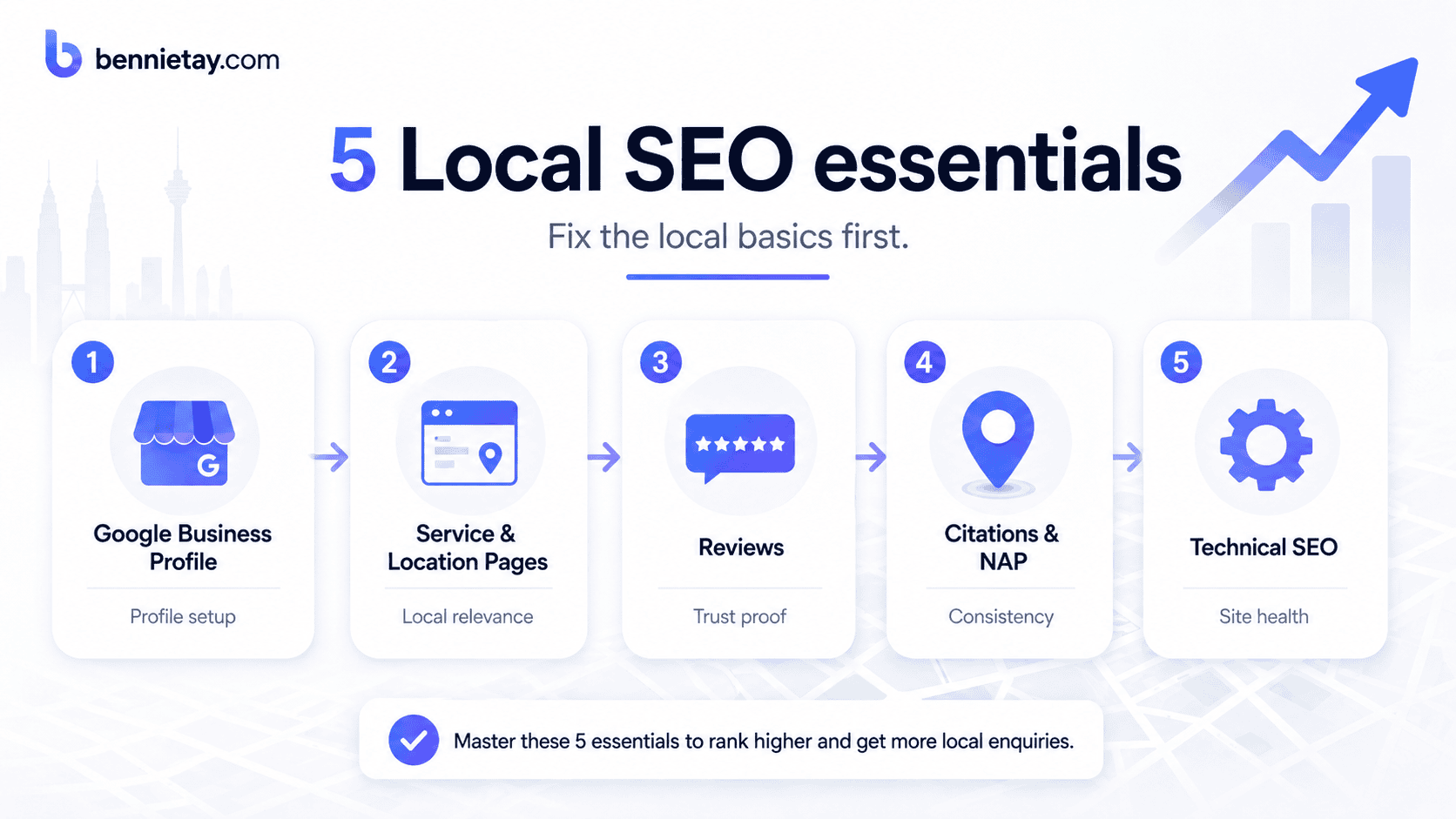
6. Claim and Verify Your Google Business Profile
For eligible local businesses, your Google Business Profile and website should work together.
Make sure the correct profile has been claimed and verified.
Then check important information such as:
- business name
- business category
- telephone number
- website
- opening hours
- address where appropriate
- service areas
- services
- photographs
Incomplete or inaccurate information makes it harder for customers to understand the business and can weaken the overall local search journey.
7. Choose the Most Accurate Primary Category
Your Google Business Profile category helps Google understand what kind of business you operate.
Choose the most specific primary category that accurately reflects what the business actually is.
Additional categories can describe other genuine activities, but they should remain relevant.
Do not add unrelated categories because somebody suggested they might generate more impressions.
Visibility from the wrong searches is not particularly useful visibility.
8. Keep Your Google Profile and Website Consistent
Customers should encounter the same business information wherever they find you.
Compare your website and Google Business Profile regularly.
Check:
- business name
- phone number
- address
- service area
- opening hours
- services
- branding
If Google says you close at 9pm but your website says 6pm, the inconsistency creates confusion.
SEO becomes somewhat academic when the customer is standing outside a locked office.
9. Build a Consistent Google Review Process
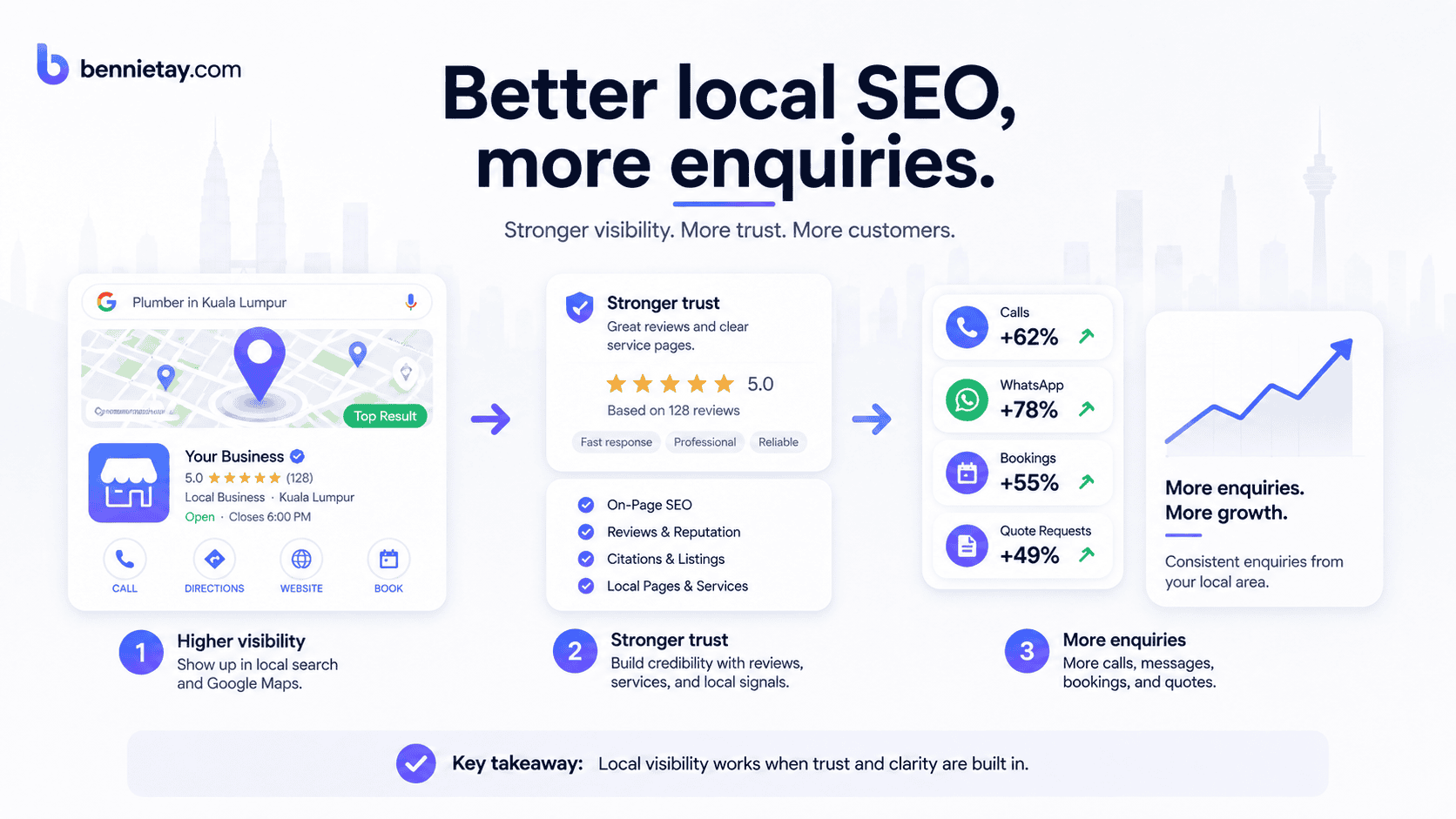
Reviews influence both trust and local visibility.
Do not leave review collection entirely to chance.
Ask satisfied customers for genuine feedback after appropriate moments such as:
- completing a project
- finishing an appointment
- delivering a service
- resolving a problem
- completing a consultation
Keep the process easy.
The objective is not to pressure customers into giving five stars. It is to build a steady flow of authentic feedback from real people.
10. Respond to Customer Reviews
Your response is not only for the customer who wrote the review.
Future prospects can read it too.
A thoughtful reply to positive feedback makes the business look active and appreciative. A calm, professional response to criticism demonstrates how your company behaves when something goes wrong.
Avoid copying the same generic response under every review.
A little specificity makes the interaction feel considerably more human.
11. Use Reviews Throughout Your Website
Do not collect excellent Google reviews and then hide all that trust on Google.
Bring genuine customer proof into relevant parts of your website.
Homepage
Show several strong testimonials demonstrating overall credibility.
Service Pages
Show feedback related to that particular service.
Location Pages
Use reviews from customers in that area where appropriate.
Pricing or Proposal Sections
Use testimonials addressing value, transparency or the buying experience.
Contact Sections
Place concise social proof near the point where visitors are deciding whether to enquire.
Getting discovered is useful.
Getting trusted is what helps discovery become revenue.
12. Build Case Studies From Real Projects
Testimonials provide quick reassurance.
Case studies provide deeper evidence.
For important projects, explain:
The Problem
What was the customer trying to solve?
The Work
What did your business provide?
The Result
What changed after the project?
Customer Feedback
What did the customer say about the experience?
Case studies are especially useful for higher-value services such as renovation, consulting, accounting and website development.
They show potential customers how you solve problems rather than merely telling them that you are experienced.
13. Add Real Business Photos
Use genuine photographs wherever possible.
Depending on your business, that might include:
- team members
- office or premises
- classrooms
- equipment
- completed projects
- products
- facilities
- work in progress
Real photographs give customers additional evidence that there is a genuine business behind the website.
A renovation prospect would generally rather see completed renovations than another stock photograph of a man in a hard hat examining architectural plans with profound concern.
14. Create Content Around Local Customer Questions
Your blog should support the customer journey rather than exist solely because somebody said websites need fresh content.
Write about questions prospects genuinely ask.
Examples include:
How Much Does Office Cleaning Cost in Kuala Lumpur?
How Much Do Accounting Services Cost in Malaysia?
How to Choose a Tuition Centre in Subang Jaya
Kitchen Renovation Cost in Malaysia: What Affects the Price?
These articles attract potential customers earlier in their research and create opportunities to guide them toward relevant services.
Useful content can support both SEO and conversion.
15. Strengthen Your Internal Links
Do not allow important pages to exist as isolated islands.
Connect related content naturally.
For example:
Kitchen Renovation Cost Guide
→ Kitchen Renovation Service
→ Petaling Jaya Renovation Page
→ Project Case Study
→ Request a Quote
Or:
Local SEO Guide
→ Google Business Profile Guide
→ Service-Area Pages
→ Local Business Schema Guide
→ Website Growth Plan
Internal links help visitors continue through the website and help search engines understand how your content fits together.
16. Optimise Titles and Headings Naturally
Your page titles should tell people what each page is about.
For example:
Accounting Services in Petaling Jaya | ABC Accounting
is more useful than:
Services | ABC Accounting
Your main heading might then say:
Accounting & Bookkeeping Services for SMEs in Petaling Jaya
That communicates the service and location without repeating the phrase every third sentence.
SEO copy should still sound as though a human being wrote it.
Keyword stuffing does not become sophisticated simply because the same city name appears 27 times.
17. Add LocalBusiness Structured Data
Where appropriate, use LocalBusiness structured data to help search engines understand information about your business.
Depending on the business type, structured information may include details such as:
- business name
- business type
- address
- telephone number
- opening hours
- website information
Structured data is useful technical SEO, but it supports the rest of the website rather than replacing it.
Schema cannot compensate for weak services, poor content or inaccurate business information.
For implementation details, see the Local Business Schema Guide.
18. Make Mobile Enquiries Easy
Many local searches happen on mobile devices.
Your website should make it easy to call, WhatsApp, submit an enquiry, request a quote or get directions without wrestling with tiny buttons and oversized menus.
Match your call to action to the type of service.
For example:
Urgent Service
Call Now
Professional Service
Book a Consultation
Project-Based Service
Request a Quote
Quick Question
WhatsApp Us
For example, an office cleaning page might say:
Need Office Cleaning in Petaling Jaya?
Tell us your premises type, approximate size and preferred cleaning schedule.
Request a Quote →
That turns local relevance into a business action.
Otherwise, you have successfully completed the difficult job of attracting a customer and then left them wondering what to do next.
19. Build Local Authority Beyond Your Website
Prominence is not created entirely on your own website.
Look for genuine opportunities to strengthen your business’s presence across the web.
Depending on your industry, this could include:
- professional associations
- suppliers
- business partners
- chambers of commerce
- local organisations
- events
- publications
- reputable directories
- community involvement
Aim for genuine mentions and relationships rather than purchasing hundreds of low-quality directory links.
One credible local or industry mention can be more meaningful than an impressive-looking spreadsheet filled with links from websites no customer has ever heard of.
20. Track Enquiries, Not Just Rankings
Ranking improvement matters because it can create visibility.
But rankings are not the final goal.
Track what visitors actually do.
Measure:
- contact form submissions
- WhatsApp clicks
- phone calls
- quotation requests
- bookings
- qualified leads
Then identify which pages and searches produce real opportunities.
A page ranking fourth and generating ten qualified enquiries may be far more valuable than a number-one ranking that generates nothing.
SEO should ultimately support business outcomes, not merely produce attractive ranking screenshots for monthly reports.
A Simple Local SEO Website Structure
For many Malaysian service businesses, a practical website could include the following.
Homepage
Clear business positioning, main services, primary locations and strong customer proof.
Main Service Pages
One useful page for each commercially important service.
Location or Service-Area Pages
Pages for genuine branches or meaningful areas you actually serve.
About Page
Company background, team, experience and credibility.
Projects or Case Studies
Real examples showing how your business solves customer problems.
Reviews and Testimonials
Customer proof distributed throughout the site.
Blog or Resources
Useful answers to questions prospects search before buying.
Contact Page
Phone, WhatsApp, location or service area and an appropriate enquiry form.
Connect this website structure to a complete and accurate Google Business Profile and you have a local search system rather than a random collection of pages.
Frequently Asked Questions
What is local SEO?
Local SEO is the process of improving a business’s visibility when people search for products, services or companies connected to a particular geographical area.
It commonly involves both your website and Google Business Profile.
What affects Google local rankings?
Google describes local results around relevance, distance and prominence.
Your optimisation should therefore help Google understand what you provide, where the business operates and whether it appears established and trustworthy.
Does every local business need location pages?
No.
Create location pages for genuine branches or when you can provide meaningful information specific to that area.
For areas you serve without having a physical branch, well-developed service-area pages may be more appropriate.
How many service areas can I add to Google Business Profile?
Eligible businesses can currently add up to 20 service areas.
Those areas should reflect where the business genuinely operates rather than every town you would theoretically be willing to accept a customer from.
Do Google reviews help local SEO?
Reviews can contribute to local prominence and are also important because customers use them when deciding whether they trust a business.
Focus on collecting genuine customer feedback consistently.
Do I need LocalBusiness schema?
It can help search engines interpret structured business information, but it should support rather than replace strong pages, accurate information, customer reviews and useful content.
Fix the Foundations Before Chasing Rankings
Local SEO does not need to begin with complicated tactics.
Start by making it completely clear what your business does, where you operate, which services you provide, why customers should trust you and how they can contact you.
Then make sure your Google Business Profile and website communicate the same story.
Once those foundations are in place, strengthen them with dedicated service pages, useful location content, genuine customer reviews, case studies, internal links and local authority.
At Bennie Studio, local business websites are structured around both discovery and conversion. The objective is not simply to appear for more searches.
It is to help the right local customers find the business, trust what they see and take the next step.
Explore Managed Website Growth Plans →
Already appearing on Google but not generating enough enquiries from your website?
Get a Free Website Growth Audit →