Someone in Petaling Jaya needs an accountant. A parent in Subang Jaya is looking for tuition. A company in Shah Alam needs an office cleaning service. A homeowner in Kuala Lumpur wants a renovation contractor.
They open Google and search.
Your business might provide exactly what they need. But until Google and the customer can understand what you offer, where you operate and why they should trust you, the quality of your service is almost irrelevant. They cannot hire a business they never find.
That is where local SEO comes in.
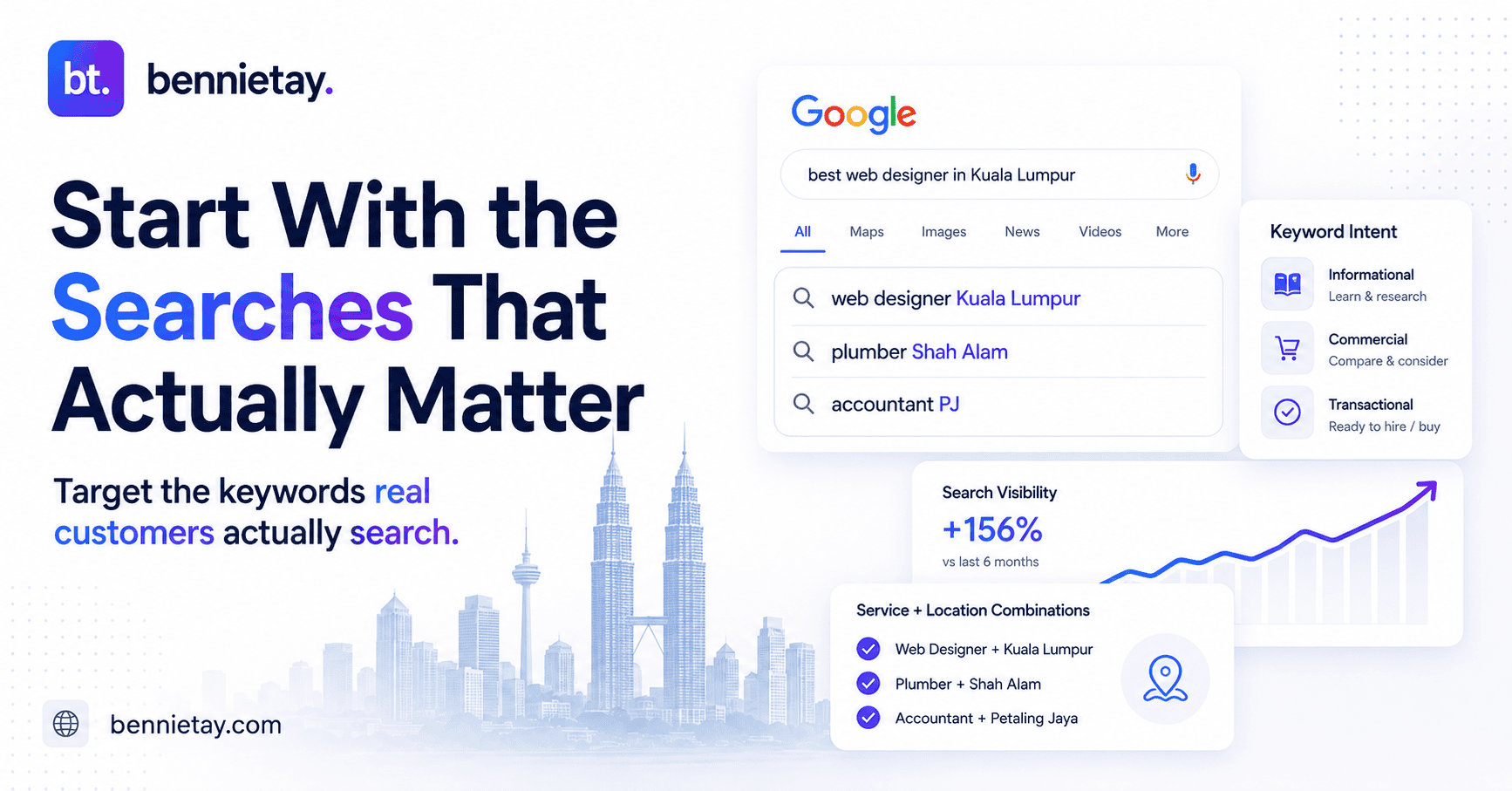
Local SEO helps businesses become more visible when customers search for services within a specific area through Google Search and Google Maps. For Malaysian service businesses, however, good local SEO is not about inserting “Kuala Lumpur” into every second sentence or generating hundreds of suburb pages with nearly identical content.
The real goal is simpler: help Google understand your business, help the right local customer find it, and make it easy for that customer to become an enquiry.
Here is how to build that system.
How Does Google Decide Which Local Businesses to Show?
Google describes local results primarily around three factors: relevance, distance and prominence.
Relevance
Relevance refers to how closely your business matches what someone is searching for. If somebody searches for corporate tax services Petaling Jaya, Google needs enough information to understand that your firm genuinely provides corporate tax services in or around that area.
Distance
Distance considers how far the business is from the location associated with the search. You cannot control where every customer is standing when they search.
A Johor Bahru plumber is unlikely to become the most locally appropriate result for someone requiring emergency plumbing in Subang Jaya, regardless of how enthusiastic the SEO agency happens to be.
Prominence
Prominence relates to how established or well known the business appears. Signals can include reviews and information about the business found elsewhere on the web, including links and mentions.
A practical local SEO strategy therefore concentrates on what you can improve: your website relevance, Google Business Profile, service pages, local content, reviews, authority, business information, customer experience and conversion paths.
1. Target Searches That Can Actually Become Customers
Do not start your SEO strategy by asking, “How do I rank number one on Google?”
A better question is: What does my ideal customer search when they are ready to solve this problem?
An accounting firm could target searches such as:
- accountant Petaling Jaya
- bookkeeping services Malaysia
- SME accounting services
- corporate tax services Kuala Lumpur
A renovation contractor might target:
- renovation contractor KL
- kitchen renovation Petaling Jaya
- office renovation Kuala Lumpur
- home renovation company near me
A tuition centre might focus on:
- tuition centre Subang Jaya
- SPM maths tuition PJ
- secondary school tuition near me
These searches typically combine service, customer need and location, which often makes them commercially stronger than broad keywords attracting people from everywhere with completely different intentions.
Ten visitors actively looking for a renovation quotation can be worth considerably more than 1,000 people who accidentally found your article while conducting homework research.
Traffic is useful. Relevant traffic is considerably more useful.
2. Make Your Homepage Immediately Understandable
Many business websites begin with headlines such as Your Trusted Partner for Excellence or Delivering Innovative Solutions for Tomorrow.
They sound respectable, but they explain almost nothing.
Your homepage should quickly answer four questions: What do you do? Who do you help? Where do you operate? What should the visitor do next?
For example, Commercial Cleaning Services for Businesses in Kuala Lumpur & Petaling Jaya is much clearer than Cleaning Excellence You Can Trust.
An accounting practice could lead with Accounting, Tax & Bookkeeping Services for Malaysian SMEs, while a renovation business might use Home & Office Renovation Services Across Kuala Lumpur and Petaling Jaya.
Clarity helps customers understand whether they have reached the right company. It also gives search engines stronger context about what the page represents.
Do not make either party guess.
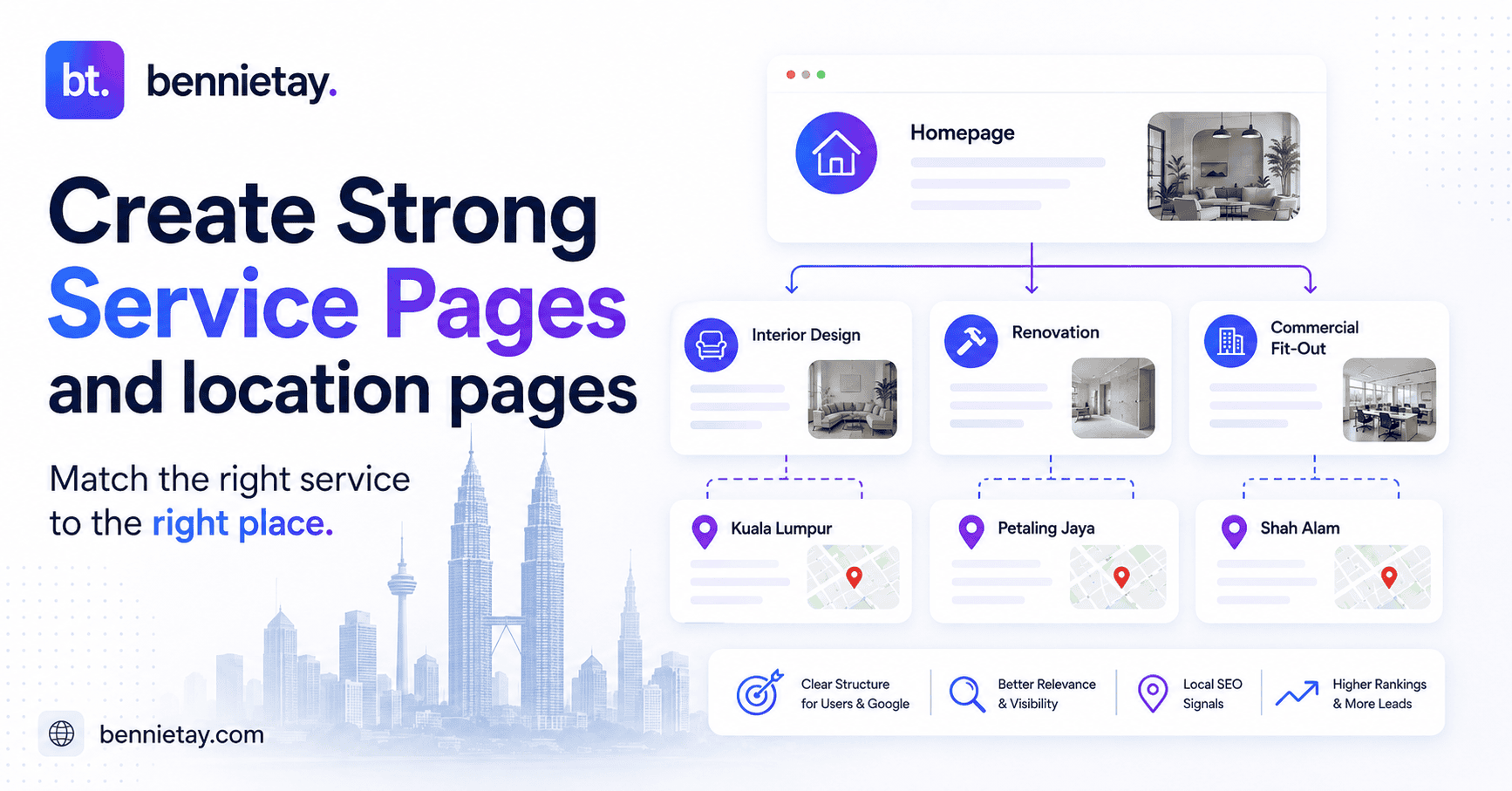
3. Build Dedicated Pages for Your Important Services
One generic /services/ page is rarely enough if your company offers several commercially important services.
Suppose an accounting firm offers bookkeeping, payroll, corporate tax, management accounts and company secretarial services. Instead of squeezing everything into one page, create useful dedicated pages such as:
/bookkeeping-services/
/payroll-services/
/corporate-tax-services/
Each page can then focus on one customer need and properly explain what the service includes, who it is designed for, common problems it solves, your process, pricing guidance where appropriate, frequently asked questions, reasons to choose you and how to make an enquiry.
This makes the website easier for potential customers to navigate and creates clearer topical signals for search engines.
A page designed around one meaningful service usually has a better chance of satisfying the search than a page desperately trying to rank for everything the business has ever sold.
4. Use Location Pages Only Where They Make Sense
Location pages can be valuable, but they need a legitimate reason to exist.
If your company has genuine branches in different locations, each branch can have its own useful page. For example:
Tuition Centre Petaling Jaya
Tuition Centre Subang Jaya
Each page could contain the branch address, telephone number, opening hours, map, photographs, courses or services, teaching team, facilities, FAQs and enquiry information.
That gives a customer evaluating the Subang Jaya branch information specifically relevant to Subang Jaya.
What you should not do is create fake offices simply to rank in more locations.
Your website should make the real business easier to discover, not quietly build an imaginary nationwide property portfolio.
5. Create Useful Service-Area Pages
A service business does not need an office in every location it serves.
A renovation contractor based in Petaling Jaya might regularly work in Subang Jaya, Shah Alam, Puchong, Mont Kiara and Kuala Lumpur. In that situation, genuine service-area pages can help explain where the company works.
For example, a page targeting Home Renovation Services in Subang Jaya could include renovation services available, neighbourhoods covered, property types commonly served, local project examples, relevant testimonials, how quotations work, project process, FAQs and photographs.
Every local landing page should offer a reason for someone in that location to read it.
If 20 location pages contain the same 700 words with different suburb names, you have not created a local content strategy. You have created a mail merge.
6. Optimise Your Google Business Profile
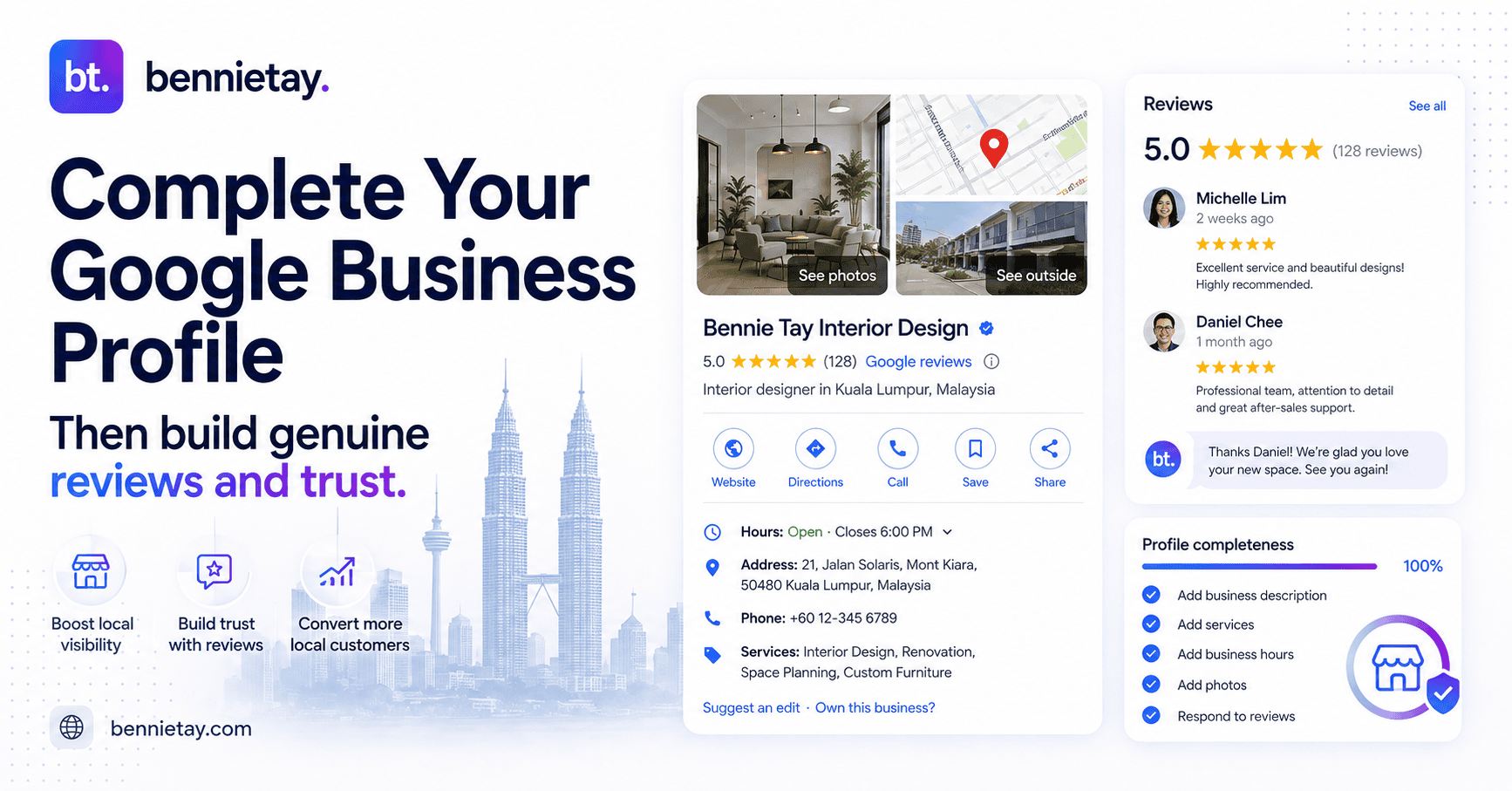
For eligible local businesses, Google Business Profile is one of the most important parts of the local search journey.
Make sure your profile accurately shows your business name, primary category, relevant additional categories, address or service area, telephone number, website, opening hours, services and photographs.
Your website and Google profile should describe the same company.
If Google says your office closes at 9pm but the website says 6pm, ranking improvements may not be your most urgent business problem. The customer standing outside the locked office will probably have opinions.
7. Choose Your Business Categories Carefully
Your Google Business Profile category helps Google understand what kind of business you operate.
Choose the most specific category that accurately describes your company. Additional categories can describe other genuine parts of the business, but they should remain relevant.
Do not select unrelated categories simply because you hope to appear in more searches.
More visibility from people who do not need your service does not magically become valuable visibility.
8. Build a Steady Flow of Genuine Reviews
Reviews influence both visibility and customer behaviour.
A potential customer comparing three local businesses may use ratings and recent reviews to decide which company deserves a click.
Build review requests into your normal customer process. After a successful project, consultation, appointment, class, service visit or installation, ask the customer for an honest review.
Do not wait six months and hope they suddenly remember.
More importantly, do not buy fake reviews. A marketing strategy requiring imaginary customers generally has problems extending beyond SEO.
9. Reply to Your Reviews
Review management does not end when the customer presses Submit.
Future customers can read your replies too.
For positive reviews, respond naturally and keep the message specific. For negative reviews, remain professional, acknowledge the concern and avoid turning a disagreement into public theatre.
The goal is not necessarily to prove that your business has never made a mistake. Potential customers often care more about seeing that you handle problems responsibly.
Specific, human responses also tend to be more credible than posting the same automated “Thank you for your valuable feedback” beneath every review known to mankind.
10. Show Real Evidence of the Business
Local customers often want reassurance that the company is real.
Use genuine photographs whenever possible. Depending on your industry, this could include team members, premises, classrooms, equipment, completed projects, work in progress, products, facilities and before-and-after results.
A renovation customer wants to see renovations. A parent evaluating a tuition centre may want to see actual facilities. A customer choosing a professional firm may want to know who they will work with.
Stock photography can support a design, but it should not replace real proof.
Another gentleman in a hard hat staring thoughtfully at a blueprint is unlikely to establish your renovation credentials.
11. Publish Content Based on Customer Questions
Service and location pages target customers with strong buying intent, while blog content can attract people earlier in their decision journey.
The key is to answer questions customers actually ask.
An accountant might publish How Much Do Accounting Services Cost in Malaysia?
A renovation company could create How Much Does Kitchen Renovation Cost in Malaysia?
A tuition centre might write How to Choose the Right SPM Tuition Centre, while a cleaning company could answer How Often Should an Office Be Professionally Cleaned?
These topics attract potential customers while they are still researching and create opportunities to guide them towards relevant service pages.
Publish because the information is useful. Do not publish four meaningless articles every month merely because somebody once told you that Google requires “fresh content.”
Google has enough content. Customers need useful answers.
12. Strengthen Your Internal Linking
Your important pages should not exist in isolation.
Connect related articles, service pages, location pages and conversion pages naturally.
For example:
Kitchen Renovation Cost Guide
→ Kitchen Renovation Service
→ Petaling Jaya Renovation Page
→ Project Portfolio
→ Request a Quote
Another journey could look like:
Local SEO Guide
→ Google Business Profile Guide
→ Service-Area SEO Guide
→ Managed Website Service
→ Website Audit
Internal links help visitors continue exploring the site and help search engines understand relationships between pages.
Every blog article should have somewhere useful to lead next. Otherwise, it becomes a small digital island where visitors arrive, read and quietly disappear into the ocean.
13. Optimise Page Titles and Headings Naturally
Your page titles should communicate what each page is about.
For example:
Accounting Services in Petaling Jaya | ABC Accounting
is more descriptive than:
Services | ABC
The main heading could then be:
Accounting & Bookkeeping Services for SMEs in Petaling Jaya
You have already established the service and location. There is no need to repeat “accountant Petaling Jaya” fifteen additional times.
Good SEO writing should still sound like language a normal person would use.
Use relevant keywords where they naturally help explain the page, then stop.
14. Add LocalBusiness Structured Data
Eligible businesses can also use LocalBusiness structured data to provide search engines with structured information about the company.
Depending on your business, this can help describe information such as business name, type, address, telephone number, opening hours and other relevant details.
Structured data can strengthen the technical foundation of the site, but it does not replace strong content, accurate business information, service pages, reviews, real locations or local authority.
Think of schema as helping Google interpret a properly built website.
It is not an emergency medical procedure for a terrible one.
15. Build Local Authority
Prominence can also be influenced by information about your business elsewhere on the web.
For a real local business, authority can come from genuine relationships and recognition.
Depending on your industry, useful opportunities may include:
- professional associations
- suppliers
- business partners
- chambers of commerce
- local organisations
- events
- industry publications
- community involvement
- reputable directories
Do not interpret “build links” as “purchase 800 directory submissions for RM49.”
Relevant mentions from genuine organisations are more valuable to your reputation than collecting links from websites whose main purpose appears to be selling links to other websites selling links.
Build a business worth mentioning, then make sure those digital signals connect back to you.
16. Make Mobile Visitors Easy to Convert
Local searches frequently happen on phones.
Your mobile website should therefore make it easy for people to understand what you do, navigate the site, call, WhatsApp, request a quotation, submit a form or get directions.
The right call to action depends on the search.
Someone searching aircon repair near me may want Call Now.
Someone researching accounting firm Petaling Jaya may prefer Book a Consultation.
A parent searching tuition centre Subang Jaya might respond better to Check Class Availability.
Match the next step to what the customer is likely trying to accomplish.
Local SEO has not succeeded simply because somebody opened your website.
The commercial journey is:
Search → Visit → Trust → Enquiry
17. Measure Leads Instead of Obsessing Over Rankings
Ranking number one feels satisfying, but a ranking is not revenue.
Track actions that indicate genuine business interest, such as contact form submissions, phone calls, WhatsApp clicks, bookings, consultation requests and quotation requests.
Then identify which pages and searches generate those actions.
A page ranking fifth that produces ten qualified enquiries can be considerably more valuable than a number-one result producing nothing.
Use Google Search Console and your website analytics to understand search queries generating impressions, pages attracting clicks, new keyword opportunities, high-performing service pages and content that needs improvement.
Use that information to decide what to optimise next.
SEO should help generate business. It should not exist mainly to provide attractive arrows on monthly ranking reports.
A Practical Local SEO Roadmap
If you are starting from scratch, prioritise the work in stages.
Phase 1: Foundations
Verify and complete your Google Business Profile, correct business information, choose accurate categories, improve homepage positioning and build important service pages.
Phase 2: Local Relevance
Create genuine branch pages, build useful service-area pages, improve titles and headings, and add real business photographs.
Phase 3: Trust
Request genuine reviews, respond to feedback, publish testimonials and create case studies or project examples.
Phase 4: Authority
Publish useful customer-focused content, improve internal linking, earn relevant local mentions and strengthen priority service pages.
Phase 5: Conversion
Improve calls to action, simplify enquiry forms, track calls and WhatsApp clicks, measure lead quality and improve pages based on actual results.
Then continue improving.
That approach is considerably more manageable than implementing 73 unrelated SEO tricks simultaneously and later having absolutely no idea which one achieved anything.
Frequently Asked Questions About Local SEO in Malaysia
What is local SEO?
Local SEO is the process of improving a business’s visibility for searches associated with a particular geographical area.
It can involve your website, Google Business Profile, reviews, local pages, business information and signals from other websites.
How do I rank my local business higher on Google?
Start by improving the factors you can influence, including relevance, complete business information, appropriate categories, website content, genuine reviews and local prominence.
You should also make sure your website clearly explains what you do, where you operate and how customers can contact you.
Can I pay Google for higher organic local rankings?
No. Organic local rankings cannot simply be purchased.
Google Ads can provide paid visibility, but paid advertising is separate from organic Google Maps and local search rankings.
Do Google reviews help local SEO?
Reviews can contribute to local prominence and also influence whether potential customers trust the business enough to contact it.
Focus on earning genuine customer feedback rather than artificially increasing review numbers.
Do I need location pages?
Create location pages for genuine branches or where you have enough useful location-specific information to justify a dedicated page.
For locations you serve without having a branch, a useful service-area page may be more appropriate.
How long does local SEO take?
There is no fixed timeline.
Results depend on competition, location, website quality, existing authority, reviews, content, technical condition and the strength of competing businesses.
Measure progress through search visibility, qualified traffic and enquiries rather than waiting for a particular date when SEO is supposedly complete.
Local SEO Should Generate Enquiries, Not Just Rankings
Local SEO is not about using the most keywords. It is about giving Google and potential customers enough clear evidence to understand what your business does, where you operate, whether you are relevant, whether customers trust you and whether you can solve their problem.
Then make taking the next step simple.
Your Google Business Profile creates visibility. Your service and location pages create relevance. Your reviews and real-world evidence build trust. Your website provides depth. Your enquiry journey turns all of that attention into business.
At Bennie Studio, local business websites are designed around this complete customer journey rather than treating SEO as a collection of isolated technical tricks.
The objective is not simply to rank. It is to help more of the right local customers find your business, trust what they see and become genuine enquiries.
Explore Managed Website Growth Plans →
Already appearing in local searches but not getting enough qualified enquiries?
Get a Free Website Growth Audit →