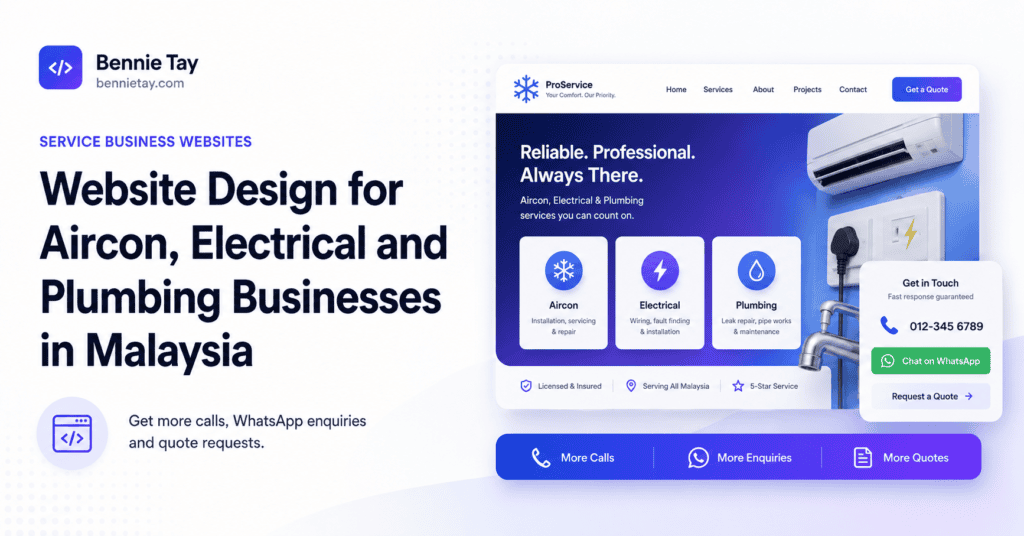
When someone searches for an aircon technician, electrician or plumber, they usually have a problem that needs solving. The air conditioner is not cooling. A power point has stopped working.
There is a leak under the sink. The water heater is giving trouble. This changes how the website should be designed. A local home-service website does not need a long brand story before visitors can take action.
It needs to answer quickly:
- Do you fix my problem?
- Do you serve my area?
- Can I trust you?
- How quickly can I contact you?
- What might it cost?
For aircon, electrical and plumbing businesses in Malaysia, the strongest websites are usually built around:
- clear services
- local visibility
- mobile usability
- trust
- fast enquiry paths
Here is how I would structure one to generate more calls, WhatsApp enquiries and quotation requests.
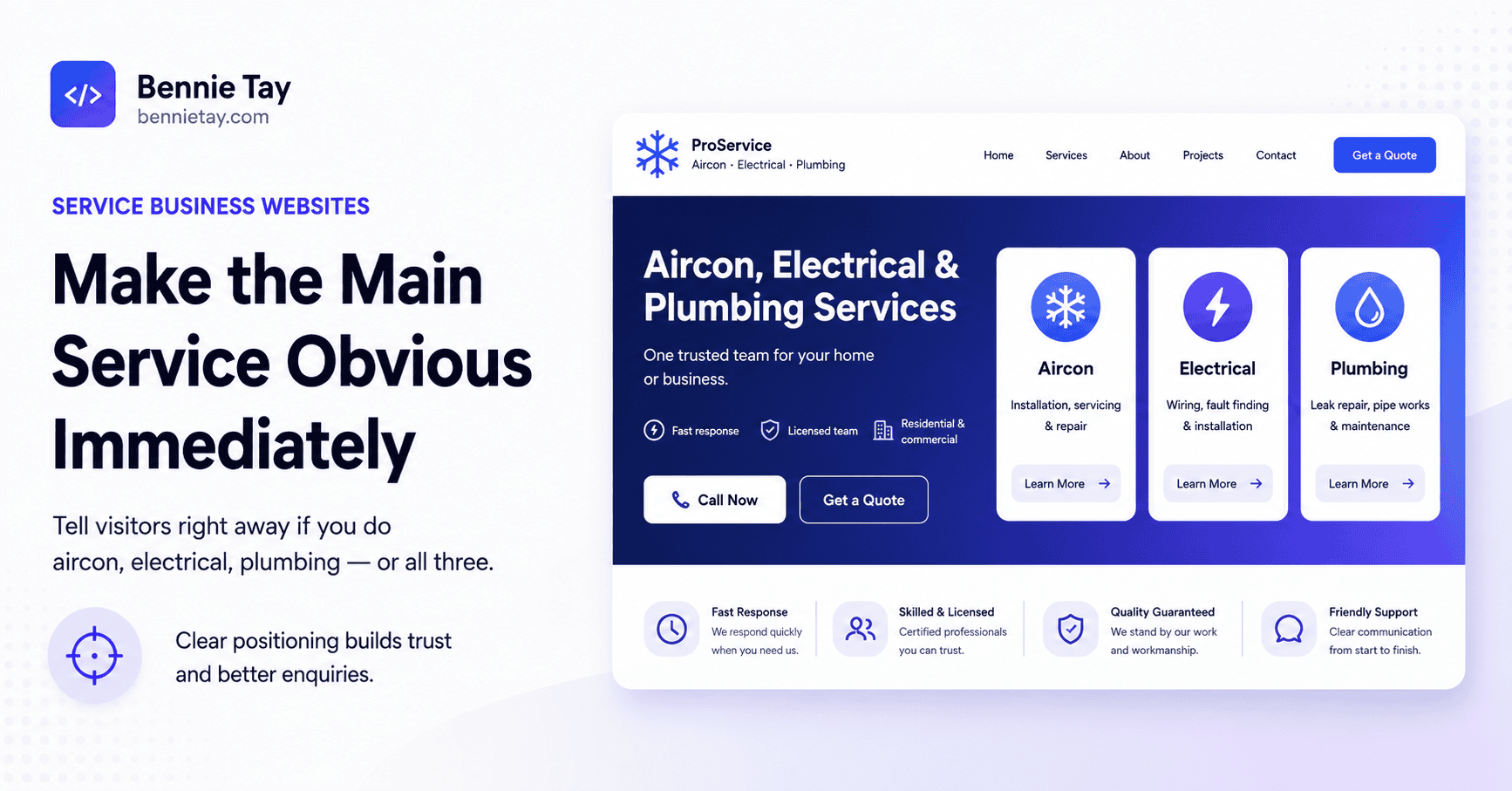
1. Make the Main Service Obvious Immediately
The first screen should clearly explain what you do.
For example:
Aircon Servicing & Repair in Petaling Jaya and Kuala Lumpur
Or:
Residential Electrical Services Across Klang Valley
Or:
Plumbing Repair & Installation for Homes and Businesses in Subang Jaya
That is much more useful than:
Your Trusted Home Service Partner
The visitor should not have to scroll to discover whether you repair air conditioners or install kitchen cabinets. Clear service + location is usually the right starting point.
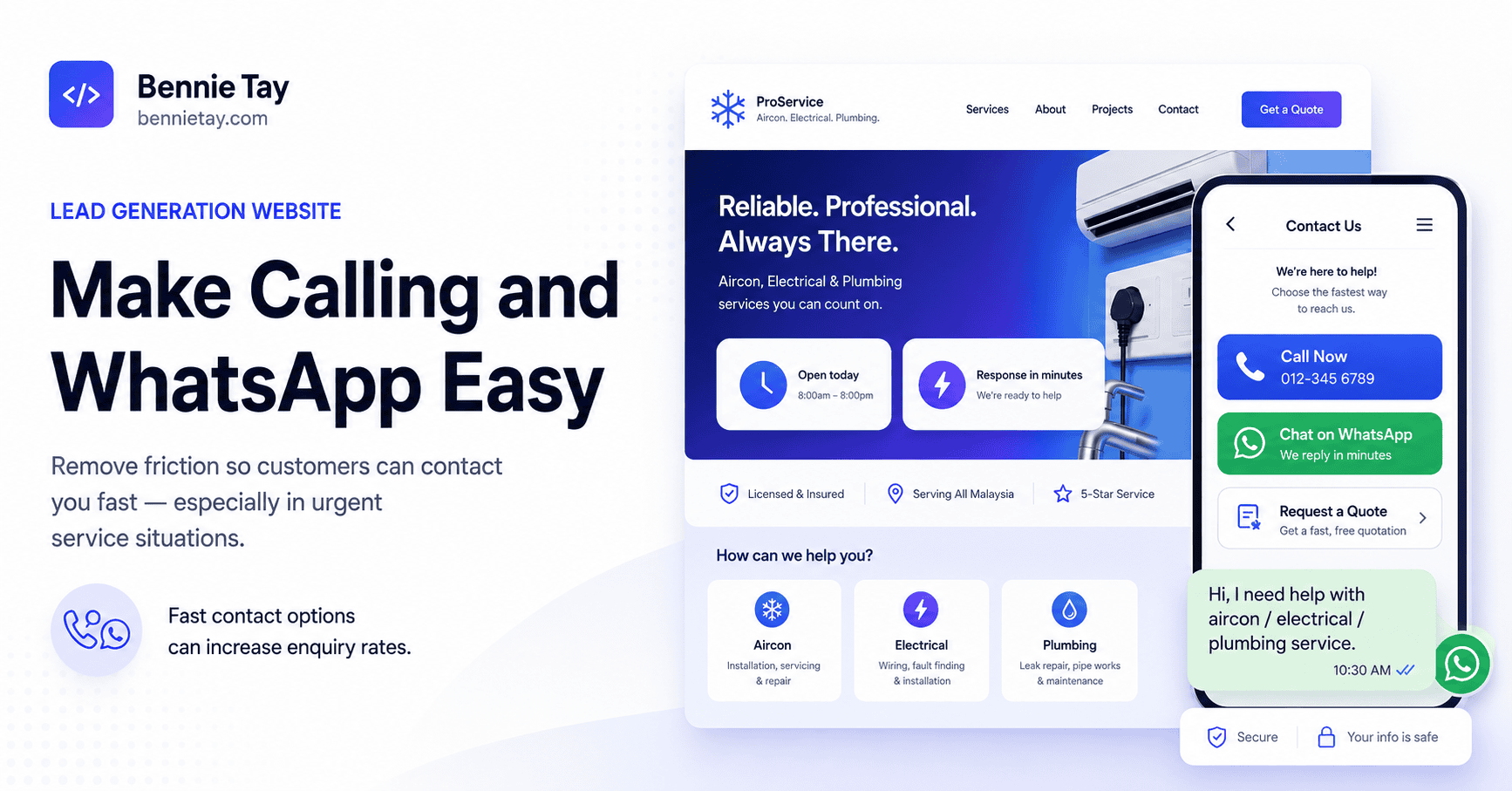
2. Make Calling and WhatsApp Extremely Easy
For urgent local services, phone and WhatsApp are often more important than a traditional contact form.
Use prominent buttons such as:
- Call Now
- WhatsApp Technician
- Request a Quote
On mobile, consider a sticky contact bar so customers can reach you from anywhere on the page.
A customer standing next to a leaking pipe does not want to hunt through:
Home → About → Contact → Enquiry Form
They want to speak to someone. Design around that reality.
3. Use Pre-Filled WhatsApp Messages
Blank WhatsApp conversations often produce:
Hi. Or: Price?
You can improve this with a pre-filled message.
For aircon:
Hi, I need help with my air conditioner. Issue: ____. Location: ____.
For plumbing:
Hi, I have a plumbing issue. Problem: ____. Location: ____.
For electrical:
Hi, I need an electrician. Work required: ____. Location: ____.
This gives your team useful context immediately. It also makes the customer feel that the enquiry process is organised.
4. Create Dedicated Pages for Important Services
Do not put everything under one generic page called:
Our Services
Important services deserve proper pages.
For an aircon company:
- Aircon Servicing
- Aircon Repair
- Aircon Installation
- Chemical Cleaning
For a plumber:
- Plumbing Repair
- Leak Repair
- Toilet Repair
- Water Heater Installation
- Pipe Replacement
For an electrical business:
- Electrical Repair
- Wiring
- Power Point Installation
- Lighting Installation
- Electrical Troubleshooting
Each page can explain:
- common problems
- service scope
- process
- pricing guidance
- areas served
- FAQ
- CTA
This improves customer clarity and gives your website stronger search relevance.
5. Build Pages Around Problems Customers Actually Search
Service names are important. But customers often search by problem.
For example:
- aircon not cold
- aircon leaking water
- toilet leaking
- low water pressure
- power keeps tripping
- socket not working
These problems can become sections, FAQs or useful articles.
A page about aircon repair might include:
Common Aircon Problems We Help With
- Unit not cooling
- Water leakage
- Strange noise
- Weak airflow
- Aircon turning off unexpectedly
This helps customers recognise that they are in the right place.
6. Explain What Is Included
A customer should understand what a service actually covers.
For example:
Standard Aircon Servicing May Include
- Filter cleaning
- Basic unit cleaning
- Drainage checks
- General operational inspection
The exact scope should reflect what your business genuinely provides.
For plumbing:
Leak inspection and repair scope depends on the source and accessibility of the affected pipe or fitting.
For electrical:
Troubleshooting begins with identifying the likely cause before any replacement or repair work is confirmed.
Clarity reduces misunderstandings.
7. Explain Pricing Without Overpromising
Pricing for local trade services can vary depending on:
- job type
- parts
- complexity
- location
- access
- urgency
That does not mean the website must show nothing.
You could publish:
- starting prices
- service-call charges
- standard package rates
- pricing factors
For example:
Standard aircon servicing from RM___ per unit.
Or:
Electrical troubleshooting is quoted based on the issue, required parts and work involved.
The purpose is to set expectations. If customers have absolutely no idea whether a visit costs RM50 or RM500, they are more likely to send low-quality price-only enquiries.
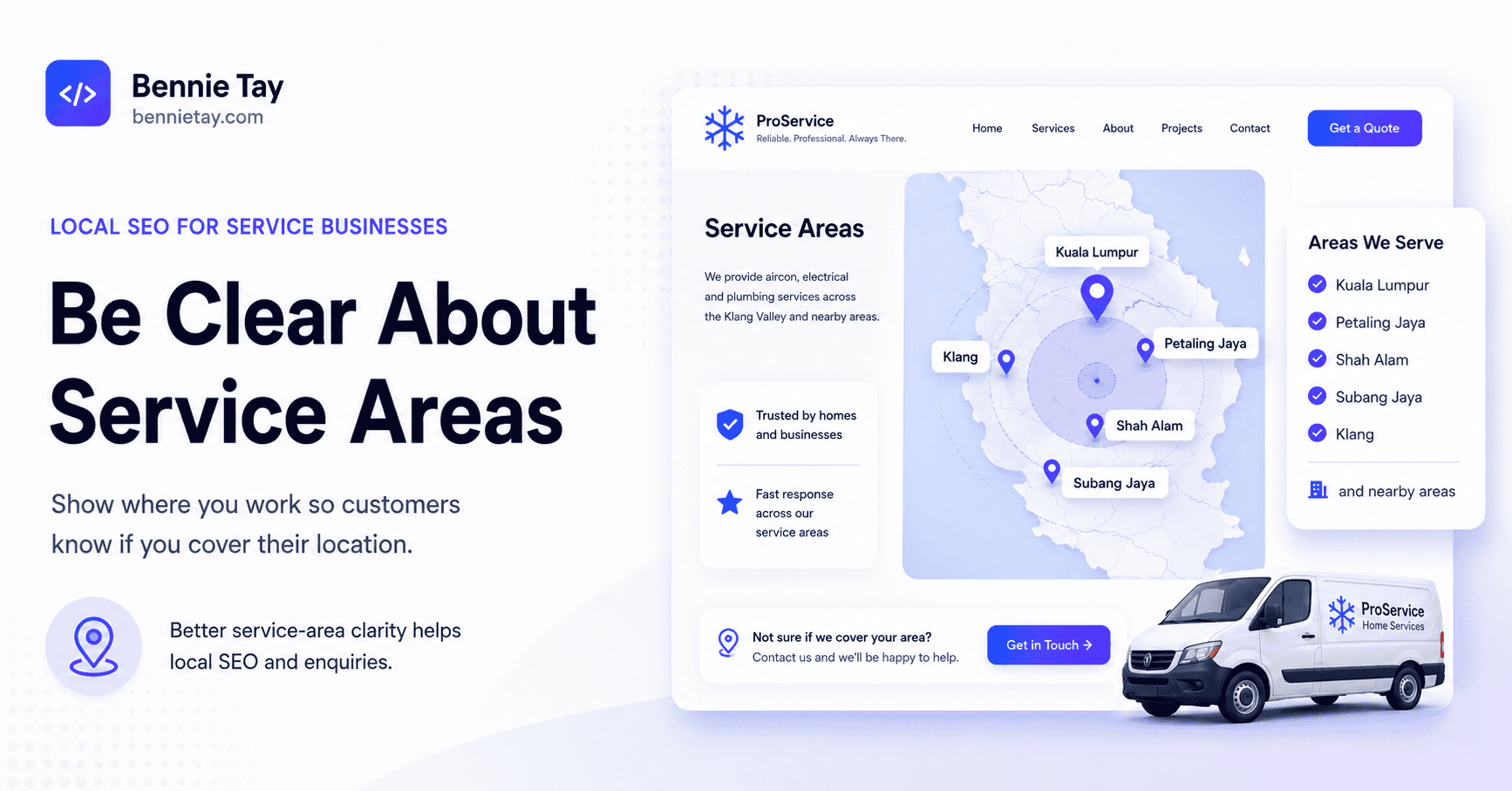
8. Be Clear About Service Areas
Local service customers need to know whether you will come to them. Show this clearly.
For example:
We serve customers across Petaling Jaya, Subang Jaya, Shah Alam, Puchong and selected Kuala Lumpur areas.
Then create dedicated service-area pages for your most important locations where appropriate.
For example:
- Aircon Service in Petaling Jaya
- Plumber in Subang Jaya
- Electrical Services in Shah Alam
Each page should contain genuine local information rather than copied paragraphs with the city name changed.
9. Use Real Photos of Your Work
Show actual work.
Useful photographs might include:
- technicians
- equipment
- completed installations
- repair work
- aircon units
- electrical boards
- plumbing fixtures
Real work demonstrates that the business exists and actively performs the services advertised. Stock images can support the design. But a plumber’s website filled entirely with photos of suspiciously spotless models holding wrenches is not especially convincing.
10. Show Your Team or Technicians
Customers may be inviting technicians into their home or workplace. That makes trust particularly important.
Where appropriate, show:
- team photographs
- uniforms
- vehicles
- experience
- training
- service process
You can also explain how customers identify your team when they arrive. This makes the business feel more professional and organised.
11. Explain How Appointments Work
Customers should know what happens after they contact you.
A simple process could be:
Step 1: Tell Us the Problem
Send a description, photo or video where useful.
Step 2: Initial Assessment
We ask any necessary questions and confirm whether a site visit is needed.
Step 3: Appointment
Agree on a suitable service time.
Step 4: Inspection
The technician checks the issue.
Step 5: Repair or Quotation
Work proceeds according to the agreed scope. This reduces uncertainty. It also helps avoid customers assuming that every problem can be accurately priced from one blurry photograph.
12. Make It Easy to Send Photos
For repair businesses, photos can be extremely useful.
Customers may want to show:
- leaking pipe
- damaged socket
- aircon unit
- electrical panel
- affected area
WhatsApp is particularly useful here.
Use a CTA such as:
Send Us a Photo on WhatsApp
This is more specific than:
Contact Us
It tells the customer exactly how to begin.
13. Show Genuine Customer Reviews
Reviews are extremely important for local trade services.
Potential customers care about:
- reliability
- punctuality
- professionalism
- workmanship
- communication
- pricing clarity
A useful review might say:
“The technician arrived within the agreed time, explained the problem clearly and confirmed the price before replacing the faulty part.”
That addresses several customer concerns at once.
Use relevant reviews throughout:
- homepage
- service pages
- location pages
Do not hide all your proof on one Testimonials page.
14. Highlight Relevant Experience
Specific experience is stronger than:
We have years of experience.
For example:
Serving residential and commercial customers across Klang Valley since 2014.
Or:
Our team handles recurring aircon servicing for homes, offices and retail premises.
Use accurate statements. If the company is new but technicians have prior industry experience, explain that clearly rather than creatively extending the age of the company.
15. Show Before-and-After Work Where Useful
Some services lend themselves well to before-and-after proof.
Examples:
- aircon cleaning
- pipe replacement
- lighting installation
- electrical upgrades
- bathroom fixture replacement
Use genuine images. Add context.
For example:
Lighting Upgrade – Petaling Jaya Office
Replacement of outdated fixtures with a new lighting layout for the main workspace.
Context turns a photograph into evidence.
16. Create Pages for Residential and Commercial Customers
If you serve both, consider separating the journeys.
Residential customers may want:
- repair
- small installations
- servicing
Commercial customers may need:
- recurring maintenance
- multiple units
- office wiring
- larger projects
- scheduled servicing
You could create:
Residential Services
and:
Commercial Services
This helps larger business customers understand that you can handle their requirements.
17. Build a Commercial Maintenance Page
For aircon and electrical companies, recurring commercial work can be especially valuable.
Create a dedicated page explaining:
- what maintenance covers
- suitable business types
- scheduling
- inspection process
- reporting where applicable
- quotation process
Use a CTA such as:
Request a Maintenance Proposal
rather than simply:
WhatsApp Us
This positions recurring commercial work differently from one-off repairs.
18. Create Emergency-Service Messaging Carefully
If you genuinely provide urgent or emergency service, make that clear.
For example:
Urgent Plumbing Assistance Available During Operating Hours
or whatever accurately reflects your service.
Do not advertise:
24/7 Emergency Service
unless somebody actually answers the phone at 3:17am. Website promises become operational expectations very quickly. Use accurate availability and response information.
19. Make Your Google Business Profile and Website Work Together
For local home services, Google Business Profile can be an important discovery channel.
Keep key business information accurate and consistent:
- business name
- phone
- website
- hours
- service areas
Your website should then provide more detail. Think of Google as the discovery layer. Your website becomes the decision layer.
The customer finds you on Google, checks your website, sees:
- service
- locations
- reviews
- work
- contact options
then decides whether to call. That journey should feel seamless.
20. Create Local SEO Content Around Customer Questions
Useful blog topics might include:
Aircon
- Why Is My Aircon Not Cold?
- How Often Should You Service an Aircon in Malaysia?
- Aircon Servicing vs Chemical Cleaning: What’s the Difference?
Plumbing
- What Causes Low Water Pressure at Home?
- When Should a Leaking Pipe Be Repaired or Replaced?
Electrical
- Why Does My Circuit Breaker Keep Tripping?
- When Should Old House Wiring Be Checked?
These articles can attract customers before they are ready to call. They also allow your company to demonstrate practical expertise. Keep the content educational.
Do not turn every article into a technical manual that encourages people to perform unsafe electrical or plumbing work themselves. The purpose is to help them understand when professional assistance may be needed.
21. Make the Mobile Experience Excellent
This is critical. Many customers will find you while holding their phone.
Your mobile website should make it easy to:
- call
- read service information
- check coverage
- request quote
Avoid:
- tiny phone numbers
- huge forms
- heavy animations
- slow image galleries
You have a few seconds to make the next step obvious. Use them wisely.
22. Track Calls and WhatsApp Clicks
If these are your main conversion actions, track them.
Monitor:
- phone clicks
- WhatsApp clicks
- form submissions
- quote requests
Then compare performance by page.
For example:
Aircon Repair Page
500 visits
45 WhatsApp clicks
Aircon Installation Page
300 visits
12 enquiries
Now you have useful business information. You can improve the weaker pages rather than simply guessing.
Recommended Website Structure
For an aircon business:
Home: Main services, locations, trust and CTA.
Aircon Servicing
Dedicated service page.
Aircon Repair
Problem-focused page.
Aircon Installation
Installation enquiries.
Commercial Aircon
B2B services.
Maintenance
Recurring contracts.
Areas We Serve
Local coverage.
About
Team and experience.
Reviews
Customer proof.
FAQ
Common questions.
Blog
Useful guides.
Contact
Call, WhatsApp and quotation form. A plumber or electrical company can use a similar structure with service categories changed accordingly.
What Should the Homepage Include?
A strong homepage might look like this.
Hero
Aircon Servicing & Repair Across Petaling Jaya and Klang Valley
Residential and commercial servicing, troubleshooting and installation with clear appointment scheduling.
Buttons:
WhatsApp Us
Request a Quote
Main Services
Show three to five core services.
Common Problems
Help customers identify what they need.
Why Choose Us
Specific trust signals.
Service Areas
Where you operate.
How It Works
Simple appointment process.
Customer Reviews
Real feedback.
Recent Work
Actual projects.
FAQ
Common buying questions.
Final CTA
Tell Us What Problem You’re Having →
That homepage is designed to move someone from:
Problem
to:
Relevant service
to:
Trust
to:
Contact
without unnecessary detours.
Common Website Mistakes
Mistake 1: Generic Homepage
Make the actual service clear.
Mistake 2: Hiding the Phone Number
For urgent services, this is particularly damaging.
Mistake 3: No Service Areas
Customers do not know whether you travel to them.
Mistake 4: No Pricing Guidance
Every lead becomes a price-only conversation.
Mistake 5: Stock Photos Only
Show real technicians and work.
Mistake 6: One Services Page
Important services should have proper pages.
Mistake 7: Poor Mobile Experience
Mobile is likely one of your most important conversion channels.
Mistake 8: No Reviews
Local service businesses need proof.
More Enquiries Are Useful Only If They Are Relevant
Imagine your WhatsApp receives 80 messages per week.
Most say:
How much?
Then disappear.
A better website could answer:
- service scope
- coverage
- price guidance
- availability
- process
Now someone may contact you with:
Hi, I have two 1.5HP aircon units in Subang Jaya that are not cooling properly. I’d like to arrange an inspection this Saturday. Can you advise availability and estimated servicing cost?
That is a much stronger enquiry. Your website has already completed some of the qualification work. That saves time for both sides.
Frequently Asked Questions
What should an aircon, electrical or plumbing website include?
It should include clear service pages, locations served, real work, customer reviews, pricing guidance, mobile-friendly call and WhatsApp buttons, FAQs and a simple enquiry process.
Is WhatsApp better than a contact form for home services?
WhatsApp is excellent for quick enquiries and allowing customers to send photos. For larger commercial work, a structured quote form may be more suitable.
Should I show prices?
Show fixed prices or starting prices where possible. Where pricing varies significantly, explain what affects the quotation.
Do I need service-area pages?
They can be useful when you genuinely serve multiple important areas and can provide meaningful local content for each one.
Should I show my technicians?
Showing real staff, vehicles and work can strengthen trust, particularly when customers are inviting technicians into homes or business premises.
What is the best CTA?
For urgent or straightforward services, Call Now or WhatsApp Us can work well.
For installations or commercial projects, Request a Quote may be more appropriate.
Your Website Should Make Getting Help Easy
Aircon, electrical and plumbing customers usually arrive with a practical problem. Your website should not make that problem harder.
Help them understand:
- whether you provide the service
- whether you cover their area
- what the process looks like
- what pricing depends on
- why they can trust you
- how to contact you now
Then remove unnecessary friction.
At Bennie Studio, local service websites are structured around this journey: local discovery, clear service information, real proof and fast enquiry options.
The goal is not simply to make the company look professional.
It is to help more local customers find the business and turn their problem into a qualified call, WhatsApp conversation or quotation request.
Explore Website Design for Local Service Businesses →
Getting calls and WhatsApp enquiries but too many customers still have to ask basic questions your website could answer first?
Get a Free Website Growth Audit →