A potential client searches Google for a lawyer. They may be dealing with a property transaction, commercial dispute, divorce, employment issue, probate matter or another legal problem they would rather resolve properly.
They open several law firm websites.
One gives them a logo, office address and a long paragraph about delivering “excellent legal solutions.” Another makes it immediately clear:
- what areas of law the firm handles
- who the lawyers are
- where the firm is located
- what experience and qualifications are relevant
- what information the client should prepare
- how to make an enquiry
Which website makes the next step easier?
Probably the second one. That is what a good law firm website in Malaysia should accomplish.
It does not need aggressive sales language, exaggerated claims or flashy design. In fact, Malaysian advocates and solicitors are subject to specific publicity rules. Publicity must comply with the Legal Profession (Publicity) Rules 2001, and Rule 5 restricts misleading, deceptive, sensational or otherwise inappropriate publicity. It also prohibits claims that a lawyer is a “specialist” or “expert” in an area of practice and restricts references to success rates.
So the objective is not to make the loudest law firm website.
It is to create a clear, credible and compliant website that helps the right person understand the firm and make an informed enquiry. Here is the checklist I would use.
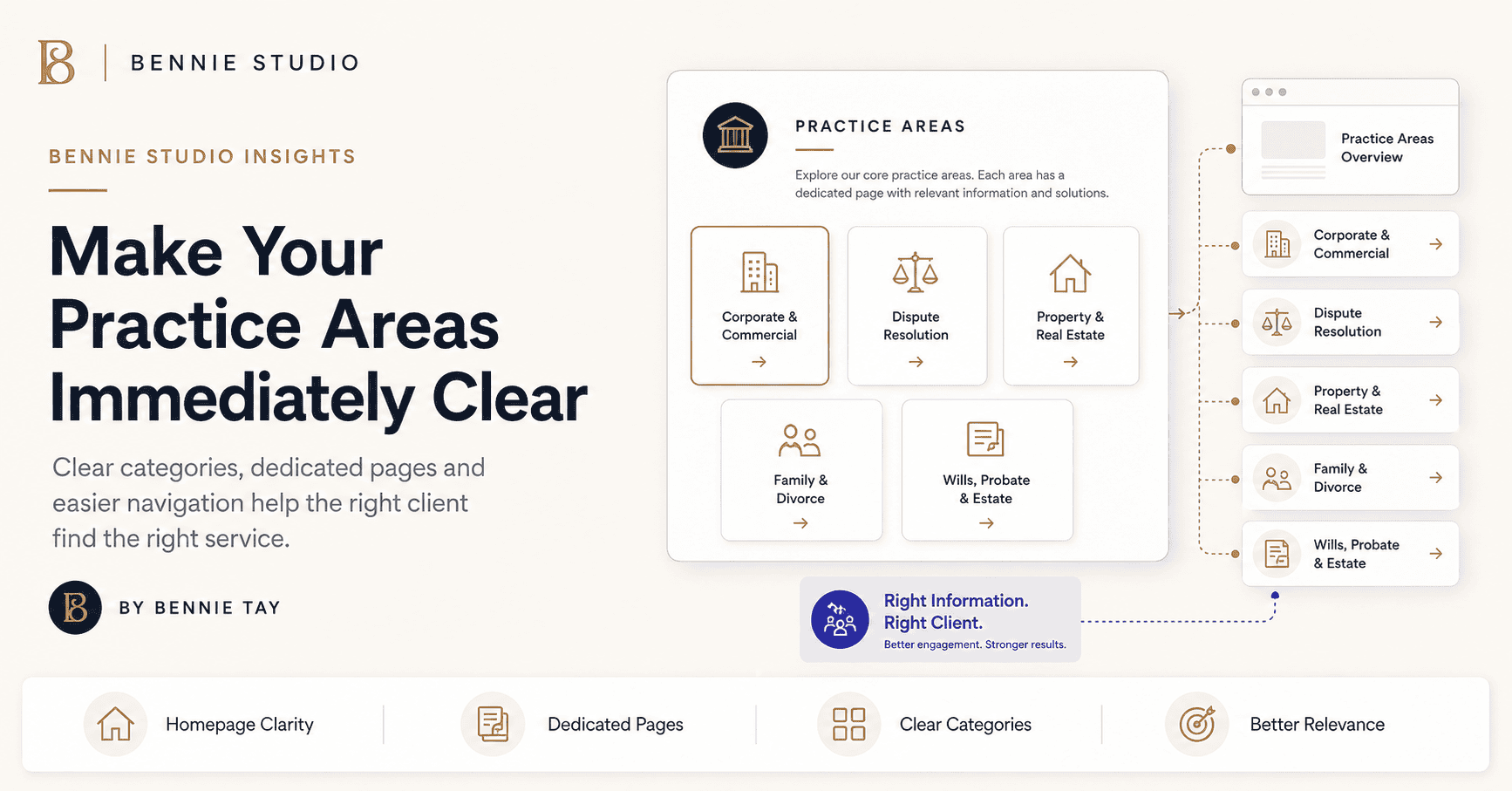
1. Make Your Practice Areas Immediately Clear
Someone visiting a law firm website usually has a particular problem. They are not searching for: Innovative and holistic legal excellence.
They are trying to work out: Do you handle my type of matter? Your website should therefore make your areas of practice easy to identify. For example:
Corporate & Commercial
- commercial agreements
- corporate advisory
- shareholder matters
- mergers and transactions
Dispute Resolution
- commercial disputes
- contractual disputes
- debt recovery
- litigation
Property & Conveyancing
- sale and purchase transactions
- loan documentation
- tenancy matters
- property-related advisory
Family Matters
- divorce
- custody
- maintenance
- matrimonial matters
Wills, Probate & Estate Matters
- wills
- probate
- letters of administration
- estate-related matters
Use only areas the firm genuinely practises in.
The Malaysian Bar’s own Legal Directory allows users to search law firms and lawyers and includes submitted areas of practice, which illustrates how important practice-area clarity is when people are trying to identify potentially relevant legal services.
Do not make prospective clients decode one enormous “Our Services” paragraph.
2. Create Dedicated Pages for Important Practice Areas
If a practice area is commercially important to the firm, give it a proper page. For example: /corporate-commercial-law/
is more useful than placing “Corporate Law” inside a list of 25 services. A strong practice-area page can explain:
- what matters the firm handles
- common situations that lead clients to seek advice
- the general process
- what information may be useful for an initial enquiry
- the relevant lawyers
- frequently asked questions
- how to contact the firm
The purpose is not to give individual legal advice online. It is to help visitors determine whether the firm may be relevant to their situation. That difference matters. A visitor should finish the page understanding: “This firm handles matters like mine, and I know how to contact them.”
3. Introduce the Lawyers Properly
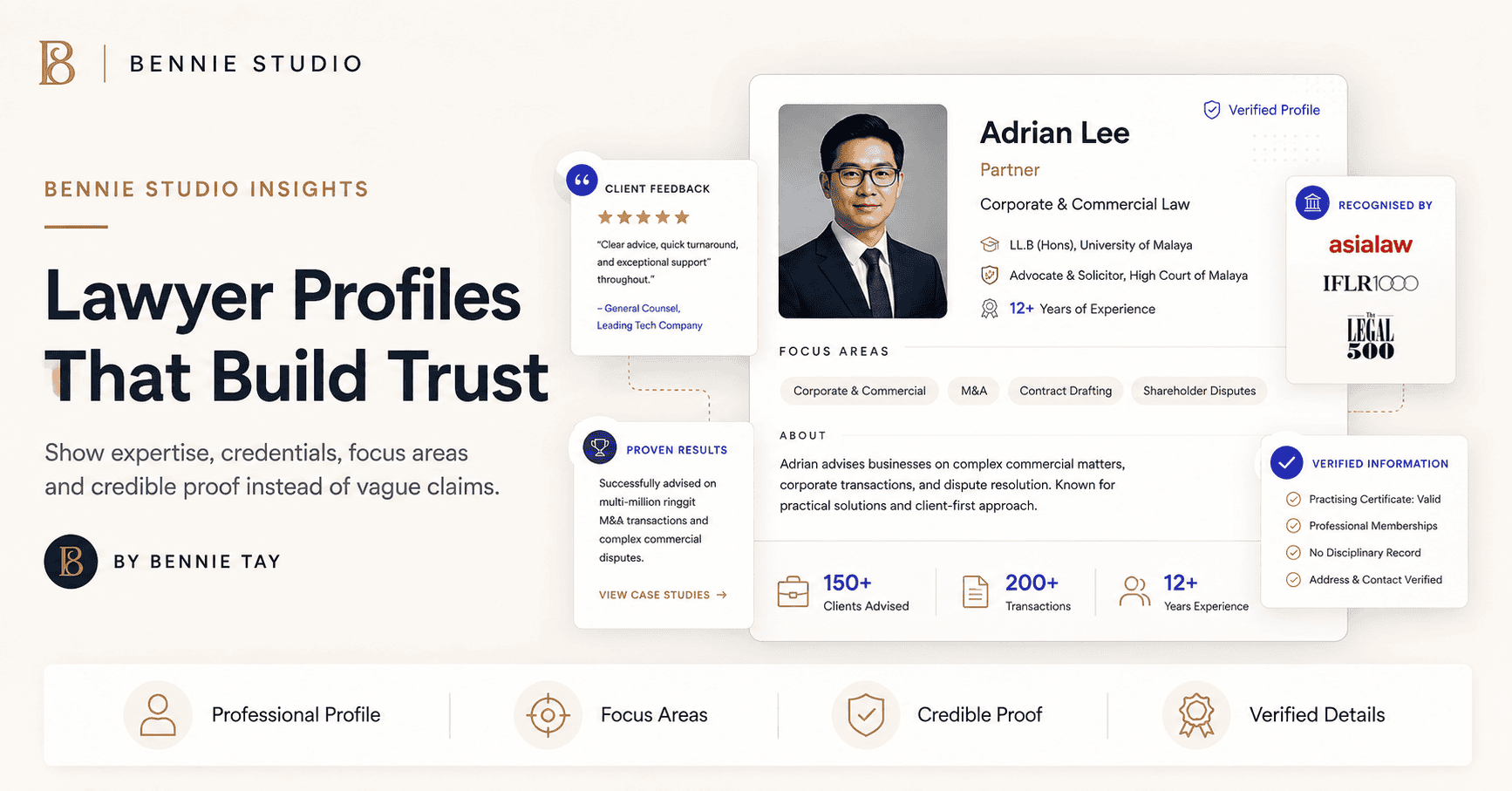
Professional services depend heavily on trust. Yet some law firm websites hide their lawyers behind a generic “Our Team” page containing little more than names and job titles. Give potential clients enough information to understand who they may be dealing with. A lawyer profile can include appropriate information such as:
- name
- role
- academic and professional qualifications
- year of admission
- areas of practice
- relevant professional background
- languages spoken where useful
- professional memberships where appropriate
The Legal Profession (Publicity) Rules define categories of “approved information,” including areas of practice and academic and professional qualifications. Avoid turning profiles into sales copy filled with unsupported superlatives.
Instead of: Mr Lee is one of Malaysia’s leading experts in corporate litigation. use factual information that the visitor can evaluate. For example: Mr Lee was admitted to the Malaysian Bar in [year] and practises in commercial disputes, contractual matters and corporate litigation.
Clarity creates credibility far better than excessive adjectives.
4. Verify the Information You Publish
Professional information should be accurate and current. The Malaysian Bar maintains an online Legal Directory containing advocates and solicitors with valid practising certificates and registered law firms. That means your website details should remain consistent with the firm’s actual status and current team.
Review periodically:
- lawyer profiles
- office addresses
- telephone numbers
- areas of practice
- branch information
- qualifications
- practising information
- contact details
A lawyer who left the firm two years ago should probably not still be presented as waiting enthusiastically for new enquiries. Accuracy is part of trust.
5. Use a Clear Homepage Positioning Statement
A law firm homepage should quickly answer:
Who are you? What kind of work do you handle? Where are you located? What should the visitor do next?
For example: Corporate, Dispute Resolution and Property Legal Services in Kuala Lumpur followed by a short factual introduction. Then give visitors two sensible pathways:
View Practice Areas and Contact the Firm
The homepage does not need an enormous slogan. Legal clients are usually looking for competence and relevance, not a cinematic brand manifesto.
6. Build Trust With Facts, Not Hype
Law firm websites need trust signals, but they should be factual and professionally appropriate. Useful elements may include:
- lawyer qualifications
- year the firm was established
- areas of practice
- branch locations
- languages spoken
- publications
- professional experience
- legal articles
- recognised appointments or qualifications where appropriate
Be especially cautious with claims involving:
- “best”
- “leading”
- “top”
- “expert”
- “specialist”
- success percentages
- numbers of cases won
Rule 5 of the Malaysian Publicity Rules specifically restricts misleading or inappropriate publicity, claims of being a specialist or expert, and references to the number or proportion of successfully undertaken cases.
For a law firm website, restraint is not weak marketing. It is often better marketing.
7. Make Enquiries Easy Without Turning the Website Into a Sales Funnel
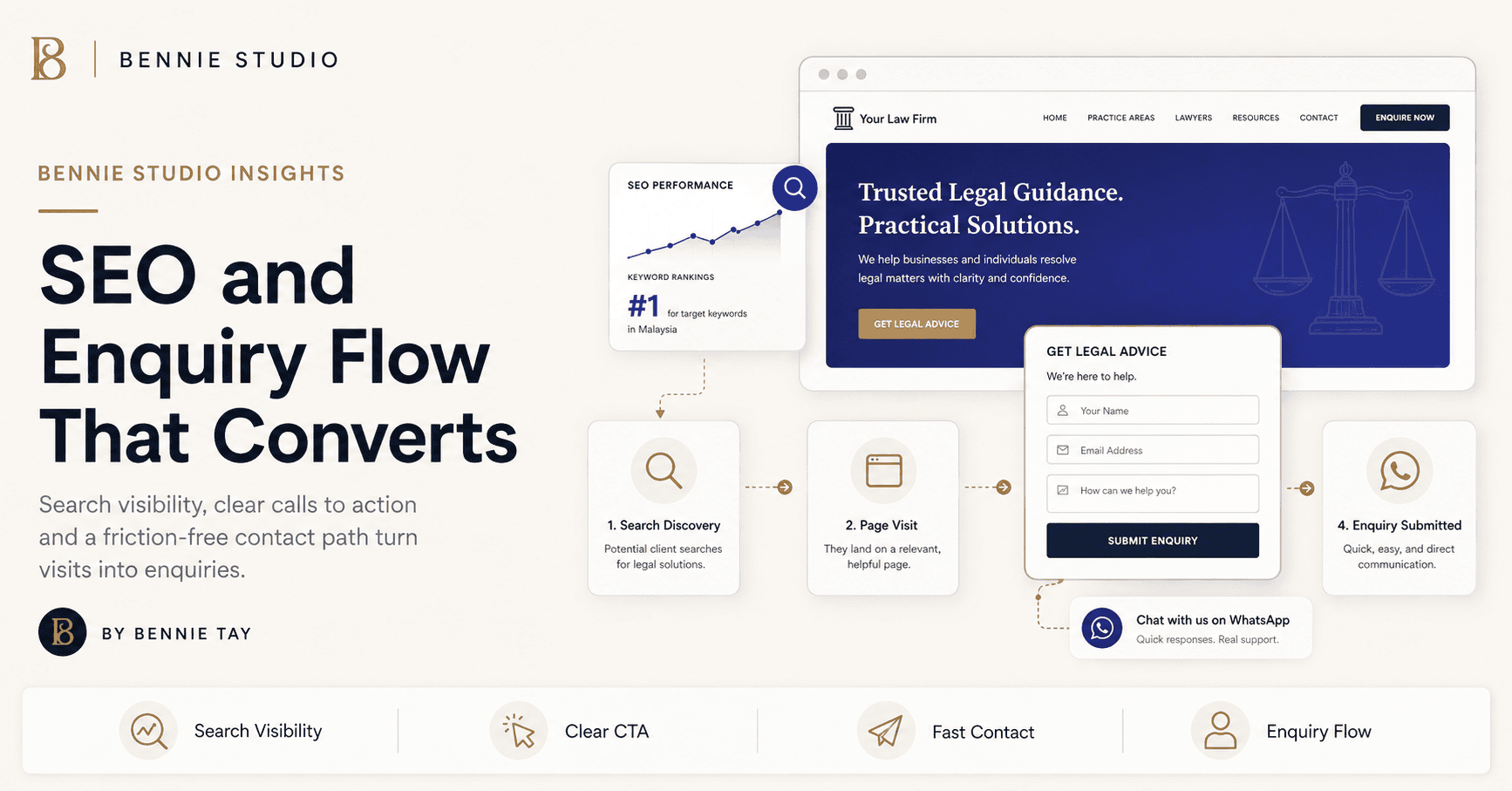
Someone dealing with a legal problem may already feel uncertain. Do not make the enquiry process harder. Useful contact options may include:
- phone
- enquiry form
- office address
- map
- business hours
- an appropriate messaging channel if the firm uses one
The Malaysian Bar’s website rules expressly contemplate website mechanisms that allow visitors to contact an advocate and solicitor for comments or enquiries. They also state that a website may provide approved information to help someone decide whether to retain a lawyer, while cautioning against establishing a solicitor-client relationship merely through the website.
That distinction should influence your forms. The objective of the first form is usually: Start an appropriate conversation. Not: Collect the entire legal case before anyone has agreed to act.
A simple initial form might request:
- name
- telephone number
- general type of matter
- short description
Avoid requesting unnecessarily sensitive information before the firm has established the appropriate relationship and process for handling it.
8. Use Clear Calls to Action
A law firm’s CTA does not need to shout. Appropriate examples might include:
Contact Our Firm / Make an Enquiry / Speak With Our Team / Contact Us About Your Matter
Avoid manufactured urgency such as: ACT NOW BEFORE IT’S TOO LATE!!!
There may genuinely be deadlines in legal matters, but the website should not use panic as a conversion tactic. The Publicity Rules expressly restrict publicity that is misleading, sensational, intrusive or otherwise unbefitting the dignity of the profession.
Clear beats theatrical.
9. Add a Proper Disclaimer
A law firm’s website provides general information. Visitors should understand that reading a page is not automatically the same as receiving legal advice. The Malaysian Bar’s website rules allow disclaimers and state that where used they should appear on the homepage or be highlighted through a prominent homepage link.
Your exact disclaimer should be reviewed by the firm and aligned with applicable Bar Council rules.
It may address matters such as:
- information being general in nature
- information not constituting legal advice
- no solicitor-client relationship arising merely from website use
- the need for advice based on individual circumstances
Do not simply copy another firm’s legal wording because it looked suitably intimidating. The disclaimer should match your own website and practice.
10. Check the Malaysian Bar Website Link Requirement
This is one of those small technical details that web designers can easily miss. The Malaysian Bar’s rules governing law firm websites state that every website shall have a link on its front page connecting to the official Malaysian Bar website or another address notified by the Bar Council.
So this should be part of the launch checklist for a Malaysian law firm website. Compliance requirements should not be treated as a decorative footer exercise added five minutes before launch. Review them during the actual website planning process.
11. Use SEO Around Genuine Practice Areas
SEO for a law firm should begin with how potential clients actually search. For example:
- corporate lawyer Kuala Lumpur
- conveyancing lawyer Petaling Jaya
- probate lawyer Malaysia
- employment lawyer Kuala Lumpur
- commercial dispute lawyer Malaysia
But avoid forcing keywords into every sentence. A useful page about a genuine practice area should naturally explain:
- the type of matter
- who it may affect
- the firm’s relevant service
- general process
- frequently asked questions
- location where relevant
The goal is to build focused pages that match legitimate searches, not create 100 nearly identical location pages in which only the suburb changes. That strategy mostly produces a website that reads as though a spreadsheet became sentient.
12. Publish Useful Legal Articles
Educational content can be particularly valuable for professional services. Potential topics might include:
- What Should You Prepare Before Meeting a Conveyancing Lawyer?
- What Happens After Someone Passes Away Without a Will in Malaysia?
- What Should Businesses Review Before Signing a Commercial Agreement?
- What Documents Are Usually Needed for a Property Sale?
- What Is the Difference Between a Will and Estate Administration?
The article should educate at a general level and encourage readers to obtain advice for their circumstances where appropriate. The Publicity Rules and Malaysian Bar rules should remain part of the firm’s content review process whenever legal content is published. Advocates and solicitors remain responsible for publicity relating to their practice that is within their control.
That means outsourced web designers and copywriters do not magically inherit the lawyer’s professional responsibility. The firm should review what is published.
13. Make the Website Mobile-Friendly
Many people will find a lawyer through their phone. They may search Google, receive the firm’s name from a friend or open a link from a message. On mobile, make sure:
- practice areas are easy to navigate
- text is readable
- telephone numbers are tappable
- forms are simple
- office locations are easy to find
- buttons are not tiny
- pages load efficiently
A beautifully designed desktop website is not particularly impressive if the mobile version forces clients to zoom in like they are examining contractual fine print.
14. Keep Lawyer and Practice-Area Pages Updated
A law firm website should not be launched and forgotten. Review it whenever:
- a lawyer joins or leaves
- an office moves
- a branch opens or closes
- areas of practice change
- contact details change
- important regulations affecting published content change
Bar Council rules place responsibility on the advocate and solicitor to ensure publicity concerning the practice complies with the relevant rules and to take steps where improper publicity is identified. Website maintenance therefore includes more than installing software updates. For professional practices, content accuracy matters just as much.
Recommended Law Firm Homepage Structure
For many Malaysian legal practices, I would consider:
1. Hero: Firm positioning + main areas of practice + location.
2. Practice Areas: Help visitors identify the relevant legal service.
3. Firm Introduction: Brief, factual explanation of the practice.
4. Lawyers: Introduce the professionals behind the firm.
5. Relevant Credentials: Use factual, permitted professional information.
6. How an Enquiry Works: Explain the initial contact process.
7. Legal Insights: Provide useful general information.
8. Location and Contact: Make the firm easy to find.
9. Disclaimer and Required Links: Ensure the website has been reviewed for applicable professional requirements.
The structure is intentionally simple. Someone searching for legal assistance should not need to solve a navigation puzzle first.
Frequently Asked Questions
What should a Malaysian law firm website include?
A practical website should normally include the firm’s details, practice areas, lawyer profiles, contact information, office location, useful legal content where appropriate, and required compliance elements. The exact information published should be reviewed against current Malaysian Bar requirements.
Can a Malaysian law firm call its lawyers experts or specialists?
Rule 5 of the Legal Profession (Publicity) Rules 2001 restricts an advocate and solicitor from claiming that they or another advocate and solicitor in the firm is a specialist or expert in an area of practice. Use factual descriptions of areas of practice, qualifications and experience instead.
Can a law firm publish articles for SEO?
Law firms can publish permitted legal information and articles, but content and publicity should be reviewed for compliance with the Publicity Rules and applicable Bar Council rules.
Should a law firm have individual lawyer profile pages?
Usually, yes, when appropriate. Profiles can help visitors understand the qualifications, areas of practice and professional background of the people behind the firm. Published information should remain accurate and compliant with applicable rules.
Can people contact a lawyer through a website?
The Malaysian Bar’s website rules permit mechanisms for visitors to make comments or enquiries, while also cautioning against establishing a solicitor-client relationship merely through the website.
Does a law firm website need a disclaimer?
The Malaysian Bar’s website rules expressly permit disclaimers and provide requirements concerning their visibility when used. The firm should review its own disclaimer against current requirements rather than relying on generic copied wording.
A Law Firm Website Should Make the Next Step Clearer
A good legal website does not need to behave like an aggressive advertising campaign. Its job is to help potential clients understand:
- What areas of law does the firm handle?
- Who are the lawyers?
- Is the firm relevant to my matter?
- Can I verify the information presented?
- How do I make an enquiry?
Do those things well and the website becomes a useful part of the firm’s client journey while maintaining the professional tone expected of legal services. At Bennie Studio, professional-service websites are designed around clarity, credibility, mobile usability and straightforward enquiry flows.
For law firms, that also means designing with the profession’s publicity requirements in mind and ensuring that final content is reviewed and approved by the firm before publication.
Explore Professional Services Website Design →
Already have a law firm website that feels outdated or difficult to navigate?
Get a Website Growth Audit →