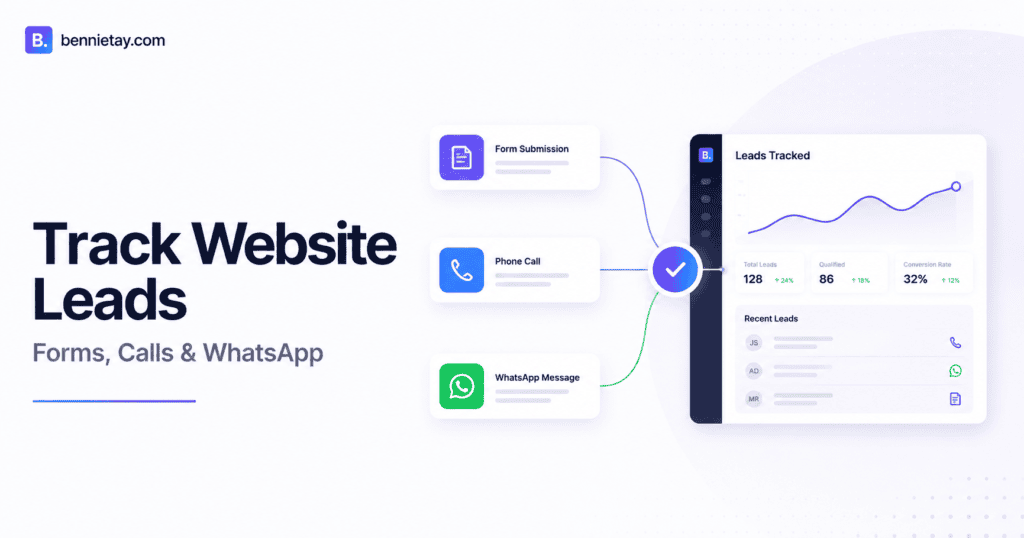
Your website is generating enquiries. Some visitors submit contact forms. Others click WhatsApp, call the business or book a consultation. That sounds positive.
But there is a more important question:
Do you know which parts of your website and marketing are producing those opportunities?
Can you identify which page generated the lead? Do you know whether the visitor came from Google, social media, advertising or a referral? Can you see which service they were interested in? More importantly, do you know which marketing channels actually produce qualified leads and paying customers?
If the answer is no, your website may be generating activity without giving you enough information to make good business decisions.
Many businesses still judge website performance mainly through metrics such as traffic, page views, ad clicks or social followers.
Those numbers can be useful, but they do not answer the most important question:
Is the website generating business?
A better approach is to track the actions that indicate real customer intent.
For a service business, those actions might include contact-form submissions, WhatsApp clicks, phone calls, bookings, quotation requests, downloads or purchases.
Once those actions are measured properly, the website becomes much easier to improve.
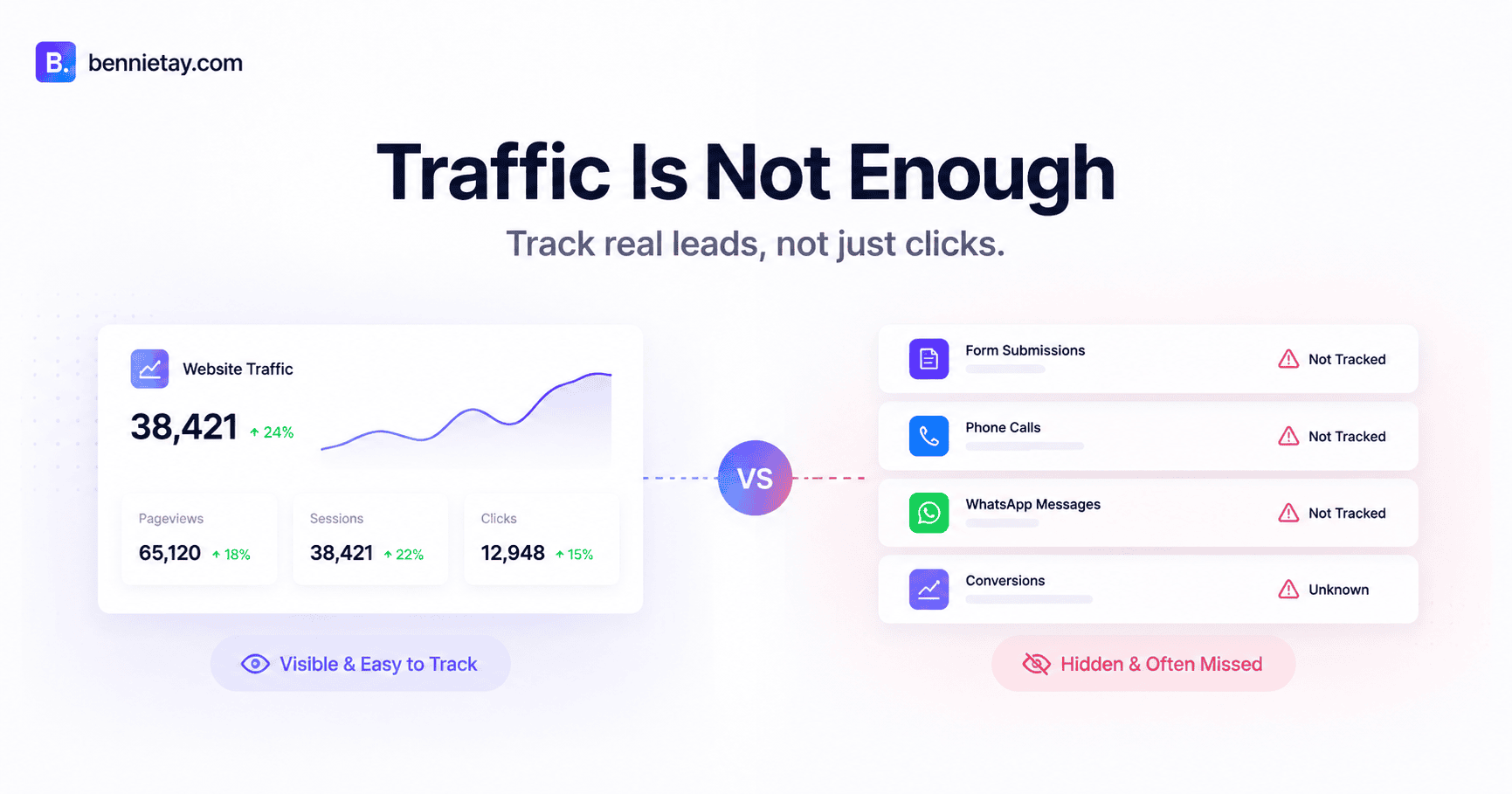
Traffic Is Not the Same as Business Performance
Website traffic is useful because people normally need to visit your site before they can become customers.
But traffic alone does not tell you whether the website is working.
Imagine two websites.
Website A receives 10,000 visitors per month and generates 15 enquiries.
Website B receives 2,000 visitors and generates 60 enquiries.
If you looked only at traffic, Website A would appear much more successful.
From a business perspective, Website B is probably performing considerably better.
The same principle applies to marketing channels.
A social campaign might send thousands of visitors while organic Google traffic sends fewer. If Google visitors are significantly more likely to request quotations or become customers, the smaller traffic source may actually be more valuable.
The goal of website measurement is therefore not to collect the largest possible number of statistics.
It is to understand which activity contributes to business outcomes.
Start by Defining Your Website Conversions
A conversion is a meaningful action a visitor takes on your website.
Not every action should have equal importance.
A useful way to structure website measurement is to separate primary conversions from secondary conversions.
Primary Conversions
These represent the main business outcome you want the visitor to complete.
Depending on your company, they might include:
- quotation requests
- consultation bookings
- service enquiries
- trial class registrations
- purchases
- enrolment requests
- project applications
These actions usually indicate stronger buying intent.
Secondary Conversions
These are valuable actions that show interest but do not necessarily represent a confirmed lead.
Examples might include:
- WhatsApp button clicks
- phone-number clicks
- brochure downloads
- newsletter signups
- portfolio views
- pricing-page visits
This distinction matters because clicking WhatsApp is not necessarily equal to submitting a detailed RM20,000 quotation request.
Someone may click WhatsApp and never send a message.
Someone may download a guide simply because the topic interests them.
Treating every interaction as a lead creates an impressive-looking report and a very misleading picture of the business.
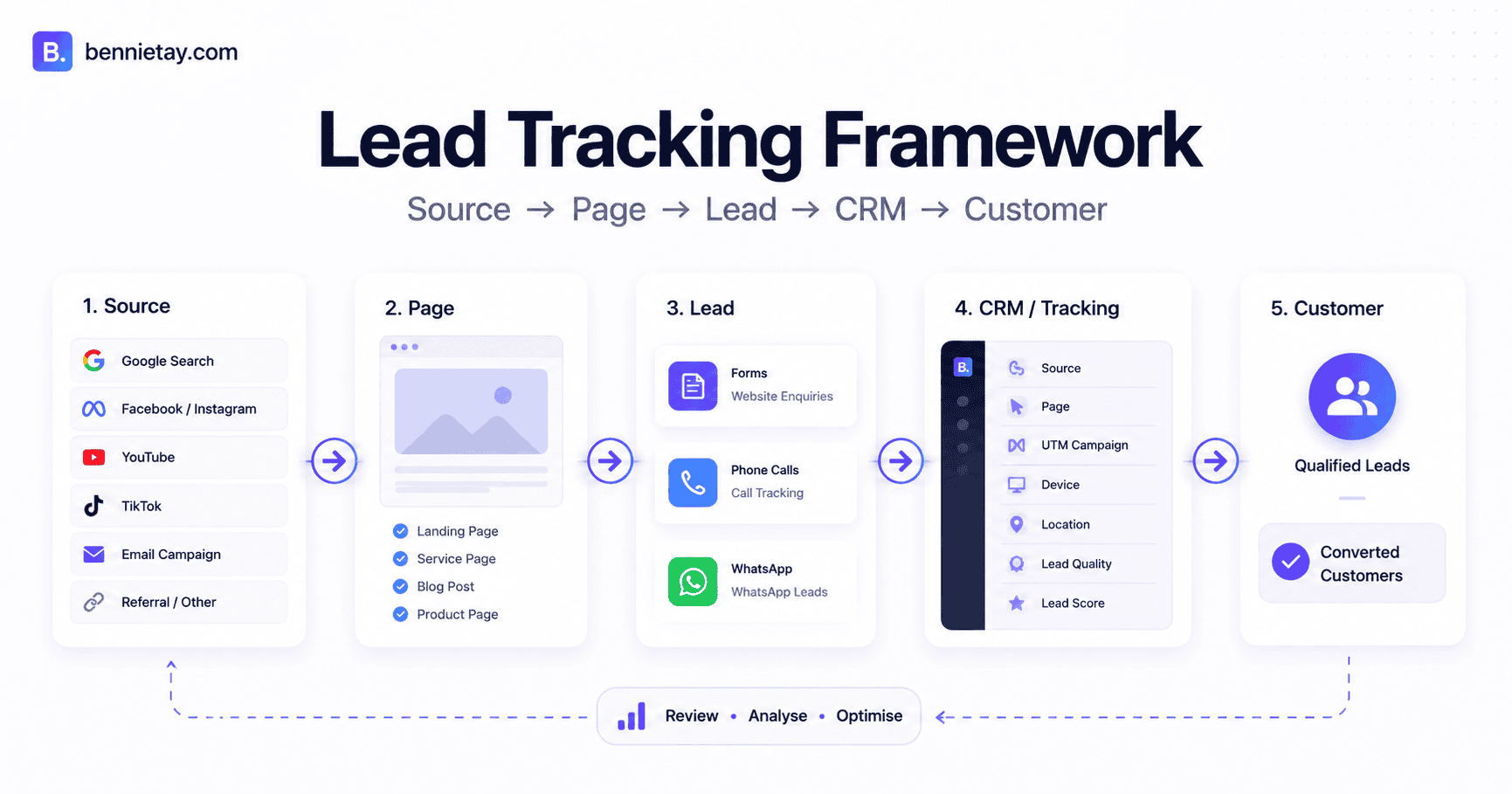
Track Where Every Lead Starts
One of the most useful questions your analytics should help answer is:
Where did this opportunity come from?
At minimum, try to understand the major marketing channels driving website visitors and conversions.
These could include:
- Google organic search
- Google Ads
- Facebook or Instagram
- referral websites
- direct traffic
- other campaigns
Suppose the website produces the following results:
Google Organic
40 leads
20 qualified leads
10 quotations
4 customers
Facebook Ads
70 leads
15 qualified leads
5 quotations
1 customer
If you only looked at lead volume, Facebook appears stronger.
It produced 70 leads compared with Google’s 40.
But once you look deeper, Google produced more qualified opportunities, twice as many quotations and four times as many customers.
That is a much more useful business comparison.
More leads do not automatically mean better marketing.
Track the Landing Page That Generated the Enquiry
Knowing the traffic source is helpful, but you should also understand which page started the visitor’s journey.
Suppose a renovation business has pages for:
- kitchen renovation
- bathroom renovation
- office renovation
- home renovation
- renovation costs
Over time, you may discover that the kitchen renovation page generates significantly more quotation requests than the homepage.
That tells you something important.
You might decide to:
- strengthen the kitchen renovation page further
- promote it more heavily
- build related articles
- create more case studies
- improve internal links towards it
- run advertising directly to it
Without page-level conversion tracking, all you know is that the website produced a lead.
That is useful.
Knowing which page helped produce it is much more actionable.
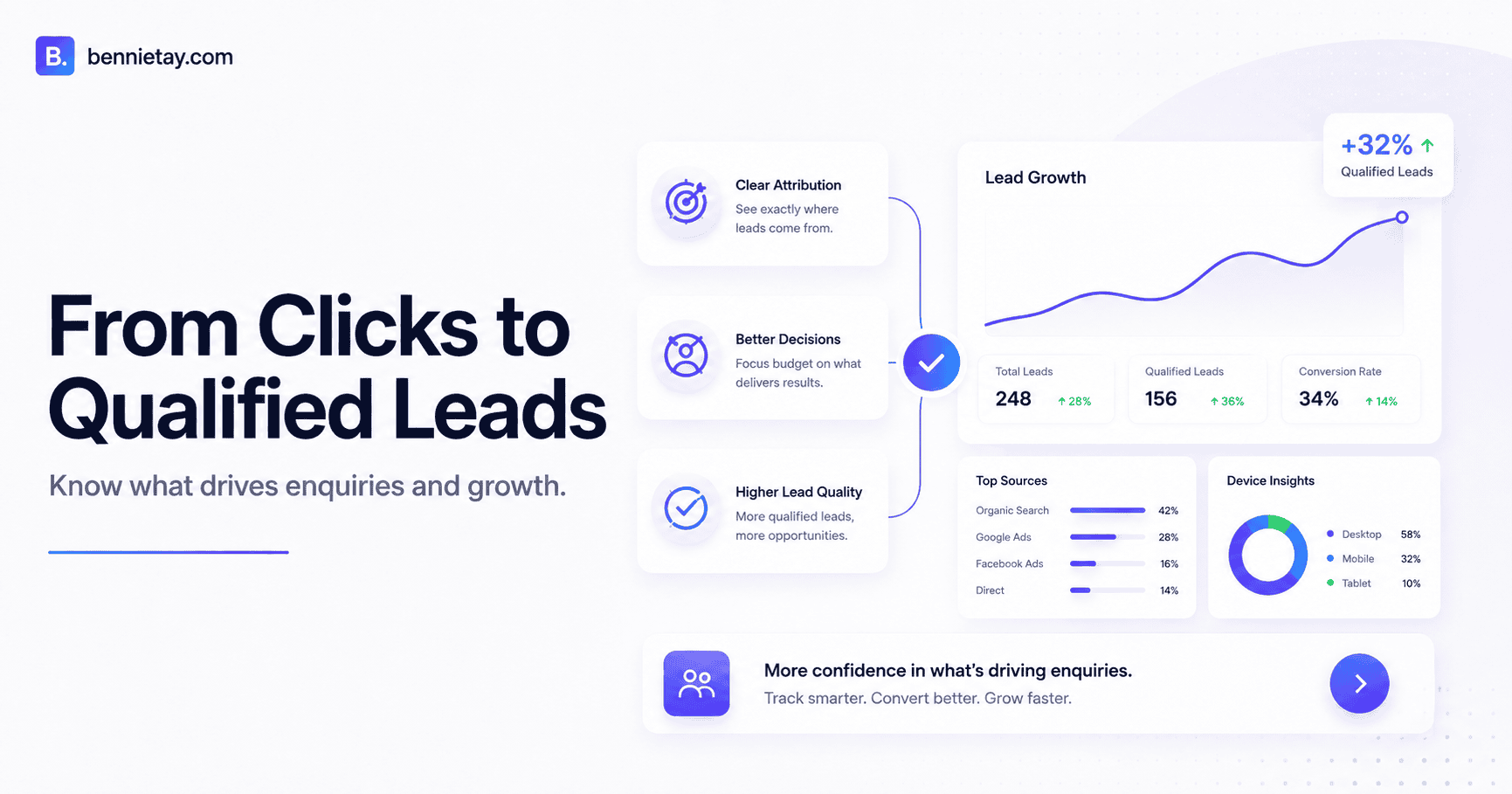
Measure Lead Quality, Not Just Lead Volume
A lead is not automatically a good lead.
Someone asking for a service you do not provide is technically an enquiry.
Someone with a RM500 budget requesting a RM20,000 service is also technically an enquiry.
Neither is particularly valuable.
That is why lead tracking should eventually include lead quality.
A simple funnel could look like:
Website Visitors → Leads → Qualified Leads → Quotations → Customers
For example:
100 website enquiries might produce:
40 qualified opportunities
20 quotations
8 customers
Now you can calculate several useful metrics.
Website Lead Rate
How many website visitors become enquiries?
Lead Qualification Rate
What percentage of enquiries are genuinely suitable?
Lead-to-Customer Rate
How many leads eventually become customers?
These metrics diagnose different problems.
If website traffic is strong but very few people enquire, the website may need conversion improvements.
If you generate many enquiries but very few are qualified, the problem could be targeting, messaging, pricing expectations or the type of traffic reaching the website.
If qualified leads regularly request quotations but rarely purchase, the issue might be in the sales process, proposal, pricing or follow-up.
Do not automatically blame the website for every business problem.
It already has enough responsibility.
Track Revenue Where Possible
Lead volume is useful.
Revenue is better.
Suppose your business provides two main services.
Custom Website Projects
20 leads
Average potential project value: RM10,000
Landing Page Projects
35 leads
Average potential project value: RM2,500
Landing pages produce more enquiries.
Custom websites potentially produce much more revenue.
That distinction can influence where you invest your marketing effort.
You might decide that custom websites deserve greater homepage visibility, more supporting content and a stronger advertising budget, even though the raw enquiry volume is lower.
For businesses with different service values, tracking only lead numbers can produce poor decisions.
Try to connect leads to estimated quotation value and eventual sales wherever practical.
Understand How Mobile and Desktop Visitors Behave Differently
Not every visitor wants to contact you in the same way.
Imagine your analytics shows:
Desktop
2,000 visitors
80 contact-form submissions
Mobile
4,000 visitors
20 contact-form submissions
150 WhatsApp clicks
It would be easy to conclude that your mobile website converts poorly if you measured only form submissions.
But the behaviour may be completely normal.
Mobile visitors might prefer WhatsApp because it allows them to move directly from your website into a conversation.
Desktop visitors may be more comfortable completing a longer form.
That is why websites offering multiple contact methods should measure each one separately.
Track actions such as:
- form submissions
- WhatsApp clicks
- phone clicks
- booking completions
Then look at the entire conversion picture rather than judging every device using the same behaviour.
WhatsApp Clicks Are Not Always Confirmed Leads
WhatsApp is particularly important for many Malaysian service businesses, but tracking it requires some care.
A button click tells you that someone opened WhatsApp.
It does not necessarily mean they sent a message.
That is why I would normally treat a WhatsApp click as a conversion event, but not automatically as a confirmed lead.
Where possible, your lead-management process should separately record actual WhatsApp enquiries.
For example:
Analytics: 100 WhatsApp clicks
Actual conversations: 65
Qualified leads: 20
Customers: 5
Now you have a much clearer view of what the channel is producing.
The same principle applies to phone clicks.
A visitor tapping a phone number is a useful signal, but it does not guarantee that the call connected or became a meaningful conversation.
Track Phone Calls Where Practical
Phone leads are more difficult to track than form submissions because customer behaviour can move offline.
Someone might:
- Find your business through Google
- Visit your website
- Save the phone number
- Leave
- Call two days later
The website influenced the enquiry, but basic analytics may not connect the two actions.
At a minimum, you can track clicks on telephone links from mobile devices.
Businesses requiring more detailed attribution may also consider dedicated call-tracking systems where appropriate.
Your CRM or sales process can help fill some of the remaining gaps.
A simple question such as:
How did you hear about us?
can still provide useful information.
No tracking system captures every customer journey perfectly.
The objective is better visibility, not omniscience.
Use Campaign Tracking Properly
If you run paid advertising, email campaigns, social promotions or other marketing activities, make sure the website can distinguish those sources.
Otherwise, valuable campaigns can become mixed into categories such as direct or referral traffic, making comparison difficult.
Campaign tracking allows you to answer questions such as:
- Which Facebook campaign produced the lead?
- Did the Google Ads campaign generate quotations?
- Did the email promotion generate website enquiries?
- Which social campaign created actual customers?
Marketing without campaign tracking often produces conversations such as:
We received more website traffic this month.
Excellent.
From where?
Social media, probably.
Which campaign?
Hard to say.
Did any of it become revenue?
We think so.
This is not measurement. It is optimism with charts nearby.
Connect Website Leads to a CRM or Lead Tracker
Website analytics tells you what happened before and during the enquiry.
To understand what happens afterwards, you need some form of lead tracking.
That does not necessarily mean buying an enormous CRM platform immediately.
A simple system can start with fields such as:
- date
- customer name
- source
- landing page
- service
- contact method
- qualified or not
- quotation value
- won or lost
- revenue
This closes the gap between website activity and business results.
Without this connection, you may know that Google generated 100 enquiries but have no idea how many became customers.
With it, you might discover:
Google Organic
40 enquiries
20 qualified
10 quotations
4 customers
55 enquiries
12 qualified
4 quotations
1 customer
Now you can make a much more sensible marketing decision.
Build a Simple Website Performance Dashboard
You do not need 100 metrics.
A practical monthly business view might contain four areas.
Website
Track:
- visitors
- main landing pages
- important traffic changes
Leads
Track:
- form submissions
- WhatsApp enquiries
- calls
- bookings
Lead Quality
Track:
- total qualified leads
- qualification rate
- major service enquiries
Sales
Track:
- quotations
- customers
- estimated revenue
- won and lost opportunities
You can then break those results down by channel:
- advertising
- social media
- referrals
- direct traffic
This gives you a useful management view.
Each month, you can ask:
What improved?
What declined?
Which pages generated opportunities?
Which channels produced qualified leads?
Which services attracted demand?
Where should we invest next?
Those questions are far more useful than celebrating because bounce rate changed by 2.4%.
Use Conversion Data to Improve Your Website
Measurement becomes valuable only when it changes what you do.
Suppose one service page attracts strong traffic but almost no enquiries.
That might indicate problems with:
- the offer
- CTA
- pricing
- trust
- page structure
- message clarity
Another page might receive relatively little traffic but convert exceptionally well.
That could justify sending more visitors there through SEO, advertising or internal links.
You may discover that mobile visitors heavily prefer WhatsApp, while desktop visitors prefer forms.
That could influence your mobile CTA hierarchy.
Your pricing page might have a surprisingly high exit rate.
Perhaps customers need clearer value explanations or testimonials near the pricing.
Tracking allows you to replace guesses with evidence.
Common Website Lead Tracking Mistakes
Mistake 1: Tracking Only Traffic
Visitors matter, but traffic is not the final objective.
Connect traffic to meaningful conversion actions.
Mistake 2: Treating Button Clicks as Confirmed Leads
A WhatsApp or phone click is useful information, but it may not result in an actual conversation.
Keep the distinction clear.
Mistake 3: Treating Every Lead Equally
A casual enquiry and a qualified RM30,000 opportunity should not have the same business value.
Track quality.
Mistake 4: Ignoring Campaign Tracking
Without consistent campaign attribution, marketing channels become difficult to compare properly.
Mistake 5: Not Connecting Leads to Sales
Lead-generation data becomes much more useful when you can identify quotations, customers and revenue.
Mistake 6: Tracking Too Much
More data does not automatically create more insight.
If nobody uses a metric to make decisions, question why you are collecting it.
Mistake 7: Never Reviewing the Numbers
Analytics that nobody checks has limited business value.
Set a regular schedule for reviewing the information and deciding what should change.
What Should a Small Service Business Track First?
You do not need an enterprise analytics system on day one.
Start with the actions closest to revenue.
Track:
- Contact-form submissions
- WhatsApp clicks
- Phone clicks
- Booking completions
- Purchases where relevant
- Traffic source
- Landing page
Then maintain a simple lead tracker recording:
- Qualified or not
- Quotation value
- Won or lost
That already provides a strong view of website performance.
Once the basics work reliably, you can become more sophisticated.
Starting simple is considerably better than building a beautiful analytics system containing 200 events that nobody understands.
Frequently Asked Questions
What is a website conversion?
A website conversion is a meaningful action taken by a visitor, such as submitting a form, booking an appointment, calling, starting a WhatsApp conversation or making a purchase.
The most useful conversions are those connected to real business outcomes.
Should WhatsApp clicks count as leads?
A WhatsApp click can be tracked as a conversion event, but I would not automatically treat it as a confirmed lead.
An actual message or conversation provides stronger evidence of customer intent.
How do I track phone calls from my website?
At a basic level, track clicks on telephone links, particularly on mobile.
Businesses requiring deeper measurement can consider dedicated call tracking and CRM attribution.
What is the difference between traffic and leads?
Traffic measures people visiting the website.
Leads are visitors who take an action that demonstrates meaningful interest in the business.
A website can have high traffic and still generate very few leads.
What is a qualified lead?
A qualified lead is an enquiry that matches important criteria for your business.
Depending on your service, that might include suitable budget, service need, location, timing, company type or project size.
Should I track every website button?
No.
Focus on actions that help you understand the customer journey and business performance.
Tracking every minor interaction can create more noise than insight.
Which website metric matters most?
There is no single perfect metric.
For most service businesses, the most useful combination is qualified leads, lead-to-customer conversion and revenue, supported by information about traffic source and landing pages.
Measure What Helps You Make Better Decisions
The purpose of website analytics is not to produce more charts.
It is to answer practical business questions.
Which pages generate enquiries?
Which channels produce qualified opportunities?
Which services attract demand?
Where are customers abandoning the journey?
Which marketing activities produce revenue?
Start with those questions.
Then track the actions required to answer them.
For most service businesses, that means measuring forms, calls, WhatsApp conversations, bookings, lead quality and sales outcomes.
Once that journey becomes visible, both your website and marketing become much easier to improve.
At Bennie Studio, lead-generation websites are planned around measurement as well as design, helping businesses understand which pages and marketing activities are producing opportunities instead of simply hoping the website is doing something useful.
Getting website enquiries but still unsure which pages or marketing channels produce your best leads?
For practical ideas on improving the results you uncover, read the Website Conversion Optimisation Guide.
Your technical setup matters too. The Website Running Cost Guide explains what Malaysian businesses should budget for hosting, maintenance and ongoing website operations.