Your website gets visitors. Some arrive from Google. Others come through social media, paid advertising, referrals, email or direct traffic. The obvious growth strategy is often:
Get more traffic.
More visitors can certainly create more opportunities. But before spending more money and effort attracting them, there is another question worth asking:
What percentage of the visitors you already have are actually taking action?
Suppose 1,000 relevant people visit your website each month and only five contact you.
If nothing else changes, doubling your traffic may simply give you 2,000 visitors and ten enquiries.
Sometimes the bigger opportunity is not getting more people through the door.
It is improving what happens after they arrive.
That is where conversion rate optimization, commonly shortened to CRO, becomes useful.
For a small or service business, CRO does not need to involve expensive testing software, behavioural psychology laboratories or endless arguments over whether a green button converts 0.7% better than a blue one.
The practical idea is much simpler:
Make your website easier to understand, easier to trust and easier to act on.
What Is Conversion Rate Optimization?
Conversion rate optimization is the process of improving a website so that a greater proportion of suitable visitors complete valuable actions.
For a service business, those actions might include:
- requesting a quotation
- sending a WhatsApp message
- making a phone call
- booking a consultation
- submitting an enquiry
- registering for a trial
- purchasing a service
For an eCommerce business, conversions might include adding a product to cart, beginning checkout or completing a purchase.
The key word is valuable.
Not every click deserves to be celebrated equally.
Someone opening your contact page is not as valuable as someone submitting a serious project enquiry.
Someone downloading a guide is not necessarily worth the same as someone requesting a RM20,000 quotation.
Good CRO improves both conversion volume and conversion quality.
Conversion Rate Alone Can Be Misleading
A higher conversion rate does not automatically mean a better business result.
Imagine two websites.
Website A
100 visitors
10 enquiries
10% conversion rate
That sounds excellent.
But all ten enquiries have budgets far below the minimum project value.
Now consider:
Website B
1,000 visitors
30 enquiries
3% conversion rate
Twenty of those enquiries are strong commercial opportunities.
Website A has the higher conversion percentage.
Website B may be far more valuable to the business.
That is why service businesses should not optimise only for form submissions.
The real objective is:
more qualified enquiries from the right customers.
A website that generates hundreds of low-quality leads can create more work without producing much revenue.
Start With Clarity
Before experimenting with anything sophisticated, make sure visitors can understand your offer.
A potential customer should be able to answer several questions quickly:
- What does this business do?
- Is the service relevant to me?
- Who is it for?
- Where does the business operate?
- What result can I expect?
- What should I do next?
Many websites fail at this first stage.
Their homepage opens with something like:
Professional Solutions for Your Business
followed by three paragraphs about company values.
The customer still has no idea what is being sold.
Compare that with:
Website Design for Malaysian Service Businesses That Need More Enquiries
The second version immediately communicates the service, audience and outcome.
Clear positioning reduces mental effort.
And reducing unnecessary effort is one of the most useful forms of conversion optimisation.
Make Every Important Page Relevant to the Visitor’s Intent
A visitor who searched for accounting services Petaling Jaya should not land on a page that spends its first screen discussing every service the company has offered since 2004.
The page should confirm that the visitor has reached the right place.
A good service page should clearly explain:
- the service
- who it is for
- what problem it solves
- what is included
- what the process looks like
- likely pricing or pricing factors
- relevant proof
- common questions
- the next step
This creates continuity between the search, advertisement or referral that brought someone to the site and the page they actually see.
When the message matches the visitor’s intention, conversion becomes easier.
Use Stronger Calls to Action
Generic CTAs such as:
Contact Us
Submit
Click Here
tell the visitor almost nothing about what happens next.
Stronger CTAs describe the action or outcome.
Examples include:
Request a Quote
Book a Consultation
Check Availability
Get a Website Review
WhatsApp Us
Schedule an Assessment
The right CTA depends on the service and where the visitor is in the buying journey.
Someone researching a professional service may prefer Book a Consultation.
Someone with an urgent plumbing problem may respond better to Call Now.
A parent comparing tuition centres might want Check Class Availability.
Conversion improves when the action matches what the customer is trying to accomplish.
Build Trust Throughout the Page
Trust should not be confined to one page called Testimonials.
Potential customers make trust decisions throughout their journey.
Use relevant evidence where hesitation is likely to appear.
Before a CTA
Show a testimonial from someone who used the service.
Near Pricing
Use a review discussing value, transparency or what was included.
On a Service Page
Include proof directly related to that service.
Near a Form
Add a short testimonial or reassurance about what happens next.
On Location Pages
Use local customer proof where appropriate.
Trust signals can include:
- customer reviews
- testimonials
- case studies
- project examples
- before-and-after results
- qualifications
- professional memberships
- client logos where appropriate
- real team information
- guarantees
- clear company details
The purpose is not to decorate the page with trust badges.
It is to answer the visitor’s question:
Why should I believe this business can deliver what it promises?
Give Customers Enough Pricing Information
Pricing uncertainty can create significant friction.
That does not mean every service business needs to publish an exact fixed price.
Complex projects may vary too much.
But you can still provide guidance.
For example:
Projects start from RM6,000
or:
Most projects fall between RM8,000 and RM20,000 depending on scope.
You can also explain the main factors that influence price.
Pricing guidance helps prospects decide whether they are roughly in the right range before contacting you.
It can reduce unsuitable enquiries while making serious prospects more comfortable taking the next step.
That can improve lead quality even if total enquiry volume falls slightly.
CRO is not always about making the biggest number bigger.
Sometimes it is about making the business outcome better.
Simplify Your Contact Forms
Long forms create friction.
That does not mean every form should contain only one field.
It means every field should have a purpose.
For a simple enquiry, you might ask for:
- name
- contact details
- service required
- message
For a more detailed project enquiry, you might include:
- name
- company
- service
- budget range
- timeline
- brief project requirements
You can collect additional information later.
Avoid making a first-time visitor complete your entire sales discovery questionnaire before anyone from the business has even said hello.
Ask yourself:
Do we genuinely need this information before responding?
If not, consider removing it.
Improve the Mobile Journey
A website can look perfectly reasonable on a desktop computer and become awkward the moment someone tries to use it on a phone.
That matters because many visitors discover local and service businesses on mobile devices.
Check whether mobile users can easily:
- read the headline
- navigate
- tap buttons
- call
- open WhatsApp
- complete forms
- view pricing
- understand the service
- find important information
Do not judge the mobile experience by shrinking your browser window slightly and declaring the matter resolved.
Use the website like a real customer would.
If an enquiry button is difficult to tap, a form is painful to complete or important content requires endless scrolling, conversion may suffer.
Website Speed Can Affect the Experience
A website does not need to load instantaneously to generate enquiries.
It does need to feel reasonably fast and usable.
Large unoptimised images, unnecessary scripts, heavy animations and poorly configured hosting can make pages slower than they need to be.
A visitor searching for an urgent service probably does not want to wait through an elaborate loading animation before discovering whether you can help them.
Website speed should support the journey rather than become part of the entertainment.
Answer Objections Before They Stop the Enquiry
Potential customers often hesitate because they still have unanswered questions.
These might include:
- How much does it cost?
- How long will it take?
- What is included?
- Do you serve my area?
- Will I own the website?
- Can you work with my existing system?
- What happens after I enquire?
- Is there a contract?
- What if I need changes?
A strong website anticipates these concerns.
You can address them through service-page content, pricing explanations, FAQs, case studies and process sections.
Every unanswered objection creates another reason for the visitor to delay.
That delay often means opening another browser tab and visiting a competitor.
Measure the Conversion Journey
You cannot improve what you cannot see clearly.
For a service business, useful conversion tracking might include:
- service-page visits
- CTA clicks
- form submissions
- WhatsApp clicks
- phone clicks
- consultation bookings
Suppose you see:
1,000 service-page visits
100 quotation-button clicks
20 form submissions
That suggests many people show interest in the CTA but do not finish the form.
The form may be creating friction.
Or perhaps the page receives:
1,000 visits
20 CTA clicks
In that case, the problem may appear earlier.
The offer, message, proof or pricing may not be convincing enough.
For an eCommerce website, the journey might look like:
1,000 product views
50 Add to Carts
20 checkouts
10 purchases
Each stage gives you somewhere to investigate.
Measurement does not automatically tell you why something is happening.
It tells you where to look.
Do Not Change Everything at Once
One of the easiest ways to make optimisation useless is to redesign the entire website every few weeks.
If you change the headline, pricing, forms, service structure, colours, navigation and CTA simultaneously, then conversions improve, you will have little idea which change helped.
For a smaller business, gradual improvement can be much more practical.
For example:
Month 1
Improve the homepage hero and primary CTA.
Month 2
Improve key service pages.
Month 3
Add clearer pricing guidance and trust signals.
Month 4
Simplify the enquiry form.
Then compare:
- conversion rate
- lead volume
- lead quality
- quotation value
- resulting sales
Not every change requires a formal A/B test.
But you should at least give yourself a chance to understand what improved.
Prioritise CRO Problems in the Right Order
It is easy to waste time improving small details while much larger problems remain.
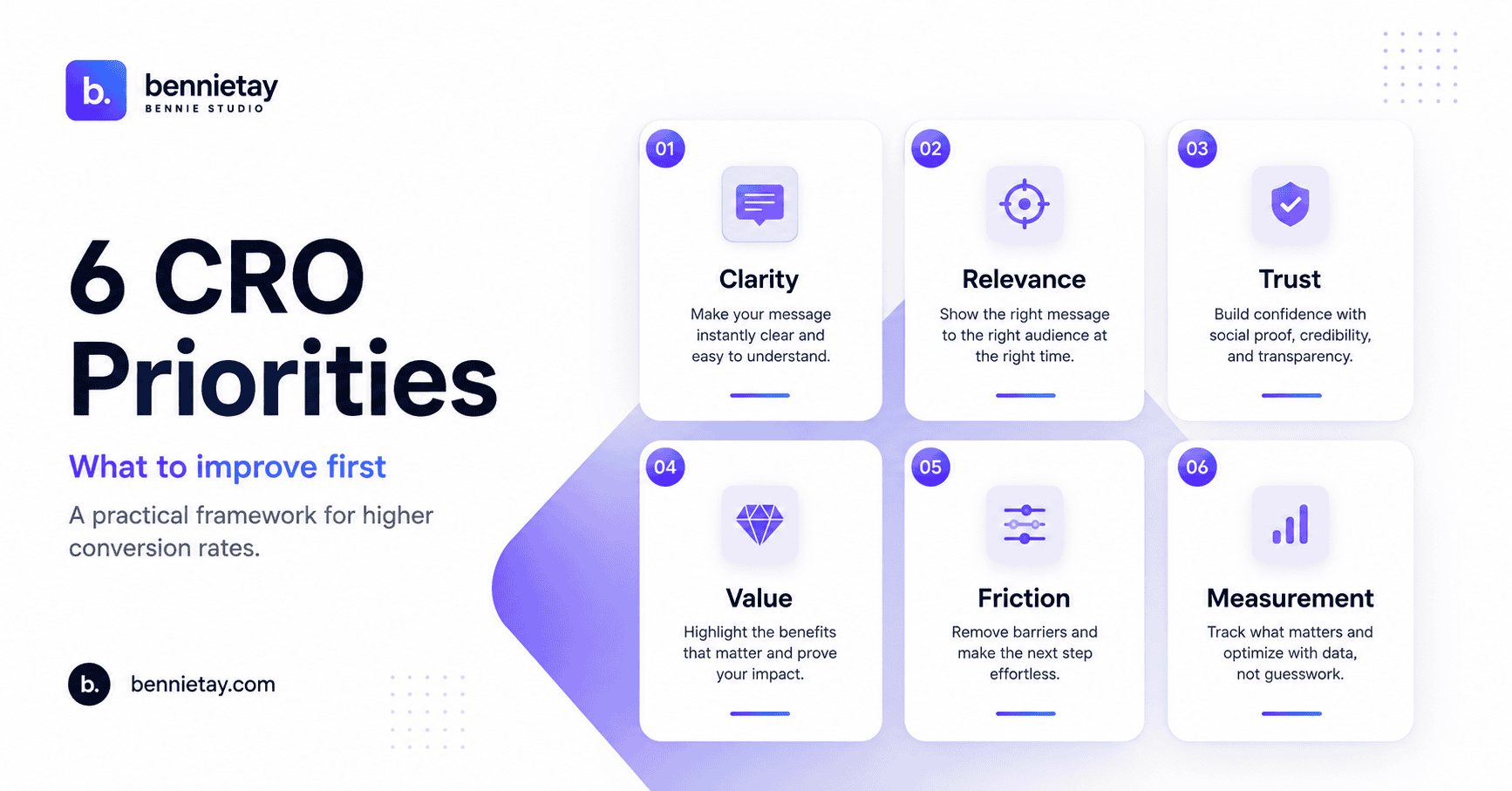
A useful priority order is:
1. Clarity
Can visitors immediately understand what you offer?
2. Relevance
Does the page match what they came looking for?
3. Trust
Is there genuine evidence that the business is credible?
4. Value
Does the visitor understand why the service is worth considering?
5. Friction
Is it easy to contact, book or buy?
6. Measurement
Can you see whether improvements are working?
Only after those foundations are solid does it make sense to spend much time on smaller optimisation details.
Changing the border radius on a button while the homepage fails to explain the service is an impressive commitment to avoiding the actual problem.
A Simple Before-and-After CRO Example
Consider a website-design business.
The original page has:
Headline
Professional Website Solutions
Copy
Three paragraphs about the company.
CTA
Contact Us
Proof
None.
Pricing
None.
The visitor needs to work out who the service is for, why it matters, whether the company is credible, how much it might cost and what happens next.
Now improve the page.
Headline
Website Design for Malaysian Service Businesses That Need More Enquiries
Supporting Copy
Clearly explain the audience, service and business outcome.
Proof
Add a relevant customer case study or testimonial.
Pricing
Projects from RM6,000
Process
Explain the project in four clear steps.
FAQs
Answer common questions about cost, timeline, ownership and support.
CTA
Request a Website Review
Nothing about this improvement requires a clever psychological trick.
The buying journey is simply clearer.
And clarity is often where the largest CRO gains begin.
CRO Should Improve Lead Quality Too
Suppose your website currently generates 50 enquiries each month, but only five are suitable.
After improving pricing guidance, service positioning and the enquiry form, total enquiries fall to 35.
However, 15 are now qualified opportunities.
Your raw enquiry count decreased.
Your business performance improved significantly.
That is a successful conversion optimisation outcome.
For service businesses, always evaluate CRO alongside:
- lead quality
- customer type
- project value
- sales conversion
- revenue
Do not optimise the website into an efficient machine for attracting people you do not want to work with.
When CRO Is Not the Real Problem
Conversion optimisation can improve the website journey.
It cannot solve every business problem.
Wrong Traffic
If visitors are not your target customers, improving buttons and forms may accomplish very little.
Fix your traffic strategy.
Weak Offer
If customers do not want the service, the website may not be the main issue.
Reconsider the offer.
Poor Pricing
If the price is not commercially competitive and there is no clear reason for the difference, CRO cannot magically remove the objection.
Weak Sales Follow-Up
If qualified enquiries wait three days for a response, the website has already completed its part of the job.
Improve the operational process.
Poor Service
A website cannot permanently compensate for negative customer experiences, weak delivery or bad reviews.
CRO improves conversion.
The rest of the business still needs to function.
Human commerce remains inconveniently interconnected.
A Simple CRO Audit for Your Website
Review your important pages and evaluate each area.
Hero
Can someone understand the business in five seconds?
Audience
Is it obvious who the service is designed for?
Services
Are the main services clearly explained?
Trust
Do visitors see genuine customer proof?
Pricing
Is there enough information to set expectations?
CTA
Is the next step clear?
Forms
Are they easy to complete?
Mobile
Can people comfortably use the website from a phone?
Speed
Does the website load and respond reasonably well?
Objections
Are common customer concerns answered?
Measurement
Are meaningful conversions tracked?
Mark each area:
Good
Needs Work
Missing
Start with anything marked Missing.
You probably do not need a six-month consulting engagement to establish that a quotation page without a quotation button has conversion potential.
How Often Should You Review Conversion Performance?
CRO should be ongoing, but that does not mean constantly changing the website.
A practical schedule might be:
Monthly
Review:
- leads
- conversion actions
- top landing pages
- lead quality
Quarterly
Review:
- core messaging
- services
- pricing
- customer journey
- key page performance
When the Business Changes
Update the website when you introduce:
- new services
- new locations
- new pricing
- new customer types
- new offers
Your website should evolve with the business rather than remaining frozen in whatever made sense when it was first launched.
Frequently Asked Questions
What is conversion rate optimization?
Conversion rate optimization is the process of improving a website so that more suitable visitors complete valuable actions such as enquiries, calls, bookings or purchases.
What is a good website conversion rate?
There is no universal percentage.
Conversion rates vary significantly depending on traffic source, industry, offer, price, page type and customer intent.
Build your own baseline and focus on improving both conversion and lead quality over time.
Do I need A/B testing?
Not necessarily.
Small businesses should usually fix obvious problems with clarity, trust, usability and messaging first.
Formal testing becomes more useful when the website already has strong foundations and enough traffic to produce meaningful results.
Does website design affect conversion?
Yes, particularly when design affects clarity, trust, navigation, mobile usability and ease of taking action.
Visual design alone does not guarantee stronger conversion.
A beautiful website that confuses visitors remains beautifully confusing.
Should I focus on traffic or conversion first?
If your website already receives relevant traffic but generates few enquiries, improving conversion may be the more immediate opportunity.
If almost nobody visits the website, you will probably need to work on both traffic generation and conversion.
How can I improve website conversion quickly?
Start with the fundamentals: improve your headline, CTA, service-page clarity, trust signals, pricing guidance, mobile experience and contact process.
These areas usually matter more than minor cosmetic experiments.
CRO Is Mostly About Making Decisions Easier
Conversion rate optimization is often presented as a sophisticated discipline filled with experiments, psychology, analytics and funnels.
Those tools can be valuable.
But for many small businesses, the biggest opportunities are much simpler.
Help visitors understand what you do, whether the service is right for them, why they should trust you, what it may cost and what happens next.
Then make taking action easy.
That alone can outperform an impressive amount of unnecessary optimisation theatre.
At Bennie Studio, websites are approached as ongoing business assets rather than finished design projects. That means looking at traffic, conversion, lead quality and customer behaviour, then improving the journey around what the business actually needs.
Explore Lead-Generation Website Design →
Getting traffic but not enough qualified enquiries from your current website?
Get a Free Website Growth Audit →