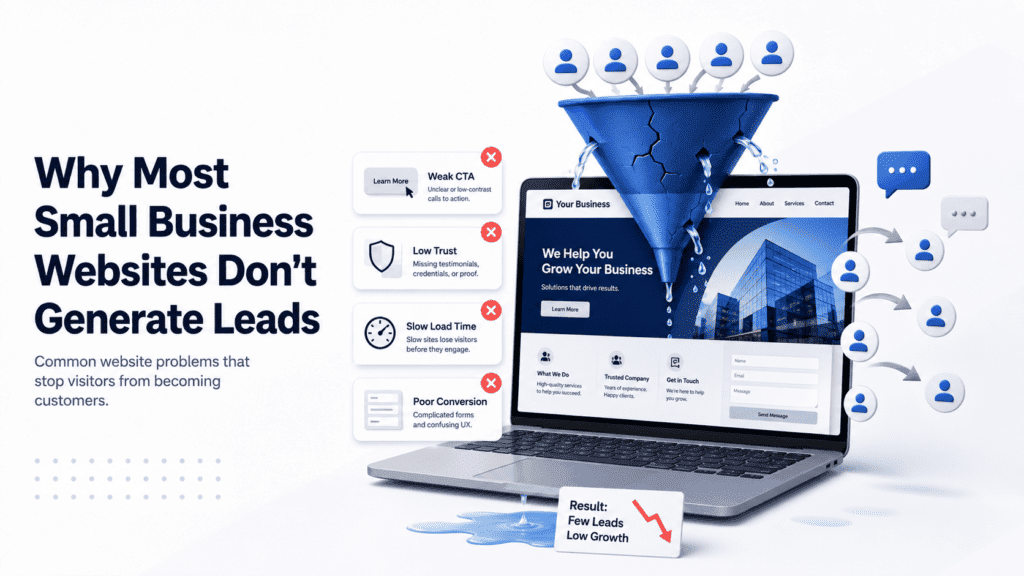
Many small businesses have a website, but very few have a website that consistently generates leads.
The website may look good. It may have a homepage, service page, about page, and contact form. It may even have nice images and a modern layout. But if visitors are not calling, sending enquiries, booking appointments, or requesting quotes, the website is not doing its job.
A business website should not only exist online. It should help turn visitors into potential customers.
The problem is that many small business websites are built like digital brochures instead of lead generation systems. They explain the business, but they do not guide visitors toward action. They look presentable, but they do not persuade. And they share information, but they do not create enough trust or urgency.
This article explains why most small business websites do not generate leads, what mistakes are holding them back, and how to turn a basic website into a stronger sales and marketing asset.
What Does It Mean for a Website to Generate Leads?
A website generates leads when it encourages visitors to take a meaningful business action.
That action could be:
- Filling out a contact form
- Booking a consultation
- Requesting a quote
- Calling your business
- Sending a WhatsApp message
- Downloading a guide
- Joining your email list
- Scheduling an appointment
- Starting a free trial
- Asking for more information
For a small business, leads are valuable because they create sales opportunities.
A lead generation website is not just designed to look attractive. It is designed to answer the visitor’s questions, build confidence, remove hesitation, and make the next step easy.
The Main Reason Small Business Websites Fail
Most small business websites fail because they are built around the business owner’s perspective instead of the customer’s decision-making process.
The website talks about the company, but it does not clearly explain why a customer should care.
A visitor usually arrives with questions such as:
- Can this business solve my problem?
- Do they understand what I need?
- Are they trustworthy?
- What makes them different?
- How much does it cost?
- What should I do next?
- Will I regret contacting them?
If your website does not answer these questions quickly, the visitor may leave and compare you with another business. A website that generates leads must be clear, helpful, trustworthy, and action-focused.
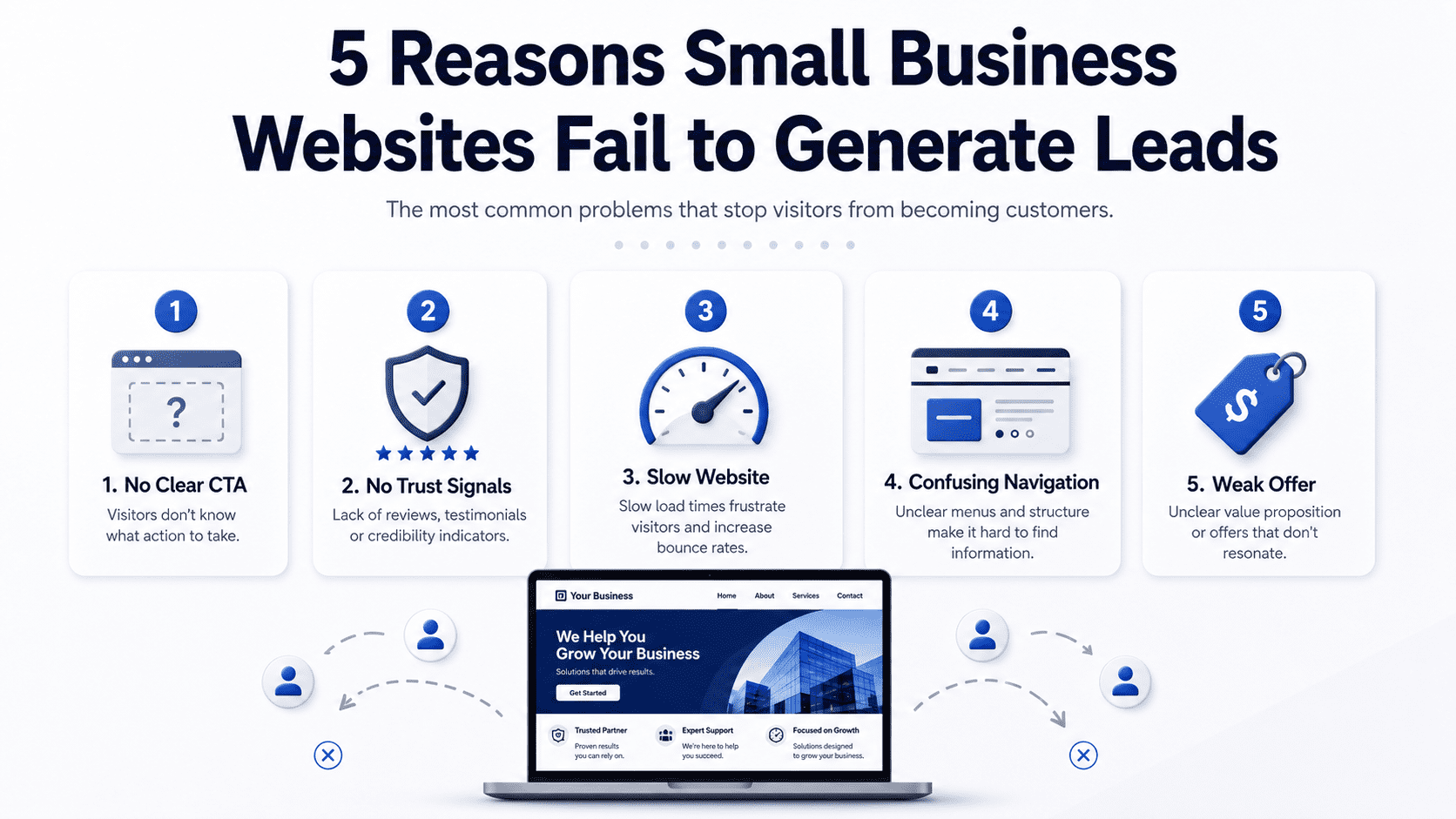
1. The Website Message Is Not Clear
One of the biggest reasons websites fail to generate leads is unclear messaging.
Many homepages use vague headlines such as:
- “Welcome to Our Website”
- “Your Trusted Partner”
- “Quality Solutions for Every Need”
- “We Help Businesses Grow”
- “Professional Services You Can Trust”
These phrases sound safe, but they do not tell visitors what the business does, who it helps, or why it matters.
A strong website headline should quickly explain:
- What you offer
- Who you help
- What result the customer can expect
- Why they should keep reading
For example, instead of saying: “Professional Digital Solutions for Your Business”
A stronger headline would be: “Affordable Website Plans for Small Businesses That Need More Leads”
The second version is clearer because it explains the offer, audience, and benefit. If visitors need to think too hard to understand your business, they will not stay long enough to become leads.
2. The Website Looks Nice but Has No Strategy
A beautiful website does not automatically generate leads.
Many small business websites focus too much on design and not enough on strategy. They use nice colors, animations, images, and layouts, but the page does not guide visitors toward a decision.
Good design should support the business goal.
A lead generation website needs:
- A clear value proposition
- Strong calls to action
- Trust-building content
- Service benefits
- Simple navigation
- Mobile-friendly design
- Fast loading speed
- Clear contact options
- Helpful FAQs
- Proof that the business can deliver
A website should not only ask, “Does this look good?”
It should ask, “Does this help visitors understand, trust, and contact the business?”
3. The Call to Action Is Weak or Missing
A call to action, also known as a CTA, tells visitors what to do next.
Common CTA examples include:
- Request a Quote
- Book a Free Consultation
- Call Now
- Send Us a WhatsApp Message
- Get a Website Plan
- Schedule an Appointment
- Download the Free Guide
Many small business websites do not generate leads because the CTA is either missing, too generic, or difficult to find.
A weak CTA might say: “Submit”
A stronger CTA might say: “Request a Free Website Quote”
A weak CTA might say: “Contact Us”
A stronger CTA might say: “Book a Free 15-Minute Consultation”
Your CTA should be specific, visible, and repeated throughout the website. Visitors should never have to search for the next step.
4. The Website Does Not Build Enough Trust
Before someone contacts your business, they need to feel confident.
Many small business websites do not provide enough proof. They say the business is reliable, experienced, or professional, but they do not show evidence.
Trust-building elements can include:
- Customer testimonials
- Google reviews
- Case studies
- Before-and-after results
- Portfolio examples
- Client logos
- Industry certifications
- Awards
- Years of experience
- Team photos
- Real project screenshots
- Clear business contact information
Trust is especially important if your service is expensive, personal, technical, or competitive. If your competitors show reviews, testimonials, pricing clarity, and strong examples while your website only has basic text, visitors may choose them instead.
5. The Website Talks Too Much About the Business
Many small business websites focus heavily on the company story.
They say things like:
- “We are passionate about excellence”
- “We have been serving customers since 2012”
- “We believe in quality and commitment”
- “Our team is dedicated to customer satisfaction”
These points can be useful, but they should not dominate the website.
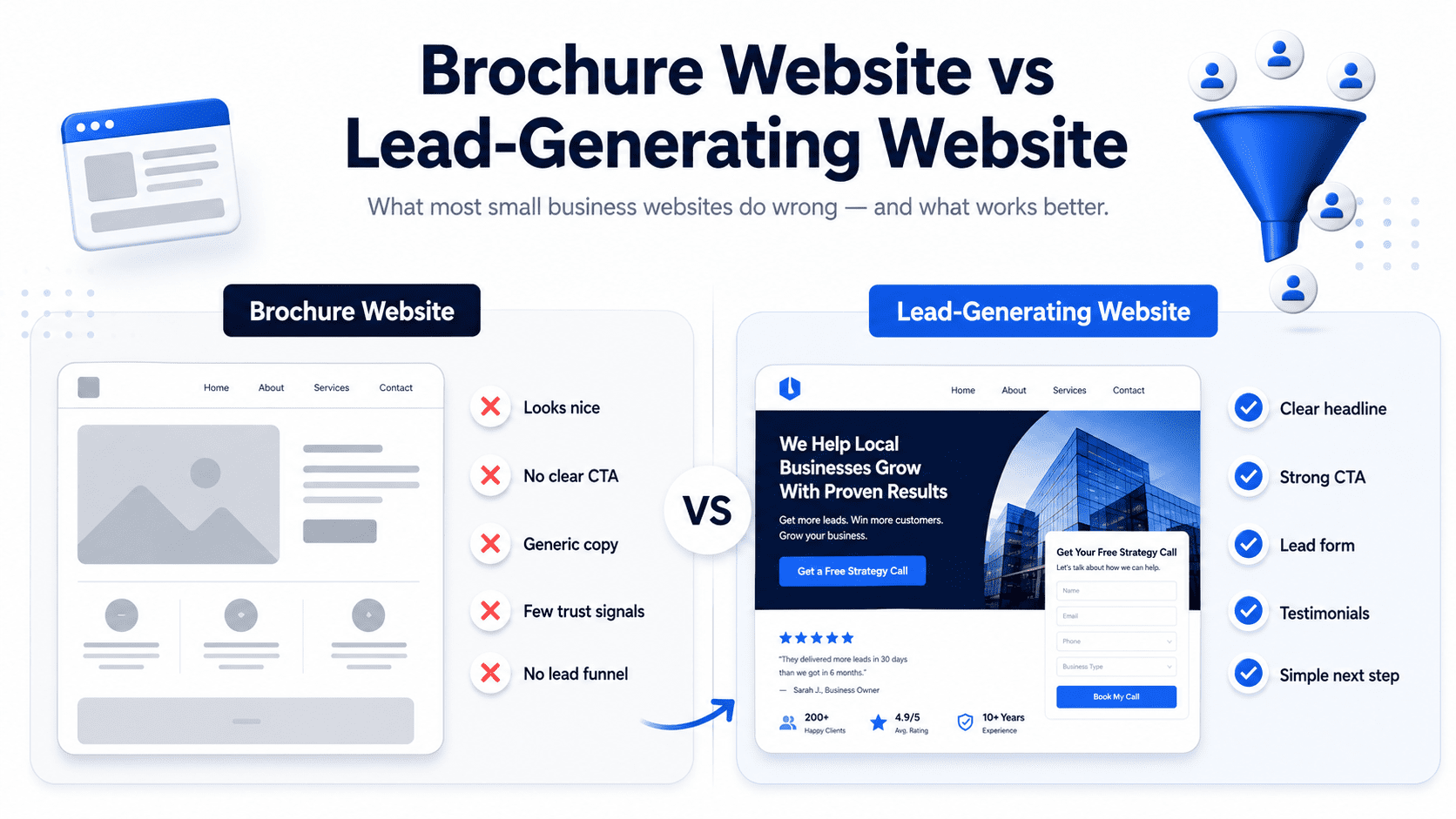
Visitors care more about their own problem than your company background. A lead-focused website should shift from “we” language to customer-focused messaging.
Instead of: “We provide high-quality web design services.”
Say: “Launch a professional website that helps your business look credible and attract more enquiries.”
The second version connects the service to the customer’s desired outcome.
6. The Website Has No Clear Offer
A website should make the offer easy to understand. Many businesses list services, but they do not package them clearly. The visitor sees a list of things the business can do, but they do not know what to choose.
For example, a web design business might list:
That list is useful, but it may still feel unclear.
A stronger offer might be: “Monthly Website Plans for Small Businesses — Design, Hosting, Maintenance, and Support Included.”
This is easier to understand because the services are packaged into a clear solution. A clear offer helps visitors make a decision faster.
7. The Website Is Too Slow
Website speed affects user experience and lead generation. If your website takes too long to load, visitors may leave before they even see your offer.
Slow websites are often caused by:
- Large image files
- Too many plugins
- Poor hosting
- Heavy scripts
- Unoptimized videos
- Bloated themes
- Too many animations
- Poor mobile optimization
A fast website feels more professional and easier to use. For small businesses, speed matters because many visitors are browsing on mobile devices. If the website loads slowly on a phone, you may lose leads before they reach your contact form.
8. The Website Is Not Mobile-Friendly
Many small business websites look acceptable on desktop but perform poorly on mobile. This is a serious problem because customers often search for local services on their phones.
A mobile-friendly website should have:
- Easy-to-read text
- Buttons that are large enough to tap
- Simple navigation
- Fast loading pages
- Click-to-call buttons
- WhatsApp or messaging links
- Forms that are easy to complete
- No awkward spacing or broken layouts
If the mobile experience is frustrating, visitors are less likely to contact you. A website that generates leads must be designed for mobile users from the start.
9. The Contact Form Is Too Complicated
Contact forms should be simple. Many websites ask for too much information too early. Long forms can reduce conversions because visitors may not want to spend time filling them out.
A basic lead form usually only needs:
- Name
- Email or phone number
- Message
- Service interest
For some businesses, even a simple WhatsApp button or booking link may convert better than a long form. The easier it is to contact you, the more likely visitors are to do it.
10. There Is No Lead Magnet
Not every visitor is ready to buy immediately.
Some visitors may be interested, but they need more time before contacting you. If your website only has a contact form, you may lose these people.
A lead magnet gives visitors a reason to share their contact information before they are ready to buy.
Examples include:
- Free checklist
- Pricing guide
- Website audit
- Consultation call
- Downloadable guide
- Discount voucher
- Email course
- Industry report
- Free template
- Quote calculator
For example, a website business could offer: “Download the Small Business Website Launch Checklist”
or “Get a Free Website Readiness Audit”
This allows the business to capture leads earlier in the buying journey.
11. The Website Does Not Answer Common Questions
Visitors often leave because they cannot find the answers they need. A strong FAQ section can remove hesitation and improve lead generation.
Common questions may include:
- How much does it cost?
- How long does it take?
- What is included?
- Do I need to prepare anything?
- Can I cancel anytime?
- Do you offer support?
- Is hosting included?
- Can you help with SEO?
- What happens after I submit the form?
When your website answers common questions clearly, visitors feel more confident taking the next step.
12. The Website Has Poor SEO
A website cannot generate leads if the right people cannot find it. Many small business websites are not optimized for search engines. They may have weak page titles, missing meta descriptions, poor heading structure, thin content, no service pages, and no location targeting.
Basic SEO helps your website show up when people search for your services.
A small business website should include:
- Keyword-focused page titles
- Clear meta descriptions
- Proper H1 and H2 headings
- Service-specific pages
- Location-based content
- Internal links
- Image alt text
- Fast loading speed
- Mobile-friendly design
- Helpful blog content
SEO does not produce instant results, but it builds long-term visibility. If your website has no SEO strategy, it may depend only on direct traffic, referrals, or paid ads.
13. The Website Does Not Match the Customer Journey
A visitor may not be ready to contact you immediately. Some visitors are just researching, some are comparing options, and some are ready to buy. A strong website should support different stages of the customer journey.
For example:
- Awareness stage: blog posts, guides, educational content
- Consideration stage: service pages, comparisons, FAQs
- Decision stage: pricing, testimonials, case studies, contact options
If your website only has a basic homepage and contact page, it may not give visitors enough information to move from interest to action.
14. The Website Has No Analytics or Tracking
Many businesses do not know whether their website is working because they do not track performance.
Without analytics, you may not know:
- How many people visit your website
- Which pages they view
- Where they leave
- Which buttons they click
- Which traffic sources bring leads
- Which forms are being submitted
- Whether mobile users are converting
Tracking helps you improve the website based on real behavior instead of guessing.
Useful tracking includes:
- Google Analytics
- Google Search Console
- Conversion tracking
- Form submission tracking
- Call tracking
- CTA click tracking
- Heatmaps
- Booking link tracking
A website should be measured and improved over time.
15. The Website Is Not Built Around Conversion
The biggest reason small business websites do not generate leads is that they are not designed with conversion in mind.
Conversion means turning a visitor into a lead or customer.
A conversion-focused website should have:
- Clear headline
- Strong offer
- Visible CTA
- Trust proof
- Simple page flow
- Fast loading speed
- Mobile-first layout
- Easy contact options
- Helpful content
- Reduced friction
- Clear next step
Every section should have a purpose. If a section does not build trust, explain value, answer a question, or move the visitor closer to action, it may not need to be there.
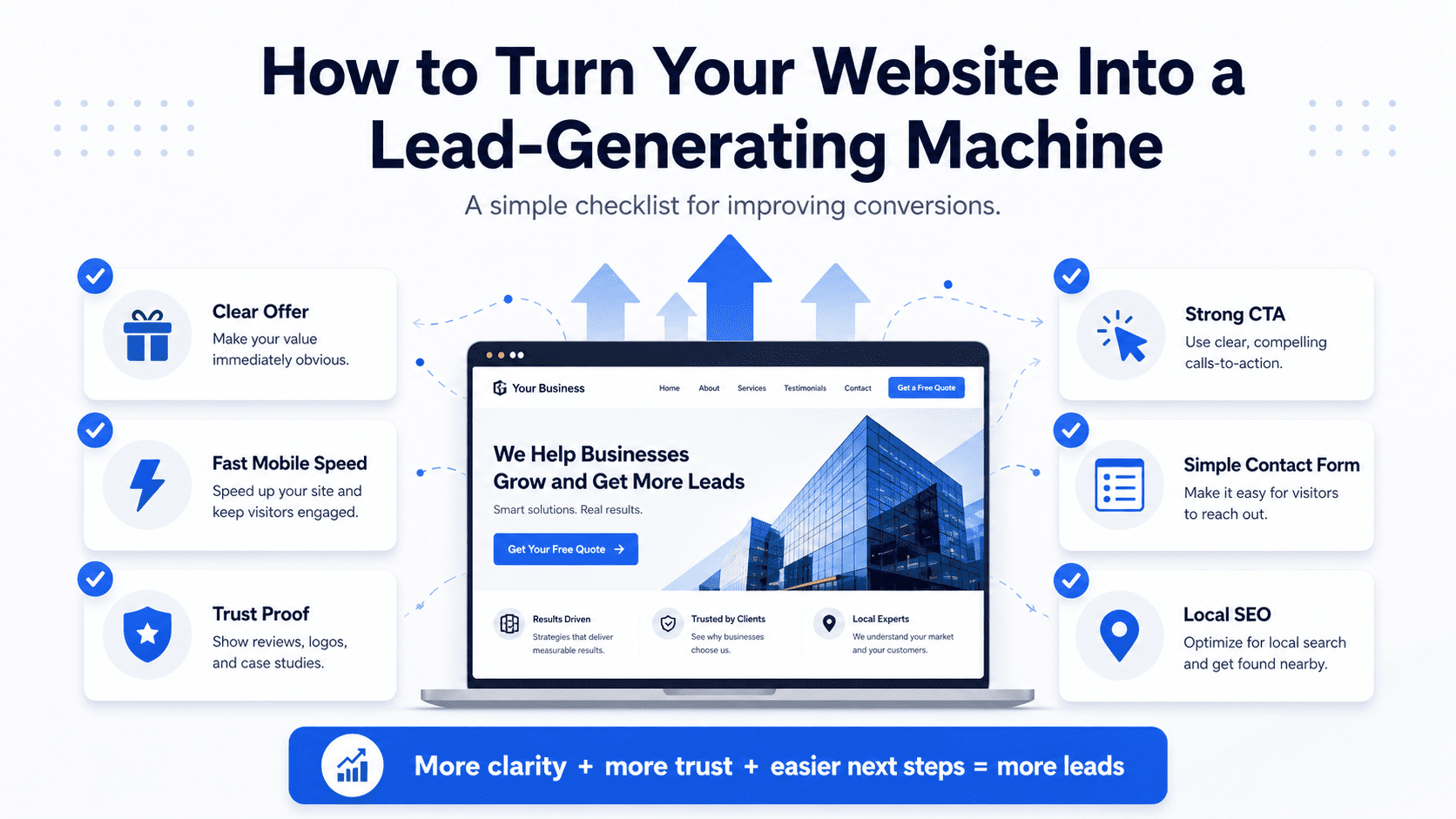
How to Turn a Small Business Website Into a Lead Generation Website
Improving website lead generation does not always require a full redesign.
Start with the most important fixes:
1. Rewrite Your Homepage Headline
Make sure visitors immediately understand what you offer and who it is for.
2. Add Strong CTA Buttons
Use specific calls to action such as “Request a Quote,” “Book a Free Call,” or “Send WhatsApp Message.”
3. Add Trust Proof
Include testimonials, reviews, project examples, client logos, or real results.
4. Improve Mobile Experience
Check your website on your phone. Make sure it is easy to read, scroll, tap, and contact you.
5. Simplify Your Contact Form
Ask only for the information you really need.
6. Improve Page Speed
Compress images, remove unnecessary plugins, and use reliable hosting.
7. Create Service Pages
Each main service should have its own page with clear benefits, FAQs, and CTA.
8. Add Local SEO Content
If you serve a specific city, area, or region, create relevant local content.
9. Add a Lead Magnet
Offer a checklist, guide, audit, or consultation to capture visitors who are not ready to buy yet.
10. Track Conversions
Measure form submissions, calls, WhatsApp clicks, and booking clicks.
What a Lead-Generating Website Should Include
A small business website designed for lead generation should include:
- Clear value proposition
- Customer-focused copy
- Professional design
- Strong CTAs
- Contact form
- Click-to-call button
- WhatsApp or messaging link
- Testimonials or reviews
- Service pages
- FAQ section
- SEO-friendly structure
- Fast loading speed
- Mobile-friendly layout
- Analytics and conversion tracking
These elements work together to make the website more useful, trustworthy, and action-driven.
Final Thoughts
Most small business websites do not generate leads because they are built to exist, not to convert. They may look decent, but they do not clearly explain the offer, build enough trust, answer customer questions, or guide visitors toward action.
A better website is not just about better design. It is about better strategy. Your website should help visitors understand what you do, why it matters, why they should trust you, and what step they should take next.
For small businesses, a lead-generating website can become one of the most valuable marketing assets. It can support your sales process, improve credibility, attract search traffic, and turn more visitors into real business opportunities.
If your website is not generating leads, the problem may not be your business. The problem may be that your website is not built to convert.