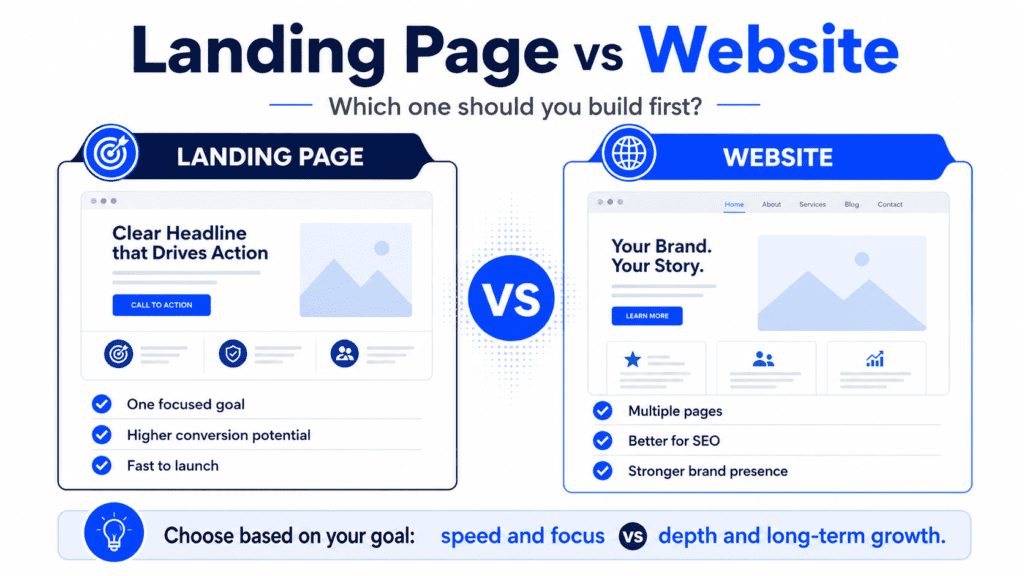
When you are starting a business, launching a new offer, or testing a marketing campaign, one of the first questions you may ask is: Should I build a landing page or a full website first?
Both can help your business get online. Both can attract visitors. And both can generate enquiries, bookings, or sales. But they are not designed for the same purpose.
A landing page is focused on one specific goal, such as getting leads, promoting an offer, collecting sign-ups, or driving bookings.
A website is broader. It gives your business a complete online presence with multiple pages, more information, service details, trust proof, SEO content, and brand credibility.
So, which one should you build first?
The answer depends on your business stage, budget, timeline, marketing goal, and how much information your customers need before they contact you.
For many small businesses, the best starting point is simple: build a landing page first if you need to test an offer quickly. Build a full website first if you need long-term credibility, organic search visibility, and a more complete brand presence.
What Is a Landing Page?
A landing page is a focused web page created for one specific campaign, offer, product, service, or action.
Unlike a full website, a landing page usually does not have many navigation links or multiple pages. It is designed to keep visitors focused on one goal.
That goal could be:
- Request a quote
- Book a consultation
- Sign up for a free trial
- Download a guide
- Register for an event
- Join a waiting list
- Buy a product
- Send a WhatsApp message
- Claim a promotion
A landing page is often used with paid ads, social media campaigns, email campaigns, LinkedIn outreach, product launches, or limited-time offers.
The main purpose is conversion.
What Is a Website?
A website is a larger online presence for your business. It usually includes multiple pages such as:
- Homepage
- About page
- Services page
- Individual service pages
- Pricing page
- Contact page
- Blog
- FAQ page
- Case studies
- Testimonials
- Location pages
A business website helps visitors understand who you are, what you offer, why they should trust you, and how to contact you. A website is better suited for long-term brand building, SEO, education, credibility, and customer research.
While a landing page is built around one action, a website supports a broader customer journey.
Landing Page vs Website: The Main Difference
The biggest difference between a landing page and a website is focus. A landing page focuses on one offer and one conversion goal. A website gives visitors more information and supports multiple goals.
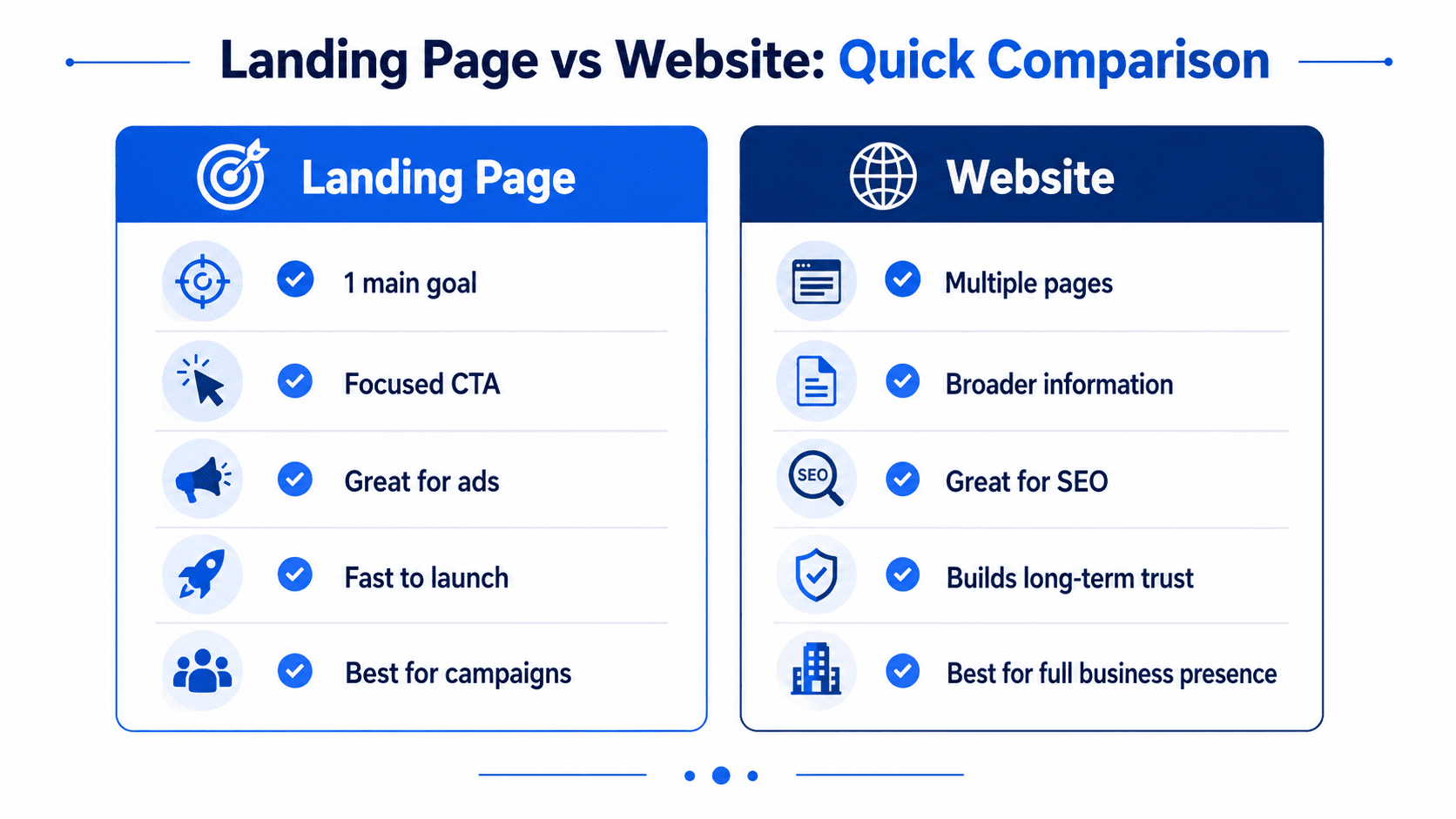
Here is a simple comparison:
| Feature | Landing Page | Website |
|---|---|---|
| Main purpose | Convert visitors for one specific offer | Build full online presence |
| Number of pages | Usually one page | Multiple pages |
| Best for | Campaigns, ads, launches, lead magnets | Business credibility, SEO, services, brand |
| Navigation | Minimal or none | Full navigation menu |
| Launch speed | Faster | Usually takes longer |
| Cost | Usually lower | Usually higher |
| SEO potential | Limited but useful for specific terms | Stronger for long-term SEO |
| Content depth | Focused | More comprehensive |
| Conversion focus | Very high | Depends on structure |
| Best traffic source | Paid ads, social media, email, outreach | Google search, referrals, direct traffic, content |
When Should You Build a Landing Page First?
A landing page is usually the better first step when you need speed, focus, and quick validation.
You should build a landing page first if you are testing a new business idea, launching a new service, running paid ads, promoting a limited offer, or trying to collect leads before investing in a full website.
1. You Want to Test an Offer Quickly
If you are not sure whether people want your offer, a landing page is a smart way to test demand.
Instead of spending weeks or months building a full website, you can create a focused page that explains the offer and asks visitors to take action.
For example, you can test:
- A new coaching program
- A website subscription plan
- A cleaning service package
- A clinic promotion
- A property service
- A webinar registration
- A digital product
- A free consultation offer
If people submit enquiries, book calls, or join your waitlist, you have early proof of interest. And if they do not, you can adjust your offer, pricing, or message before spending more money.
2. You Are Running Paid Ads
Landing pages are often better for paid advertising because they remove distractions.
If someone clicks an ad for a specific offer, they should land on a page that matches that offer exactly.
For example, if your ad says: “Get a Managed Website for Your Service Business”
The landing page should focus only on that website plan. It should not send visitors to a general homepage where they need to search for details.
A focused landing page usually includes:
- Matching headline
- Clear offer
- Benefits
- Trust proof
- Pricing or starting price
- FAQs
- Strong call to action
- Contact form or booking button
This makes the visitor journey smoother and easier to measure.
3. You Have One Main Goal
A landing page works best when you want visitors to do one thing.
For example:
- Book a demo
- Request a quote
- Register for a webinar
- Download a checklist
- Join a waitlist
- Claim an offer
- Send a WhatsApp message
When there are fewer choices, visitors are less distracted. A full website may have many pages, links, and options. That is useful for research, but not always ideal for a campaign.
4. You Need to Launch Fast
If speed matters, a landing page is easier to launch than a full website. A full website needs more pages, more copy, more design decisions, more SEO setup, and more testing.
A landing page can focus only on the essentials:
- What is the offer?
- Who is it for?
- Why should people care?
- What proof supports it?
- What should visitors do next?
This makes it ideal for businesses that need to move quickly.
5. You Have a Limited Budget
A landing page usually costs less than a full website because it has fewer pages and a smaller scope. This is useful for startups, freelancers, solo founders, local businesses, and small teams that want to start marketing without a large upfront investment.
However, cheaper does not mean less important. A landing page still needs strong copy, clean design, mobile responsiveness, speed, and clear conversion tracking.
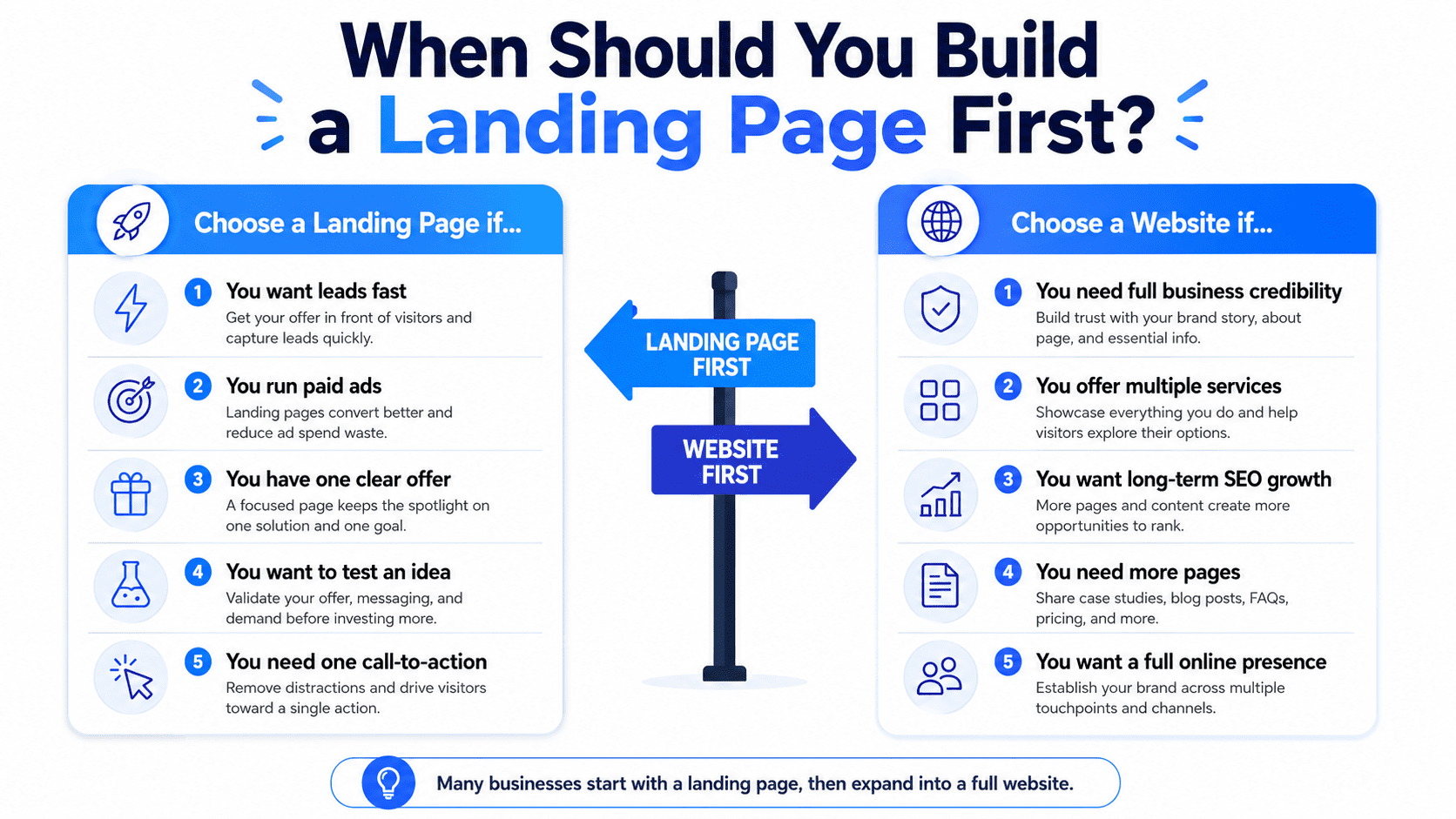
When Should You Build a Website First?
A full website is the better first step when your business needs credibility, search visibility, multiple service pages, and a more complete online presence.
You should build a website first if customers need to research your business before contacting you, or if your long-term goal is to rank on Google and build trust.
1. You Need Business Credibility
For many small businesses, a website acts as a trust signal.
Before contacting you, customers may want to know:
- Are you a real business?
- What services do you provide?
- Where are you located?
- Who have you worked with?
- Do you have testimonials?
- What makes you different?
- How can I contact you?
- Do you look professional?
A full website gives you more space to answer these questions.
This is especially important for service businesses where customers compare multiple providers before making a decision.
2. You Offer Multiple Services
If your business offers more than one service, a full website may be better. For example,
A digital agency may offer:
- Website design
- SEO
- Landing pages
- Paid ads
- Branding
- Website maintenance
A clinic may offer:
- General consultation
- Health screening
- Vaccination
- Specialist services
- Corporate health packages
A full website allows each service to have its own page. This helps visitors find the specific information they need. It also helps SEO because people often search for individual services.
3. You Want to Rank on Google
If organic search traffic is important, a website is usually better than a single landing page. A full website gives you more opportunities to create SEO-friendly pages, including:
- Service pages
- Location pages
- Blog posts
- Comparison pages
- FAQs
- Case studies
- Industry pages
For example, a business selling Website-as-a-Service could create content around:
- Website-as-a-Service explained
- Small business website cost
- Monthly website plan vs one-time website build
- Landing page vs website
- Why small business websites do not generate leads
- Local business website checklist
This content helps search engines understand your expertise and gives potential customers more ways to discover your business.
4. Your Customers Need More Information
Some offers are simple. Others require more explanation. If your product or service is high-value, technical, complex, or trust-based, customers may need more information before contacting you.
A full website gives you space for:
- Detailed service explanations
- Pricing guidance
- Case studies
- Process breakdowns
- Testimonials
- FAQs
- About page
- Blog content
- Trust indicators
This can reduce hesitation and improve lead quality.
5. You Want a Long-Term Business Asset
A landing page is often campaign-focused. A website is usually a long-term asset. Your website can grow over time as your business expands. You can add pages, publish blog posts, build SEO visibility, collect leads, improve conversion rates, and strengthen your brand.
If your goal is to build a serious long-term online presence, a website is usually the better foundation.
Pros of Building a Landing Page First
- Faster to launch
A landing page can usually be planned, written, designed, and published faster than a full website. - Lower initial cost
Because it has fewer pages, a landing page is usually more affordable to build. - Easier to test
You can test headlines, offers, pricing, CTAs, and audience segments without changing an entire website. - Stronger focus
A landing page keeps visitors focused on one action, which can improve conversion. - Better for campaigns
Landing pages work well for ads, launches, promotions, webinars, lead magnets, and outreach campaigns.
Cons of Building a Landing Page First
- Limited SEO potential
One landing page can rank for some keywords, but it cannot compete with a full content-rich website in most industries. - Less brand depth
A single page may not give visitors enough information about your business, team, services, process, or credibility. - Not ideal for multiple services
If you offer many services, one page may become too crowded or confusing. - Short-term focus
Landing pages are often built for campaigns, not long-term brand development.
Pros of Building a Website First
- More credibility
A full website makes your business look more established and trustworthy. - Better for SEO
Multiple pages give you more opportunities to rank for different keywords. - More complete customer journey
Visitors can explore your services, pricing, story, proof, FAQs, and contact options. - Easier to scale
You can add new pages, blog posts, landing pages, case studies, and resources over time. - Better for local businesses
Local businesses can benefit from service pages, location pages, Google Maps, reviews, and local SEO content.
Cons of Building a Website First
- Higher cost
A full website usually costs more than a single landing page. - Longer timeline
More pages mean more planning, writing, designing, testing, and revisions. - More decisions
A website requires decisions about navigation, page structure, SEO, content, branding, and technical setup. - Can delay selling
Some businesses spend too long building a perfect website instead of testing the offer and getting cu
Landing Page or Website: Which One Is Better for Lead Generation?
Both can generate leads, but they do it differently. A landing page is better for direct response campaigns. It works well when traffic comes from ads, email, social media, LinkedIn outreach, or a specific promotion.
A website is better for long-term lead generation. It works well when visitors come from Google search, referrals, direct traffic, content marketing, or customers comparing your business with competitors.
The best setup is often both. Your website acts as your main online presence. Your landing pages support specific campaigns and offers.
For example:
- Website: explains your business, services, credibility, and SEO content
- Landing page: promotes one specific offer, plan, lead magnet, or campaign
Which One Should a New Business Build First?
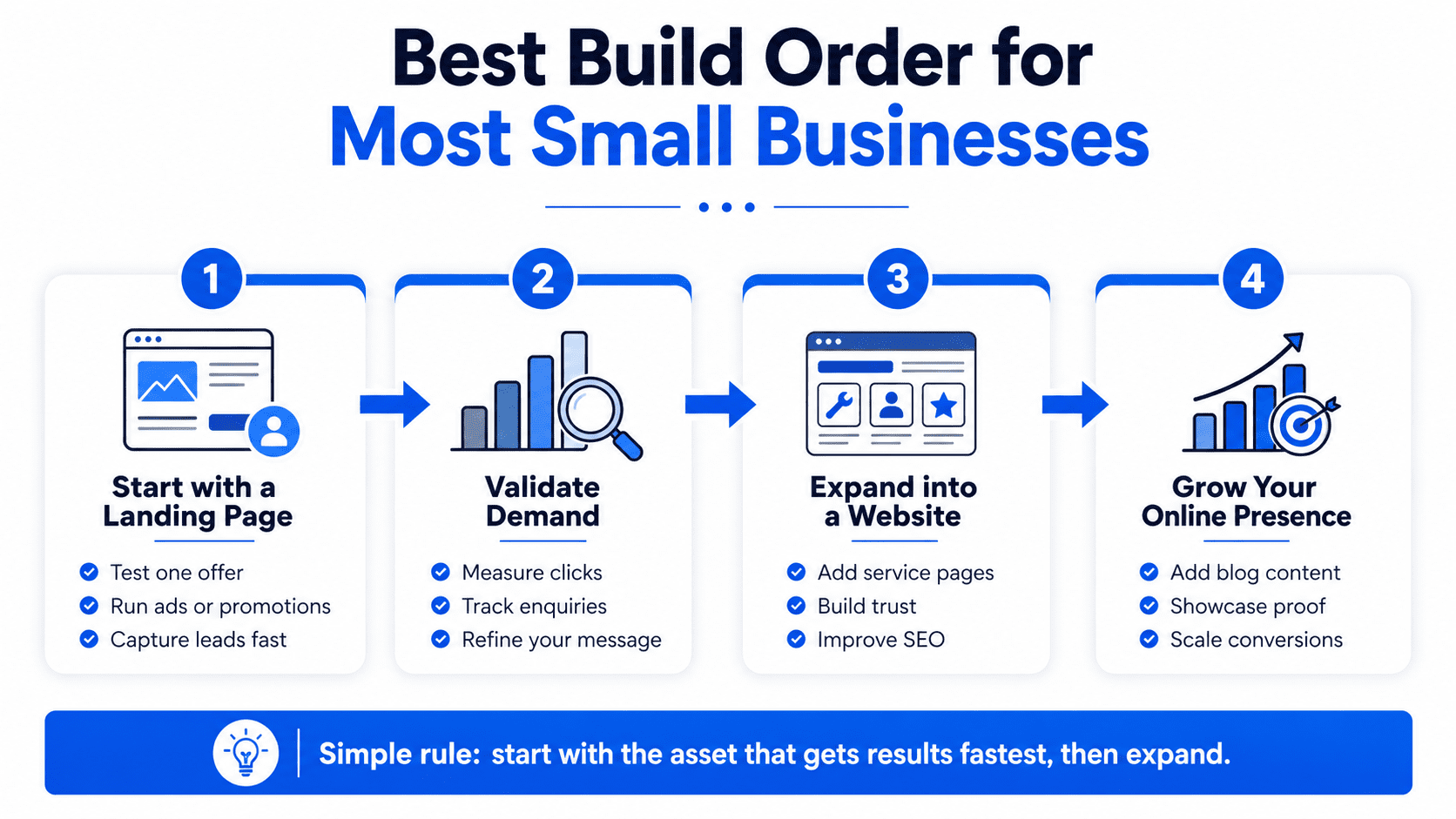
For a new business, the best choice depends on whether you already know your offer. If your offer is still untested, build a landing page first. Use it to validate demand, collect leads, and test your message.
If your business is already clear and ready to operate, build a website first. You need credibility, service information, contact options, and a professional online presence.
A practical path could be:
- Start with a landing page to test the offer.
- Use enquiries and feedback to improve the message.
- Build a full website once the offer is clearer.
- Add more landing pages for future campaigns.
This approach helps avoid overbuilding too early.
Which One Should a Local Business Build First?
For most local businesses, a website is usually the better first foundation.
Local customers often search for businesses on Google, compare options, read reviews, check service areas, and look for contact details. A local business website should include:
- Homepage
- Services page
- Location information
- Contact page
- Reviews or testimonials
- FAQs
- Click-to-call button
- WhatsApp or enquiry button
- Google Maps section
- Local SEO content
However, if the local business is running a specific promotion, such as “first-time customer discount” or “free consultation,” a landing page can be added later to support that campaign.
Which One Should a Service Business Build First?
For service businesses, a website is usually the better long-term asset. Service buyers often need information before making a decision. They want to understand the service, process, pricing, proof, and next steps.
However, if you sell one clear service package, such as a website plan, coaching program, audit, consultation, or workshop, a landing page can work very well as the first step.
The simpler the offer, the more suitable a landing page becomes. The more complex the service, the more useful a full website becomes.
What Should a Landing Page Include?
A high-converting landing page should include:
- Clear headline
- Short explanation of the offer
- Strong hero CTA
- Main benefits
- Who the offer is for
- How it works
- Trust proof
- Pricing or value explanation
- FAQs
- Simple form or booking button
- Final CTA
The page should stay focused on one goal. Avoid adding too many links or unrelated sections that distract visitors.
What Should a Business Website Include?
A strong business website should include:
- Clear homepage message
- About section
- Services overview
- Individual service pages
- Contact page
- Testimonials or reviews
- FAQs
- Blog or resource section
- Local SEO content if relevant
- Clear CTAs
- Mobile-friendly design
- Fast loading speed
- Analytics and tracking
A website should help visitors understand, trust, and contact your business.
Common Mistakes to Avoid
- Building a full website before testing the offer
Some businesses spend too much money on a website before knowing whether people want the offer. - Sending ad traffic to a general homepage
Paid ad traffic usually performs better when sent to a focused landing page that matches the ad. - Creating a landing page with too many goals
A landing page should not ask visitors to do five different things. Keep the action clear. - Building a website with no CTA
A website without clear calls to action may attract visitors but fail to generate enquiries. - Ignoring mobile experience
Both landing pages and websites must work well on mobile devices. - Forgetting SEO
A website without SEO structure may struggle to attract organic traffic. - Not tracking conversions
You need to track forms, calls, WhatsApp clicks, booking links, and other key actions.
Final Verdict: Landing Page vs Website
Build a landing page first if you need to test an offer, run ads, launch quickly, promote one campaign, or collect leads with a focused message.
Build a website first if you need long-term credibility, SEO visibility, multiple service pages, trust-building content, and a complete online presence.
For many businesses, the best answer is not landing page or website. It is landing page first, website next — or website first, landing pages later.
A landing page helps you move fast. And a website helps you build trust and long-term visibility.
The right choice depends on your current goal.
If you need to validate an offer quickly, start with a landing page. If you need a professional foundation for your business, start with a website. However, if you want the strongest marketing system, build both: a website for credibility and SEO, and landing pages for campaigns and conversions.