A cheap website can look like a smart decision at first.
When you are starting a business or trying to control costs, it is tempting to choose the lowest-priced website option available. A few hundred dollars, a quick template, a basic homepage, and your business is online. Problem solved.
Except not always.
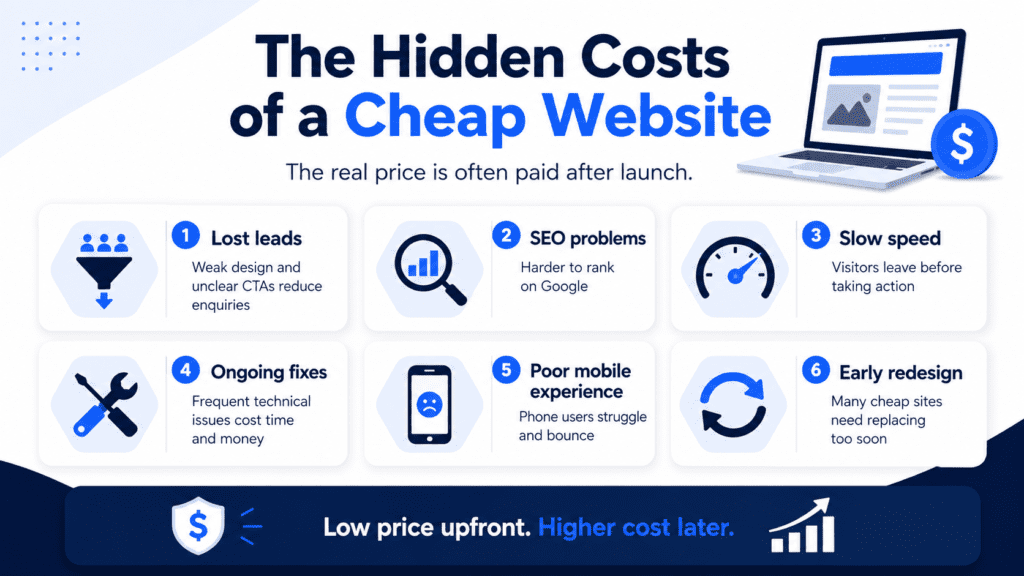
A cheap website may save money upfront, but it can cost more later if it is poorly built, difficult to update, slow to load, weak on mobile, missing SEO basics, or unable to generate enquiries.
For small businesses, the real cost of a website is not only what you pay to build it. The real cost is what happens after it goes live.
Does it help customers trust you? Does it explain your services clearly? Does it work properly on mobile? Does it rank on Google? Does it bring in enquiries? Can it grow with your business?
If the answer is no, that “cheap” website may become much more expensive than it first appeared.
This article explains why cheap websites often cost more in the long run, what hidden costs to watch for, and how small businesses can choose a website option that balances affordability with quality.
What Is a Cheap Website?
A cheap website is usually a low-cost website built with minimal strategy, limited customization, basic design, and little or no ongoing support.
Not every affordable website is bad. That distinction matters, because apparently words still need supervision.
An affordable website can be simple, professional, and well structured. A cheap website, on the other hand, often cuts important corners.
A cheap website may use a generic template with little customization. It may have weak copy, poor mobile layout, slow loading speed, no proper SEO setup, no conversion strategy, and no clear maintenance plan.
At first, it may look acceptable. But once customers start visiting, the problems become more obvious.
The issue is not that a website costs less. The issue is that the website may not be built to support your business properly.
The Difference Between Affordable and Cheap
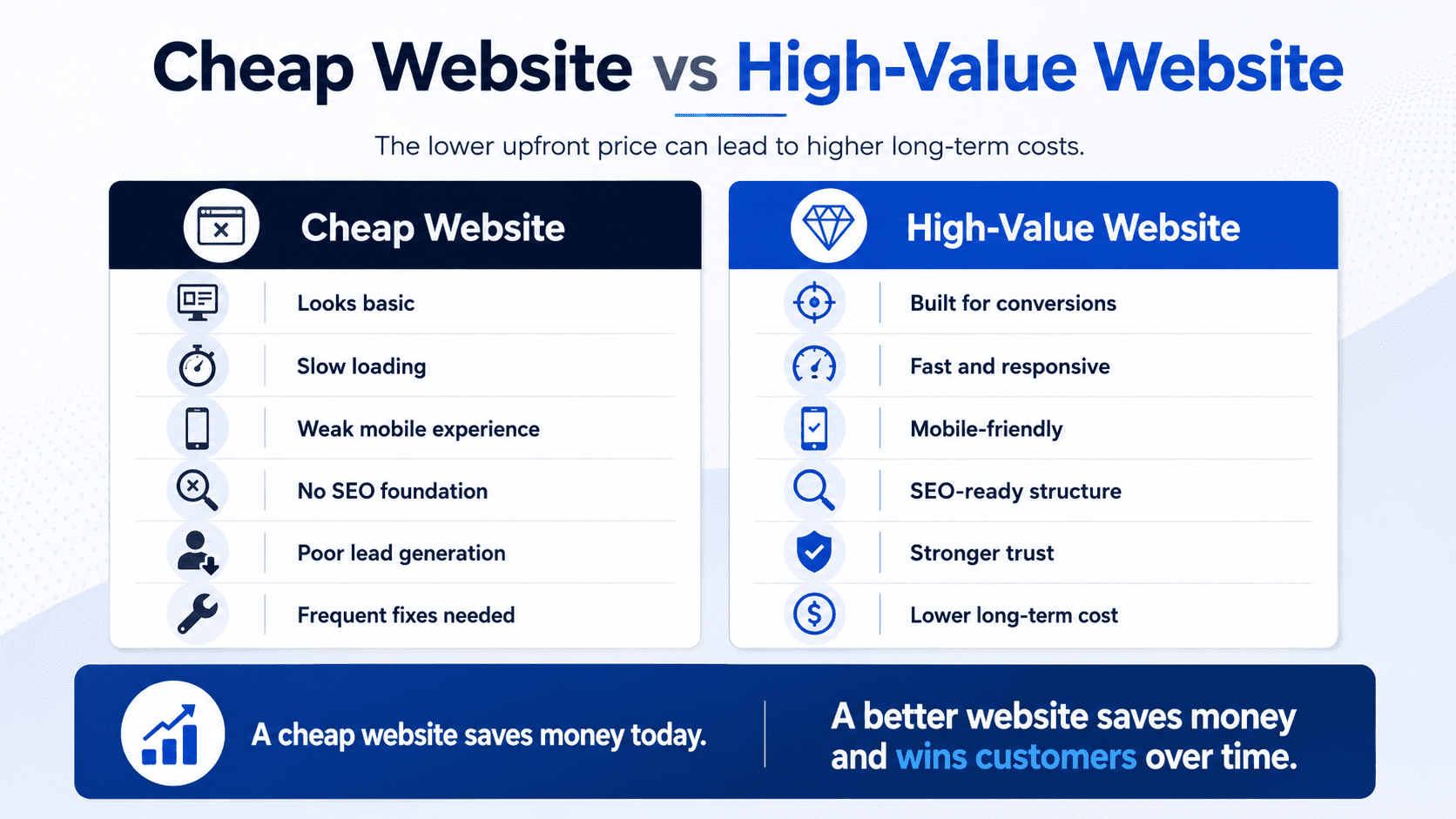
There is a big difference between an affordable website and a cheap website.
An affordable website is priced reasonably but still built with care. It has clear messaging, a professional layout, mobile-friendly design, basic SEO setup, fast loading speed, and a clear call to action.
A cheap website usually focuses only on getting something online as quickly as possible. It may skip planning, strategy, copywriting, SEO, testing, and support.
Affordable means good value.
Cheap often means missing pieces.
For example, a Website-as-a-Service plan can be affordable because it spreads the cost into a monthly subscription and includes hosting, maintenance, and support. That can be a smart option for small businesses that want a professional website without paying a large upfront fee.
A cheap one-time website, however, may cost less upfront but leave you with technical issues, weak performance, and extra costs later.
The goal is not to buy the most expensive website. The goal is to avoid buying the wrong website.
Cheap Websites Often Have Weak Strategy
A website should not be built by simply choosing a template and filling in boxes.
A good business website needs strategy.
It should be planned around your target customers, services, offer, positioning, trust proof, SEO goals, and conversion path.
Cheap websites often skip this step.
They may look like a website, but they do not guide visitors properly. The homepage may not explain the offer clearly. The services may be too vague. The call to action may be weak. The contact form may be hidden. The page structure may not match how customers make decisions.
This creates a website that exists, but does not sell.
And existence, while technically impressive for rocks and domain names, is not enough for a business.
A strategic website asks what the visitor needs to understand before they take action. A cheap website often asks only how fast the site can be finished.
That difference matters.
Poor Copy Can Cost You Leads
Many cheap websites come with basic or generic copy.
The text may sound professional, but it does not persuade.
It may say things like:
“We provide high-quality solutions for your business.”
“We are your trusted partner.”
“We are committed to excellence.”
These phrases are common, but they do not explain what the business does, who it helps, or why customers should care.
Website copy should help visitors understand your offer quickly. It should explain the problem you solve, the benefit of your service, why your business is trustworthy, and what the visitor should do next.
Weak copy creates confusion. Confusion reduces enquiries.
A cheap website may save money on copywriting, but if visitors do not understand your value, the business may lose far more in missed leads.
Clear words sell. Generic words decorate.
Unfortunately, many cheap websites are decorated very enthusiastically.
Poor Mobile Experience Can Lose Customers
Many customers visit small business websites from their phones.
This is especially true for local service businesses, consultants, clinics, salons, trades, restaurants, and appointment-based businesses.
A cheap website may look acceptable on desktop but perform badly on mobile.
Text may be too small. Buttons may be hard to tap. Images may be cropped awkwardly. Forms may be frustrating to complete. Navigation may feel clumsy. Important contact details may be buried too far down the page.
Mobile visitors are not patient. If they cannot understand your offer or contact you quickly, they may leave and choose a competitor.
A mobile-friendly website should be designed and tested properly. It should make it easy for visitors to call, message, book, request a quote, or submit an enquiry.
If a cheap website loses mobile visitors, it is not really cheap. It is leaking potential customers.
Very economical, if the goal is to save money while losing revenue.
Slow Loading Speed Creates Hidden Costs
Website speed affects user experience, SEO, and conversion.
Cheap websites are often slow because they use bloated templates, oversized images, poor hosting, too many plugins, heavy animations, or unoptimized code.
A slow website can cost your business in several ways.
Visitors may leave before the page finishes loading. Google may view the website less favorably if performance is poor. Paid ads may become less effective because traffic is being sent to a slow page. Mobile users may abandon the site before seeing your offer.
Speed problems are often invisible until you test the site or look at analytics.
A cheap website may seem fine during delivery, but if it loads slowly for real visitors, it can quietly reduce enquiries every day.
A website should not make customers wait like they are queuing at a government office. Load the page. Show the offer. Let them contact you.
Cheap Websites Often Skip SEO Basics
A website that cannot be found is limited.
Cheap websites often skip important SEO foundations such as proper page titles, meta descriptions, heading structure, internal links, image alt text, clean URLs, service pages, local SEO signals, and content planning.
This does not mean every small business website needs an advanced SEO campaign from day one.
But the basics should be in place.
If your website is missing SEO foundations, it may struggle to rank for your services, city, or business category. That can force you to rely more heavily on paid ads, referrals, or social media just to get traffic.
For local businesses, SEO is especially important because customers search for services near them.
A website that does not clearly show what you offer and where you serve may miss valuable search opportunities.
Fixing SEO later can cost more because pages may need to be rewritten, restructured, renamed, or rebuilt.
It is cheaper to build the foundation properly than to repair the mess later. Humanity continues learning this across every industry, slowly and with invoices.
Weak Design Can Damage Trust
A website does not need to be flashy, but it does need to look credible.
Customers judge businesses online quickly. If your website looks outdated, messy, inconsistent, or unfinished, visitors may question whether your business is professional.
This is especially true if your competitors have cleaner, clearer, and more trustworthy websites.
Cheap websites often rely on generic layouts, poor spacing, mismatched fonts, low-quality images, weak color choices, and inconsistent branding.
The result may not look terrible, but it may not inspire confidence either.
Trust matters because visitors are deciding whether to contact you, book you, pay you, or share their information with you.
A cheap-looking website can make your business feel less established than it really is.
That is a costly impression.
Cheap Websites May Not Be Built for Conversion
A website should guide visitors toward action.
A conversion-focused website includes clear calls to action, easy contact options, trust proof, service explanations, FAQs, pricing guidance, and a logical page flow.
Cheap websites often miss these elements.
They may have a contact page, but no strong CTA. They may list services, but not explain benefits. They may show nice images, but no testimonials. They may include a form, but place it where few visitors reach it.
A website that is not built for conversion may receive traffic but produce few enquiries.
This is one of the biggest hidden costs of a cheap website.
You may save money on the build, but lose revenue because the website does not turn visitors into leads.
A website without conversion strategy is just a brochure with hosting fees.
Hidden Maintenance Costs Can Add Up
Many cheap website projects do not include ongoing maintenance.
After launch, you may be responsible for updates, backups, security, hosting, plugin issues, broken links, speed problems, and content changes.
At first, this may not seem like a problem.
Then something breaks.
A contact form stops working. A plugin update causes layout issues. A page loads slowly. A security warning appears. A booking link fails. The website needs a content update, but no one knows how to make it.
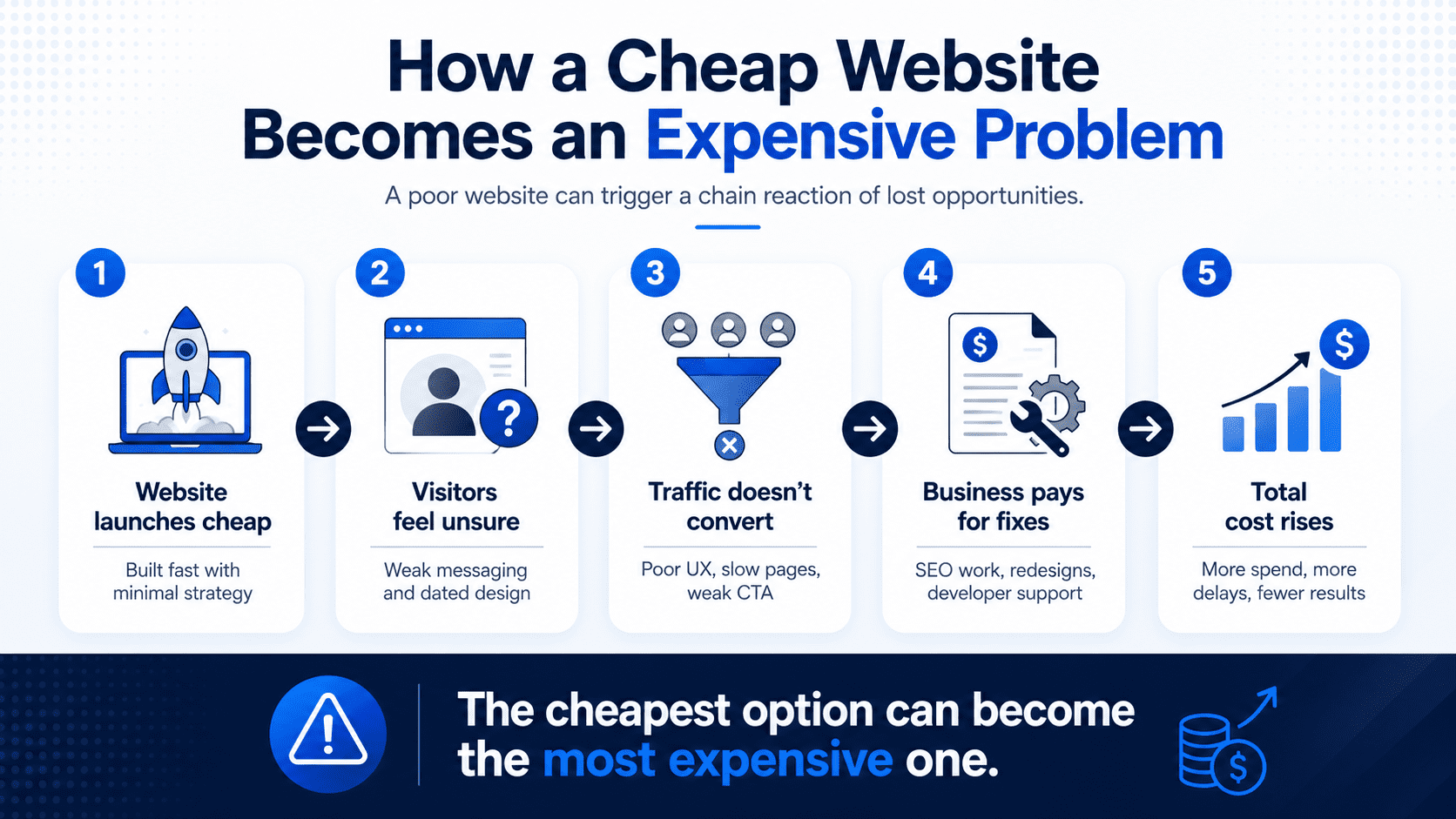
Suddenly, the cheap website needs paid fixes.
Maintenance costs can add up quickly when the website was not built with long-term management in mind.
A proper website plan should make it clear what happens after launch. Who updates the site? Who fixes issues? Who handles hosting? Who checks forms? Who keeps the website secure?
If nobody is responsible, the website will eventually become a problem.
Because websites, like humans, do not improve when ignored.
Cheap Websites Can Be Hard to Update
Some cheap websites are built in a way that makes updates difficult.
The layout may be fragile. The page builder may be confusing. The code may be messy. The structure may not allow easy changes. The original builder may disappear after launch, because naturally the lowest-cost provider is not always running a lifelong support monastery.
If you cannot easily update your website, your marketing becomes slower.
You may struggle to add new services, update pricing, publish blog posts, add testimonials, create landing pages, or improve SEO.
A website should grow with your business.
If a cheap website makes every small change difficult, it can slow down your ability to sell, promote, and adapt.
The cost is not only technical. It is operational.
Cheap Websites Often Lack Proper Support
Support matters.
When something goes wrong with your website, you need someone who can help.
Cheap website offers often include limited or no support after launch. Once the website is delivered, every change or fix may cost extra. In some cases, the provider may not be available at all.
This becomes a problem when your business depends on the website for enquiries.
If your form stops working, your site goes down, or your mobile layout breaks, you need a fast solution.
A cheap website without reliable support can leave you stuck.
That is one reason managed website plans and Website-as-a-Service models are useful for small businesses. They can include ongoing support, hosting, maintenance, and updates in one predictable monthly plan.
The website is not just built. It is looked after.
Radical concept, apparently.
Poor Hosting Can Create Problems
Cheap websites often come with cheap hosting.
Poor hosting can affect website speed, uptime, security, backups, and support.
If your website is slow or frequently unavailable, customers may not be able to access it when they need you. That can damage trust and cost enquiries.
Hosting is not the most exciting part of a website, but it matters.
A reliable website needs hosting that is stable, secure, and suitable for the business.
If a cheap website uses low-quality hosting just to reduce the price, you may pay for it later through downtime, slow performance, or technical issues.
A website is not useful if customers cannot access it properly.
Rebuilding Later Can Cost More Than Building Properly First
One of the biggest long-term costs of a cheap website is the rebuild.
Many businesses start with a cheap website, then realize later that it cannot support their growth. The design is weak. The SEO structure is poor. The pages are hard to edit. The website is slow. The copy is unclear. The platform is limiting.
At that point, they need to rebuild the website.
That means paying again.
The original cheap website becomes a temporary expense instead of a lasting asset.
Sometimes starting small is smart. But starting badly is expensive.
A simple, affordable website that is properly structured can grow over time. A cheap website built without planning may need to be replaced completely.
That is where the long-term cost appears.
Cheap Websites Can Hurt Paid Advertising Results
If you run paid ads, your website quality matters even more.
A paid ad can bring traffic, but the landing page or homepage must convert that traffic into enquiries.
If your website has unclear messaging, weak CTAs, slow speed, poor mobile experience, no trust proof, or confusing forms, your ad budget may be wasted.
You may think the ads are not working, when the real issue is the website.
A cheap website can make every paid click less effective.
That means you may spend more money on ads to get the same number of leads.
In this case, the cheap website does not only cost you during the build. It increases your marketing cost over time.
A weak website is like pouring water into a bucket with holes, then blaming the water.
Cheap Websites Can Attract the Wrong Customers
Your website shapes how people perceive your business.
If your website looks cheap, unclear, or poorly positioned, it may attract price-sensitive customers who are looking for the lowest possible cost.
That may not be the type of customer you want.
A stronger website helps position your business more professionally. It can communicate value, process, quality, proof, and outcomes. This can help attract better-fit enquiries.
For service businesses, the quality of your website can influence the quality of your leads.
If your website feels premium, clear, and trustworthy, prospects may be more willing to pay for your service.
If your website feels cheap, visitors may assume your service is cheap too.
Brand perception has consequences. Annoying, but real.
The Real Cost of a Cheap Website
The real cost of a cheap website is not only the amount you paid upfront.
It includes missed enquiries, wasted traffic, poor conversion, lower trust, weak SEO, technical fixes, redesign costs, lost time, and ongoing frustration.
A website that costs $300 but generates no enquiries may be more expensive than a website that costs more but helps bring in customers.
A website should be judged by value, not only price.
This does not mean every small business needs a large custom website.
Many businesses can start with a simple, affordable website. But it still needs the right structure, messaging, mobile experience, SEO basics, and support.
Cheap becomes expensive when it fails to do the job.
When a Low-Cost Website Makes Sense
A low-cost website can make sense in some situations.
If your business is brand new, your offer is still being tested, or you only need a simple online presence, a basic website may be enough to start.
A small one-page website can work if it is clear, mobile-friendly, fast, and focused on one main action.
The key is to avoid cutting the wrong corners.
You can start small without starting poorly.
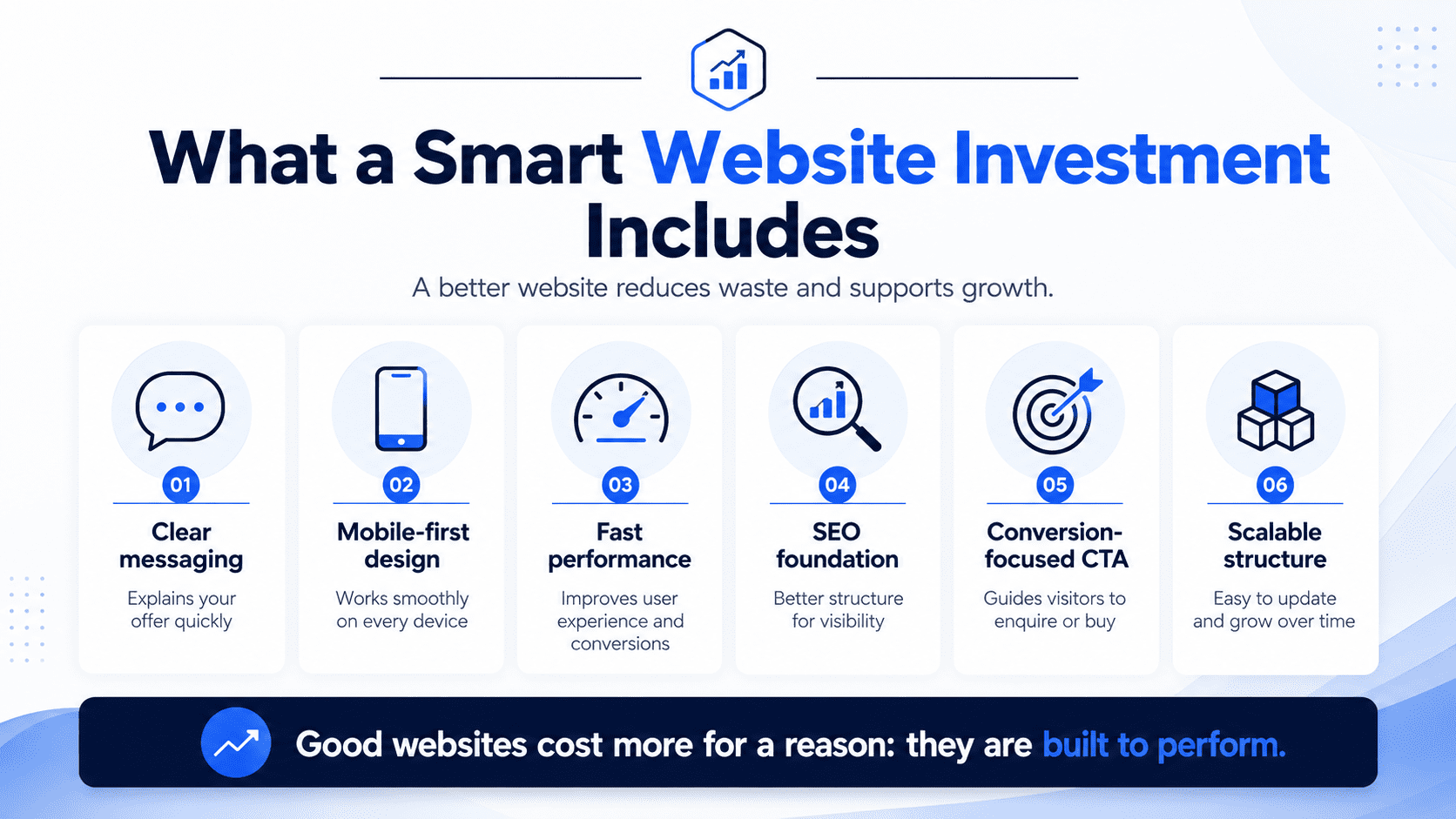
A good low-cost website should still include clear messaging, strong CTA, basic SEO, mobile-friendly design, fast loading speed, trust proof, contact options, and a maintenance plan.
The issue is not simplicity.
The issue is carelessness.
What to Look for Instead of Just the Cheapest Price
When choosing a website provider, do not only ask, “How much does it cost?”
Ask what is included.
Does the website include mobile-friendly design? Is SEO setup included? Will the site load quickly? Are contact forms tested? Is hosting included? Who handles maintenance? Can the website be updated easily? Is there ongoing support? Does the homepage have a clear conversion structure? Are service pages included? Are you getting copywriting help?
The cheapest quote may not include the things your business actually needs.
A better website option should balance cost, quality, support, and business value.
That may mean choosing a Website-as-a-Service plan, a done-for-you website package, or a custom build, depending on your stage and needs.
The best choice is not always the most expensive option.
It is the option that gives your business the strongest foundation without unnecessary waste.
Affordable Website Options for Small Businesses
Small businesses do not need to choose between an overpriced custom website and a cheap website that barely works.
There are better middle-ground options.
A monthly website plan or Website-as-a-Service model can be useful because it gives businesses a professional website with hosting, maintenance, and support included. This reduces upfront cost while still providing structure and ongoing care.
A done-for-you website plan can also help business owners avoid DIY mistakes while keeping pricing more manageable than a fully custom agency project.
For businesses with advanced needs, a custom website may still be the right investment.
The important thing is to choose based on your business goals, not just the lowest price.
If your website needs to generate leads, support SEO, and build trust, it should be treated as a business asset.
Not a box to tick.
Signs Your Cheap Website Is Costing You Money
You may already have a cheap website that is costing your business more than you realize.
Warning signs include low enquiries, poor mobile experience, slow loading speed, outdated design, confusing messaging, no clear CTA, no SEO traffic, broken forms, difficult updates, no testimonials, no pricing guidance, and no analytics tracking.
Another sign is that you feel embarrassed to send people to your website.
That is usually a problem.
Your website should make your business easier to trust. If you avoid sharing it, it is not doing its job.
A website should support your sales conversations, not create excuses.
Final Thoughts
Cheap websites often cost more in the long run because they cut corners that matter.
They may save money upfront, but they can create hidden costs through lost enquiries, weak SEO, poor mobile experience, slow speed, technical issues, redesigns, maintenance problems, and wasted marketing spend.
A small business website does not need to be expensive to be effective. But it does need to be clear, credible, mobile-friendly, fast, easy to update, optimized for search, and built to convert visitors into enquiries.
The goal is not to buy the cheapest website.
The goal is to buy the right website for your business stage.
An affordable website can be a smart investment.
A cheap website can become an expensive mistake.
And yes, unfortunately, there is a difference.