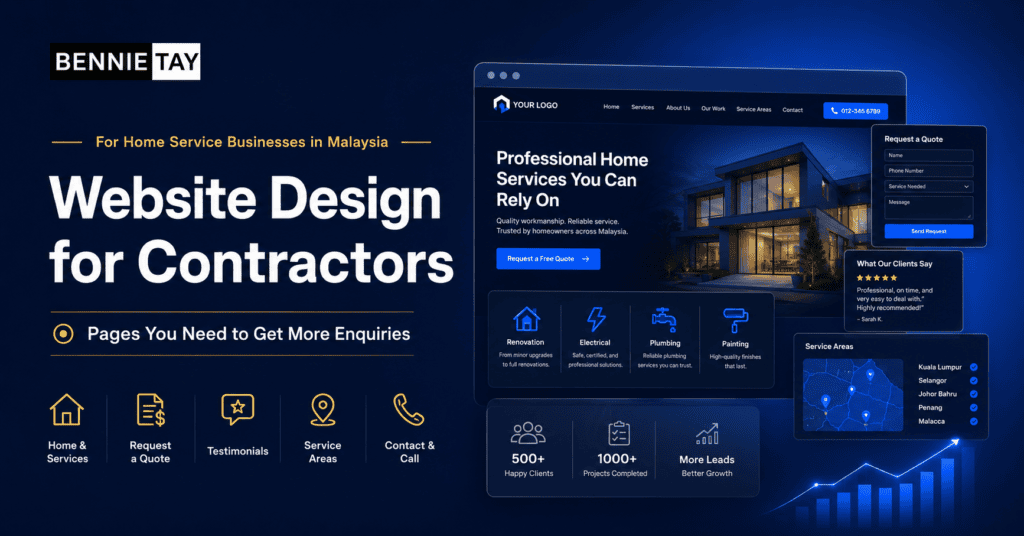
Contractors and home service businesses rely heavily on trust. When someone is choosing a renovation contractor, plumber, cleaner, electrician, pest control company, aircond service provider, landscaper, or repair specialist, they want to know one thing first: can this business do the job properly?
Your website should answer that question quickly. It should show what you do, where you serve, what kind of work you have completed, and how someone can request a quote. A nice design helps, but a contractor website should not only look good. It should help visitors feel confident enough to contact you.
Many contractor websites in Malaysia are too thin. They have a homepage, a contact page, and a few generic service names. That is usually not enough. Customers want details. Google also needs details if you want your website to show up for local searches.
Why contractors need more than a basic website
A contractor website is often checked before a customer calls or messages. Even if the lead comes from Facebook, Google Business Profile, WhatsApp, referral, or a marketplace platform, people may still visit your website to confirm whether you look professional.
If the website is outdated, unclear, slow, or missing project examples, the customer may move on to another company. This is especially true for higher-value services such as renovation, roofing, waterproofing, electrical work, built-in cabinets, landscaping, or commercial maintenance.
Your website does not need to be complicated. It needs to be clear, organized, mobile-friendly, and built around the questions customers ask before hiring you.
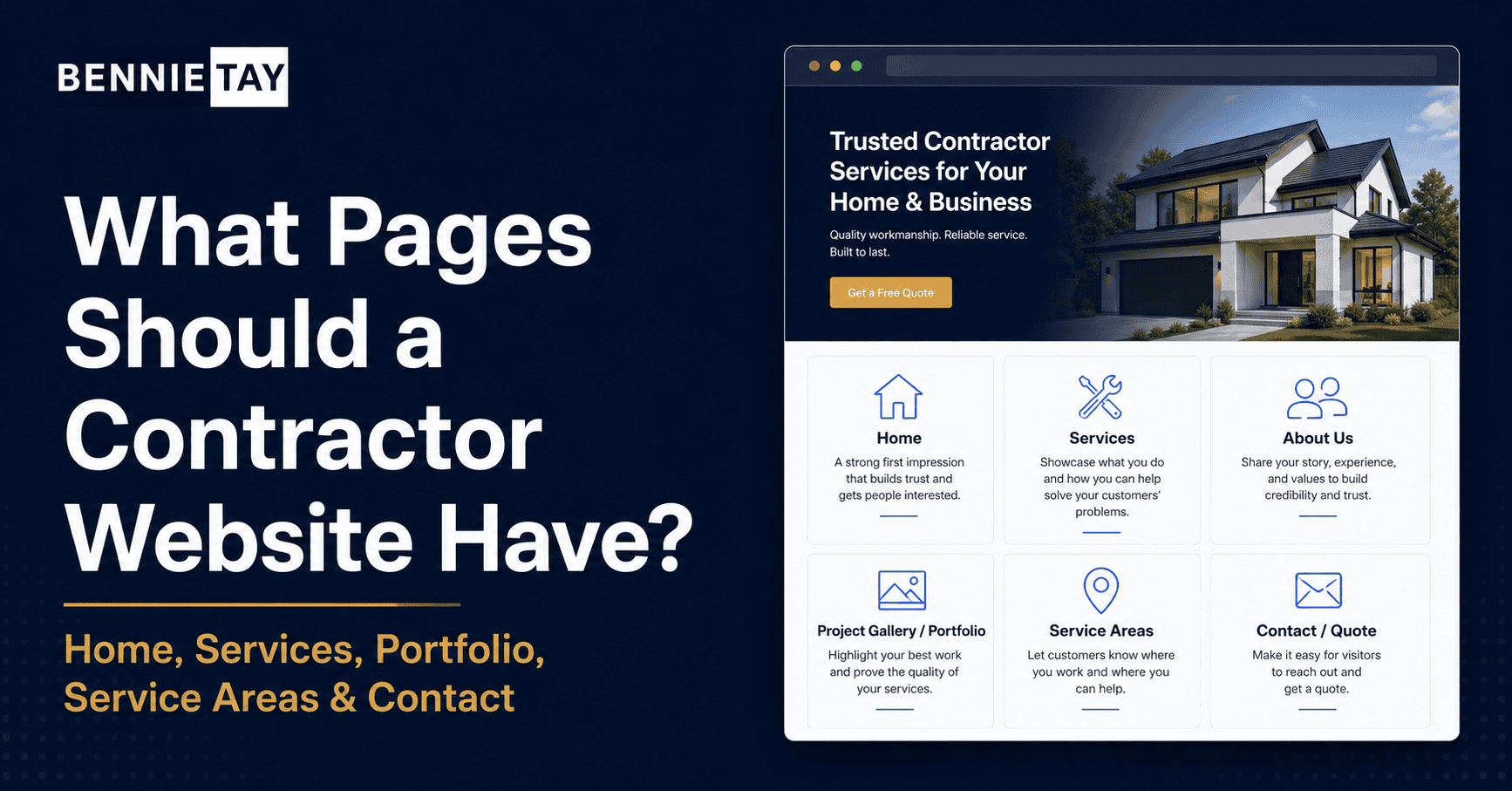
Start with a clear homepage
Your homepage should explain your service in the first few seconds. Do not open with vague lines like “Your trusted solution provider.” Say what you do, who you serve, and where you operate.
For example, a stronger homepage headline might be: “Renovation Contractor in Klang Valley for Homes, Shops, and Offices.” A plumbing business might use: “Fast Plumbing Repair and Installation Services in Kuala Lumpur and Selangor.”
Below the headline, add a short explanation of your main services and a clear call to action. If WhatsApp is your main enquiry channel, make the WhatsApp button easy to find. If you prefer quote forms, keep the form short and simple.
Your homepage should also include trust signals. Add project photos, reviews, years of experience, service areas, licensing or certification if relevant, and a simple process showing how customers can work with you.
Create separate service pages
One common mistake is placing every service on one page. This may look simple, but it often weakens both user experience and SEO.
If you offer renovation, painting, wiring, plumbing, and waterproofing, each major service should have its own page. A dedicated service page lets you explain the problem, the work involved, common use cases, photos, service area, and how to request a quote.
For example, a waterproofing page can talk about roof leaks, bathroom leaks, balcony leaks, inspection process, repair options, and warranty. A painting page can explain interior painting, exterior painting, paint types, preparation work, and expected timeline.
Separate pages help customers find the exact service they need. They also help Google understand what each page should rank for.
Add project or portfolio pages
Contractor websites need proof. Customers want to see real work. A project gallery or case study section can help build confidence quickly.
Do not only upload random photos. Organize them by service type or project type. A renovation company can show kitchen renovation, bathroom renovation, condo renovation, shop renovation, and office renovation. A landscaping company can show residential gardens, commercial landscapes, maintenance work, and before-and-after photos.
For each project, add a short description. Mention the location, problem, scope of work, and result. This makes the project more useful than a simple image gallery.
If you cannot show client names or exact addresses, keep the details general. For example: “Condo bathroom waterproofing repair in Petaling Jaya” or “Office partition and painting work in Subang Jaya.”
Build location pages carefully
Many home service businesses serve multiple areas. If you want enquiries from specific towns or cities, location pages can help. But they must be useful, not copied pages with only the location name changed.
A good location page should mention the services available in that area, common customer needs, response time if relevant, nearby coverage areas, and examples of work done around that location.
For example, a page for “Aircond Service in Cheras” should not be identical to “Aircond Service in Puchong.” Add local context where possible. Keep the page readable and helpful.
Location pages are especially useful for businesses that depend on local SEO, such as plumbers, electricians, cleaners, pest control companies, roof repair contractors, movers, and appliance repair services.
Explain your process
Customers often hesitate because they do not know what will happen after they contact you. A process section removes uncertainty.
Use simple steps: send enquiry, schedule inspection, receive quotation, confirm work, complete job, final check. If your work requires a site visit, say so. If you can quote from photos, explain what photos you need.
This helps customers understand the next step and reduces repeated questions. It also makes your business feel more organized.
Include reviews and trust signals
Reviews are important for contractors and home service providers. Add testimonials from past customers where possible. If you have Google reviews, project ratings, certifications, insurance, team photos, or years of experience, include them.
Trust signals should be placed near calls to action, not hidden at the bottom of the website. When someone is deciding whether to contact you, proof can make the difference.
Use real photos when possible. Stock photos may look clean, but they do not prove that your team can do the work. Real project photos, even if imperfect, often build more trust.
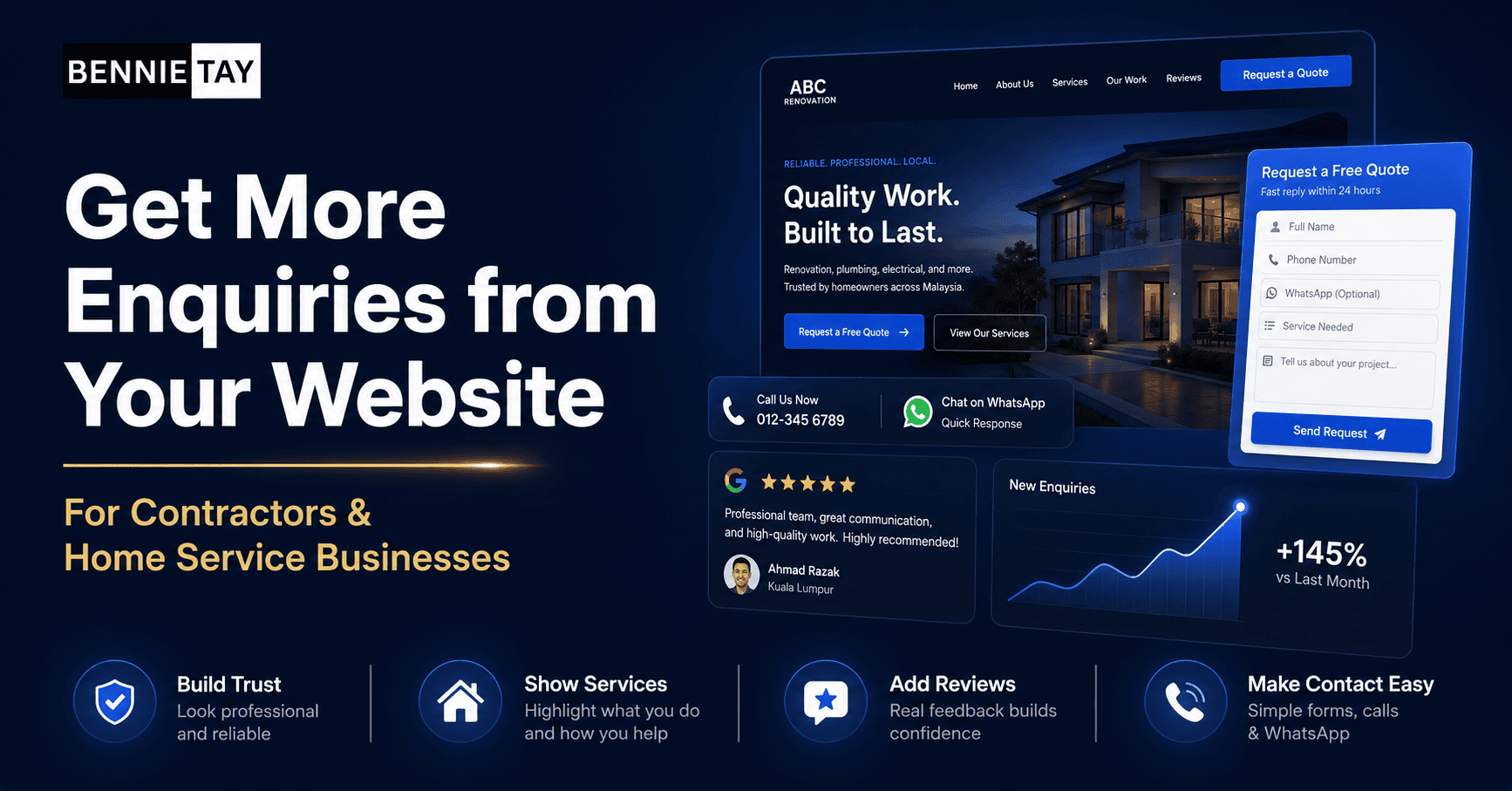
Make contact easy
A contractor website should make it very easy to enquire. Add WhatsApp buttons, phone-click buttons, a contact form, and service area details. On mobile, these buttons should be visible and easy to tap.
Your form should not be too long. Ask for name, phone number, service needed, location, and a short message. If useful, allow customers to upload photos later through WhatsApp rather than forcing a complicated form.
Also set expectations. Tell visitors whether you respond during business hours, whether inspection fees apply, and what information helps you prepare a quotation.
Include a useful FAQ section
An FAQ section can improve both user experience and lead quality. Contractors often receive the same questions repeatedly, so answer them on the website before the customer contacts you.
Useful FAQ topics include service area, inspection fees, quotation process, estimated timeline, warranty, materials, payment terms, emergency service availability, and whether small jobs are accepted.
For example, a renovation contractor can answer whether a site visit is required before quoting. A pest control company can explain how long treatment takes. A cleaning company can explain what is included in a deep cleaning package.
Good FAQs reduce hesitation. They also filter out customers who are not a good fit.
Add before-and-after content
Before-and-after photos are powerful for home service businesses. They help customers see the difference your work makes.
This works especially well for renovation, painting, cleaning, landscaping, pest control, waterproofing, roof repair, flooring, and restoration services. A simple before-and-after gallery can communicate value faster than a long paragraph.
Add short captions to explain what changed. For example: “Bathroom leak repair and waterproofing in Cheras” or “Exterior house repainting in Shah Alam.” These captions also give search engines more context.
If the project involved a challenge, mention it briefly. Customers appreciate knowing that you can handle real problems, not only perfect showroom-style projects.
Show pricing guidance where possible
Many contractors avoid pricing completely, but some guidance can help. You do not need to publish fixed prices if every job is custom. Instead, explain what affects cost.
For example, renovation cost may depend on size, material selection, site condition, demolition work, plumbing, electrical changes, and timeline. Cleaning cost may depend on property size, condition, and frequency. Pest control cost may depend on property type and infestation level.
This helps customers understand why you need details before quoting. It also reduces unrealistic enquiries from people expecting a fixed price without inspection.
Connect your website to follow-up
Getting an enquiry is only the first step. A contractor website should support follow-up too. Make sure form submissions go to the right person and are not lost in a general inbox.
If you use WhatsApp, create a simple process for saving customer details, project type, location, and next action. If you use email, set up notifications and test them regularly. If you run ads, track which form submissions or WhatsApp clicks came from each campaign.
Fast follow-up matters in home services. Customers often contact several providers at the same time. If your website makes it easy to enquire but your team responds too slowly, the lead may go elsewhere.
You can also create simple auto-replies. Let customers know that you received their enquiry and what information they should prepare, such as photos, measurements, preferred timing, or property location.
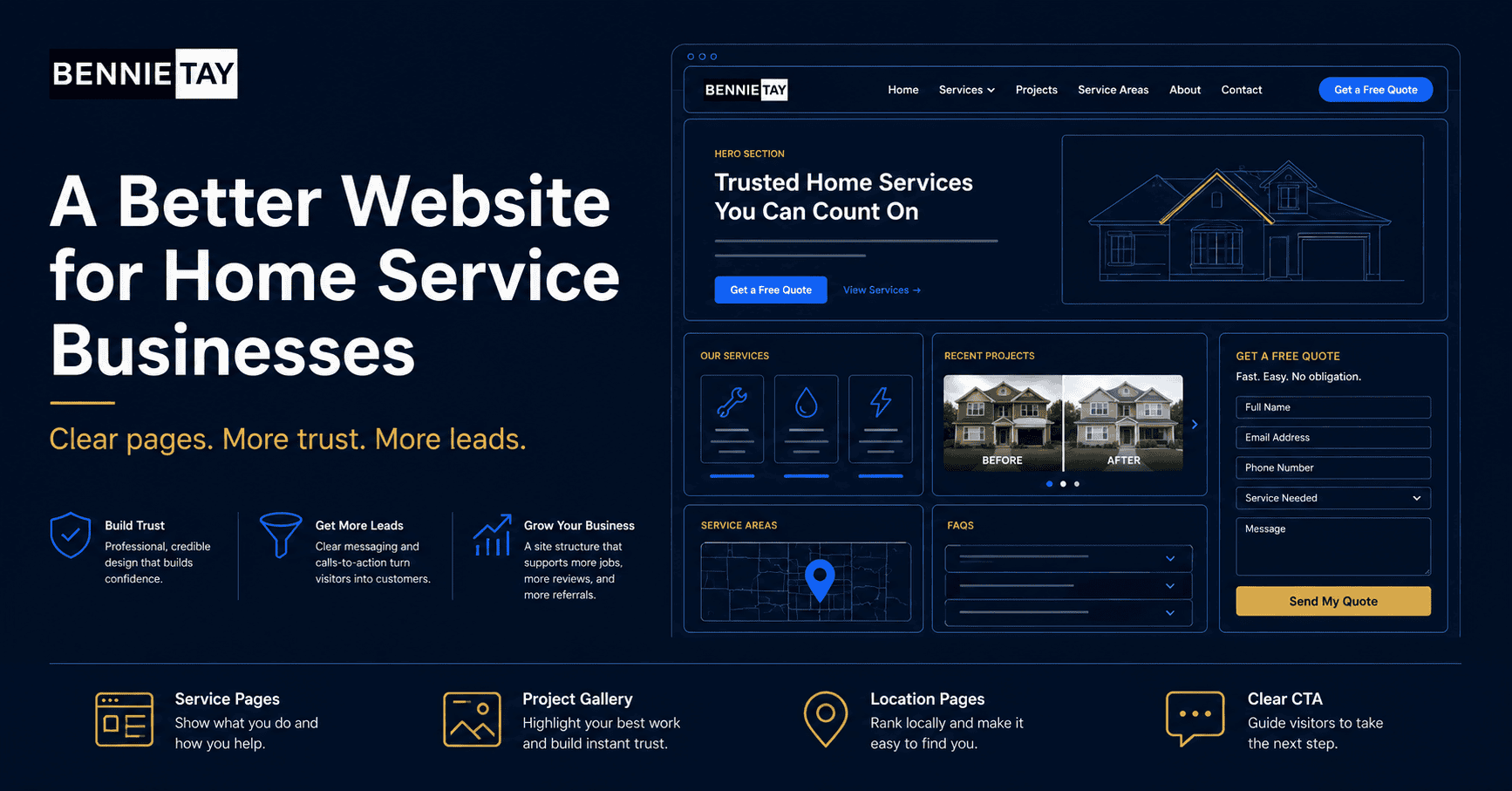
A simple contractor website checklist
Before launching or redesigning your website, check whether it answers the most important customer questions.
Can visitors understand your main service within five seconds? Can they see where you operate? Can they view real work? Can they read reviews? Can they request a quote easily from mobile? Can they understand what happens after they contact you?
If the answer is no, fix those areas first. A contractor website does not need every possible feature. It needs the pages and proof that help customers trust you and take action.
Do not ignore mobile speed
Many contractor leads come from mobile search or social media. If your website loads slowly or is hard to read on a phone, you will lose enquiries.
Compress images, avoid unnecessary animation, keep buttons clear, and make text readable. A project gallery should not load huge image files that slow the whole page.
Mobile experience matters because customers often search while the problem is urgent. A leaking pipe, broken aircond, or pest issue requires quick action. Your website should help them contact you without friction.
Final thoughts
Website design for contractors in Malaysia should focus on trust, clarity, local visibility, and easy enquiries. You do not need a flashy website. You need the right pages.
Start with a clear homepage, dedicated service pages, real project examples, location pages where useful, customer reviews, a simple process, and strong contact options. When your website answers customer questions before they ask, you are more likely to receive better enquiries.