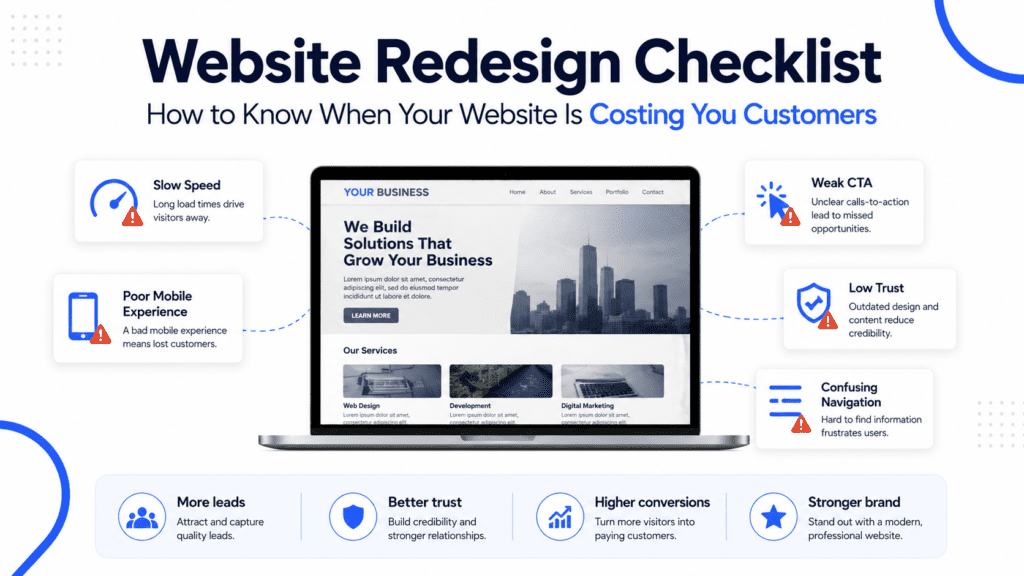
Your website may look acceptable at first glance. It may have your logo, service details, contact form, and a few nice images. But if it is not generating enquiries, building trust, or helping visitors take action, it may be quietly costing your business customers.
A website should not only exist online. It should help your business look credible, explain your offer clearly, and convert visitors into leads, bookings, calls, or sales.
The problem is that many business owners do not realize their website is underperforming. They assume that because the website is live, it is doing its job. But an outdated, slow, confusing, or poorly structured website can push potential customers away before they ever contact you.
This website redesign checklist will help you identify whether your current website needs improvement, what warning signs to look for, and how to decide whether you need a few updates or a full redesign.
What Is a Website Redesign?
A website redesign is the process of improving the structure, design, content, user experience, and performance of an existing website.
A redesign can be simple or extensive.
A simple redesign may involve updating the homepage layout, improving call-to-action buttons, refreshing images, rewriting service descriptions, and fixing mobile spacing.
A full redesign may involve rebuilding the entire website with a better structure, clearer messaging, stronger SEO, faster performance, improved navigation, new page designs, and a more conversion-focused user journey.
The goal is not just to make the website look newer. The goal is to make the website work better for your business.
A successful redesign should help your website:
- Build trust faster
- Explain your offer clearly
- Improve mobile experience
- Load faster
- Rank better on search engines
- Generate more enquiries
- Support your sales process
- Reflect your current brand and services
Why Website Redesign Matters
Your website is often the first impression customers have of your business.
Before someone calls you, books a consultation, requests a quote, or visits your shop, they may check your website first. If the site feels outdated, confusing, slow, or unprofessional, they may choose a competitor instead.
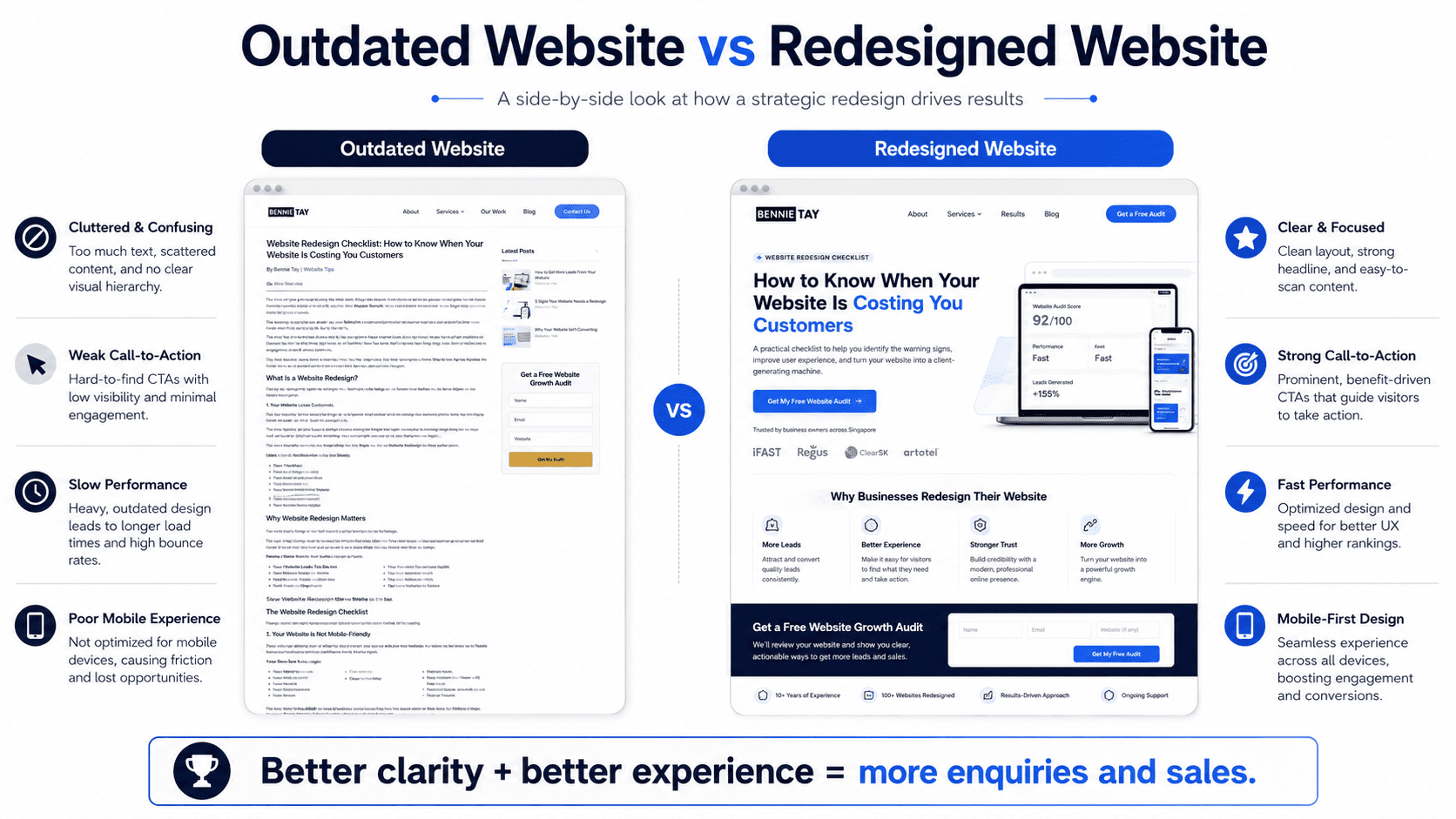
A poor website can affect your business in several ways:
- Visitors leave before contacting you
- Potential customers lose trust
- Mobile users struggle to navigate
- Forms do not get completed
- Your business looks less credible
- Search rankings decline
- Paid ad traffic is wasted
- Enquiries go to competitors
A website redesign is not just a design decision. It is a business decision.
The Website Redesign Checklist
Use this checklist to evaluate whether your website is helping or hurting your business.
1. Your Website Looks Outdated
Design trends change, but your website does not need to follow every trend. What matters is whether your website still looks trustworthy, professional, and relevant to your target customers.
An outdated website may have:
- Old design style
- Poor spacing
- Cluttered layout
- Low-quality images
- Tiny text
- Inconsistent fonts
- Broken sections
- Old branding
- Heavy gradients or outdated graphics
- Design that does not match your current business
Visitors make quick judgments. If your website looks neglected, they may assume your business is also outdated or less professional. A redesign can help modernize the look and make your business feel more credible.
2. Your Website Is Not Mobile-Friendly
A website that works on desktop but performs poorly on mobile is a major problem. Many customers browse websites on their phones. This is especially true for local businesses, service providers, restaurants, clinics, salons, consultants, and home services.
Your mobile website may need redesigning if:
- Text is too small to read
- Buttons are hard to tap
- The menu is confusing
- Images are cropped badly
- Sections overlap
- Forms are difficult to complete
- Pages require too much zooming
- Contact details are hard to find
- The website loads slowly on mobile data
A mobile-friendly website should feel simple, clear, and easy to use. Visitors should be able to understand your offer, view your services, and contact you within a few taps.
3. Your Website Loads Too Slowly
Website speed affects user experience, SEO, and conversions. If your website takes too long to load, visitors may leave before they even see your offer.
Common causes of slow websites include:
- Large uncompressed images
- Too many plugins
- Poor hosting
- Heavy animations
- Unoptimized videos
- Bloated page builders
- Too many third-party scripts
- Old themes or code
- Lack of caching
A slow website can cost you customers because people expect pages to load quickly. If your site feels slow on mobile, it may be time to redesign or optimize the technical structure.
4. Your Homepage Message Is Unclear
Your homepage should quickly answer one simple question: “What does this business do, and why should I care?”
Many websites fail because the homepage headline is vague. Examples of weak headlines include:
- “Welcome to Our Website”
- “Your Trusted Partner”
- “Quality Solutions for Every Business”
- “We Help You Succeed”
- “Professional Services You Can Count On”
These headlines sound generic and do not explain the offer. A stronger homepage headline should clearly communicate:
- What you offer
- Who you help
- What problem you solve
- Where you serve, if relevant
- What action visitors should take next
For example: “Affordable Website Plans for Small Businesses That Need More Enquiries”
This is clearer because it explains the service, audience, and outcome. If visitors need to guess what you do, your website is costing you leads.
5. Your Website Has Weak Calls to Action
A call to action, or CTA, tells visitors what to do next. If your website does not clearly guide visitors, they may leave without taking action.
Weak CTAs include:
- Submit
- Learn More
- Click Here
- Contact
- Read More
Stronger CTAs include:
- Request a Free Quote
- Book a Free Consultation
- Send Us a WhatsApp Message
- Schedule an Appointment
- Get Your Website Plan
- Check Availability
- Start Your Free Assessment
Your website may need a redesign if:
- CTA buttons are hard to find
- Buttons are not repeated throughout the page
- The CTA wording is too generic
- There is no clear next step
- Mobile users cannot easily contact you
- The contact form is hidden at the bottom of the site
Every important page should guide visitors toward a useful action.
6. Your Website Is Not Generating Enquiries
One of the clearest signs your website needs attention is low enquiry volume. If your website gets visitors but few people contact you, something is blocking conversion. Possible reasons include:
- Unclear messaging
- Weak offer
- Poor page structure
- No trust proof
- Slow loading speed
- Confusing navigation
- Weak CTA
- Long contact forms
- No pricing guidance
- Poor mobile experience
- Lack of testimonials
- No service-specific pages
A redesign should focus on conversion, not just visuals. The goal is to help more visitors become leads.
7. Your Contact Form Is Too Complicated
Contact forms should make enquiry easy. If your form asks for too much information too soon, visitors may abandon it. A basic enquiry form usually only needs:
- Name
- Email or phone number
- Service interest
- Message
For some local businesses, a WhatsApp button, click-to-call button, or booking link may convert better than a long form. Your website may need redesigning if:
- The form is too long
- Required fields are unnecessary
- The form does not work properly
- There is no confirmation message
- Mobile users struggle to complete it
- You are not receiving form submissions
- The form looks outdated or untrustworthy
The easier it is to contact you, the more likely visitors are to do it.
8. Your Website Does Not Build Trust
Before visitors contact you, they need to feel confident. A website that lacks trust proof can make potential customers hesitate. Trust-building elements include:
- Customer testimonials
- Google reviews
- Case studies
- Project examples
- Client logos
- Team photos
- Certifications
- Awards
- Before-and-after images
- Clear business address
- Real contact details
- Transparent process
- FAQs
If your website only says you are reliable but does not show proof, visitors may not be convinced. A redesign can help place trust elements in the right sections so visitors see them before making a decision.
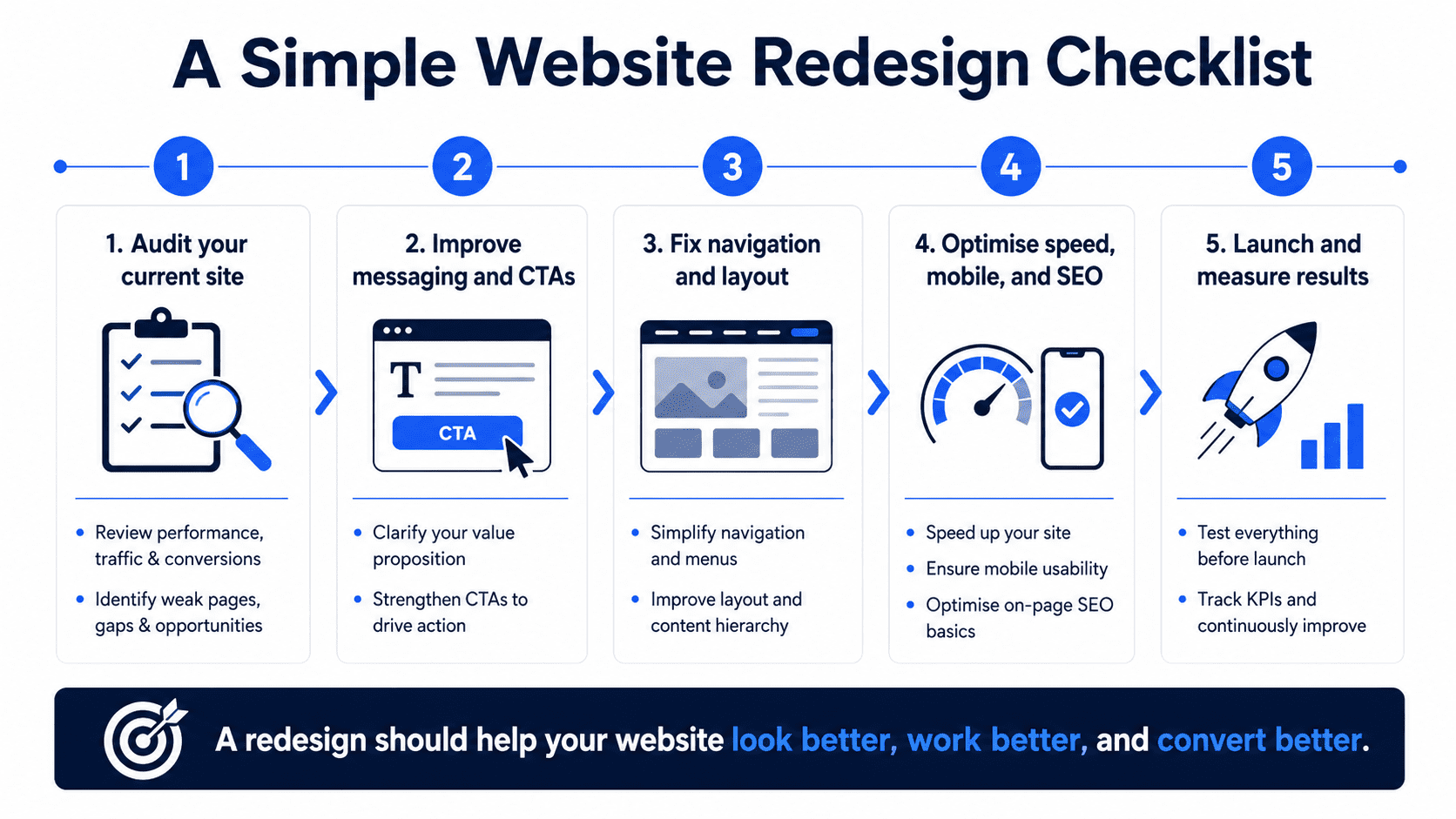
9. Your Services Are Not Clearly Explained
Many business websites list services but do not explain them well.
For example, a website might say: “We offer web design, SEO, branding, and digital marketing.”
That tells visitors what you do, but it does not explain the value. A stronger service section should explain:
- What the service includes
- Who it is for
- What problem it solves
- What outcome the customer can expect
- Why your approach is different
- What the next step is
If your service pages are too short, vague, or generic, they may not persuade visitors to enquire. A website redesign can help turn basic service descriptions into stronger sales pages.
10. Your Website Has Poor Navigation
Navigation affects how easily visitors can find what they need. If your menu is confusing, cluttered, or missing key pages, visitors may leave. Poor navigation signs include:
- Too many menu items
- Important pages are hidden
- Service pages are hard to find
- The contact button is not visible
- The mobile menu is difficult to use
- Page names are unclear
- Visitors need too many clicks to get information
A good navigation menu should be simple and practical. Common menu items include:
- Home
- Services
- Pricing
- About
- Blog
- Contact
For some businesses, adding a visible “Book a Call” or “Request a Quote” button in the header can improve conversions.
11. Your Website Is Not Optimized for SEO
A website that is not optimized for search engines may struggle to attract organic traffic. SEO problems include:
- Missing page titles
- Weak meta descriptions
- No proper H1 heading
- Thin content
- No internal linking
- No image alt text
- Poor URL structure
- No service pages
- No location pages
- Duplicate content
- Slow loading speed
- Poor mobile experience
- No blog or resource content
A redesign is a good opportunity to improve SEO from the foundation.
Instead of only changing visuals, you can rebuild the site structure around keywords, services, locations, and customer questions.
12. Your Website Does Not Reflect Your Current Business
Businesses change over time. You may have new services, updated pricing, better positioning, new customers, stronger proof, or a different target market.
Your website may be outdated if it still shows:
- Old services
- Old pricing
- Old branding
- Old team members
- Old contact details
- Outdated images
- Old testimonials
- Irrelevant offers
- Messaging that no longer fits your business
If your website no longer represents what you sell today, it can create confusion and reduce trust. A redesign helps align your website with your current business direction.
13. Your Competitors’ Websites Look Better
Your website does not exist in isolation. Customers often compare several businesses before making a decision. If your competitors have clearer messaging, better design, stronger reviews, faster pages, and easier contact options, they may win the enquiry.
Compare your website with competitors and ask:
- Is our offer as clear as theirs?
- Do we look as credible?
- Are our CTAs stronger?
- Is our mobile experience better?
- Do we show enough proof?
- Is our pricing or process clearer?
- Is it easier to contact us?
- Do we have better SEO content?
If your website makes your business look less professional than competitors, it may be time to redesign.
14. Your Website Has Broken Links or Technical Issues
Technical problems can damage trust and reduce conversions. Common issues include:
- Broken links
- Missing images
- Error pages
- Forms not working
- Buttons going nowhere
- Outdated plugins
- Security warnings
- Layout problems
- Browser compatibility issues
- Slow checkout or booking flow
Visitors may not report these problems. They may simply leave. Regular testing is important, especially after updates or platform changes.
15. Your Website Has No Analytics or Conversion Tracking
If you are not tracking your website performance, you may not know what is working. Important website metrics include:
- Total visitors
- Traffic sources
- Top pages
- Bounce rate
- Form submissions
- Phone clicks
- WhatsApp clicks
- Booking link clicks
- Conversion rate
- Search queries
- Mobile performance
Tools like Google Analytics, Google Search Console, and conversion tracking can help you understand how visitors behave. If your website has no tracking, a redesign should include analytics setup from the start.
16. Your Website Does Not Support Your Sales Process
A good website should make selling easier. It should answer common questions, explain your offer, build trust, and help prospects take the next step.
Your website may be costing you customers if your sales calls are filled with basic questions that your website should already answer.
For example:
- What do you offer?
- How much does it cost?
- How does the process work?
- Who is this for?
- What is included?
- How long does it take?
- Can I see examples?
- What happens after I enquire?
When your website answers these questions upfront, prospects arrive more informed and more qualified.
17. Your Website Has No Clear Conversion Path
A visitor should not feel lost on your website. Every page should have a clear path.
For example:
Homepage → Services → Pricing or enquiry → Contact form
Blog post → Relevant service page → CTA → Booking or enquiry
Service page → Benefits → Proof → FAQ → Request quote
If your pages do not guide visitors to the next step, you may lose potential leads. A redesign can create a stronger customer journey across the entire website.
18. Your Website Is Hard to Update
Some websites are difficult to manage because they were built with outdated tools, poor structure, or no clear content management system.
This becomes a problem when you need to:
- Add new services
- Update pricing
- Publish blog posts
- Change images
- Add testimonials
- Create landing pages
- Improve SEO
- Edit page content
If every small update requires technical help, your website may slow down your marketing.
A redesign can make the website easier to manage and improve over time.
19. Your Paid Ads Are Not Converting
If you are sending paid traffic to your website but not getting leads, your website may be wasting ad spend.
Paid ads need strong landing pages or conversion-focused service pages.
Problems may include:
- The ad message does not match the page
- The page has too many distractions
- The CTA is weak
- The form is too long
- The offer is unclear
- The page loads slowly
- There is not enough trust proof
- The mobile experience is poor
Before increasing your ad budget, make sure your website can convert visitors effectively.
20. Your Website Feels Like a Brochure Instead of a Sales Tool
Many websites simply list information. A lead-generating website does more than that. It should:
- Attract the right visitors
- Explain the offer clearly
- Build trust
- Answer objections
- Show proof
- Guide visitors toward action
- Capture enquiries
- Support follow-up
If your website only provides basic information but does not move visitors toward a decision, it may need a conversion-focused redesign.
Do You Need a Full Redesign or Just Website Improvements?
Not every website needs to be rebuilt from scratch.
Sometimes, targeted improvements are enough.
You may only need updates if:
- The design still looks good
- The platform works well
- Pages load quickly
- Mobile experience is acceptable
- You only need better copy, CTAs, or trust proof
- The structure is mostly correct
You may need a full redesign if:
- The website is outdated
- Mobile experience is poor
- The site is slow
- The structure is confusing
- SEO is weak
- The design does not match your brand
- The platform is hard to update
- The website is not generating leads
- Competitors look much stronger
- Technical issues keep happening
A good redesign should be based on business goals, not just personal taste.
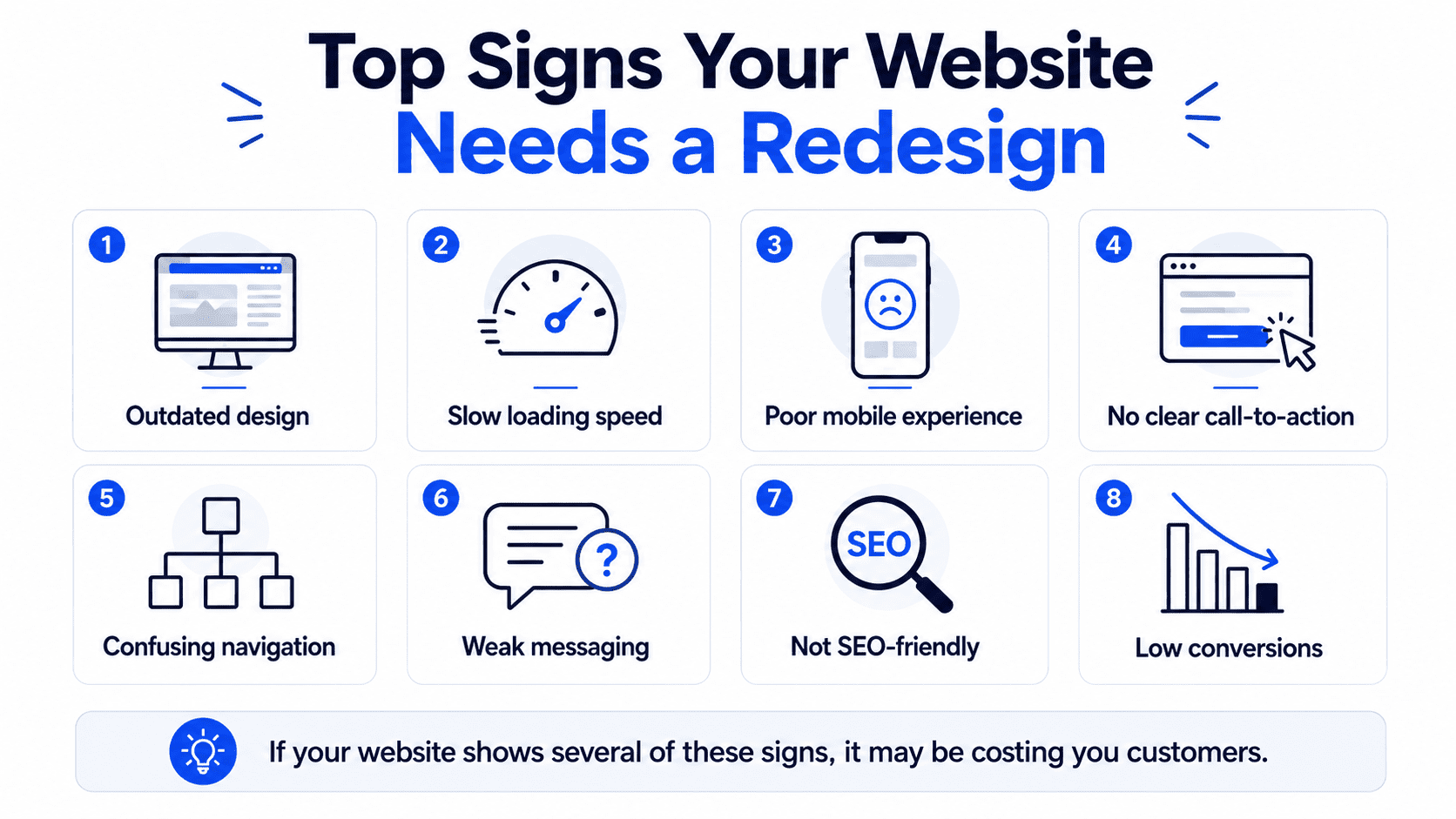
Website Redesign Priority Checklist
If you are planning a redesign, focus on the areas that affect conversions first.
High Priority
- Clear homepage headline
- Strong CTA buttons
- Mobile-friendly layout
- Fast loading speed
- Easy contact options
- Service pages
- Trust proof
- Working forms
- SEO basics
- Analytics tracking
Medium Priority
- Updated visuals
- Better page structure
- Improved FAQ section
- Blog layout
- Case studies
- Location pages
- Internal links
- Pricing guidance
Lower Priority
- Advanced animations
- Decorative graphics
- Complex effects
- Extra pages that do not support conversion
- Design trends that do not improve usability
The most important redesign question is not “Does it look modern?”
The better question is “Does it help visitors become customers?”
What a Better Redesigned Website Should Include
A redesigned small business website should include:
- Clear positioning
- Customer-focused copy
- Professional modern design
- Fast page speed
- Mobile-first layout
- Strong calls to action
- Service-specific pages
- Trust-building sections
- Helpful FAQs
- Simple contact forms
- Click-to-call or WhatsApp buttons
- Local SEO structure
- Analytics and conversion tracking
- Easy content management
- Clear customer journey
These elements help turn your website from a passive online brochure into an active business asset.
Final Thoughts
Your website may be costing you customers if it is unclear, outdated, slow, hard to use, or not designed to convert. A redesign is not only about making the website look better. It is about improving how the website supports your business.
A good website should help visitors quickly understand your offer, trust your business, and take action.
If your current website is not generating enquiries, not ranking, not converting, or not representing your business properly, it may be time to redesign it with a stronger strategy.
The goal is not to have the most beautiful website. Instead, the goal is to have a website that helps your business win more customers.