A small business website should not be built only to look good.
It should also be structured so search engines and potential customers can understand what your business offers. If your website has unclear pages, vague service descriptions, weak headings, and no internal links, it becomes harder for Google to understand your content. More importantly, it becomes harder for visitors to understand why they should contact you.
That is why SEO website structure matters.
For small businesses, SEO is not just about adding keywords into a page and hoping Google throws traffic at you out of pity. A good SEO structure helps organize your website around your services, locations, customer questions, and enquiry goals.
If you run a clinic, beauty salon, renovation company, consulting business, coaching service, tuition centre, agency, fitness studio, cleaning service, or local service business, your website should be built around how customers search and how they make decisions.
SEO Structure Starts With Business Clarity
Before thinking about keywords, you need to be clear about your business.
For SEO, keep the language natural and specific. Mention SEO website structure where it genuinely fits, then support it with related terms, service details, locations, buyer questions, and internal links so the page feels useful rather than forced.
A useful rule is to assign one main keyword theme to one page. Avoid making several pages compete for the same phrase. Instead, use supporting articles and service pages to answer related questions, then link them back to the most important conversion page.
Your Homepage Should Not Carry All the SEO Weight
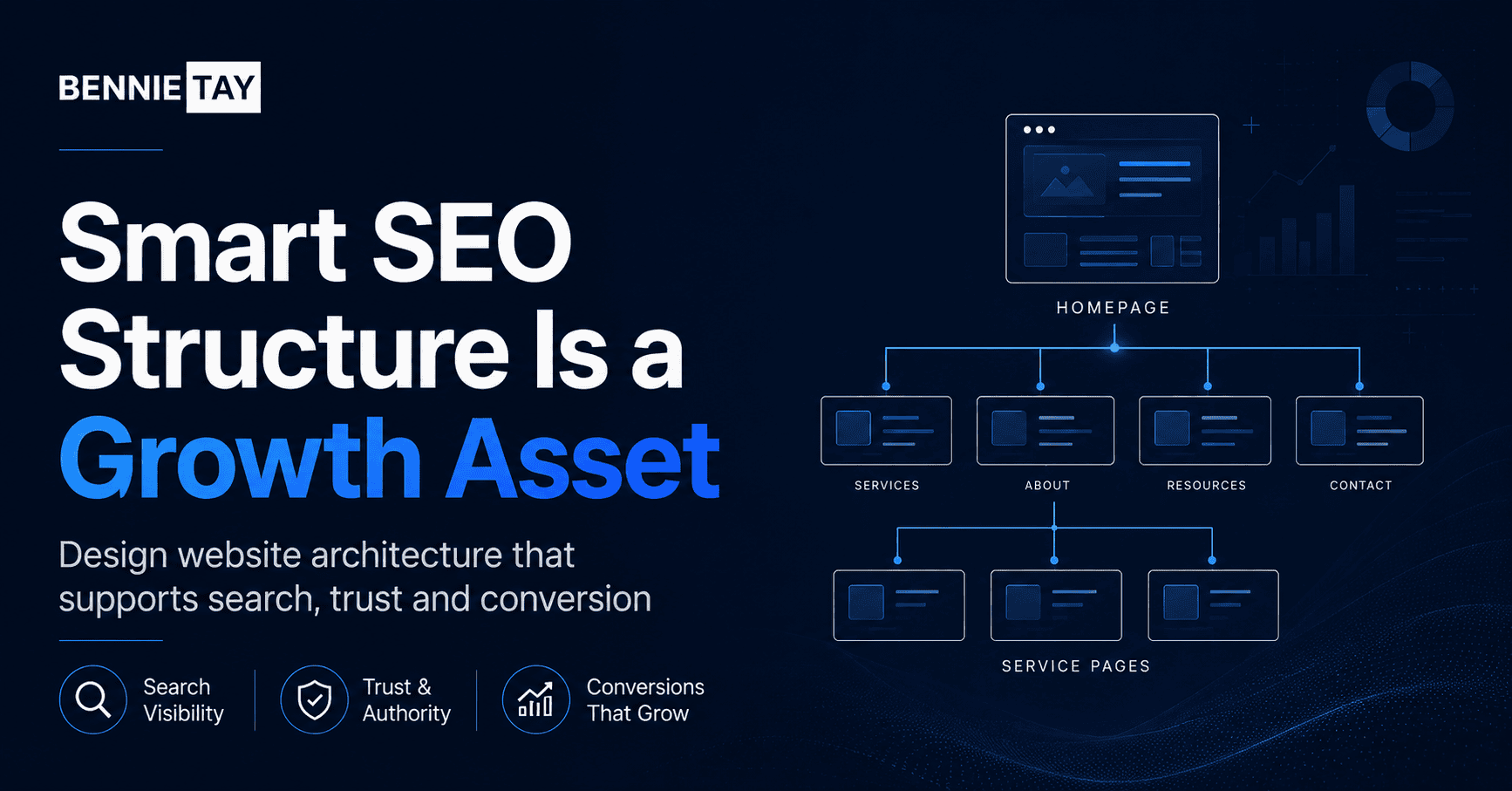
Many small businesses expect the homepage to rank for everything.
For SEO, keep the language natural and specific. Mention SEO website structure where it genuinely fits, then support it with related terms, service details, locations, buyer questions, and internal links so the page feels useful rather than forced.
A useful rule is to assign one main keyword theme to one page. Avoid making several pages compete for the same phrase. Instead, use supporting articles and service pages to answer related questions, then link them back to the most important conversion page.
Service Pages Are the Foundation of Small Business SEO
Service pages are some of the most important pages on a small business website.
For SEO, keep the language natural and specific. Mention SEO website structure where it genuinely fits, then support it with related terms, service details, locations, buyer questions, and internal links so the page feels useful rather than forced.
A useful rule is to assign one main keyword theme to one page. Avoid making several pages compete for the same phrase. Instead, use supporting articles and service pages to answer related questions, then link them back to the most important conversion page.
Location Pages Help Local Search Visibility
For local service businesses, location pages can be useful when they are done properly.
A strong page structure helps both people and search engines. Each page should have one clear purpose, a focused headline, supporting sections, internal links to related pages, and a next step that matches the visitor’s stage of decision-making.
For readability, keep each section focused. Use one idea per section, short paragraphs, direct headings, and clear transitions. Visitors should be able to scan the page and still understand what you do, who it is for, and why it matters.
Blog Posts Should Answer Buyer Questions
A blog is useful for SEO when it answers real questions your customers ask before they buy.
The goal is not to add more words for the sake of length. The goal is to answer the questions a serious buyer is already asking, remove uncertainty, and make the next step feel obvious, useful, and worth taking.
When writing this section, use concrete details instead of broad claims. Replace vague lines such as “we provide quality service” with details about the offer, timeline, deliverables, target customer, common problems solved, and what makes the experience easier for the buyer.
Keywords Should Match Page Intent
Keyword research is useful, but keywords should be matched to the right type of page.
For SEO, keep the language natural and specific. Mention SEO website structure where it genuinely fits, then support it with related terms, service details, locations, buyer questions, and internal links so the page feels useful rather than forced.
A useful rule is to assign one main keyword theme to one page. Avoid making several pages compete for the same phrase. Instead, use supporting articles and service pages to answer related questions, then link them back to the most important conversion page.
Internal Links Help Search Engines and Visitors
Internal links are links between pages on your own website.
The goal is not to add more words for the sake of length. The goal is to answer the questions a serious buyer is already asking, remove uncertainty, and make the next step feel obvious, useful, and worth taking.
When writing this section, use concrete details instead of broad claims. Replace vague lines such as “we provide quality service” with details about the offer, timeline, deliverables, target customer, common problems solved, and what makes the experience easier for the buyer.
Your Website Menu Should Support SEO and User Experience
Website navigation affects both users and search engines.
For SEO, keep the language natural and specific. Mention SEO website structure where it genuinely fits, then support it with related terms, service details, locations, buyer questions, and internal links so the page feels useful rather than forced.
A useful rule is to assign one main keyword theme to one page. Avoid making several pages compete for the same phrase. Instead, use supporting articles and service pages to answer related questions, then link them back to the most important conversion page.
FAQs Can Support SEO and Conversion
FAQ sections are useful because they answer common questions directly.
For SEO, keep the language natural and specific. Mention SEO website structure where it genuinely fits, then support it with related terms, service details, locations, buyer questions, and internal links so the page feels useful rather than forced.
A useful rule is to assign one main keyword theme to one page. Avoid making several pages compete for the same phrase. Instead, use supporting articles and service pages to answer related questions, then link them back to the most important conversion page.
Do Not Create Pages Just for SEO
It is tempting to create many pages in the hope of ranking for more keywords.
For SEO, keep the language natural and specific. Mention SEO website structure where it genuinely fits, then support it with related terms, service details, locations, buyer questions, and internal links so the page feels useful rather than forced.
A useful rule is to assign one main keyword theme to one page. Avoid making several pages compete for the same phrase. Instead, use supporting articles and service pages to answer related questions, then link them back to the most important conversion page.
SEO Structure Should Support Lead Generation
Small business SEO should not be measured only by traffic.
For SEO, keep the language natural and specific. Mention SEO website structure where it genuinely fits, then support it with related terms, service details, locations, buyer questions, and internal links so the page feels useful rather than forced.
A useful rule is to assign one main keyword theme to one page. Avoid making several pages compete for the same phrase. Instead, use supporting articles and service pages to answer related questions, then link them back to the most important conversion page.
A Simple SEO Structure for Small Businesses
A practical SEO website structure for a small service business can be simple.
For SEO, keep the language natural and specific. Mention SEO website structure where it genuinely fits, then support it with related terms, service details, locations, buyer questions, and internal links so the page feels useful rather than forced.
A useful rule is to assign one main keyword theme to one page. Avoid making several pages compete for the same phrase. Instead, use supporting articles and service pages to answer related questions, then link them back to the most important conversion page.
Final Thoughts
SEO website structure is not only about ranking on Google.
Use this as a practical checklist before redesigning or publishing the page. When the structure, copy, proof, and call-to-action are clear, the website becomes easier to rank, easier to read, and more likely to turn visitors into real enquiries.
Before publishing, read the page as if you were a new customer with limited time. If the promise, proof, process, and enquiry step are clear within a few minutes, the page is already doing more strategic work than most small business websites.