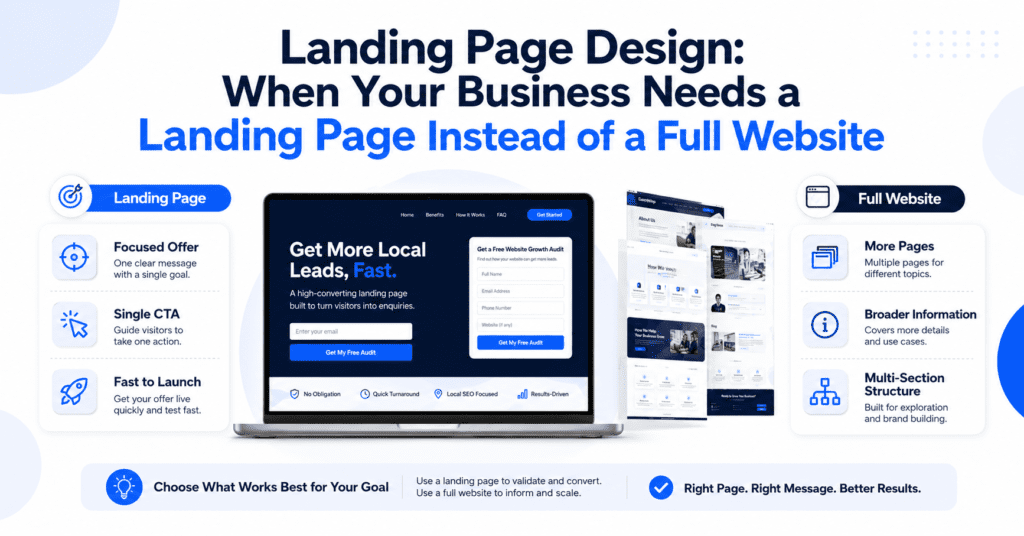
Many business owners assume they need a full website before they can start marketing online.
In many cases, a full website is useful. It gives your business a proper online presence, explains your services, builds trust, supports SEO, and gives customers a place to learn more about your company.
But not every situation needs a full website immediately.
Sometimes, what your business really needs is a focused landing page.
A landing page is a single web page built around one specific goal. That goal may be to get enquiries, collect leads, promote a service, sell an offer, book appointments, generate quote requests, or support an advertising campaign.
Unlike a normal website, a landing page does not try to explain everything about your business. It focuses on one audience, one offer, and one action.
This makes landing pages especially useful when you want to promote a specific service, test a new business idea, run paid ads, launch a campaign, offer a free consultation, or capture leads from social media.
A full website helps people explore your business. A landing page helps people take action.
Both are useful, but they serve different purposes.
This guide explains what landing page design is, when your business should use a landing page, how it compares with a full website, and what makes a landing page convert visitors into leads.
What Is a Landing Page?
A landing page is a focused page designed for a specific marketing goal.
It is usually where someone “lands” after clicking an ad, social media link, email link, search result, QR code, or campaign link. Instead of sending visitors to a general homepage, a landing page sends them to a page that matches the exact message they clicked.
For example, if a renovation company runs an ad for kitchen renovation, the visitor should land on a kitchen renovation page. If a consultant promotes a free strategy call, the visitor should land on a page about that specific call. If a clinic promotes a health screening package, the visitor should land on a page explaining that package and how to book.
This is different from a homepage.
A homepage usually introduces the whole business. It may include many services, company background, navigation links, blog links, contact details, and other general information.
A landing page is more focused. It removes distractions and guides the visitor toward one main action.
That action may be filling in a form, clicking a WhatsApp button, booking a call, requesting a quotation, downloading a guide, registering for an event, or purchasing an offer.
The best landing pages are clear, direct, and built around conversion.
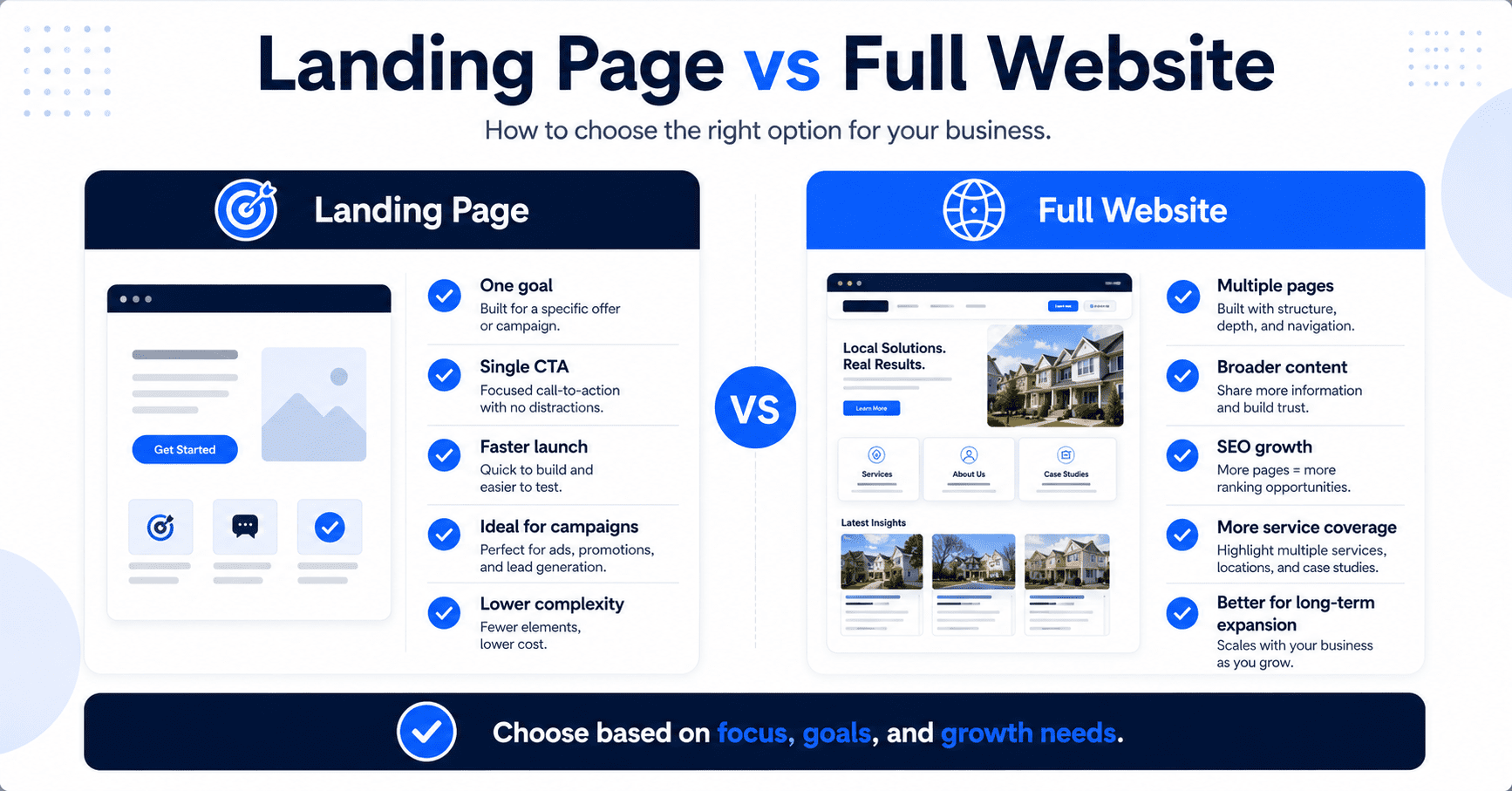
Landing Page vs Full Website
A full website is usually designed to represent your whole business. It may include a homepage, about page, service pages, portfolio, blog, contact page, FAQs, and other supporting pages.
This is useful when customers need to understand your business in more detail. A full website is also better for long-term SEO because each page can target different keywords and search intents.
A landing page is different because it is much narrower.
Instead of giving visitors many options, it focuses on one message and one next step.
This is why landing pages often work better for campaigns. When someone clicks an ad or promotion, they are usually interested in one specific offer. If you send them to a homepage with too many choices, they may get distracted or leave without taking action.
For example, a visitor who clicks an ad for “free website audit” should not land on a general homepage about all website services. They should land on a page that explains the free audit, who it is for, what they will receive, why it matters, and how to request it.
A full website is for broader trust and information. A landing page is for focused action.
Your business may need both. The website builds long-term credibility, while landing pages help convert specific campaigns.
When Your Business Should Use a Landing Page
A landing page is useful when you have one clear offer and want visitors to take one specific action.
This often happens when you are running ads. Paid traffic works better when the page matches the ad closely. If your ad talks about one service, your landing page should continue that same message. This helps visitors feel they are in the right place.
Landing pages are also useful for service promotions. If you are offering a limited-time package, consultation, trial session, audit, quote request, or special campaign, a landing page can present that offer clearly without changing your whole website.
A landing page is also useful when you are testing a new idea. Before building a complete website, you can create a simple page to see whether people are interested. This can help you validate an offer, collect leads, and understand customer demand before investing more.
For small businesses, landing pages can also support social media. If you post on Instagram, Facebook, LinkedIn, TikTok, Rednote, or Pinterest, you can direct interested people to a focused landing page instead of sending them to a general website.
This is especially useful when each campaign has a different audience. For example, one landing page can target clinic owners, another can target beauty salons, and another can target home service businesses.
A landing page gives you control over the message.
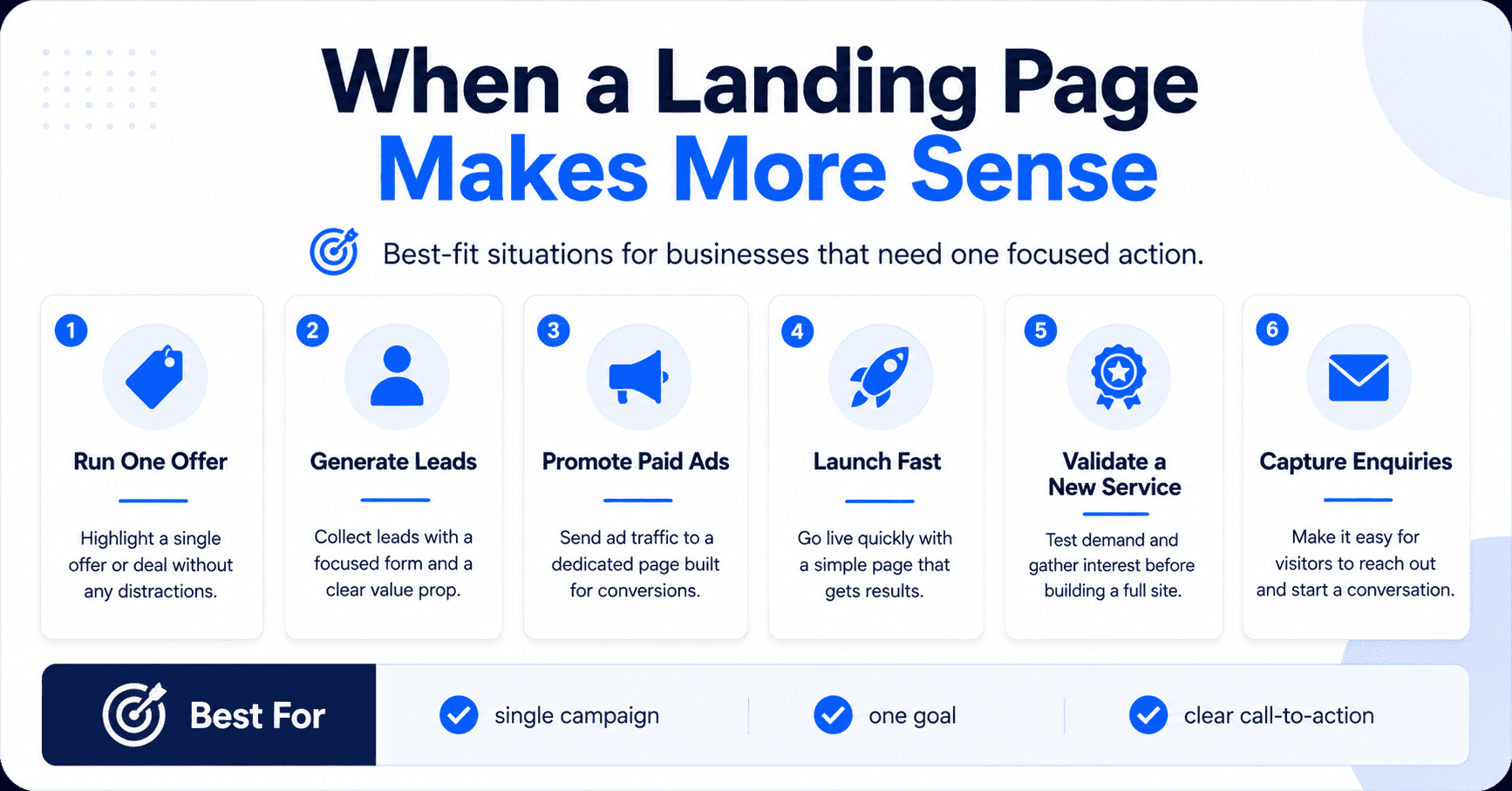
Why Landing Pages Often Convert Better Than Homepages
A homepage has many jobs.
It needs to introduce the business, explain services, build brand trust, show navigation, link to important pages, and support different types of visitors.
Because of this, a homepage can become too general for campaign traffic.
A landing page has one job.
It is built to move the visitor toward one clear action. This focus can improve conversion because the visitor is not distracted by too many links, too many services, or too many choices.
When people click a campaign, they usually have a specific expectation. If the landing page matches that expectation, they are more likely to continue reading. If the page feels unrelated or too general, they may leave.
For example, someone who clicks an ad about “monthly website plans” wants to learn about monthly website plans. If they land on a general web design homepage with many different services, the message may feel less relevant. But if they land on a page dedicated to monthly website plans, the page can answer their exact questions.
That is why message match is important.
The closer your landing page matches the visitor’s intent, the stronger the chance of conversion.
A Good Landing Page Starts With a Clear Offer
The first thing a landing page needs is a clear offer.
Visitors should quickly understand what you are offering, who it is for, and why it matters.
A weak landing page often begins with vague wording. It may say things like “Grow your business today” or “Professional solutions for your success.” These phrases sound positive, but they do not explain enough.
A stronger landing page is specific.
For example, instead of saying “Improve your online presence,” a website service provider could say, “Get a professional business website built to generate more enquiries without paying a large upfront fee.”
That message is clearer because it explains the outcome and the pain point.
The landing page headline should be direct. It should connect with the visitor’s problem or goal. The subheadline should expand the promise and give more context.
The page should not make visitors guess what the offer is.
If they cannot understand the offer within a few seconds, they may leave.
The Landing Page Should Focus on One Audience
A landing page works best when it is written for a specific audience.
Trying to speak to everyone usually makes the message weaker.
For example, a landing page for “business website design” can be general. But a landing page for “website design for clinics” can be much more specific. It can talk about appointment enquiries, doctor profiles, clinic location, patient trust, service pages, and local search visibility.
A landing page for “website design for beauty salons” can talk about treatment pages, booking buttons, customer reviews, service photos, and online bookings.
A landing page for “website design for renovation companies” can talk about project galleries, quote requests, service areas, before-and-after photos, and site visit enquiries.
The more specific the landing page, the easier it is for the visitor to feel understood.
This does not mean your business can only serve one type of customer. It means each landing page should focus on one customer segment at a time.
Specific landing pages usually perform better because the message feels more relevant.
The Page Structure Should Guide the Visitor
A landing page should be structured like a focused sales conversation.
It should not simply throw information onto the page randomly.
The first section should capture attention and explain the offer clearly. After that, the page should explain the problem, show why the offer matters, describe what is included, build trust, answer common questions, and guide visitors toward action.
This flow matters because visitors need different types of information before they convert.
Some visitors need to understand the value. Some need proof. Some need to know the process. Some need reassurance. Some need pricing guidance. Some need to know what happens after they submit the form.
A good landing page answers these concerns naturally.
For example, a landing page for a free website audit may explain what problems the audit checks, who it is suitable for, what the visitor will receive, how long it takes, and how to request it.
A landing page for a renovation quote may explain the type of renovation covered, previous project examples, quotation process, site visit options, and how to send project details.
A landing page should not only persuade. It should make the decision easier.
Your Call-to-Action Must Be Obvious
A landing page without a clear call-to-action will not perform well.
The call-to-action tells visitors what to do next. It may be “Request a Free Quote,” “Book a Consultation,” “Get a Website Audit,” “Download the Guide,” “Reserve Your Slot,” or “WhatsApp Us Now.”
The CTA should match the offer.
If the page is about quotation requests, use quote-related wording. If the page is about appointments, use booking-related wording. If the page is about a free audit, make the audit the action.
Avoid vague button text if the visitor needs direction. A button that says “Submit” is usually weaker than “Request My Free Audit” or “Send My Quote Request.”
The CTA should also appear more than once. Some visitors may be ready to take action immediately. Others may need to read more before deciding. Repeating the CTA naturally throughout the page gives them multiple chances to convert.
On mobile, the CTA should be easy to tap and easy to find.
A good landing page does not hide the next step.
Trust Is Important on Landing Pages
Many landing pages fail because they ask for action before building enough trust.
Visitors may be interested, but they still need confidence. They want to know whether the business is real, whether the offer is useful, whether other customers have had good experiences, and whether it is safe to submit their details.
Trust can be built in several ways.
Customer testimonials can help. Case studies can help. Before-and-after examples can help. Portfolio samples can help. Client logos, reviews, certifications, years of experience, founder background, process explanation, and clear contact details can also build confidence.
The type of trust element depends on the offer.
For a website audit landing page, sample audit points or examples of improvements may build trust. For a home service quote page, real project photos and reviews may be more important. For a consultant, case studies and client outcomes may be stronger. For a clinic or wellness business, professional profiles and service explanations may matter more.
A landing page should not only say “trust us.” It should give visitors reasons to trust you.
The more confidence the page creates, the easier it is for visitors to take action.
Forms Should Be Simple and Relevant
Forms are one of the most important parts of a lead generation landing page.
A form should collect enough information to start a useful conversation, but not so much that visitors feel tired before submitting it.
The right form length depends on the offer.
For a simple enquiry, you may only need name, contact number, email, and message. For a quote request, you may ask for service type, location, project details, and preferred contact method. For a website audit, you may ask for the website URL, business type, and main goal.
The form should feel easy to complete, especially on mobile.
Long forms can reduce submissions if the visitor does not yet trust you. If you need more information, you can collect it after the first enquiry.
It is also useful to explain what happens after submission. For example, you can say that your team will review the request and respond within a certain timeframe. This helps visitors feel more comfortable.
The goal of the form is not to collect everything. The goal is to start the right conversation.
Landing Pages Should Remove Distractions
A normal website often has a full navigation menu, many links, blog posts, multiple services, social icons, and several paths for the visitor to explore.
A landing page is different.
Because it has one main goal, it should reduce distractions. This does not mean the page must be empty or overly simple. It means every section should support the conversion goal.
If a landing page has too many unrelated links, visitors may wander away before taking action.
For example, if the goal is to get people to request a quote, the page should not distract them with unrelated blog articles, unrelated services, or too many menu options. The content should keep bringing them back to the offer and the CTA.
This is especially important for paid ads. When you pay for traffic, you want the visitor to stay focused on the campaign.
A focused page usually creates a stronger path to conversion.
Mobile Experience Can Make or Break a Landing Page
Many visitors will view your landing page from a phone.
This means mobile experience is not optional.
A landing page should load quickly, display clearly, and make action easy on mobile. The headline should be readable. The CTA button should be easy to tap. The form should be simple. The images should load quickly. The page should not feel crowded.
If the page is slow or difficult to use, visitors may leave before reading the offer.
This is especially important for traffic from social media and messaging apps. People clicking from mobile platforms usually expect a fast, smooth experience. They may not have the patience to wait for a heavy page to load.
A mobile landing page should also prioritise the most important information near the top. Visitors should quickly understand the offer and see the next step.
Good landing page design is not only about how it looks. It is about how easily people can act.
Landing Page Copywriting Matters
The words on your landing page are just as important as the design.
Good copywriting explains the offer clearly, connects with the visitor’s problem, builds interest, answers objections, and guides the visitor toward action.
Weak copy often sounds too generic. It talks about the business but not enough about the customer. It uses broad claims but does not explain specific value.
Strong landing page copy is customer-focused.
It should show that you understand what the visitor wants. It should explain why the offer matters. It should make the next step feel simple and low-risk.
For example, a landing page for a monthly website plan should not only say “We build websites.” It should explain that the business owner can get a professional website without paying a large upfront fee, without struggling with DIY tools, and with support included.
The copy should also handle objections. If visitors may worry about price, explain the pricing model. If they worry about time, explain the process. If they worry about quality, show examples. If they worry about commitment, explain the terms clearly.
Good copy makes the page feel more helpful and persuasive.
SEO Landing Pages vs Ad Landing Pages
Not all landing pages are the same.
Some landing pages are built mainly for paid ads. These pages are usually focused, direct, and conversion-driven. They may not need to rank on Google because traffic comes from advertising.
Other landing pages are built for SEO. These pages need to be useful, detailed, and keyword-focused so they can appear in search results. They often include more content, FAQs, service details, internal links, and helpful explanations.
For example, a landing page for “landing page design” may be created as an SEO page to attract people searching for that service. It needs enough content to answer search intent.
A campaign landing page for “free website audit” may be shorter and more direct because the visitor is coming from a specific CTA.
Both types can work, but the strategy is different.
An SEO landing page needs depth and structure. An ad landing page needs message match and conversion focus. Some pages can do both, but you need to plan carefully so the page does not become too long for campaign traffic or too thin for search engines.
The best approach depends on your traffic source.
When a Landing Page Is Better Than a Full Website
A landing page is better when you want to promote one specific offer.
If you are running a campaign, launching a new service, testing an idea, promoting a free consultation, collecting leads, or targeting one customer segment, a landing page may work better than a full website.
A landing page is also useful when speed matters. You may not have time to build a full website before launching a campaign. A focused page can help you start faster.
It is also useful when your business already has a website but needs a more focused page for ads or social media. Instead of changing your whole website, you can create a landing page for each offer.
For example, a business may have a main website but also create separate landing pages for free consultation, monthly website plans, clinic website design, salon website design, renovation website design, or website audit.
Each page can speak directly to a specific need.
This is where landing pages become powerful. They allow your marketing to become more targeted.
When a Full Website Is Better
A landing page is useful, but it does not fully replace a website in every situation.
A full website is better when your business needs to explain multiple services, build long-term SEO, show a larger portfolio, publish blog content, provide company background, and support different types of visitors.
If customers usually need more information before contacting you, a full website may be important.
For example, a business with multiple service lines should not rely only on one landing page forever. A consultant with several offers, a clinic with many treatments, a renovation company with multiple services, or an agency with different packages may need a full website to organise everything properly.
A full website also helps build stronger brand credibility. It gives your business a more complete online presence and allows visitors to explore at their own pace.
The best setup is often a full website supported by landing pages.
The website builds trust and long-term visibility. The landing pages support campaigns and specific conversion goals.
Common Landing Page Mistakes
One common mistake is sending all traffic to the homepage. This may be convenient, but it often reduces conversion because the homepage is too general.
Another mistake is having too many offers on one landing page. A landing page should not try to sell every service at once. If you have different offers, create different landing pages.
Some landing pages also fail because the headline is unclear. Visitors should not need to scroll halfway down the page to understand what the offer is.
Another mistake is asking for too much information too soon. A long form can discourage visitors, especially if the offer is simple.
Many landing pages also lack trust. They ask people to submit details without showing proof, testimonials, process, or examples.
A landing page can also fail if it is slow on mobile. This is especially damaging when traffic comes from ads or social media.
The best landing pages are simple, focused, credible, and easy to act on.
How to Know If Your Landing Page Is Working
A landing page should be measured by results, not only appearance.
The most important question is whether visitors are taking the action you want.
This may include form submissions, WhatsApp clicks, phone calls, booking requests, downloads, sign-ups, or purchases.
If your landing page gets traffic but few conversions, the issue may be the offer, headline, copy, trust, CTA, form, or mobile experience.
If people leave quickly, the page may not match what they expected when they clicked. If people scroll but do not submit, the form or CTA may need improvement. If people submit but the leads are low quality, the message may need to better qualify the audience.
Landing pages should be improved over time.
You can test different headlines, CTA wording, form length, proof sections, images, pricing explanations, and page structure.
A landing page is not just a design asset. It is a marketing tool that should be reviewed and improved based on performance.
Final Thoughts: A Landing Page Helps Turn Attention Into Action
A landing page is useful when your business wants visitors to take one clear action.
It is not meant to explain everything about your company. It is meant to focus attention, match the visitor’s intent, and guide them toward conversion.
For many businesses, landing pages are especially useful for ads, campaigns, service promotions, lead magnets, free consultations, quote requests, event registrations, and niche-specific offers.
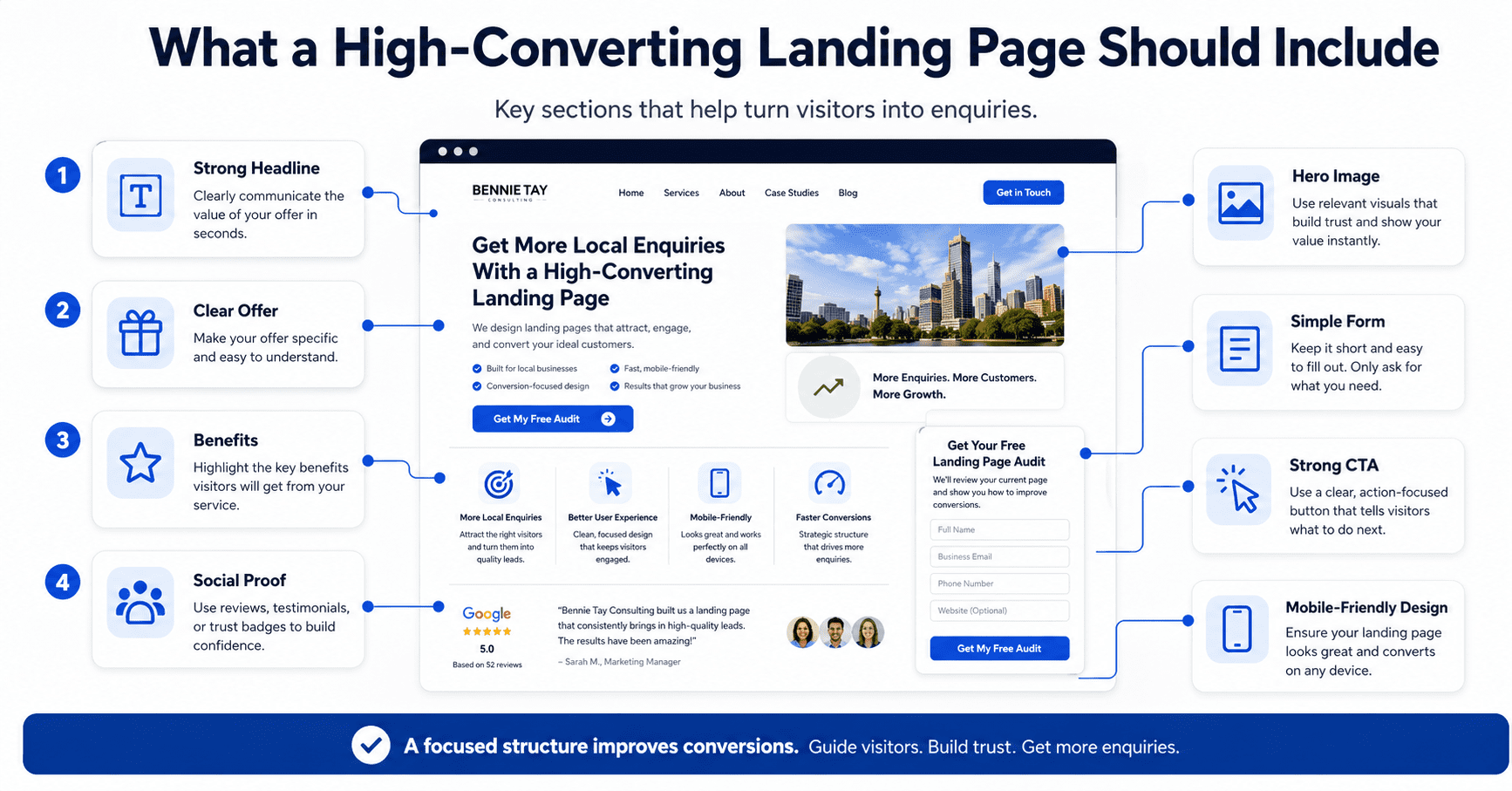
A good landing page has a clear message, strong offer, focused structure, visible CTA, trust elements, simple form, mobile-friendly design, and persuasive copy.
A full website helps build your overall online presence. A landing page helps convert specific traffic.
The strongest approach is often to use both.
Build a website that gives your business credibility, then create landing pages for each offer, campaign, or customer segment you want to target.
When done properly, a landing page can help your business turn clicks, views, and interest into real enquiries.
Need a Landing Page That Gets More Enquiries?
If you are running ads, promoting a service, launching an offer, or trying to collect leads, sending people to a general homepage may not be enough.
At Bennie Tay, we help businesses build conversion-focused landing pages designed to explain your offer clearly, build trust, and guide visitors toward action.
Whether you need a landing page for quote requests, consultations, bookings, audits, campaigns, or lead generation, the goal is simple:
Build a focused page that helps turn visitors into enquiries.
FAQ: Landing Page Design
What is landing page design?
Landing page design is the process of creating a focused web page built around one specific goal, such as collecting leads, getting quote requests, booking consultations, promoting a service, or supporting an ad campaign.
Is a landing page better than a website?
A landing page is better for one specific offer or campaign. A full website is better for explaining your whole business, supporting SEO, showing multiple services, and building long-term credibility.
What should a landing page include?
A landing page should include a clear headline, strong offer, explanation of the problem, benefits, trust elements, call-to-action, simple form or contact option, FAQs, and mobile-friendly design.
Why do landing pages convert better than homepages?
Landing pages often convert better because they are focused on one message and one action. Homepages usually have more links, services, and information, which can distract campaign visitors.
Do I need a landing page for ads?
Yes, a landing page is usually better for ads because it can match the exact message of the campaign. This helps visitors understand the offer quickly and take action.
Can a landing page rank on Google?
Yes, a landing page can rank on Google if it is built with enough useful content, proper keyword targeting, SEO structure, internal links, and search intent alignment.