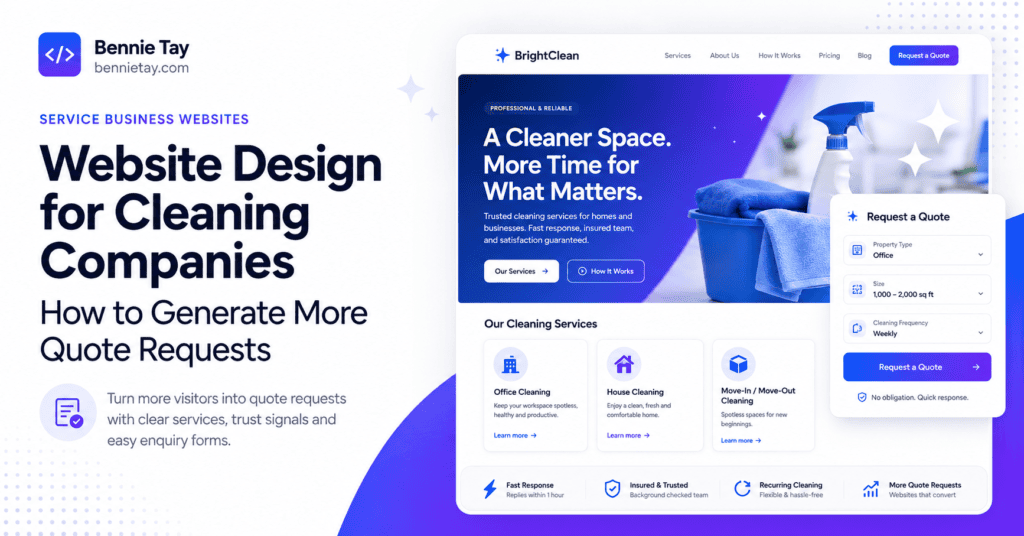
In brief: A cleaning company website should explain the services, locations, scope and pricing factors clearly, then make it easy to request a useful quotation. This guide covers the practical page structure, trust signals and contact options to plan. Examples below are illustrative, not customer results.
A potential customer searches:
- “office cleaning Petaling Jaya”
- “commercial cleaning Kuala Lumpur”
- “post renovation cleaning near me”
They may compare several websites before enquiring. Generic promises such as “professional cleaning you can trust” or “high-quality cleaning solutions” do little to explain which business is suitable. A useful website answers the questions that affect the buying decision.
Before asking someone to contact you, make these answers easy to find:
- Do you provide the cleaning service I need?
- Do you serve my location?
- What is included?
- How does pricing work?
- Can I trust your cleaners?
- How quickly can I get a quotation?
For cleaning businesses, the website should be built around local search, trust and quotation requests. The easier you make it for customers to understand the service and request an accurate quote, the more useful the website becomes as a sales tool. Here is how I would structure a cleaning company website in Malaysia.
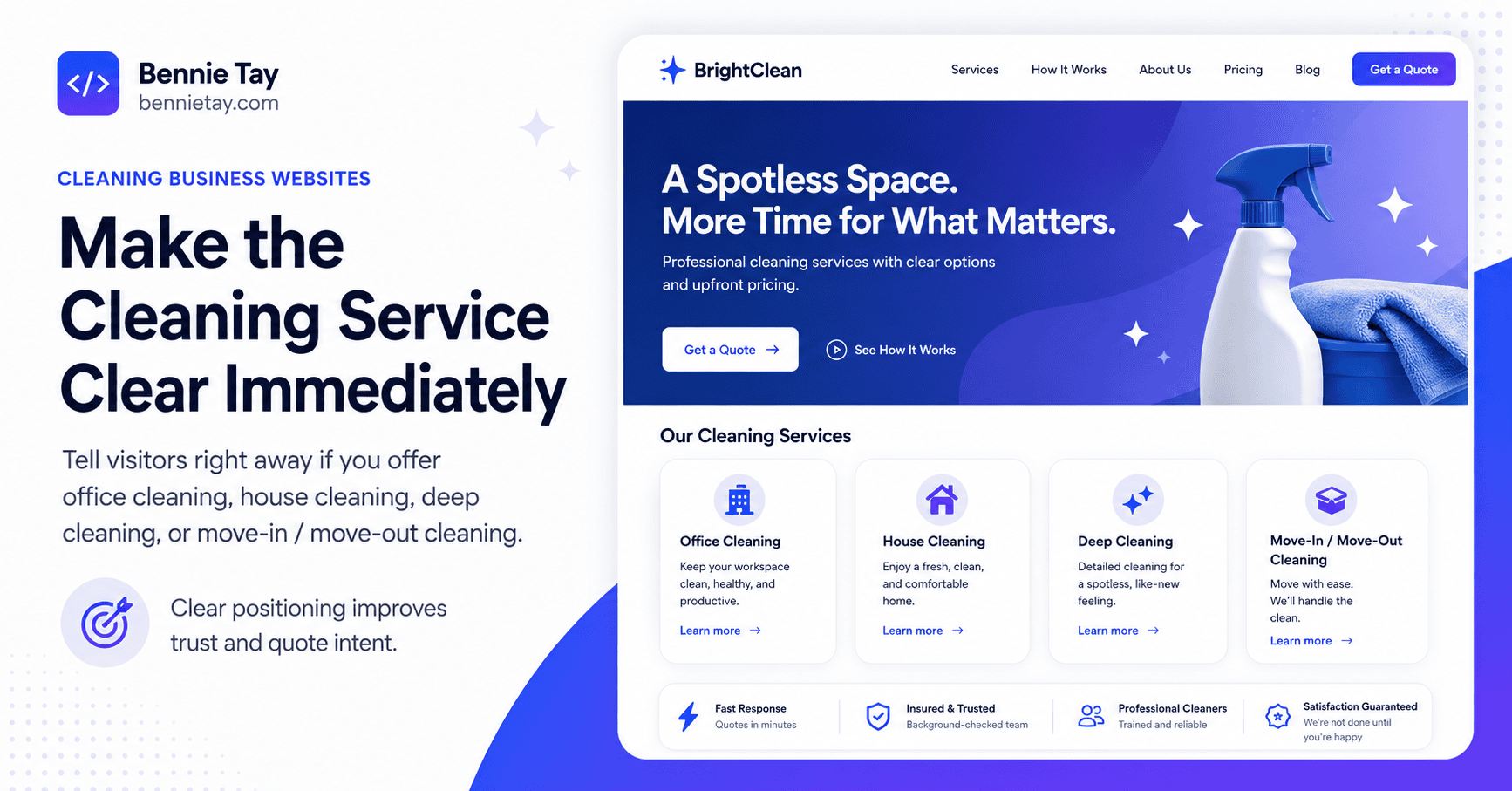
1. Make the Cleaning Service Clear Immediately
Your homepage should quickly explain what kind of cleaning you provide. For example:
Commercial Cleaning Services for Offices in Kuala Lumpur & Petaling Jaya
Or:
Home, Move-In & Post-Renovation Cleaning Across Klang Valley
This immediately communicates:
- service
- customer
- location
Compare that with:
Creating Cleaner Spaces for Better Living
Pleasant. But not particularly useful. The visitor should understand what you offer before they have to scroll.
2. Separate Your Main Cleaning Services
Do not place every service into one giant paragraph. Important services should have dedicated pages. For example:
- Office Cleaning
- Commercial Cleaning
- Post-Renovation Cleaning
- Move-In / Move-Out Cleaning
- Deep Cleaning
- Retail Cleaning
This makes the site easier for customers to navigate. It also gives each service enough room to explain:
- what is included
- who it is for
- process
- pricing
- FAQs
- quotation requirements
Someone searching for recurring office cleaning has very different needs from someone needing a one-time post-renovation clean. Treat them accordingly.
3. Explain Exactly What Is Included
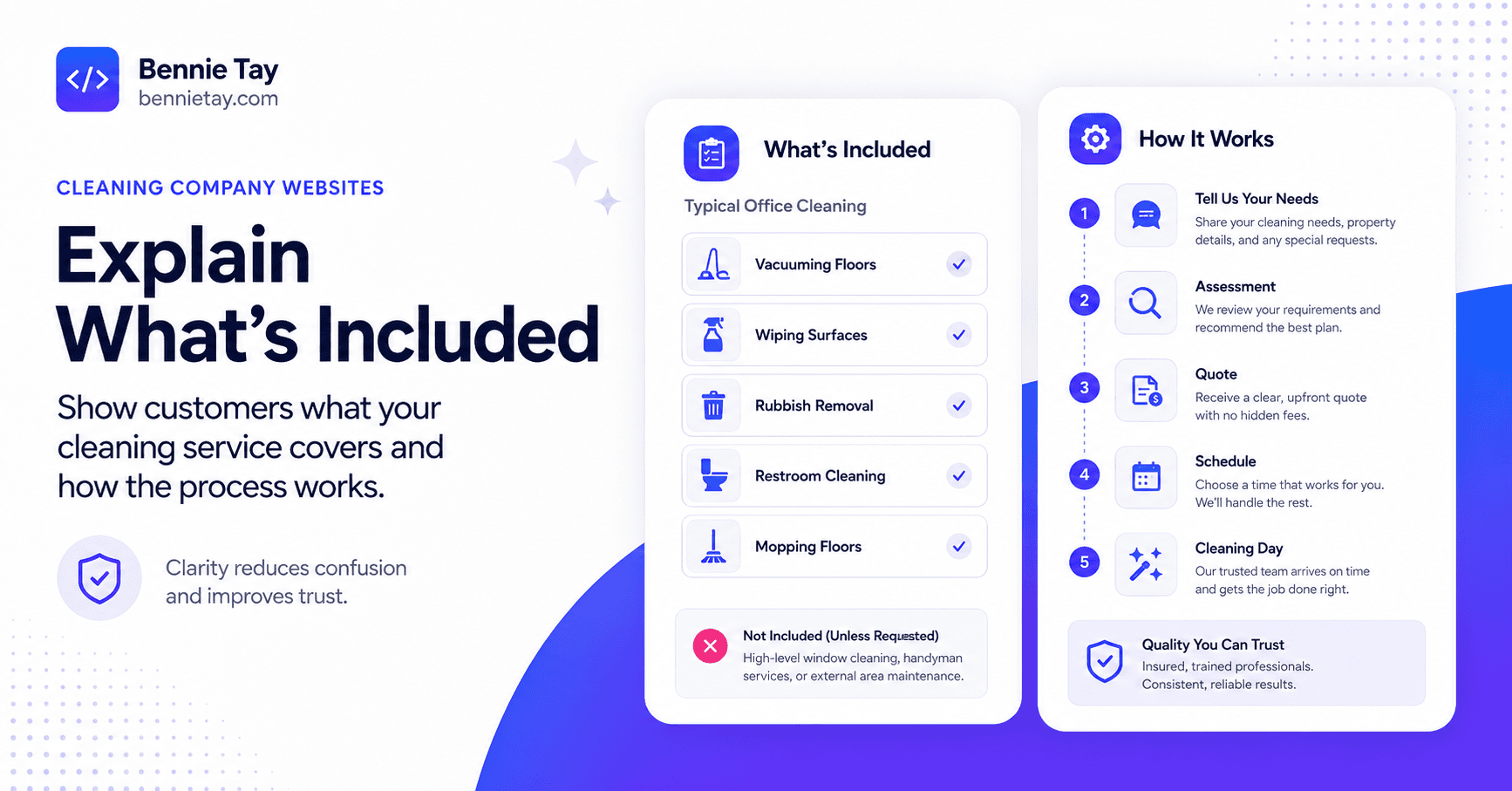
“Office cleaning” can mean different things to different customers. Spell out the scope. For example:
Typical Office Cleaning May Include
- Vacuuming and mopping floors
- Wiping accessible surfaces
- Pantry cleaning
- Washroom cleaning
- Bin emptying
- Common-area cleaning
Then clarify:
Exact scope depends on premises size, frequency and requirements.
This prevents customers from assuming services that are not included. It also makes quotations easier to compare. Specific scope builds trust.
4. Explain What Is Not Included
This is just as important. For example:
Standard office cleaning does not automatically include carpet extraction, high-level glass cleaning or specialist disinfection unless included in the quotation.
Clear exclusions reduce misunderstandings. They also prevent the delightful post-service conversation:
“But I thought this was included.”
Good website content can reduce operational friction before the job even starts.
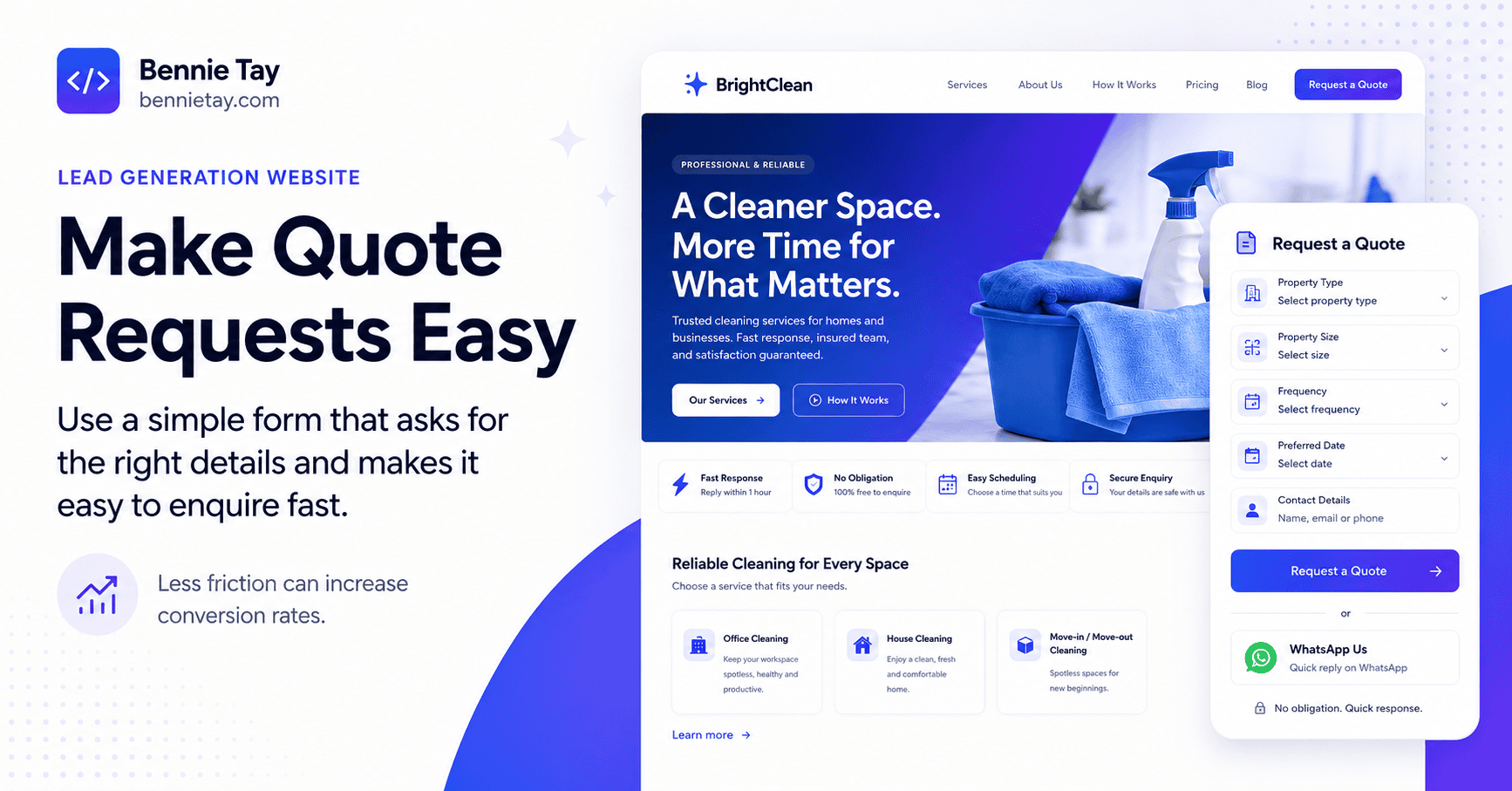
5. Make Quote Requests Easy
Cleaning businesses often need a little information before quoting. A useful quotation form might ask:
- Name
- Phone / WhatsApp
- Cleaning type
- Location
- Property type
- Approximate size
- Preferred date
- Frequency
- Brief requirements
Do not turn the form into a tender document. You need enough information to assess the job. Not enough to conduct a census. For simpler jobs, WhatsApp can work very well. Use a pre-filled message such as:
Hi, I’d like a cleaning quotation. Cleaning type: ____. Location: ____. Property size: ____.
This creates a much better lead than:
Price?
6. Ask for Property Size Early
For many cleaning services, size affects pricing significantly. Make it easy for customers to provide:
- square feet
- number of rooms
- number of floors
- office size
- property type
If they do not know the exact size, allow an approximate answer. For example:
Approximate Office Size
- Below 1,000 sq ft
- 1,000–3,000 sq ft
- 3,001–5,000 sq ft
- Above 5,000 sq ft
- Not sure
This helps qualification without creating unnecessary friction.
7. Show Pricing Guidance Where Possible
Cleaning customers often want to understand price early. If your services are relatively standardised, show:
- fixed package prices
- hourly rates
- starting prices
- ranges
For example:
One-Time Cleaning From RM___
Or:
Commercial cleaning is quoted based on premises size, cleaning frequency and required scope.
You can also explain what affects the price:
- floor area
- frequency
- manpower
- cleaning type
- equipment required
- timing
- location
Complete pricing secrecy often creates more low-quality WhatsApp enquiries, not better customers.
8. Explain Recurring vs One-Time Cleaning
These are different buying journeys. A customer looking for:
one-time move-out cleaning
wants speed and availability. A business looking for:
daily office cleaning
may need:
- site visit
- cleaning schedule
- manpower planning
- contract scope
- recurring quotation
Separate these clearly. For example:
One-Time Cleaning
Suitable for:
- moving
- post-renovation
- deep cleaning
CTA:
Check Availability
Recurring Commercial Cleaning
Suitable for:
- offices
- retail
- buildings
CTA:
Request a Site Assessment
This makes the next step much clearer.
9. Explain Your Cleaning Process
People want to know what happens after they enquire. A simple process might be:
Step 1: Tell Us What You Need
Share the property, location and cleaning requirements.
Step 2: Assessment
For larger or recurring jobs, we may arrange a site assessment.
Step 3: Quotation
You receive the recommended scope and pricing.
Step 4: Schedule
Confirm the cleaning date or recurring schedule.
Step 5: Cleaning
Our team completes the agreed scope. Simple. Clear. Customers can picture what working with you looks like.
10. Show Real Cleaning Photos
Cleaning is a highly visual service. Use photographs of:
- actual cleaners
- equipment
- office environments
- completed work
- before and after where appropriate
Real photographs demonstrate activity. Stock photos of impossibly cheerful people holding spray bottles can support the design, but they should not be your entire portfolio. Customers want evidence that the business actually performs the work.
11. Use Before-and-After Content Carefully
Before-and-after imagery can be very effective for:
- post-renovation cleaning
- deep cleaning
- floor cleaning
- specialised cleaning
Show genuine examples. Where possible, explain:
- cleaning type
- challenge
- work completed
For example:
Post-Renovation Cleaning – Petaling Jaya
Removal of construction dust from floors, cabinets, windows and accessible surfaces before handover.
This creates stronger proof than an anonymous before-and-after image.
12. Build Trust Around Your Cleaning Team
Customers may be allowing cleaners into:
- homes
- offices
- private rooms
- business premises
Trust matters. Explain the practices you genuinely follow. For example:
- staff training
- supervision
- uniformed team
- defined work procedures
- attendance processes
- customer support
If you have genuine background-checking or security processes, explain them accurately. Do not invent safety claims. Specific operational information creates confidence.
13. Show Customer Reviews
Cleaning services benefit strongly from reviews because customers care about:
- punctuality
- thoroughness
- responsiveness
- reliability
- professionalism
A useful review might say:
“We engaged the team for post-renovation cleaning before moving into our new office. They arrived on time, explained what was included and completed everything within the agreed schedule.”
That is much more persuasive than:
Five stars! Excellent!
Place reviews near the relevant service. An office-cleaning testimonial belongs on the office-cleaning page.
14. Create Case Studies for Commercial Clients
For B2B cleaning, short case studies can build considerable trust. For example:
Client
Professional services office in Petaling Jaya
Requirement
Recurring cleaning five days per week.
Challenge
Cleaning needed outside normal office hours.
Solution
Custom cleaning schedule with agreed scope for work areas, pantry, washrooms and common spaces.
Outcome
Reliable recurring service aligned with office operating hours. This helps business buyers understand that you can handle ongoing contracts.
15. Create Service Area Pages
Cleaning is highly local. If you genuinely serve important areas, create useful service-area pages. For example:
- Office Cleaning in Petaling Jaya
- Commercial Cleaning in Shah Alam
- Post-Renovation Cleaning in Subang Jaya
Each page should contain more than the city name. Add:
- services offered
- neighbourhoods served
- project examples
- cleaning process
- relevant testimonials
- quote CTA
This supports local search and makes it clear where you operate.
16. Make Location Coverage Easy to Understand
Customers should not have to ask:
Do you come to my area?
Show your main service coverage. For example:
We serve commercial and residential customers across Kuala Lumpur, Petaling Jaya, Subang Jaya, Shah Alam and selected surrounding Klang Valley areas.
If there are extra travel charges in certain locations, explain where relevant. Clear service coverage reduces wasted enquiries.
17. Build Pages for Commercial Niches
If you want larger B2B clients, consider pages for specific premises. For example:
- Office Cleaning
- Retail Cleaning
- Showroom Cleaning
- Education Centre Cleaning
- Industrial Office Cleaning
Only create pages where you genuinely provide the service. These pages can speak to industry-specific concerns. An office manager and a retail operator may require different:
- timing
- cleaning frequency
- scope
- access arrangements
Specificity improves lead quality.
18. Create Helpful Content Around Buying Questions
Cleaning companies have plenty of commercially relevant blog topics. For example:
- How Much Does Office Cleaning Cost in Malaysia?
- Daily vs Weekly Office Cleaning: Which Does Your Business Need?
- What Is Included in Post-Renovation Cleaning?
- How to Prepare Your Office Before a Deep Cleaning
- How Often Should Office Carpets Be Professionally Cleaned?
These topics attract customers during the research stage. They can then link naturally to your service pages. Good SEO content should help answer buying questions, not merely satisfy an editorial calendar.
19. Show Availability or Response Expectations
Customers often care about timing. If you can provide accurate expectations, show them. For example:
Quotations are normally responded to within one business day.
Or:
Weekend bookings are subject to availability.
Do not promise:
Same-day service guaranteed
unless you can reliably deliver it. Customers value clarity more than exaggerated speed claims.
20. Design for Mobile First
Many cleaning enquiries will come from mobile visitors. Make sure they can easily:
- call
- request quote
- upload or send photos
- check service areas
A useful mobile layout could include:
Request Quote
and:
as prominent CTAs. Keep the page light and fast. Cleaning customers generally did not arrive to admire advanced animation techniques. They arrived because something needs cleaning.
Recommended Cleaning Company Website Structure
A strong site might include:
Home
Positioning, trust and primary CTA.
Cleaning Services
Overview.
Office Cleaning
Dedicated commercial service.
Commercial Cleaning
Larger business requirements.
Deep Cleaning
One-time service.
Post-Renovation Cleaning
Dedicated high-intent page.
Move-In / Move-Out Cleaning
Where offered.
Areas We Serve
Local SEO coverage.
About
Company, team and process.
Projects / Case Studies
Proof.
Reviews
Customer feedback.
FAQ
Common questions.
Request a Quote
Simple enquiry journey.
Blog
Useful cleaning guides. This gives both customers and search engines a much clearer understanding of the business.
What Should the Homepage Include?
A good homepage structure might be:
Hero
Professional Office & Commercial Cleaning in Klang Valley
Flexible recurring and one-time cleaning services for offices and business premises.
Buttons:
- Request a Quote
- WhatsApp Us
Main Services
Show the most important options.
Why Choose Us
Use specific differentiators.
How It Works
Simple quotation process.
Service Areas
Show where you operate.
Customer Reviews
Real proof.
Recent Work
Photography or case studies.
FAQ
Answer buying questions.
Final CTA
Tell Us What You Need Cleaned →
The entire page should move the visitor toward one obvious outcome.
Common Cleaning Website Mistakes
Mistake 1: Only Saying “Professional Cleaning”
Explain what you actually clean.
Mistake 2: No Service Scope
Customers cannot compare quotations properly.
Mistake 3: No Pricing Guidance
Every enquiry becomes:
How much?
Mistake 4: Weak Trust Signals
Show reviews, real team and real work.
Mistake 5: No Local Information
Cleaning is location-dependent.
Mistake 6: Huge Contact Form
Keep the quotation process manageable.
Mistake 7: One Page for Every Service
Important services deserve proper pages.
More Quotes Are Not Always the Goal
Suppose your website gets:
100 WhatsApp enquiries
but most contain:
Price?
and disappear after receiving a quote. That is not necessarily good website performance. A better site can pre-qualify customers by clearly showing:
- services
- scope
- pricing guidance
- locations
- process
Then a lead might arrive saying:
Hi, we have a 4,000 sq ft office in Petaling Jaya and need cleaning three evenings per week. Can we arrange a site assessment?
That is a much more useful enquiry. Your website should help create better conversations, not simply more notifications.
Frequently Asked Questions
What should a cleaning company website include?
A strong cleaning website should include dedicated service pages, clear scope, service areas, customer reviews, real photos, pricing guidance, FAQs and an easy quotation process.
Should cleaning companies show prices?
If services can be priced consistently, fixed or starting prices can help. For variable commercial jobs, explain the factors that affect quotations and the assessment process.
Is WhatsApp useful for cleaning businesses?
Yes. WhatsApp can be particularly useful for fast enquiries and allowing customers to send photos or property details. For larger commercial jobs, a structured quotation form may be better as the primary CTA.
Do cleaning companies need local SEO?
Local SEO can be very important because customers often search for cleaning services by area or using “near me” queries.
Should I create a page for every city I serve?
Create pages only for meaningful areas you genuinely serve and where you can provide useful local content. Avoid large numbers of copied pages.
What is the best CTA for a cleaning website?
For many cleaning businesses, Request a Quote, Check Availability or Request a Site Assessment are clearer than a generic Contact Us.
Your Cleaning Website Should Make Quoting Easier
A cleaning website does not need to be complicated. It needs to be useful. Customers should quickly understand:
- what you clean
- where you operate
- what is included
- how pricing works
- why they can trust you
- how to request a quote
The stronger those answers are, the less work your sales team has to do before reaching the real conversation. At Bennie Studio, cleaning company websites are structured around local search, trust and simple quotation journeys rather than generic brochure pages. The goal is to turn searches into qualified cleaning enquiries, not merely website visits.
Explore Website Design for Local Service Businesses →
Getting cleaning enquiries but spending too much time answering the same basic questions before you can even prepare a quote?
For related guidance, see our home services website guide.