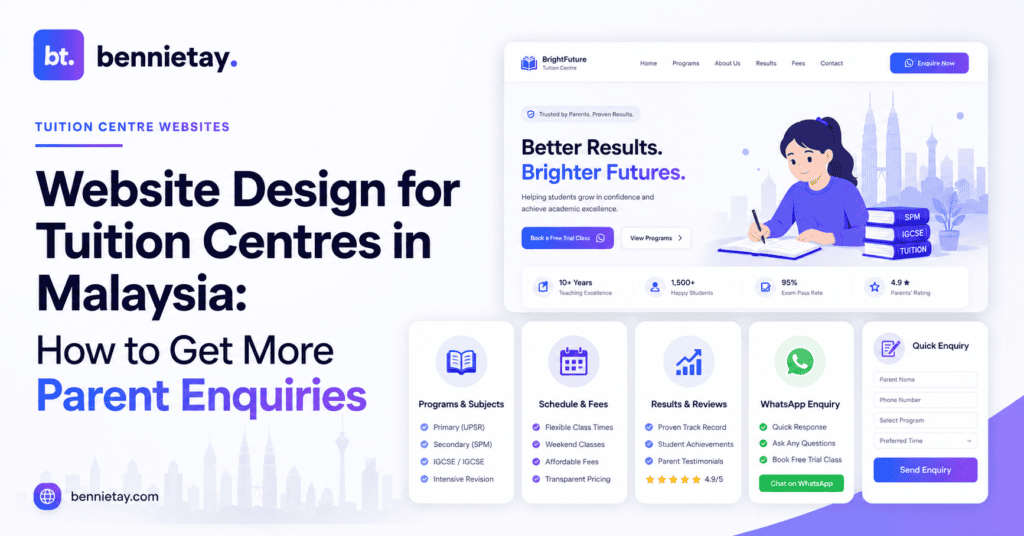
A parent searches Google for a tuition centre near their home. They open three websites.
The first takes too long to load and gives them a long story about the centre’s philosophy. The second looks modern but does not clearly show which subjects are available, who teaches them or when classes are held.
The third immediately tells them:
- which students the centre teaches
- what subjects are available
- where the centre is located
- who the tutors are
- how classes work
- how to book a trial class
There is also a clear WhatsApp button.
Which centre is more likely to receive the enquiry?
Probably the third one.
That is the real job of a tuition centre website in Malaysia.
It is not simply to prove that your tuition centre exists. It should help a parent move from:
“I am looking for tuition for my child”
to:
“This centre looks suitable. Let me contact them.”
Current Malaysian tuition-centre website examples increasingly structure the journey around programme information, parent trust, FAQs and simple WhatsApp or trial-class enquiries.
If your website is not helping parents make that decision, a prettier homepage alone will not solve the problem. Here is how I would structure a tuition centre website to generate more parent enquiries.
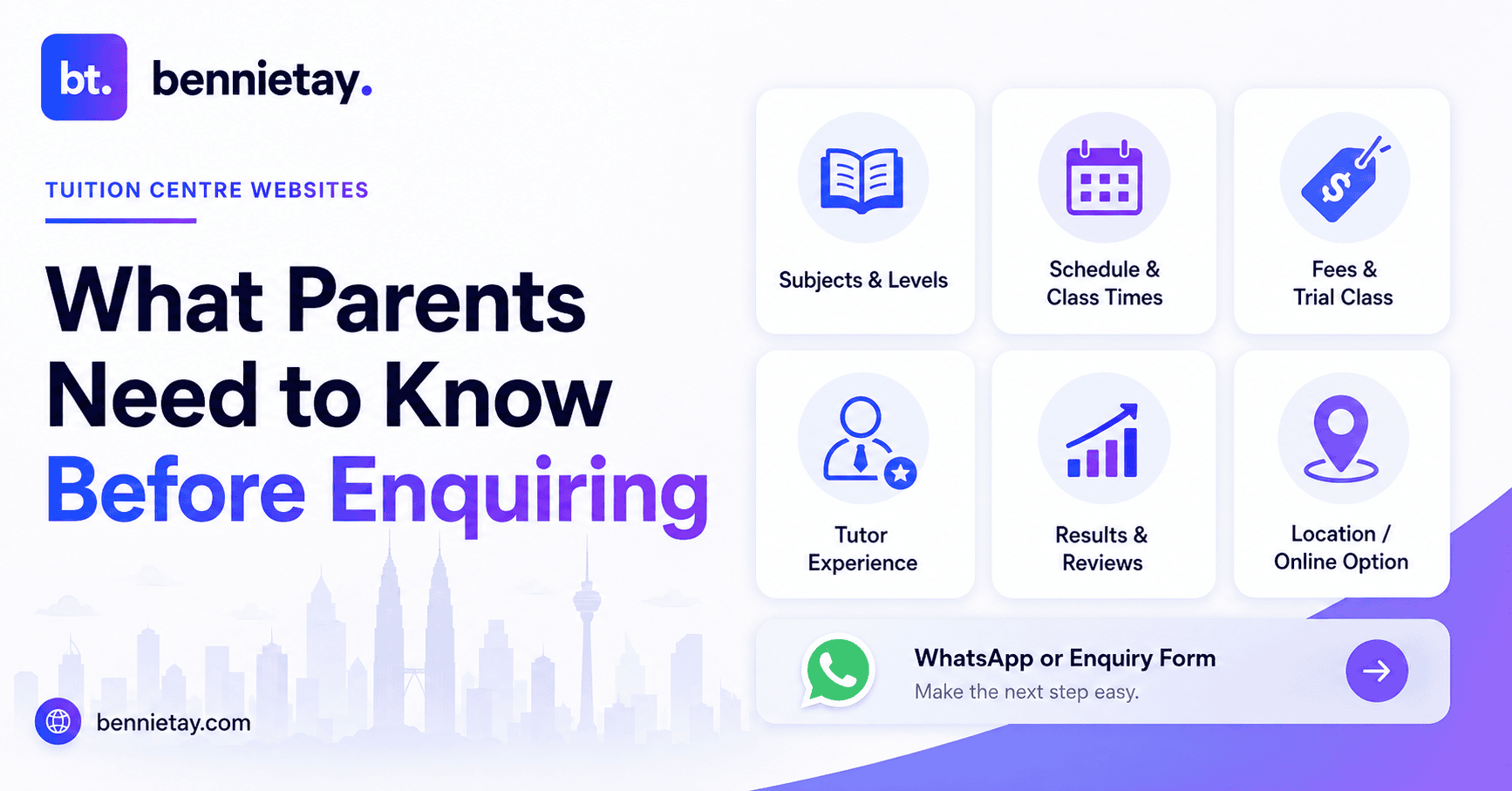
What Does a Parent Need to Know Before Enquiring?
Start with the parent’s questions rather than your website menu.
A parent considering tuition will usually want to understand things such as:
- Do you teach my child’s level?
- Do you offer the subject they need?
- Where are the classes?
- When are they held?
- Who will teach my child?
- What is your teaching approach?
- How much does it cost?
- Can my child try a class first?
- How do I contact you?
Your website should make these answers easy to find. A common mistake is designing a tuition website around the centre instead.
The homepage becomes:
About Us → Our Vision → Our Mission → Our History → Message From Founder
All of that may have a place. But it should not come before helping the parent decide whether you offer the right class.
Primary School
- Bahasa Melayu
- English
- Mathematics
- Science
Secondary School
- Mathematics
- Science
- English
- Bahasa Melayu
SPM
- Additional Mathematics
- Mathematics
- Physics
- Chemistry
- Biology
If you offer IGCSE, STPM, language classes or other programmes, create equally clear categories. For larger centres, I would consider creating dedicated pages for important programmes.
For example:
/spm-add-maths-tuition-pj/
or:
/igcse-chemistry-tuition-subang-jaya/
This gives you more space to explain the course and can also support local search. Current Malaysian tuition web-design examples use subject-and-level pages specifically to match what parents are searching for and help them compare suitable programmes.
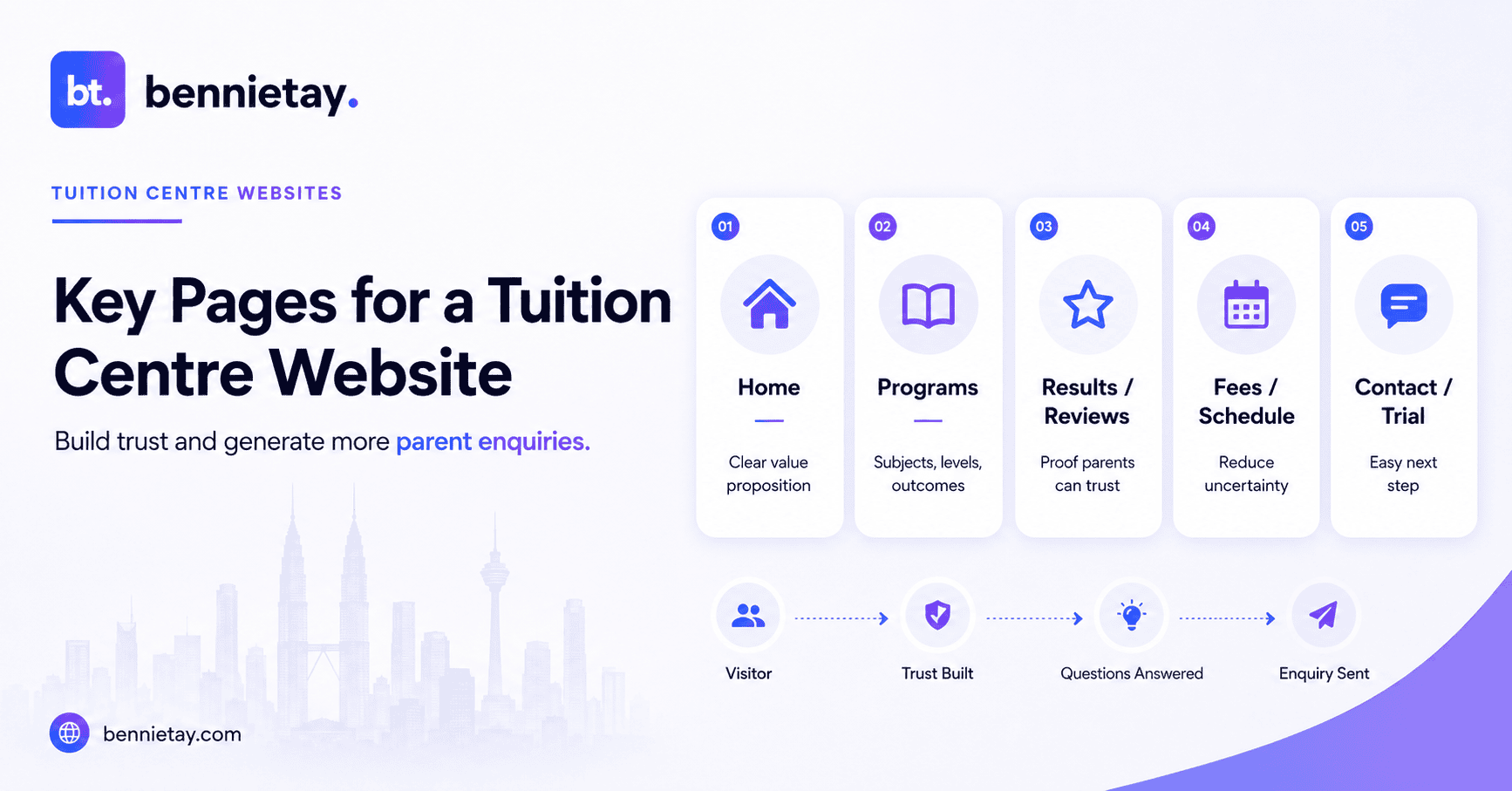
1. Hero
Who you teach + what you teach + location + CTA.
2. Programme Overview
Primary, secondary, SPM, IGCSE or other programmes.
3. Why Parents Choose the Centre
Specific differentiators.
4. Tutor Profiles
Show who teaches.
5. Teaching Approach
Explain how classes work.
6. Student/Parent Results and Testimonials
Build credibility.
7. Schedule or Fees
Reduce uncertainty.
8. Location
Map, address and branch information.
9. FAQ
Answer common parent questions.
10. Trial Class / WhatsApp CTA
Give the visitor a clear next step.
Notice what is not at the top:
A 700-word company history. That information can live on an About page. The homepage has a more urgent job.
Does a tuition centre really need a website?
A tuition centre can operate without one, especially if referrals and social media already generate students. However, a website gives parents one central place to verify your programmes, tutors, location, schedule, results and contact information before deciding whether to enquire.
Should a tuition centre website show prices?
If your fees are relatively straightforward, showing them can reduce uncertainty and repetitive enquiries. If pricing varies, provide a useful range or explain the factors involved rather than forcing parents to ask for every basic detail.
Should I use WhatsApp or an enquiry form?
For many tuition centres, both work well. WhatsApp is useful for quick questions, while a structured form can collect information such as student level, subject and preferred branch.
Can a tuition centre website help with Google SEO?
Yes, particularly when the website has useful pages for specific programmes and locations. For example, a centre in Petaling Jaya may create useful pages around its actual subjects, levels and location rather than relying only on a generic homepage.
What pages should a tuition centre website have?
A typical structure may include:
- Home
- Programmes
- Tutors
- About
- Results or Testimonials
- Locations
- FAQ
- Contact
Larger centres may also benefit from separate pages for important subjects, levels and branches.
How much does a tuition centre website cost in Malaysia?
The cost depends on the number of programmes, branches, custom design requirements, content, registration features and integrations required. A simple centre website can be relatively straightforward, while a multi-branch website with online registration, payment or learning systems will require a larger scope.
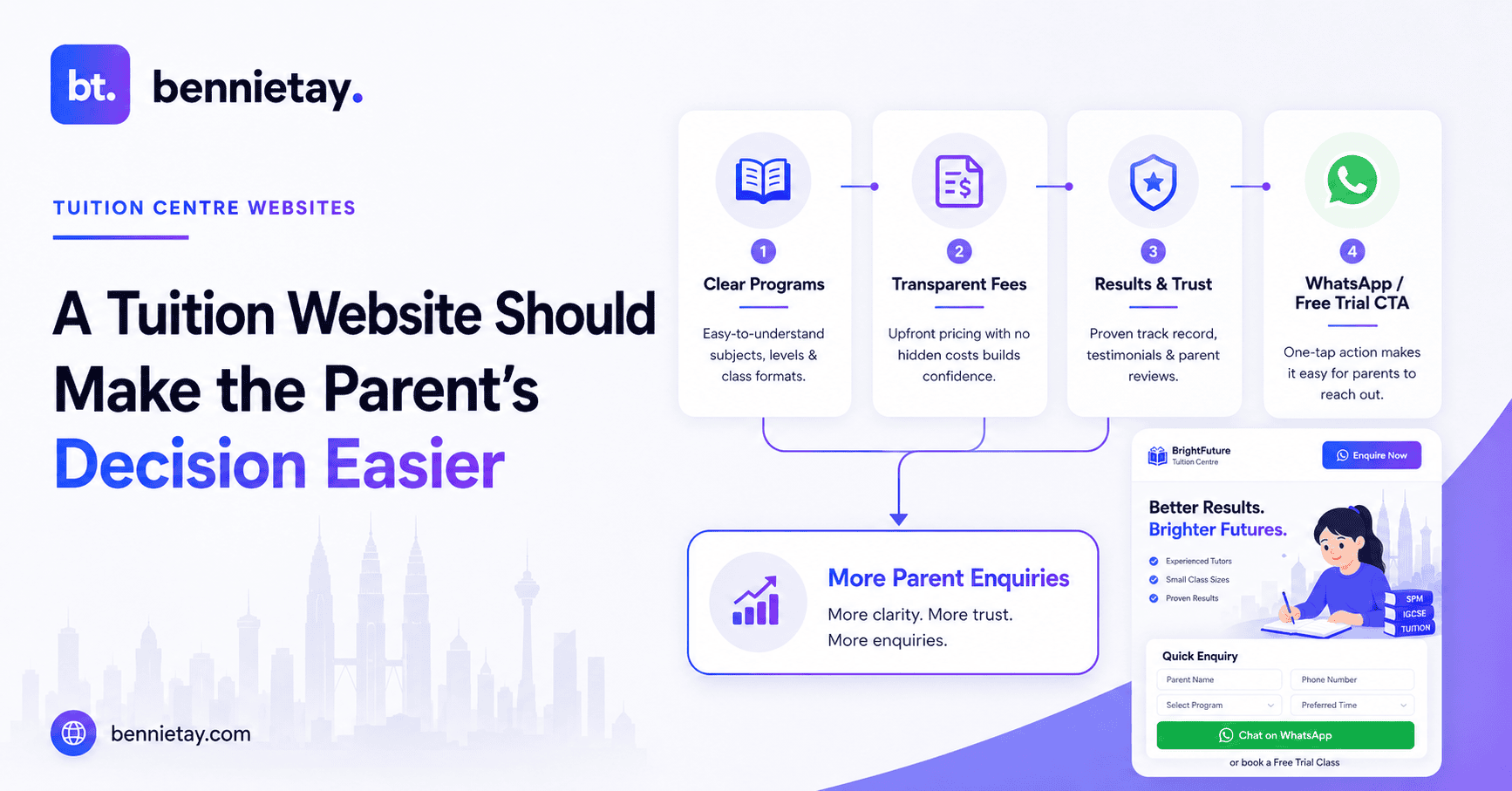
A Tuition Website Should Make the Parent’s Decision Easier
The best tuition centre website is not necessarily the one with the most animation, pages or educational buzzwords.
It is the one that answers the parent’s important questions clearly:
Do you teach what my child needs?
Can I trust you?
Will this work for our schedule?
What does it cost?
What should I do next?
Get those right and your website becomes more than an online brochure. It becomes part of your enrolment process.
At Bennie Studio, tuition and education websites are designed around the parent journey, from discovering the centre and understanding the programmes to building trust and making an enquiry.
The focus is not simply making the centre look professional. It is making it easier for the right parents to choose you.
Explore Website Design for Education Businesses →
Already have a tuition centre website but not getting enough enquiries?
Get a Free Website Growth Audit →