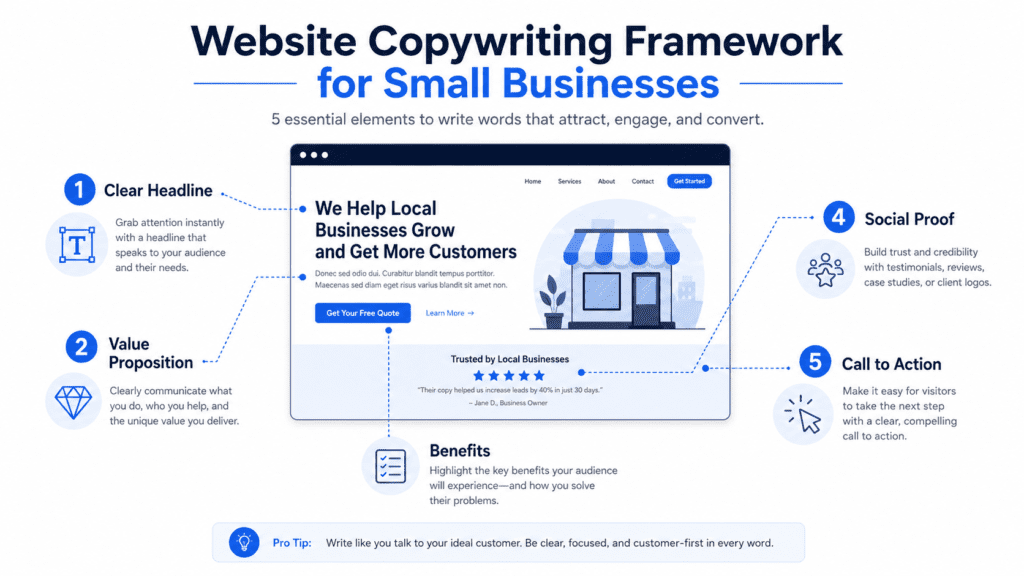
A small business website does not sell because it has beautiful design alone. Design gets attention. Copy turns attention into action. The words on your website explain what you offer, why it matters, why visitors should trust you, and what they should do next. If your website copy is unclear, generic, or too focused on your business instead of your customer, visitors may leave without calling, booking, requesting a quote, or buying.
Many small business websites fail because the copy sounds professional but says very little. Phrases like “quality solutions,” “trusted partner,” “customer-focused service,” and “we are passionate about excellence” may sound safe, but they rarely persuade anyone.
Good website copywriting is different.
It is clear, specific, customer-focused, and action-driven. It helps visitors understand the value of your offer quickly and gives them a reason to take the next step. This guide explains website copywriting for small businesses, including how to write homepage copy, service page copy, calls to action, headlines, benefits, FAQs, and SEO-friendly content that helps your website sell.
What Is Website Copywriting?
Website copywriting is the process of writing the words on your website to communicate clearly and persuade visitors to take action. It includes:
- Homepage headlines
- Service descriptions
- Calls to action
- About page copy
- Pricing page copy
- FAQ answers
- Contact page copy
- Landing page copy
- Blog introductions
- Product or service benefits
- Meta titles and descriptions
The goal of website copywriting is not just to fill space. The goal is to help visitors understand your business and feel confident enough to act. For a small business, that action may be:
- Requesting a quote
- Booking an appointment
- Sending a WhatsApp message
- Calling your business
- Filling out a contact form
- Downloading a guide
- Joining an email list
- Starting a free consultation
- Buying a product or service
Website copywriting is where your business message becomes clear enough for customers to care.
Why Website Copywriting Matters for Small Businesses
Small businesses often compete against larger brands, local competitors, freelancers, marketplaces, directories, and social media pages. Your website copy helps you stand out.
Good copy can help your small business:
- Explain your offer clearly
- Build trust faster
- Attract better-quality enquiries
- Improve website conversions
- Support SEO
- Reduce customer hesitation
- Make your services easier to understand
- Position your business professionally
- Guide visitors toward the next step
Bad copy does the opposite. It creates confusion, weakens trust, and makes visitors work too hard to understand why they should choose you. A website with weak copy may look nice but still fail to generate leads.
The Biggest Copywriting Mistake Small Businesses Make
The biggest mistake is writing from the business owner’s perspective instead of the customer’s perspective.
Many websites say things like: “We are a professional company committed to delivering high-quality services.”
That sentence is not terrible, but it is not very useful. It talks about the business, not the customer’s problem or desired outcome.
A stronger version would be: “Get a professional website that helps your small business look credible, explain your services clearly, and generate more enquiries.”
This version is stronger because it focuses on what the customer wants. Good website copy should answer the customer’s real questions:
- Can you solve my problem?
- Is this service right for me?
- Why should I trust you?
- What makes you different?
- What exactly do I get?
- How much does it cost?
- What happens next?
- How do I contact you?
Your website copy should make these answers obvious.
Start With Your Customer, Not Your Business
Before writing website copy, define who you are writing for. Do not write for “everyone.” That is how copy becomes vague, and vague copy is where conversions go to quietly disappear.
Ask:
- Who is my ideal customer?
- What problem are they trying to solve?
- What are they worried about?
- What result do they want?
- What have they tried before?
- What would make them trust me?
- What objections might stop them from enquiring?
- What words do they use to describe their problem?
For example, a small business owner may not say: “I need a digital presence optimization solution.”
They may say: “I need a professional website that makes my business look credible and helps me get enquiries.” Use the language your customers actually understand. Clear copy beats clever copy almost every time.
Write a Clear Value Proposition
Your value proposition is the main message that explains why someone should choose your business. It should appear near the top of your homepage.A strong value proposition explains:
- What you offer
- Who it is for
- What result it helps create
- Why it is different or valuable
Weak value proposition: “Professional Digital Solutions for Your Business”
Stronger value proposition: “Affordable Website Plans for Small Businesses That Need More Enquiries”
The second version is better because it is specific. It explains the offer, audience, and outcome.
Here are more examples:
Weak: “Your Trusted Cleaning Partner”
Stronger: “Reliable Home Cleaning Services for Busy Families in Kuala Lumpur”
Weak: “Helping Businesses Grow”
Stronger: “Sales Strategy Consulting for B2B Service Businesses That Need More Qualified Leads”
Weak: “Quality Accounting Services”
Stronger: “Simple Accounting and Tax Support for Small Business Owners Who Want Less Financial Stress”
A good value proposition should make visitors think: “This is for me.”
Write Headlines That Explain the Benefit
Headlines are one of the most important parts of website copywriting. Many visitors scan before they read. Your headlines need to make the page easy to understand. A strong headline should be clear, specific, and benefit-driven.
Instead of: “Our Services”
Use: “Website Services Designed to Help Small Businesses Get More Enquiries”
Instead of: “About Us”
Use: “Helping Small Businesses Launch Professional Websites Without the Usual Technical Stress”
Instead of: “Why Choose Us”
Use: “Why Small Businesses Choose Our Monthly Website Plans”
Good headlines help visitors understand the page even if they only skim.
Focus on Benefits, Not Just Features
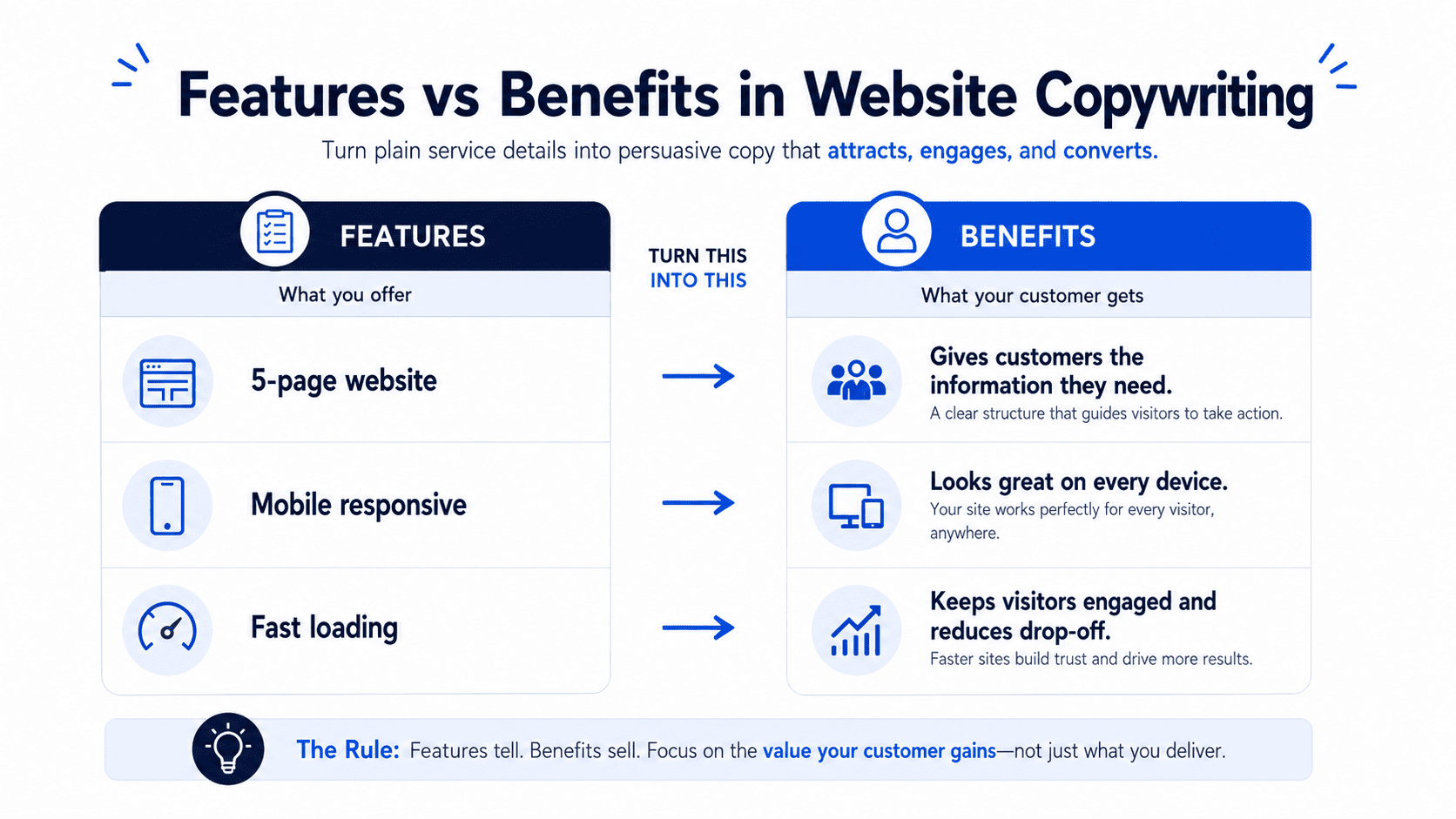
Features explain what is included. Benefits explain why it matters. Both are useful, but benefits are what sell.
Example for a website plan:
Feature: “Hosting included”
Benefit: “You do not need to manage a separate hosting account or worry about technical setup.”
Feature: “Mobile-friendly design”
Benefit: “Customers can easily browse your website and contact you from their phones.”
Feature: “SEO setup”
Benefit: “Your website has a stronger foundation to be found on Google.”
Feature: “Contact form”
Benefit: “Visitors can send enquiries directly from your website.”
A strong service page should include both features and benefits.
Features answer: “What do I get?”
Benefits answer: “Why should I care?”
And yes, customers care about the second one more. Cruel but predictable.
Use Customer-Focused Language
Website copy should speak to the customer. A simple way to improve your copy is to use more “you” language and less “we” language.
Business-focused copy: “We provide professional web design services with a focus on quality and customer satisfaction.”
Customer-focused copy: “You get a professional website that clearly explains your services, builds trust, and makes it easy for customers to contact you.”
The second version is more direct and more useful. This does not mean you should never talk about your business. It means your business details should connect back to the customer’s needs.
Instead of only saying: “We have 10 years of experience.”
Say: “With 10 years of experience, we know how to build websites that help service businesses explain their offer clearly and generate better enquiries.”
Experience matters more when visitors understand how it benefits them.
Make Your Offer Easy to Understand
A confused visitor does not become a customer. Your copy should explain your offer clearly. Avoid broad service labels without explanation. For example, if you offer website services, do not only say: “Web Design”
Explain the offer: “Professional website design for small businesses that need a clear, mobile-friendly website built to generate enquiries.”
If you offer a monthly website plan, explain what is included: “Our monthly website plan includes website design, hosting, maintenance, basic SEO setup, contact forms, and ongoing support in one predictable subscription.” A clear offer should answer:
- What is it?
- Who is it for?
- What is included?
- How does it work?
- What problem does it solve?
- What should visitors do next?
If people need to contact you just to understand the offer, your copy is doing unpaid leave.
Write Strong Calls to Action
A call to action, or CTA, tells visitors what to do next.
Weak CTAs are vague.
Examples:
- Submit
- Click Here
- Learn More
- Contact
- Read More
Stronger CTAs are specific.
Examples:
- Request a Free Quote
- Book a Free Consultation
- Send Us a WhatsApp Message
- Start Your Website Plan
- Schedule an Appointment
- Get a Free Website Audit
- View Website Packages
- Download the Free Checklist
Your CTA should match the visitor’s intent.
For a local service business: “Request a Free Quote”
For a consultant: “Book a Strategy Call”
For a website service: “View Website Plans”
For an appointment-based business: “Book an Appointment”
A good CTA reduces uncertainty. It tells visitors exactly what happens next.
Use Proof to Support Your Claims
Good copy does not only make claims. It proves them. Many small business websites say they are:
- Reliable
- Professional
- Experienced
- Affordable
- Customer-focused
- High quality
The problem is that everyone says this. Including businesses that are none of those things, because apparently the internet is not legally required to be useful. Support your claims with proof.
Proof can include:.
- Testimonials
- Reviews
- Case studies
- Portfolio examples
- Before-and-after results
- Client logos
- Certifications
- Awards
- Years of experience
- Number of customers served
- Screenshots
- Project examples
- Guarantees
Instead of saying: “We build high-quality websites.”
Say: “We have helped small businesses launch mobile-friendly websites with clearer service pages, stronger calls to action, and easier enquiry forms.”
Then support it with a testimonial or example. Proof makes your copy more believable.
Write Service Pages That Sell
Service pages are where many small business websites lose potential customers.A weak service page gives a short description and a contact button. But a strong service page explains the service clearly and guides visitors toward enquiry.
A good service page should include:
- Service-specific headline
- Problem the customer has
- How your service solves it
- What is included
- Benefits
- Who the service is for
- Process
- Pricing guidance
- Testimonials or proof
- FAQs
- Clear CTA
Example headline: “Monthly Website Plans for Small Businesses”
Supporting copy: “Get a professional website with design, hosting, maintenance, and support included, without paying a large upfront website cost.”
This immediately explains the offer and value. Each main service should have its own page if possible. This improves both SEO and conversion.
Write an About Page That Builds Trust
Your about page should not be only about you. That sounds strange, but it is true. Visitors read your about page to decide whether they can trust you.
A strong about page should include:
- Who you help
- What problem you solve
- Why your business exists
- Your experience
- Your approach
- Your values
- Proof or credentials
- A clear CTA
Weak about copy: “We are passionate about delivering quality services to our valued customers.”
Stronger about copy: “We help small businesses launch clear, professional websites that make their services easier to understand and easier to enquire about.”
Then you can add your background and story. The best about pages connect the business story to the customer’s needs.
Write Copy for Local SEO
If your small business serves a local area, your website copy should include location signals. This helps visitors and search engines understand where you operate.
Examples:
- “Website design for small businesses in Malaysia”
- “Cleaning services in Petaling Jaya”
- “Dental clinic in Subang Jaya”
- “Aircon repair services in Singapore”
- “Accounting support for small businesses in Kuala Lumpur”
Local SEO copy should sound natural. Do not stuff the same city name into every sentence like the page is having a geography emergency.
Use location details in:
- Page titles
- Headings
- Service descriptions
- Contact page
- Footer
- Location pages
- FAQ answers
- Meta descriptions
For local businesses, copy should make both the service and service area clear.
Use FAQs to Handle Objections
FAQs are powerful because they answer questions that may stop visitors from contacting you. Good FAQ copy should be direct and helpful. Common small business website FAQs include:
- How much does it cost?
- How long does it take?
- What is included?
- Do you offer support?
- Can I use my own domain?
- Do you serve my area?
- Can I request changes?
- What happens after I enquire?
- How do I get started?
- Is there a contract?
For example:
How long does it take to launch a website?
Most small business websites can be launched faster when the content, branding, and business details are ready. The timeline depends on the number of pages, required changes, and any custom features.
Is hosting included?
Yes, hosting can be included in a monthly website plan, so you do not need to manage a separate hosting account.
FAQs reduce friction and help visitors feel more confident. They also support SEO because people search using question-based phrases.
Write Meta Titles and Meta Descriptions
Website copywriting also includes SEO metadata. A meta title is the title that may appear in search results. A meta description is the short summary that may appear below it.
For example:
SEO title: “Monthly Website Plans for Small Businesses”
Meta description: “Launch a professional small business website with design, hosting, maintenance, and support included in one affordable monthly plan.”
Good metadata should be:
- Clear
- Keyword-focused
- Relevant to the page
- Written for humans
- Specific enough to attract clicks
Avoid stuffing keywords unnaturally. Search engines need clarity, but humans still need to want to click.
Make Your Copy Easy to Scan
Most visitors do not read every word at first. They scan. Your copy should be easy to skim before it asks people to read deeply.
Use:
- Clear headings
- Short paragraphs
- Bullet points
- Bold key ideas
- Simple section structure
- Benefit-led subheadings
- Specific CTAs
- White space
Avoid huge blocks of text. A wall of text on a website is not persuasive. It is a punishment with paragraph spacing. Small business website copy should feel clear, simple, and easy to follow.
Match Copy to the Customer Journey
Different visitors are at different stages. Some are just learning. Some are comparing options. Some are ready to buy. Your website copy should support all three stages.
Awareness Stage
The visitor is learning about a problem. Helpful content includes blog posts, checklists, guides, and problem-focused homepage sections
Example: “Why Most Small Business Websites Do Not Generate Leads”
Consideration Stage
The visitor is comparing solutions. Helpful content includes service pages, comparison articles, pricing guidance, and FAQs.
Example: “DIY Website Builder vs Done-for-You Website Plan”
Decision Stage
The visitor is close to enquiring. Helpful content includes testimonials, case studies, contact page, booking page, strong CTA and pricing page
Example: “Book a Free Website Consultation”
A website that supports the full customer journey can convert more visitors over time.
Common Website Copywriting Mistakes
Avoid these common mistakes:
- Writing vague headlines
- Talking too much about the business
- Not explaining the customer problem
- Listing features without benefits
- Using generic claims without proof
- Hiding the CTA
- Using weak CTA wording
- Writing long paragraphs
- Ignoring SEO
- Not including location keywords
- Making the offer hard to understand
- Using too much jargon
- Not answering common questions
- Forgetting mobile readers
- Having no pricing guidance
- Publishing service pages that are too thin
Most copy problems come from a lack of clarity. If visitors cannot quickly understand your value, they will not take action.
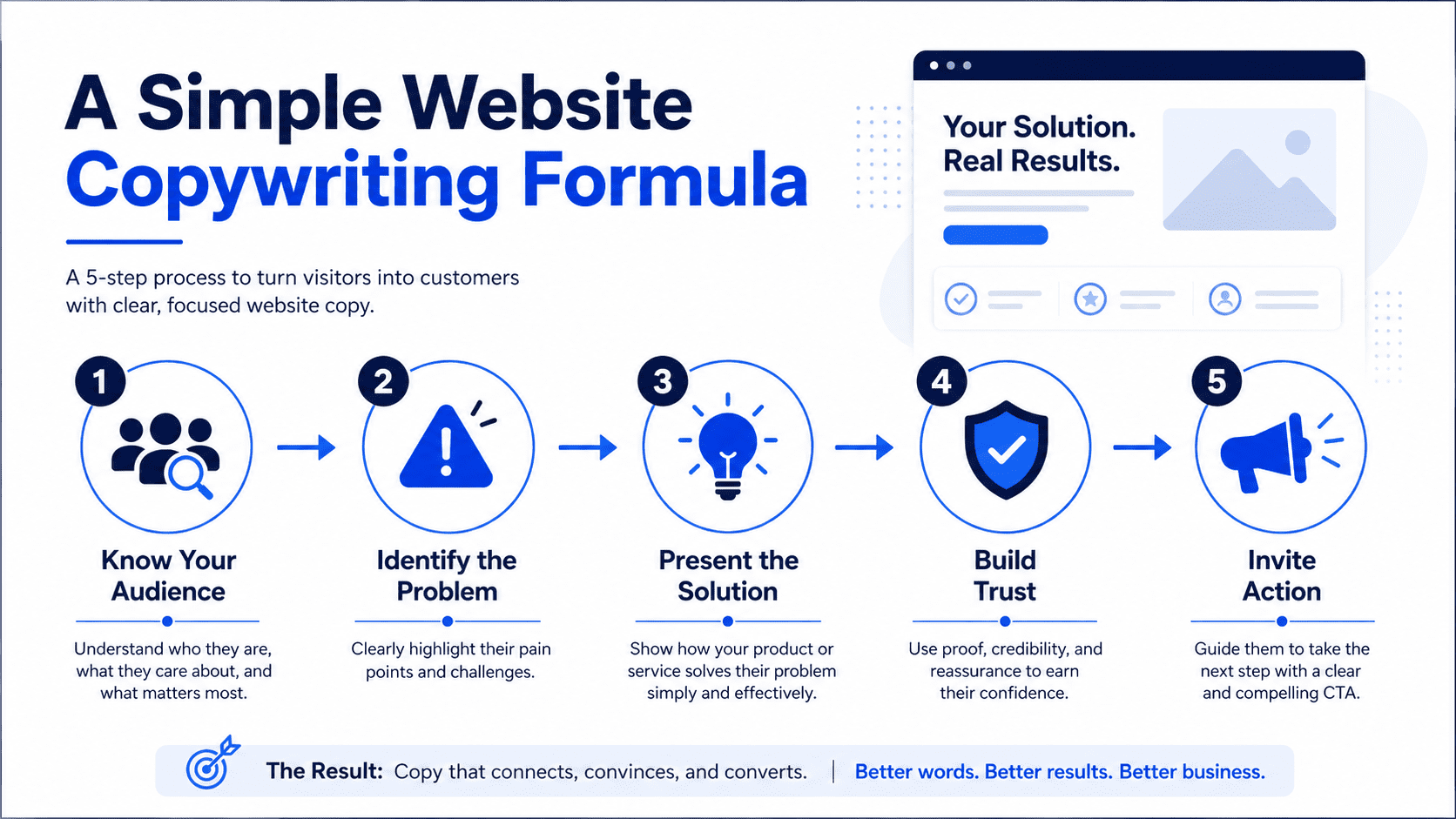
Simple Website Copywriting Formula
Use this simple formula for important website sections:
- Problem: What is the customer struggling with?
- Solution: How does your service solve it?
- Benefit: What outcome does the customer get?
- Proof: Why should they believe you?
- Action: What should they do next?
For example: “Many small businesses have websites that look fine but do not generate enquiries. Our monthly website plans give you a professional, mobile-friendly website with hosting, maintenance, and support included. You get a clearer online presence without paying thousands upfront. See our website plans or book a free consultation today.”
This structure works because it follows the customer’s decision-making process.
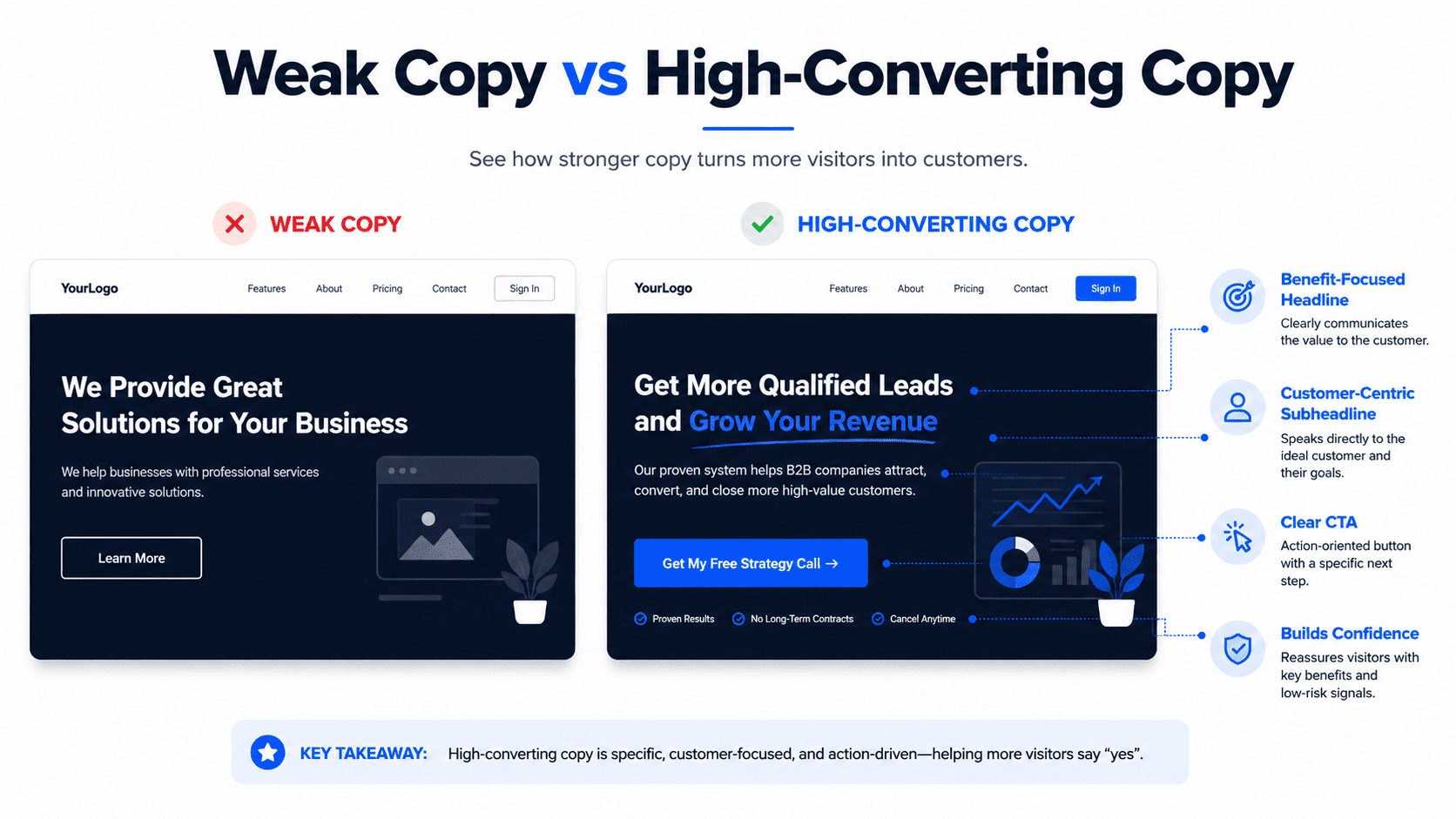
Example Website Copy Before and After
Before:
“We are a professional web design company providing quality website solutions for businesses of all sizes. Contact us today to learn more.”
After
“Launch a professional website that helps your small business look credible, explain your services clearly, and generate more enquiries. Our monthly website plans include design, hosting, maintenance, and support, so you can focus on running your business.”
The second version is better because it is specific, benefit-focused, and easier to understand.
Before
“Our cleaning services are high quality and reliable.”
After
“Keep your home clean without losing your weekends. Our reliable home cleaning service helps busy families save time with scheduled cleaning, clear pricing, and easy booking.”
The second version connects the service to the customer’s real life.
Homepage Copywriting Checklist
Use this checklist to review your homepage copy:
- Does the headline clearly explain what you offer?
- Does it say who the service is for?
- Does it explain the main benefit?
- Is there a clear CTA?
- Does the page describe the customer’s problem?
- Does the copy explain your solution clearly?
- Are benefits included, not just features?
- Is there trust proof?
- Are your services easy to understand?
- Do you explain why customers should choose you?
- Is pricing guidance included if relevant?
- Are common questions answered?
- Is the copy easy to scan?
- Are keywords used naturally?
- Is the tone clear and human?
- Does every section guide visitors toward action?
If your homepage copy fails several of these points, it may be costing you enquiries.
Service Page Copywriting Checklist
Use this checklist for each service page:
- Is the service name clear?
- Does the headline include the main keyword?
- Does the page explain who the service is for?
- Does it describe the customer problem?
- Does it explain what is included?
- Does it explain the benefits?
- Does it include proof or testimonials?
- Does it show the process?
- Does it provide pricing guidance?
- Does it answer FAQs?
- Does it include a strong CTA?
- Does it link to related pages?
- Is the page specific enough to rank for search?
A good service page should feel like a helpful sales conversation, not a thin description written five minutes before launch.
Final Thoughts
Website copywriting for small businesses is about clarity, trust, and action. The words on your website should help visitors understand what you offer, why it matters, why they should trust you, and what they should do next.
Good copy does not need to be clever. It needs to be clear.
Focus on your customer’s problem, explain your solution simply, show the benefits, support your claims with proof, and use strong calls to action. When your website copy is written well, your website becomes more than an online brochure. It becomes a sales tool that helps turn visitors into enquiries, bookings, calls, and customers.