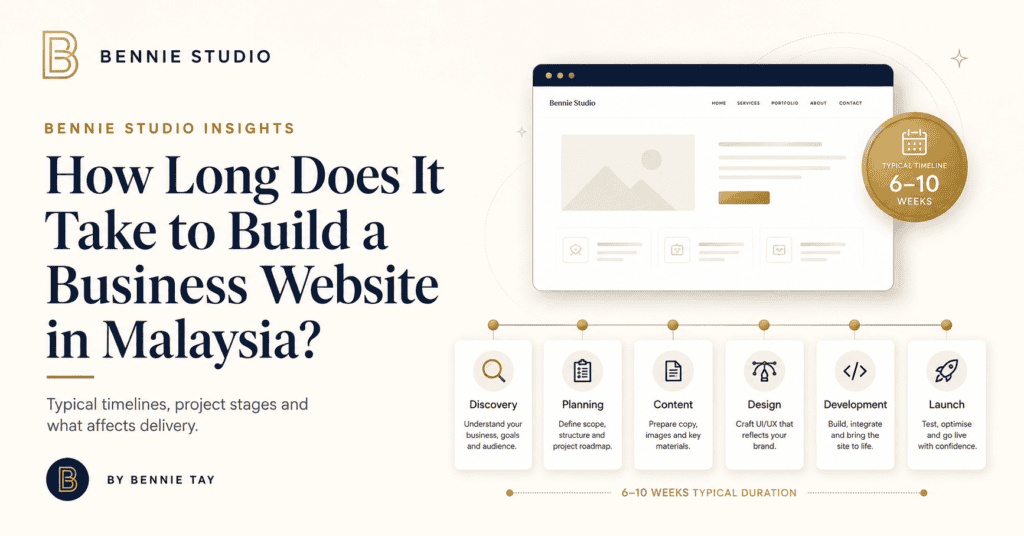
You have decided your business needs a new website. Now comes the next question: How long will it take?
One web designer says two weeks. Another says six weeks. An agency says three months. Someone on Facebook claims they can finish everything in three days. Who is right? Potentially, all of them.
The time required to build a business website depends on what is actually being built, how prepared the business is, how much custom work is required and how quickly decisions are made during the project. A simple five-page website using an existing design system can be completed relatively quickly.
A custom website involving strategy, copywriting, multiple services, integrations, SEO, content migration and several decision-makers can take considerably longer. So instead of asking only: “How many days does a website take?”
a better question is: “What needs to happen between starting the project and launching it properly?”
Here is a realistic guide for Malaysian SMEs planning a new business website.
Quick Answer: How Long Does a Business Website Take?
As a practical planning guide:
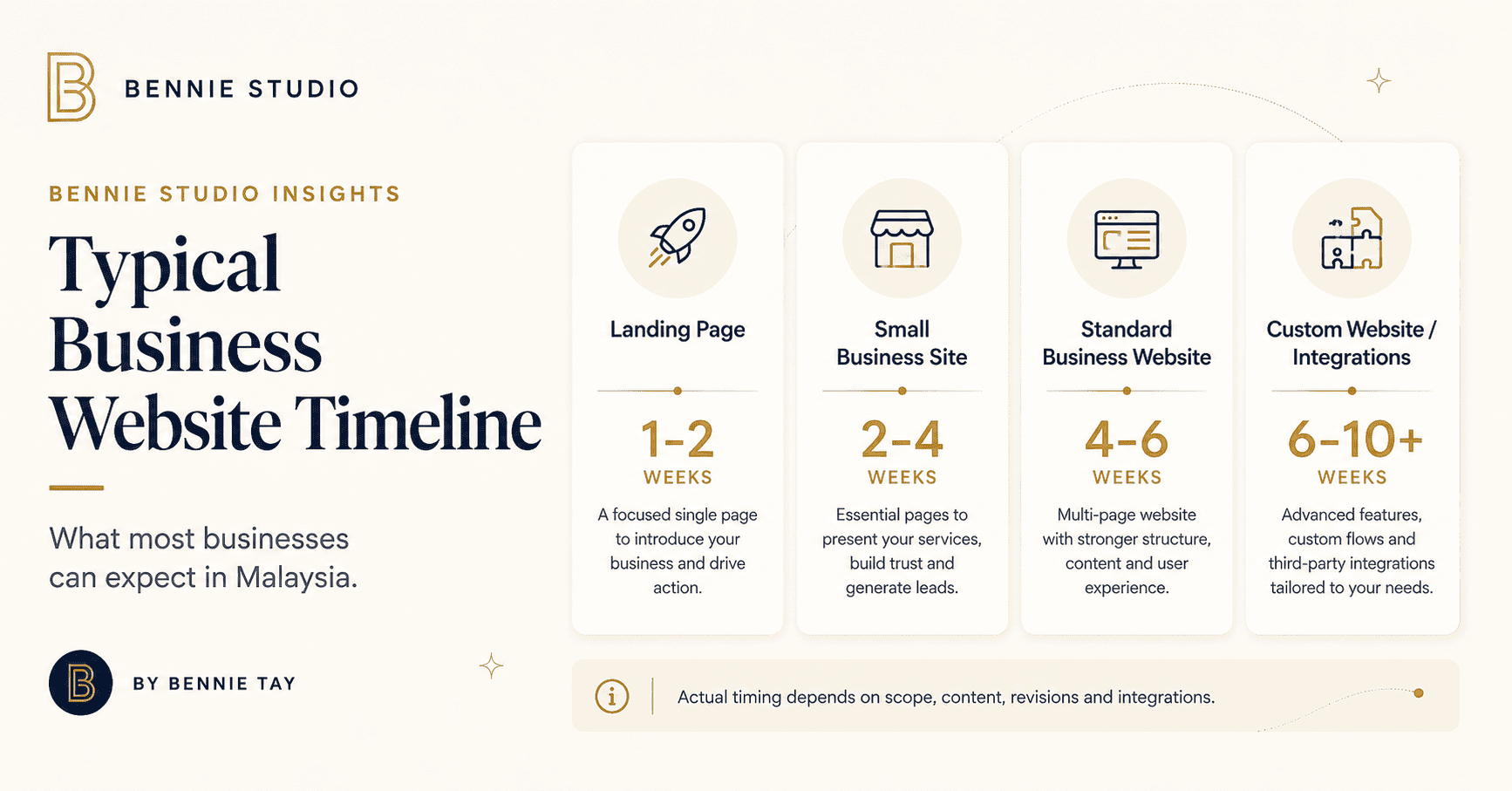
| Website Type | Typical Timeline |
|---|---|
| Simple landing page | 1–2 weeks |
| Basic small-business website | 2–4 weeks |
| Professional SME website | 4–8 weeks |
| Custom business website | 6–12 weeks |
| eCommerce website | 6–12+ weeks |
| Complex portal or custom platform | 3 months+ |
These are not guarantees. A ten-page website can sometimes take longer than a thirty-page website if the content is unclear, approvals are slow or integrations are complex. The biggest delays in website projects are often not caused by coding.
They are caused by waiting.
- Waiting for content.
- Waiting for photographs.
- Waiting for feedback.
- Waiting for somebody’s director to return from a trip and decide whether the button should say “Contact Us” or “Get in Touch.”
That is why project preparation matters.
What Actually Happens During a Website Project?
A website does not usually move directly from: Deposit paid → designer presses buttons → website appears.
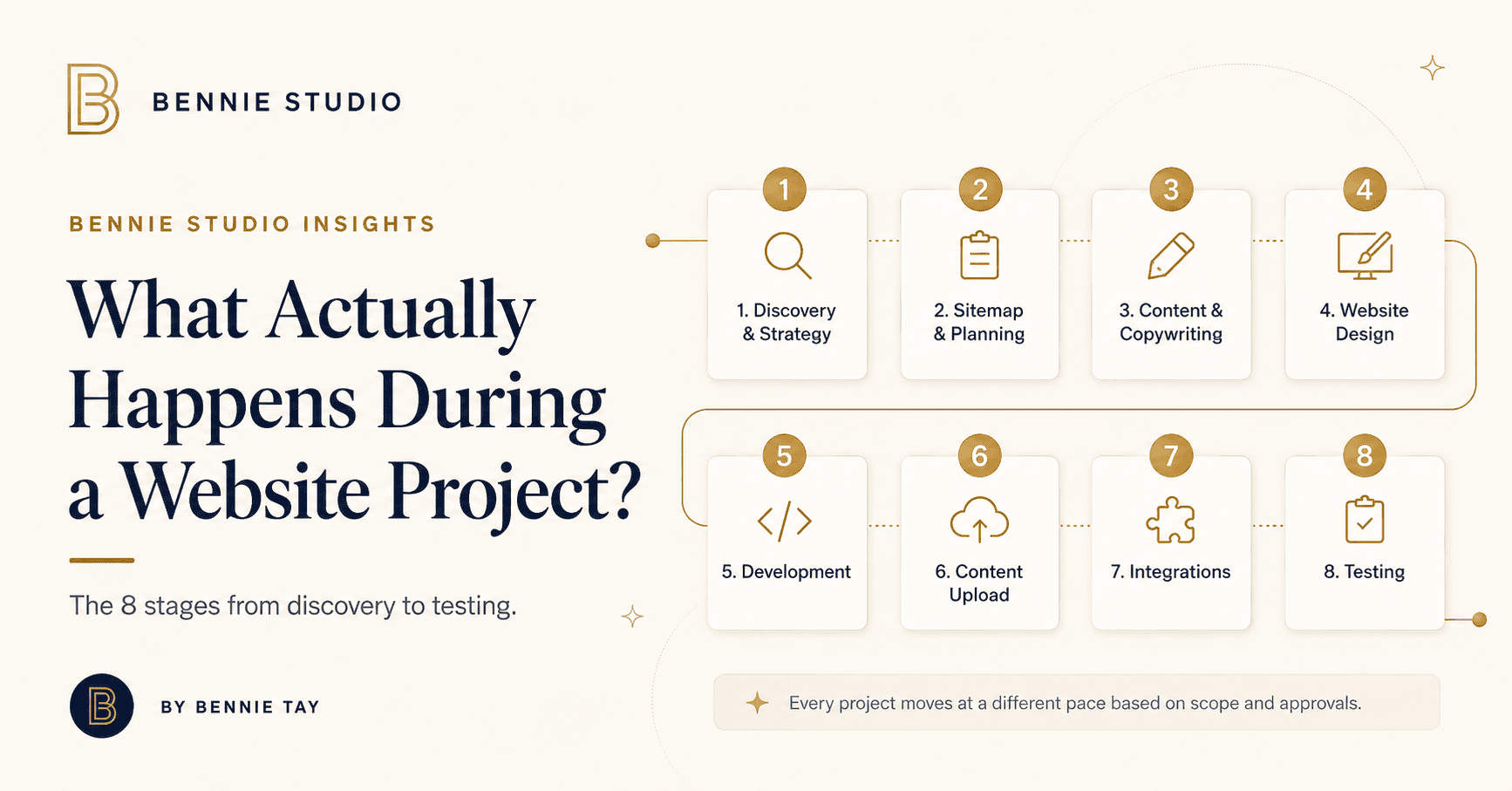
There are several stages. For a professional business website, the process may include:
- Discovery
- Website strategy
- Sitemap
- Content planning
- Copywriting
- Design
- Development
- Integrations
- Mobile optimisation
- SEO setup
- Testing
- Revisions
- Launch
Some projects combine these stages. Others involve much deeper work in each one. Understanding them helps explain why a good website can take several weeks.
Stage 1: Discovery and Website Strategy
Typical time: 2–5 business days
The first step should be understanding the business. That may involve questions such as:
- What do you sell?
- Who are your ideal customers?
- What action should visitors take?
- Which services matter most?
- Where do customers come from?
- Who are your competitors?
- What problems does the current website have?
- What does success look like?
This stage influences everything that comes later. For example, a website designed for a renovation company should probably focus heavily on:
- projects
- service areas
- quotations
- photographs
- trust
An accounting firm may need more emphasis on:
- credentials
- service structure
- professional credibility
- consultation enquiries
A tuition centre may focus on:
- programmes
- tutors
- schedules
- trial classes
- parent enquiries
Without this understanding, website design easily becomes decoration. Strategy does not need to become a six-week corporate consulting exercise. But skipping it entirely often creates problems later.
Stage 2: Sitemap and Page Planning
Typical time: 1–3 business days
Next, decide what pages the website actually needs. A simple SME website might include:
- Home
- About
- Services
- Individual Service Pages
- Portfolio or Case Studies
- FAQ
- Contact
Larger sites may add:
- Industries
- Locations
- Resources
- Careers
- Team
- Pricing
The sitemap should support both the customer journey and future SEO. For example, if you offer five important services, putting them all on one page may save time initially. But creating five dedicated service pages may make it easier to:
- explain each service properly
- rank for relevant searches
- send campaign traffic to the right page
- improve conversions
Making this decision before design prevents unnecessary restructuring later.
Stage 3: Content and Copywriting
Typical time: 3 days to several weeks
This is one of the biggest variables in website timelines. Who is writing the website? If the web designer includes copywriting, the process may move relatively smoothly. If the business is providing all content internally, delays are common. The team may need to prepare:
- company introduction
- services
- team biographies
- FAQs
- testimonials
- case studies
- project information
- photographs
- contact details
A website project cannot progress efficiently when every page says: Copy coming soon.
One of the best ways to speed up a project is to prepare content early. Even imperfect source material is useful. You can provide:
- existing brochures
- company profiles
- proposals
- presentations
- old website content
- customer FAQs
- WhatsApp sales conversations
These materials help the copywriter understand how the business already explains itself.
Stage 4: Website Design
Typical time: 5–15 business days
Design usually starts once the structure and content direction are reasonably clear. This may involve designing:
- homepage
- service pages
- navigation
- buttons
- forms
- mobile layouts
- visual components
A template-based project can move faster because much of the layout already exists. A custom website takes longer because the structure and design system are created specifically for the business. The number of feedback rounds matters too.
For example:
Efficient feedback
The structure works. Please increase the emphasis on our project portfolio and change the CTA wording.
Difficult feedback
- Something feels wrong. Can you make it pop?
- The second comment may be emotionally sincere.
It is not particularly efficient. Clear feedback keeps the project moving.
Stage 5: Website Development
Typical time: 5–20 business days
Once designs are approved, the website needs to be built. Development may include:
- responsive layouts
- page templates
- content management system
- forms
- animations
- integrations
- speed optimisation
- technical SEO setup
A straightforward business website may be relatively quick. Complex features increase development time. For example: Simple contact form
is different from: Multi-step quotation form that sends different leads to different departments and synchronises with a CRM. Both may look like a form to the customer.The development effort is very different.
Stage 6: Content Upload and Migration
Typical time: 2–10 business days
If you already have a website, content may need to be moved. That could include:
- blog posts
- services
- team profiles
- case studies
- products
- downloadable files
A small website may have almost nothing to migrate. A ten-year-old website containing hundreds of articles is a different project. Existing SEO also needs attention. If URLs change, redirects may be required so valuable old pages do not simply disappear.
This stage should be planned before launch. Not after somebody notices Google still points to 47 missing pages.
Stage 7: Integrations
Typical time: 1–10+ business days
Some websites need to connect to other systems. Examples include:
- CRM
- calendar booking
- email marketing
- payment gateway
- accounting software
- membership tools
- live chat
- external databases
Third-party integrations can introduce uncertainty. The website may be ready, but the business is still waiting for:
- account approval
- API credentials
- payment verification
- access permissions
If you know integrations are required, prepare those accounts early.
Stage 8: Testing
Typical time: 2–5 business days
Before launch, test the website properly. Check:
- desktop
- mobile
- tablet
- navigation
- forms
- buttons
- links
- phone numbers
- emails
- page speed
- redirects
- analytics
- SEO settings
The aim is to catch problems before customers do. For an eCommerce website, testing becomes more involved. You may need to test:
- product pages
- cart
- checkout
- payment
- emails
- shipping
- discounts
- order management
This is one reason online stores usually take longer than simple service websites.
Stage 9: Revisions and Approval
Typical time: 2–7 business days
The final website usually goes through one or more review rounds. This is another point where projects often slow down. The fastest projects have:
- one clear decision-maker
- consolidated feedback
- agreed deadlines
The slowest projects have:
- six stakeholders
- six separate WhatsApp messages
- contradictory instructions
- no final decision-maker
If several people need to approve the website, collect their feedback internally first. Then send one consolidated response. Your web designer will be grateful. More importantly, your launch date will remain vaguely connected to reality.
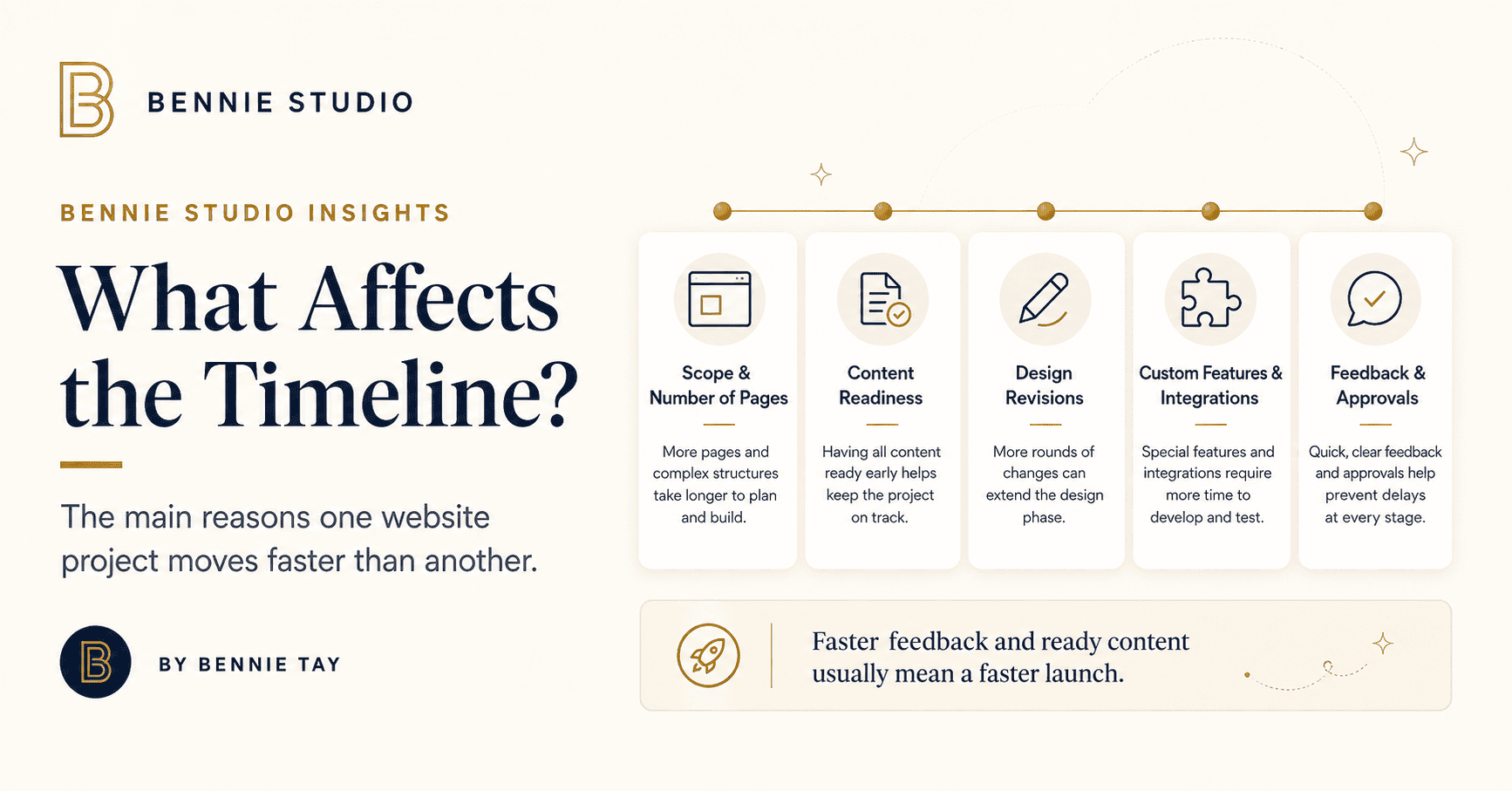
What Can Make a Website Take Longer?
Several things commonly extend timelines.
Too Many Decision-Makers
Every additional approver can add waiting time. Choose one project owner where possible.
Missing Content
This is perhaps the biggest one. Start preparing content before the design is finished.
Major Scope Changes
Adding: By the way, we also need an online booking system. two days before launch will affect the timeline.
Unclear Requirements
The more decisions made upfront, the fewer surprises later.
Complex Integrations
External systems may require additional development and testing.
Slow Feedback
A designer may need two days to make changes. But if feedback arrives three weeks later, the project has still moved three weeks.
Perfectionism
There is a difference between quality control and endlessly adjusting minor details. At some point, the website needs to launch and meet real customers. You can improve it afterward.
Can a Business Website Be Built in One Week?
Yes. Under the right conditions. A one-week project might work when:
- the website is small
- requirements are clear
- content is ready
- branding already exists
- no complex integrations are required
- decisions are made quickly
- an existing design system is used
A fast website is not automatically a bad website. Likewise, a website taking three months is not automatically better. Time spent should produce value. Not merely elapsed calendar days.
Is a 24-Hour Website Realistic?
For a simple landing page or basic temporary site, possibly. For a complete strategic business website, expectations should be different. A good professional website may require:
- research
- positioning
- content
- design
- development
- testing
Compressing all of that into 24 hours usually means something has been reduced. Maybe the website is template-based. Maybe the content is provided.Or maybe there is little customisation. That may be acceptable. Just understand what the speed is trading off.
How Can You Speed Up Your Website Project?
Business owners have more control over project speed than they sometimes realise.
Prepare Your Content
Gather:
- company profile
- service information
- photographs
- team details
- testimonials
- FAQs
Appoint One Decision-Maker
Someone needs authority to approve things.
Know Your Main Goal
Decide whether the website should primarily generate:
- calls
- WhatsApp enquiries
- quotation requests
- bookings
- sales
Give Clear Feedback
Explain what needs changing and why.
Avoid Mid-Project Scope Creep
New ideas are inevitable. Separate essential launch requirements from Phase 2 improvements.
Respond Quickly
Website projects tend to move at approximately the speed of the slowest approval. A truth everyone finds inconvenient.
Should You Delay Launch Until Everything Is Perfect?
Usually, no. You should not launch a broken or incomplete website. But perfection is not a realistic finish line. You can continue improving after launch. For example, launch with:
- core services
- strong homepage
- proper contact flow
- essential SEO
- key proof
Then add over time:
- more case studies
- additional blog content
- new location pages
- advanced resources
This phased approach can be much more practical. A business often benefits more from a strong website live in six weeks than a theoretical perfect website still waiting for approval after six months.
A Realistic 6-Week SME Website Timeline
Here is one example.
Week 1
- discovery
- strategy
- sitemap
- content planning
Week 4
- website development
- content implementation
Week 1
- copywriting
- homepage design
- service-page structure
Week 5
- integrations
- mobile optimisation
- SEO setup
Week 3
- design revisions
- remaining page design
Week 6
- testing
- revisions
- analytics
- launch
Could this be faster? Yes.
Could it take longer? Also yes.
The purpose of a timeline is to create a realistic framework rather than guarantee that every website magically requires exactly 30 working days.
Frequently Asked Questions
How long does it take to build a small business website?
A relatively straightforward small-business website can often be completed within two to six weeks, depending on content, design, functionality and feedback speed.
How long does a custom website take?
A more customised business website commonly takes around six to twelve weeks or longer if it includes significant strategy, custom functionality or integrations.
How long does an eCommerce website take?
A straightforward online store may take six to twelve weeks, while more complex stores can take longer because products, payments, shipping and checkout flows all require additional setup and testing.
What usually delays a website project?
Common delays include missing content, slow feedback, scope changes, complex integrations and too many decision-makers.
Can I launch first and add pages later?
Yes. A phased approach can work well when the core website is complete but additional content such as case studies, blog posts or secondary pages can be added afterward.
Should I rush my business website?
Do not delay unnecessarily, but do not sacrifice important planning, content or testing simply to achieve an arbitrary launch date.
Plan the Website Around the Business Deadline
If you need a website for:
- a company launch
- exhibition
- advertising campaign
- new service
- rebranding
- investor meeting
tell your website provider at the beginning. Then work backward from that deadline. Decide what absolutely needs to be ready for launch and what can be improved later. For many Malaysian SMEs, a well-planned professional website can realistically be completed within four to eight weeks.
The biggest factor is rarely how quickly someone can write code. It is how efficiently the project moves from strategy to decisions to approval. At Bennie Studio, website projects are structured around clear scope, customer journeys and realistic launch timelines so businesses know what is happening at each stage.
The objective is not to keep a website project running forever. It is to get the right website live and then continue improving it based on real business needs.
Explore Custom Website Design →
Planning a new website and need to know what timeline makes sense for your project?
Request a Website Project Review →