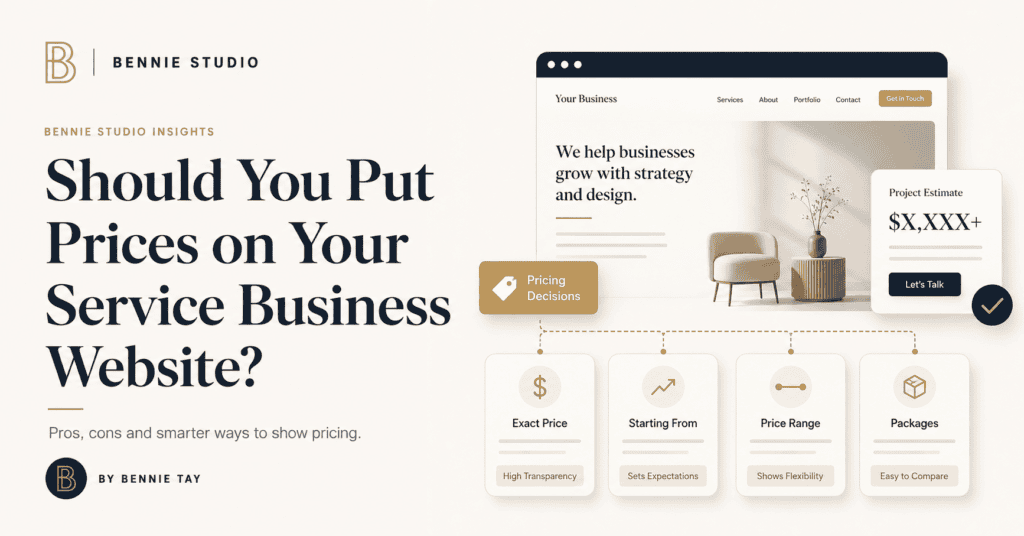
One of the most common questions service businesses ask when building a website is:
Should we show our prices?
Some businesses believe publishing prices will scare potential customers away. Others think hiding prices creates unnecessary friction. Both can be right.
The best answer depends on:
- what you sell
- how standardised the service is
- how much projects vary
- how customers buy
- how much qualification is needed before quoting
There is no rule saying every service business should publish an exact price list.
But there is a strong argument for giving potential customers some form of pricing guidance.
Because when someone visits your website, one of the questions sitting quietly in the back of their mind is usually:
Can I afford this?
If the website refuses to give them any clue, they have to decide whether contacting you is worth the effort. Sometimes they will. Sometimes they will simply open another website.
So instead of asking:
“Should we show prices or hide prices?”
a better question is:
“How much pricing information does the customer need to confidently take the next step?”
Here is how I would decide.
The Short Answer
If your service is standardised, show the price.
If your service varies considerably, show:
- starting prices
- typical ranges
- package prices
- minimum project values
- examples
- factors that affect the quote
If pricing genuinely cannot be estimated until you understand the requirement, explain why and describe what happens after the customer contacts you.
For most service businesses, complete pricing secrecy is rarely necessary. You do not have to publish every number. But making customers contact you simply to discover whether your service costs RM500 or RM50,000 creates unnecessary uncertainty.
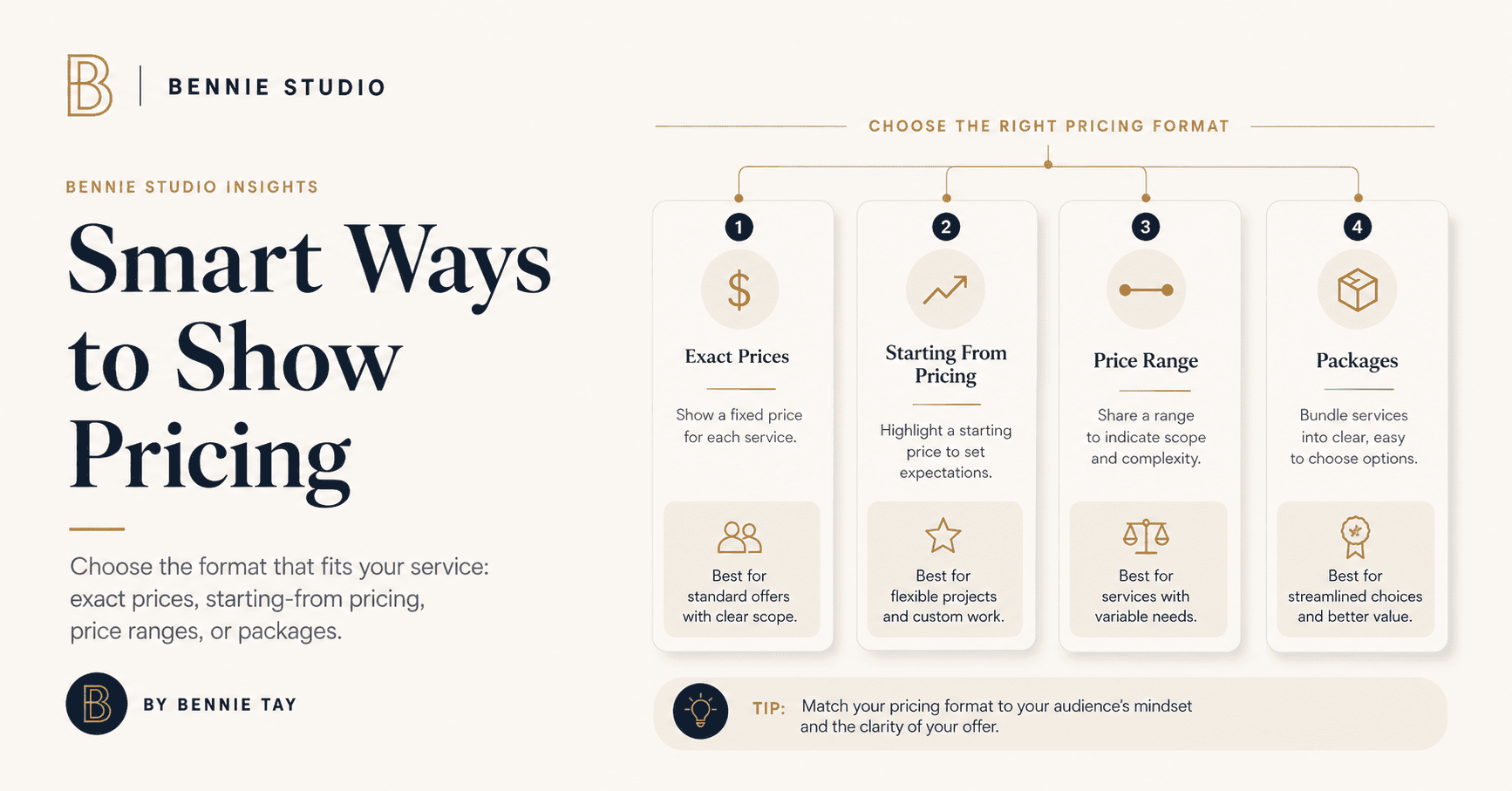
Why Businesses Hide Their Prices
There are several understandable reasons.
1. Every Project Is Different
A renovation contractor cannot quote a complete renovation simply from a website visit.
The price depends on:
- property size
- materials
- scope
- condition
- design
- timeline
Likewise, a custom website may vary depending on:
- pages
- functionality
- copywriting
- integrations
- design requirements
Exact pricing may not be practical.
2. Competitors Can See the Price
Some businesses worry competitors will undercut them. That can happen.
But customers can also ask your price, send the quotation to your competitors and achieve roughly the same result. If your entire competitive advantage disappears because someone sees your pricing, the pricing page may not be the real problem.
3. The Price Might Scare Customers
This is perhaps the biggest concern. Suppose your service starts at RM5,000. You worry someone will see that number and leave. They might.
But if their budget is RM800, they were unlikely to become a customer anyway. Publishing some pricing information can therefore prevent your team from spending time qualifying leads that were never financially suitable.
4. Salespeople Want to Explain the Value First
This can be a valid argument. Some complex services are difficult to understand from a number alone.
RM10,000 might look expensive before the customer understands:
- what is included
- what problem it solves
- how long it lasts
- what support is provided
The solution is not necessarily hiding the number. It may be improving the way the website explains the value around it.
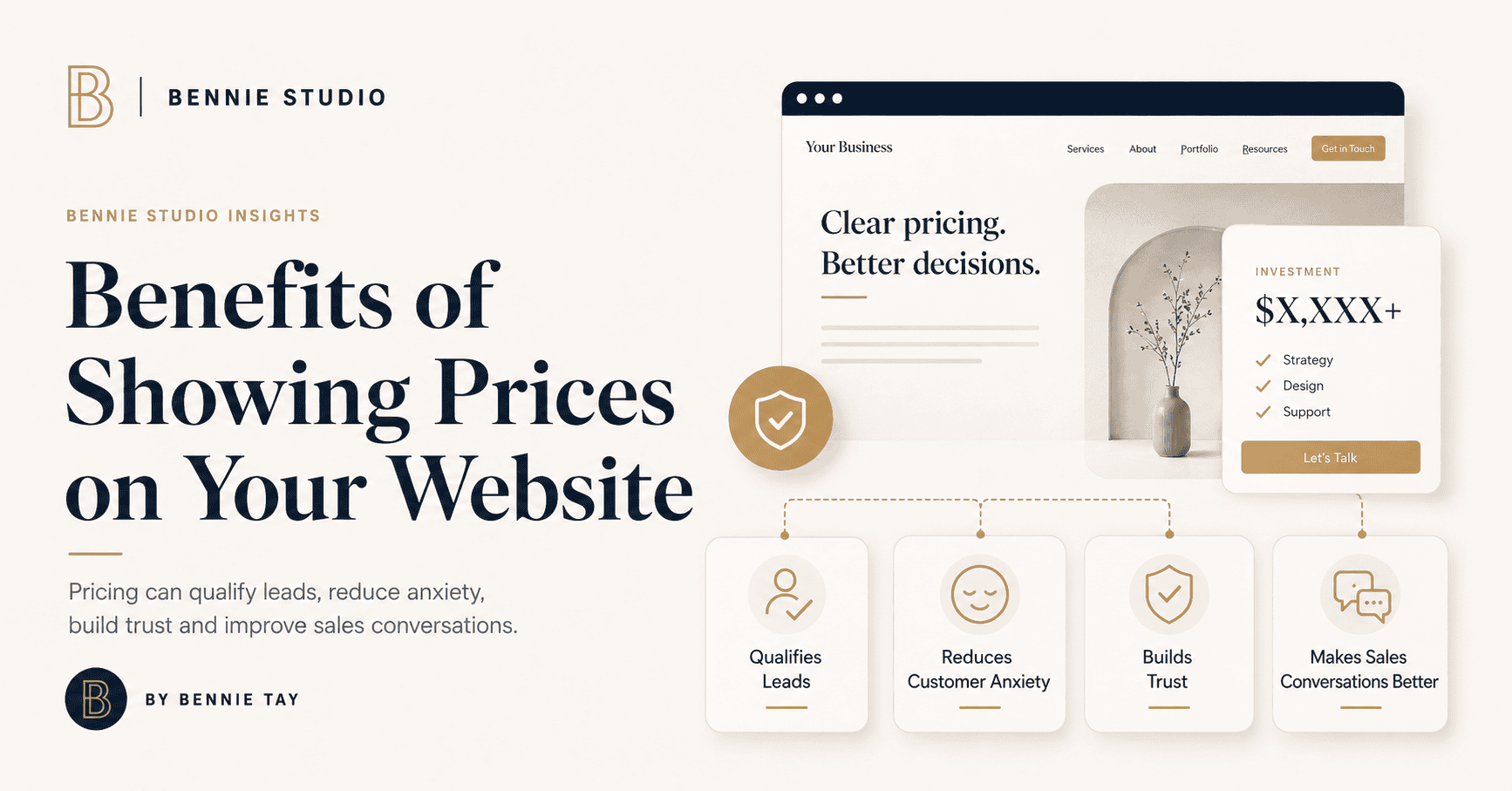
The Benefits of Showing Prices
Pricing information can improve the website in several ways.
1. It Qualifies Leads
Imagine your minimum project value is RM8,000. Someone looking for a RM500 solution contacts you.
Your team:
- responds
- asks questions
- schedules a call
- prepares information
Then discovers the budget mismatch. Now multiply that by 20 enquiries. Giving the customer a pricing benchmark can reduce this.
For example:
Projects typically start from RM8,000.
That does not stop serious customers from contacting you. It simply helps unsuitable leads self-select out. Your sales team gets fewer enquiries, perhaps. But potentially better ones.
2. It Reduces Customer Anxiety
People dislike uncertainty around money.
Imagine visiting a restaurant where the menu contains descriptions but no prices. You might wonder whether ordering dinner requires a personal loan. Service businesses create a milder version of the same uncertainty when they hide every number.
A potential customer may think:
Maybe this company is far outside my budget.
Giving even a range helps.
For example:
Most small business projects fall between RM5,000 and RM10,000 depending on scope.
Now the visitor can evaluate whether continuing makes sense.
3. It Builds Trust
Transparent pricing can signal confidence.
You are effectively saying:
This is roughly what our service costs. Here is what affects the final price.
That can make the sales process feel more straightforward.
Customers are already used to comparing information online. Forcing them to contact five suppliers just to obtain a basic pricing indication is not necessarily creating exclusivity. Sometimes it is just creating admin.
4. It Makes Sales Conversations Better
When customers already understand the approximate price, your first conversation can focus on:
- requirements
- fit
- scope
- outcomes
instead of spending the first ten minutes recovering from price shock. The customer comes into the conversation better informed. That can make both sides more productive.
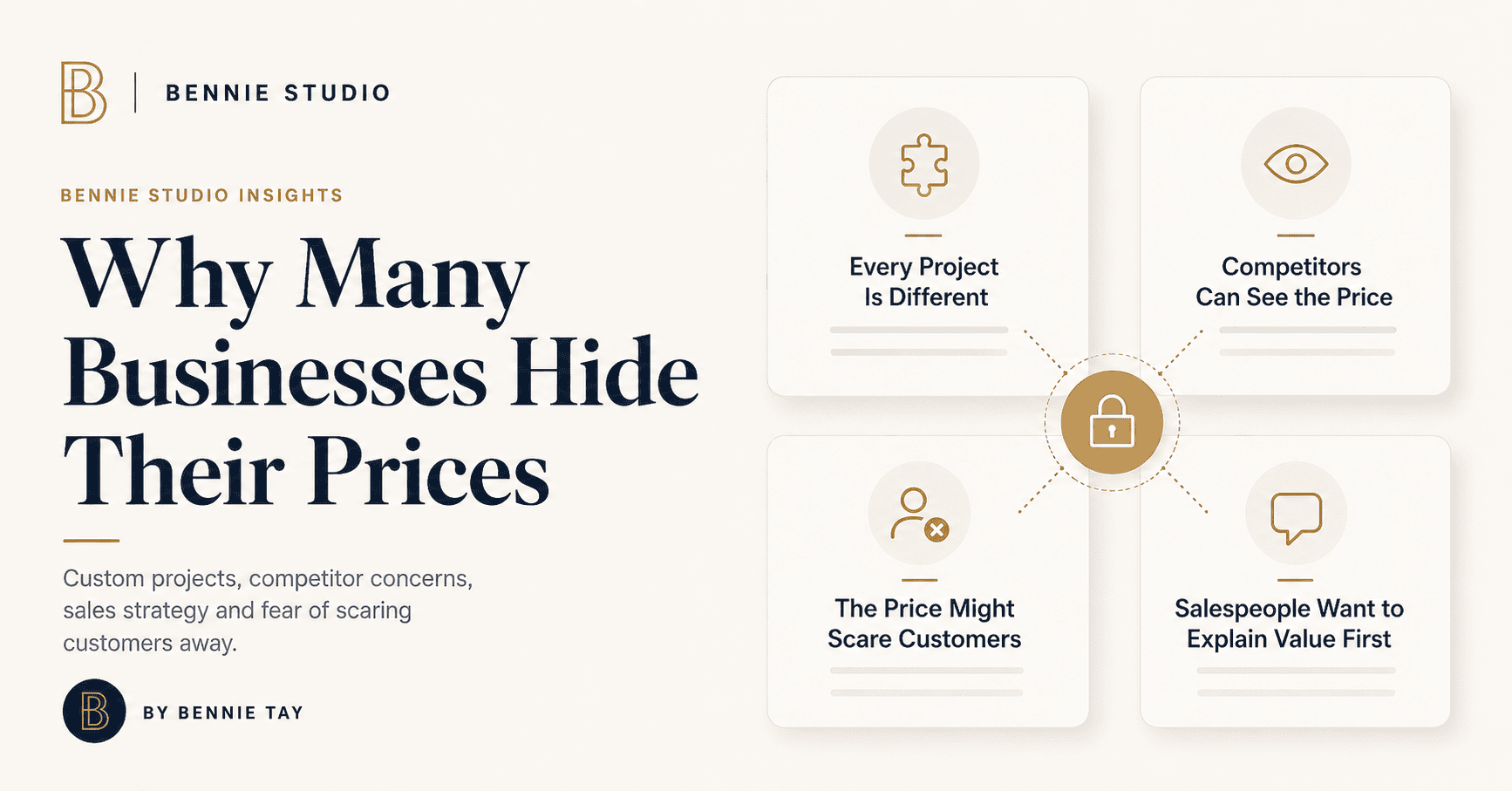
When Should You Show Exact Prices?
Exact pricing works well when the service is relatively standardised.
Examples might include:
- monthly website plans
- cleaning packages
- tuition classes
- fixed consultation sessions
- photography packages
- standard accounting packages
For example:
Starter Accounting Package
RM600/month
Includes:
- monthly bookkeeping
- standard management accounts
- basic support
This is easy to understand. The customer knows what they receive and what it costs. Exact prices are especially useful when the main differences between customers are limited.
When Should You Use “Starting From” Pricing?
Starting prices work well when every project varies but there is still a clear minimum.
For example:
Custom website projects start from RM6,000.
This tells visitors:
- the service is custom
- RM6,000 is approximately the entry point
- the final quotation depends on requirements
This approach can dramatically reduce unsuitable enquiries without pretending every project costs the same. It also gives the business room to scope properly.
When Should You Show a Price Range?
Ranges work well when customers need a better understanding of typical investment.
For example:
Most SME website projects range from RM5,000 to RM12,000 depending on pages, content and functionality.
Or:
Kitchen renovation projects typically range from RM20,000 to RM60,000 depending on size, materials and scope.
A range helps the visitor budget. The key is explaining what moves the price.
For example:
Lower end
- smaller scope
- standard materials
- fewer custom requirements
Higher end
- larger scope
- premium materials
- more custom work
This makes the pricing feel rational rather than arbitrary.
When Should You Use Packages?
Packages work well when customers can be grouped into common levels.
For example:
| Plan | Price | Suitable For |
|---|---|---|
| Starter | RM250/month | Small brochure website |
| Growth | RM500/month | Lead-generation website |
| Pro | RM900/month | Businesses needing regular improvements |
Packages make comparison easier. They also help customers understand what additional investment provides.
The mistake is creating packages where the differences are impossible to understand. If every plan contains a list of 37 technical features, the pricing table may technically be informative while still being completely useless. Focus on meaningful differences.
What If Your Service Is Too Custom for Pricing?
Some services genuinely cannot be priced responsibly before understanding the project.
Examples include:
- large construction
- complex consulting
- enterprise software
- custom development
- major legal or professional assignments
You can still provide useful guidance.
Explain:
What affects pricing
For example:
- project size
- complexity
- timeline
- number of locations
- integration requirements
Minimum engagement
For example:
Projects typically start from RM15,000.
Example projects
For example:
A typical three-month advisory engagement may fall between RM20,000 and RM40,000 depending on scope.
Your quotation process
For example:
- Initial consultation
- Requirements review
- Scope definition
- Proposal and quotation
You are not publishing an exact price. You are reducing uncertainty.
Should You Hide Prices From Competitors?
Usually, I would not let competitors determine your entire website strategy. Competitors can obtain pricing in many ways. More importantly, your website exists for customers.
If pricing information makes it easier for the right customer to choose you, that benefit may outweigh the fact that competitors can see it too. Your differentiation should ideally come from more than the number.
For example:
- specialisation
- process
- expertise
- speed
- support
- customer experience
- results
If two businesses provide apparently identical services and customers choose purely on price, you may need stronger positioning. Hiding prices does not solve that.
What About Premium Services?
Some premium businesses worry showing prices will make the service feel commoditised. That depends on presentation.
Compare:
Website RM8,000.
with:
Custom Business Website Projects From RM8,000
Designed for established service businesses that need clearer positioning, stronger lead generation and a website built around their sales process.
The price is only one part of the message.
You can still communicate:
- positioning
- process
- expertise
- scope
- value
Premium does not require mystery.
Should You Put Prices on the Homepage?
Usually, I would not make pricing the first thing visitors see unless price itself is a major selling point.
The homepage should first establish:
- what you offer
- who you help
- why it matters
Then introduce pricing when the customer has enough context.
You might use:
Plans from RM250/month
with a button:
View Plans
This gives a useful signal without turning the entire homepage into a price comparison table. For more complex services, a dedicated pricing page is often better.
What Should a Pricing Page Include?
A good pricing page should not contain numbers alone.
I would normally include:
1. Who Each Option Is For
Help customers choose.
2. What’s Included
Be clear about scope.
3. What’s Not Included
This prevents misunderstandings.
4. Starting Price or Range
Give a useful financial benchmark.
5. What Changes the Price
Explain major variables.
6. FAQs
Address common concerns.
7. CTA
For example:
Request a Custom Quote
or:
Choose This Plan
The objective is to make the decision easier.
What If Competitors Are Cheaper?
Then explain why. Suppose your website service costs RM6,000 and another provider charges RM2,000. Do not pretend the competitor does not exist. Explain what is different.
Perhaps your scope includes:
- copywriting
- custom design
- analytics
- SEO setup
- ongoing support
while the cheaper option expects the client to provide everything. The price difference then becomes easier to understand.
Your website should help customers compare based on scope and value, not just price.
Pricing Transparency Can Improve SEO Content Too
Pricing questions are often excellent blog topics.
Potential customers search for things such as:
- website cost Malaysia
- accounting service cost Malaysia
- renovation cost Malaysia
- tuition fees
- photography package price
Publishing useful cost guides can attract people who are actively evaluating a purchase. These visitors are often commercially valuable because they are further along the decision journey.
A pricing guide can explain:
- typical ranges
- cost factors
- options
- hidden costs
- what customers should budget
Then lead naturally toward your service.
When Should You NOT Publish Pricing?
There are still situations where public pricing may be unhelpful.
For example:
Highly confidential or negotiated contracts
Enterprise deals may have complex commercial structures.
Pricing changes constantly
If costs move weekly, static prices may quickly become inaccurate.
Regulations limit how pricing can be communicated
Certain professional or regulated industries may require additional care.
Every project is genuinely unique
If any published range would be misleading, explain the quotation process instead.
The principle remains the same:
Give customers as much useful clarity as you reasonably can.
A Good Middle Ground for Most Service Businesses
If you are unsure, this is the approach I recommend:
Show a starting price
Projects from RM5,000.
Show a typical range
Most projects fall between RM5,000 and RM10,000.
Explain cost factors
Final pricing depends on pages, copywriting, integrations and functionality.
Explain the next step
After a short requirements discussion, we provide a fixed project quotation.
This gives the visitor enough information to make a decision without pretending your service is completely standardised.
Frequently Asked Questions
Should service businesses put prices on their websites?
In many cases, yes, or at least provide a starting price or typical range. Pricing information helps customers self-qualify and reduces uncertainty.
Does showing prices reduce enquiries?
It may reduce enquiries from customers whose budgets do not match your service. That can be beneficial if it improves lead quality.
What if every project is different?
Use starting prices, typical ranges or examples instead of fixed pricing. Also explain the main factors that affect the final quotation.
Will competitors copy my prices?
They can see your public pricing, but customers can also share quotations. Your differentiation should ideally come from more than price alone.
Should I show prices if I’m expensive?
If your higher price reflects greater scope or value, explain that clearly. Hiding the price does not automatically make the service more premium.
Should I show pricing on the homepage?
You can show a starting price or link to a dedicated pricing page. The homepage should still focus primarily on the customer problem and your value proposition.
Pricing Should Help the Customer Decide
The purpose of showing prices is not merely transparency for the sake of transparency. It is to make the buying journey easier.
Your website should help potential customers understand:
Is this service suitable for me?
What does it roughly cost?
What affects the final price?
What do I get?
What should I do next?
If exact pricing is simple, show it. If pricing varies, give useful guidance.
If the work is highly custom, explain why and make the quotation process clear. What I would avoid is forcing every potential customer to contact you simply to discover whether your service is remotely within their budget.
At Bennie Studio, website pricing and service pages are structured around helping customers make informed decisions rather than hiding important information behind an enquiry form.
The goal is not necessarily more leads.
It is more suitable leads.
Explore Website Plans →
Already getting enquiries but spending too much time qualifying people with the wrong budget?
Get a Free Website Growth Audit →