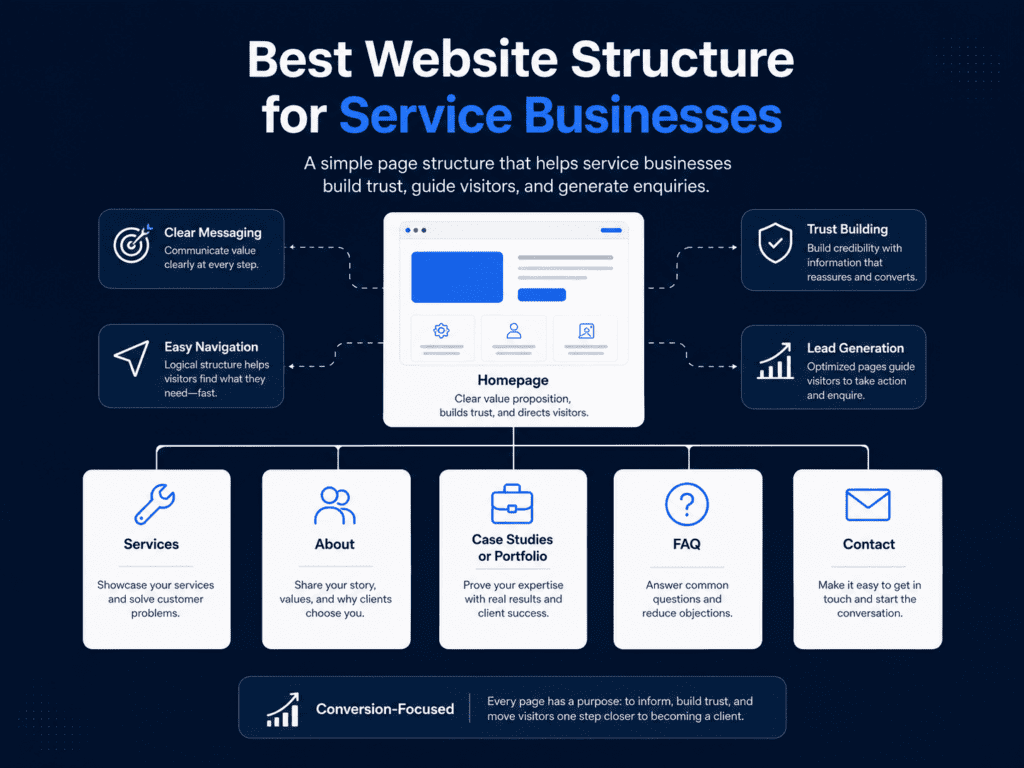
A service business website has one main job: to turn visitors into enquiries, bookings, calls, or consultation requests.
Unlike an e-commerce website, a service business website usually does not sell a physical product directly from a shopping cart. Instead, it needs to build trust, explain the service clearly, answer customer questions, and make it easy for potential clients to take the next step.
The problem is that many service business websites are built without a clear structure. They may have a homepage, a basic about page, a short services section, and a contact form, but the customer journey is weak. Visitors arrive, look around, and leave without taking action.
A good website structure helps visitors understand what you offer, why they should trust you, and how to contact you. It also helps search engines understand your business, services, and locations.
This guide explains the best website structure for service businesses, including the key pages, homepage layout, service page structure, local SEO considerations, and conversion elements every service website should include.
What Is a Service Business Website?
A service business website is a website designed to promote services instead of physical products.
Examples of service businesses include:
- Web design agencies
- Consultants
- Coaches
- Marketing agencies
- Accountants
- Lawyers
- Clinics
- Dentists
- Cleaning companies
- Plumbing services
- Electricians
- Aircon repair companies
- Beauty salons
- Fitness trainers
- Real estate agents
- Home renovation companies
- IT service providers
- Photographers
- Event planners
For these businesses, the website needs to create enough confidence for someone to enquire, book, call, or request a quote.
That means the website structure should be built around clarity, trust, and conversion.
Why Website Structure Matters for Service Businesses
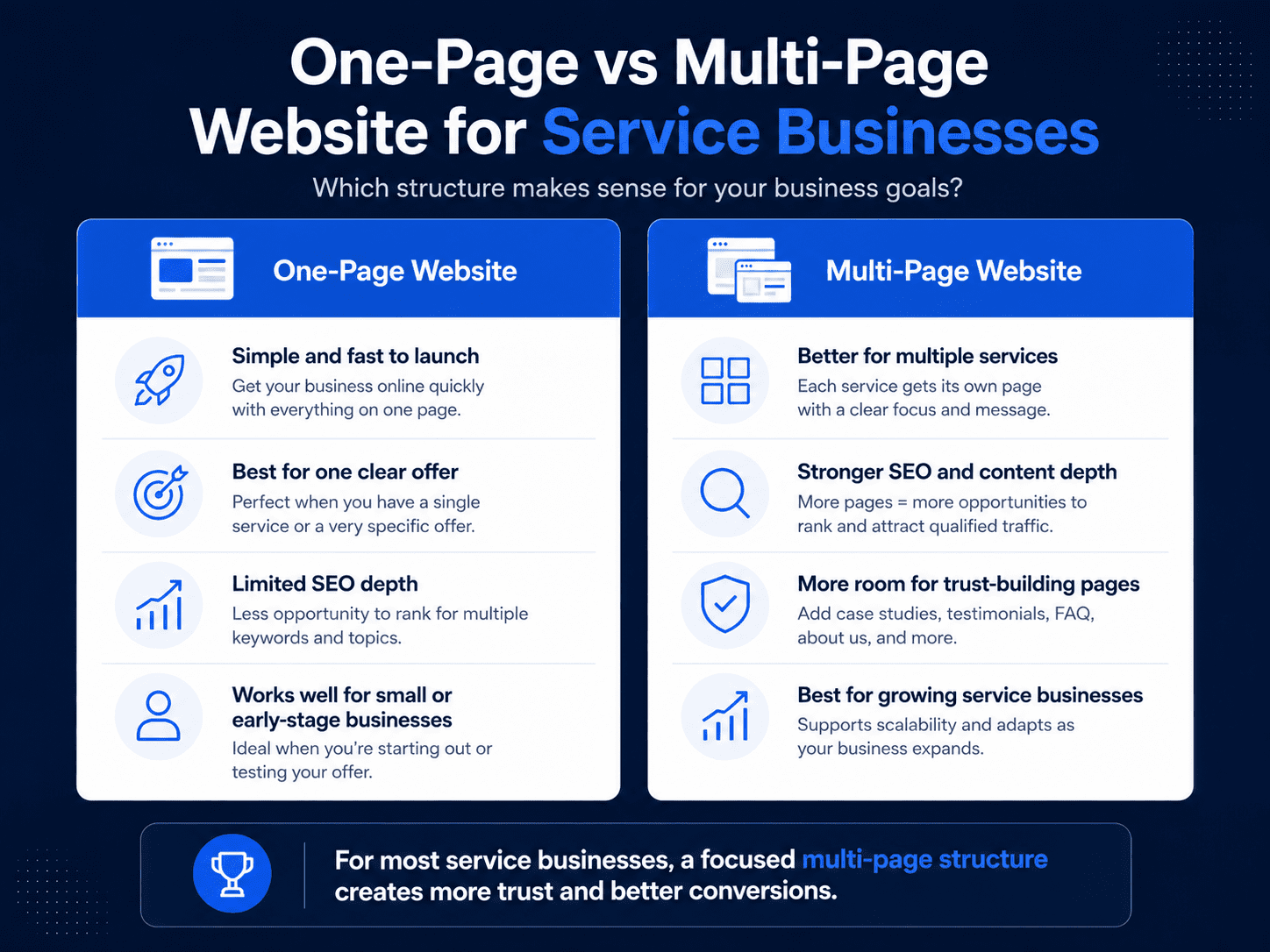
Your website structure affects how easily visitors can find information and how likely they are to contact you.
A poor structure can confuse visitors.
A strong structure can guide them naturally from awareness to enquiry.
For example, a visitor may land on your homepage and ask:
- What does this business do?
- Is this service right for me?
- Can I trust this company?
- What exactly is included?
- How much does it cost?
- Where do they operate?
- What should I do next?
Your website should answer these questions without making visitors work too hard.
Website structure also affects SEO. If your services are buried inside one generic page, search engines may struggle to understand what each service is about. Dedicated service pages make it easier to rank for specific keywords.
The Best Website Structure for Service Businesses
A strong service business website should include these core pages:
- Homepage
- Services overview page
- Individual service pages
- About page
- Case studies or portfolio page
- Testimonials or reviews page
- Pricing or packages page
- FAQ page
- Blog or resources section
- Contact page
- Location pages, if relevant
Not every business needs every page immediately. A new business can start smaller. But this structure gives your website room to grow.
Recommended Website Sitemap
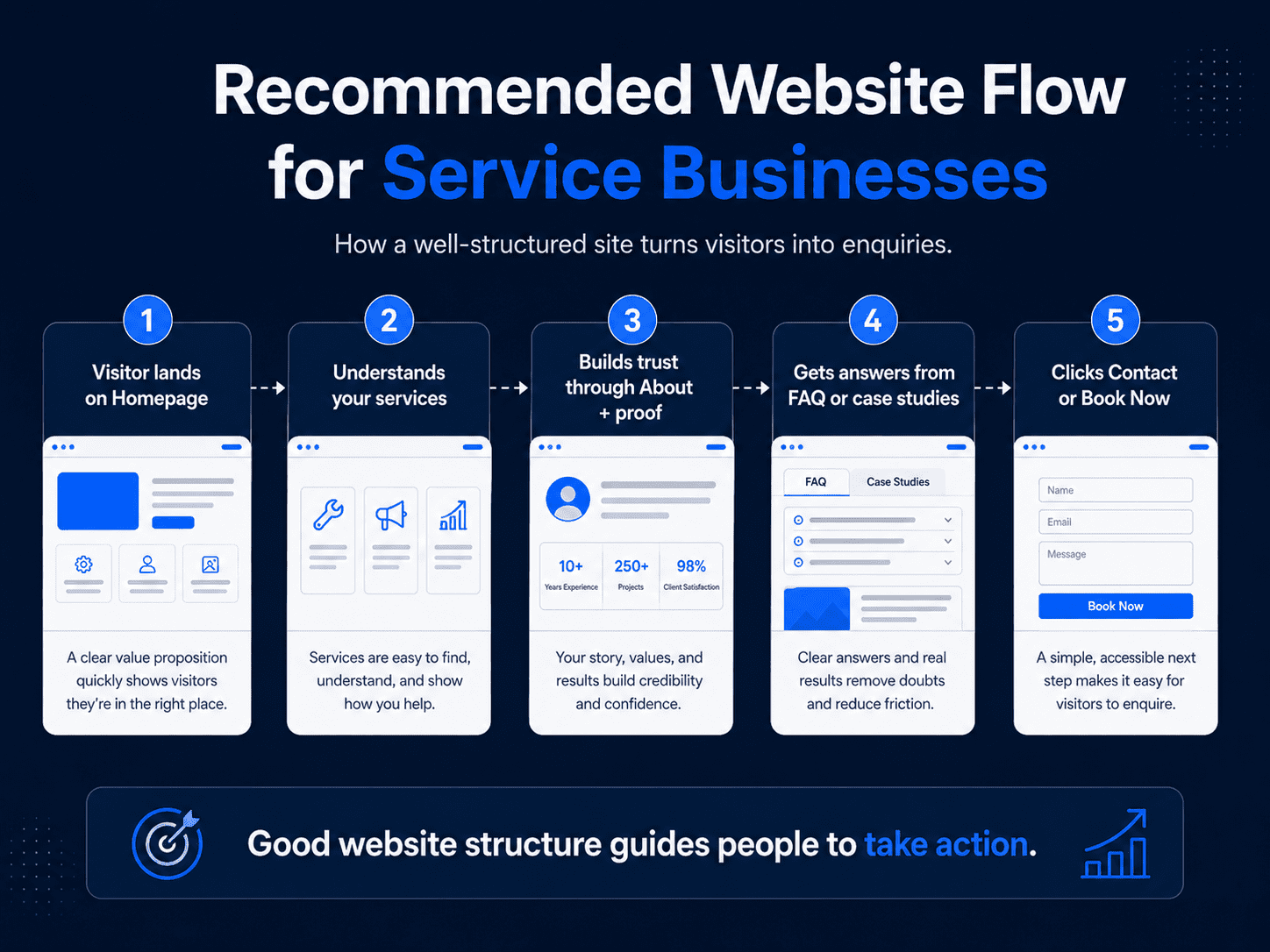
Here is a simple sitemap for a service business website:
- Home
- Services
- Service 1
- Service 2
- Service 3
- About
- Work / Case Studies
- Pricing
- Blog
- Contact
For local service businesses, the sitemap may look like this:
- Home
- Services
- Main Service 1
- Main Service 2
- Main Service 3
- Areas We Serve
- City 1
- City 2
- Reviews
- About
- Blog
- Contact
For a professional service business, the sitemap may look like this:
- Home
- Services
- Industries
- Case Studies
- About
- Insights
- Contact
The goal is to make the website easy to understand for both visitors and search engines.
1. Homepage
The homepage is your main entry point.
It should quickly explain what your business does, who you help, why you are different, and what visitors should do next.
A strong homepage should not try to say everything. Instead, it should introduce your most important message and guide visitors to the right pages.
Best Homepage Structure for Service Businesses
A high-converting service business homepage can follow this structure:
- Hero section
- Trust indicators
- Problem and solution section
- Services overview
- Why choose us
- Process section
- Testimonials or proof
- Case study or result highlight
- Pricing guidance or package preview
- FAQ section
- Final call to action
- Footer with contact details
Hero Section
The hero section is the first thing visitors see.
It should include:
- Clear headline
- Short supporting description
- Primary call to action
- Secondary call to action
- Relevant image or visual
- Trust indicator if available
A weak headline might say: “Professional Solutions for Your Business”
A stronger headline would say: “Website Design and Monthly Website Plans for Small Businesses That Need More Enquiries”. This works better because it explains the service, audience, and outcome.
Trust Indicators
Trust indicators help visitors feel confident quickly. Examples include:
- “Trusted by 100+ local businesses”
- “5-star rated service”
- “Over 10 years of experience”
- “Certified professionals”
- Client logos
- Review snippets
- Industry awards
These should appear near the top of the homepage, not hidden at the bottom.
Services Overview
The homepage should introduce your main services, but it should not replace your individual service pages.
Each service card should include:
- Service name
- Short description
- Main benefit
- Link to the full service page
For example:
Website-as-a-Service
Launch a professional business website with hosting, maintenance, and support included in one monthly plan.
Landing Page Design
Create focused campaign pages designed to convert ad traffic into leads and bookings.
Website Redesign
Improve an outdated website with clearer messaging, stronger CTAs, and better mobile performance.
Why Choose Us Section
This section explains why visitors should choose your business instead of competitors.
Avoid generic claims such as:
- High quality
- Professional service
- Best solution
- Customer satisfaction
Instead, be specific.
Examples:
- Fixed monthly website plans with no large upfront cost
- Mobile-first design built for enquiries
- Hosting, updates, and maintenance included
- Clear process from onboarding to launch
- SEO-friendly structure for service businesses
Specific reasons are more persuasive than generic promises.
Process Section
A process section reduces uncertainty. Visitors want to know what happens after they enquire. For example:
- Book a quick consultation
- Share your business details
- Review your website draft
- Launch your website
- Get ongoing support and updates
This makes your service feel easier to buy.
Final CTA
Your homepage should end with a strong call to action.
Examples:
- Request a Free Website Quote
- Book a Free Consultation
- Start Your Website Plan
- Send Us a WhatsApp Message
- Schedule a Discovery Call
The final CTA should repeat the main action you want visitors to take.
2. Services Overview Page
The services overview page lists all your main services in one place. This page is useful because not every visitor knows exactly what they need. It helps them compare your offers and choose the right service.
A strong services overview page should include:
- Short introduction
- List of main services
- Who each service is for
- Benefits of each service
- Links to individual service pages
- CTA section
- FAQ section
For example, a website business may include:
- Monthly website plans
- Custom website design
- Landing page design
- Website redesign
- SEO setup
- Website maintenance
Each service should link to its own dedicated page.
3. Individual Service Pages
Individual service pages are among the most important pages on a service business website.
Many businesses make the mistake of putting all services on one page. This limits both SEO and conversion potential.
A dedicated service page allows you to explain one service in detail.
Best Service Page Structure
A strong service page should include:
- Service-specific hero section
- Problem section
- Solution section
- What is included
- Benefits
- Who it is for
- Process
- Proof or testimonials
- Pricing guidance
- FAQs
- Strong CTA
Service-Specific Hero Section
The headline should clearly describe the service.
Example: “Affordable Monthly Website Plans for Small Businesses”
Supporting copy: “Get a professional website with design, hosting, maintenance, and support included in one predictable monthly plan.”
CTA: “View Website Plans” or “Request a Free Consultation”
Problem Section
Show that you understand the customer’s problem.
Example: “Many small businesses know they need a professional website, but they do not want to pay thousands upfront or manage hosting, updates, and technical issues themselves.”
Solution Section
Explain how your service solves the problem.
Example: “Our monthly website plans give you a professional, mobile-friendly website without the stress of managing the technical side.”
What Is Included
Be specific about what the customer gets.
Examples:
- Website design
- Mobile-friendly layout
- Hosting
- Maintenance
- Basic SEO setup
- Contact form
- WhatsApp button
- Content updates
- Technical support
Benefits
Explain why the service matters.
Examples:
- Lower upfront cost
- Faster launch
- Professional online presence
- Easier lead generation
- Ongoing support
- Predictable monthly pricing
Who It Is For
Help visitors self-identify.
Examples: “This service is ideal for local businesses, consultants, freelancers, coaches, clinics, salons, and service providers that need a professional website without a large upfront investment.”
Process
Show the steps clearly.
Examples:
- Choose your plan
- Submit your business details
- Review your website
- Launch your site
- Receive ongoing support
Pricing Guidance
Pricing does not always need to be exact, but some guidance helps reduce friction.
Examples:
- Managed Website pricing, with setup fees shown separately
- Custom quotes available for advanced websites
- Book a consultation for accurate pricing
FAQs
Answer common objections.
Examples:
- Is hosting included?
- Can I use my own domain?
- How long does it take to launch?
- Can I request changes?
- What happens if I cancel?
- Is SEO included?
CTA
End with a clear next step.
Example: “Ready to launch your business website? Book a free consultation today.”
4. About Page
The about page should not only talk about the company history.
It should build trust. A strong about page should explain:
- Who you are
- Who you help
- Why your business exists
- What makes your approach different
- Your experience
- Your values
- Your team
- Why customers can trust you
For service businesses, the about page is especially important because customers are often buying expertise, reliability, and relationship.
A good about page should still include a CTA.
Examples:
- Work With Us
- Book a Consultation
- Request a Quote
- Meet the Team
5. Case Studies or Portfolio Page
Proof helps service businesses convert more visitors.
A case study or portfolio page shows that you can deliver results.
Depending on your industry, this page may include:
- Website projects
- Before-and-after examples
- Client results
- Project screenshots
- Problem-solution-result stories
- Testimonials
- Photos of completed work
- Industry-specific examples
A simple case study structure:
- Client background
- Problem
- Solution
- Result
- Testimonial
- CTA
For new businesses without many case studies, you can start with sample projects, demonstration work, or detailed service examples.
6. Testimonials or Reviews Page
Testimonials help reduce doubt. You can include testimonials throughout the website, but a dedicated reviews page may also be useful.
Strong testimonials are specific.
A weak testimonial says: “Great service. Highly recommended.”
A stronger testimonial says: “Our new website made it easier for customers to understand our services and contact us. The process was simple, and the monthly support gives us peace of mind.”
Specific testimonials feel more believable because they describe the problem, experience, and outcome.
7. Pricing or Packages Page
A pricing page helps visitors understand whether your service fits their budget. Many service businesses avoid showing pricing, but complete silence can create hesitation.
You can provide:
- Fixed packages
- Starting prices
- Price ranges
- Custom quote explanation
- Comparison table
- What affects pricing
- FAQs about payment
For example:
| Service | Suitable For | Commercial Model |
|---|---|---|
| Managed Website | A professionally built and managed business website | Monthly service and setup fee |
| Website Growth | Additional ongoing website improvement | Upgrade with a total monthly price |
| Growth Partner | Consultant-led strategic involvement | Consultation before engagement |
| Custom Website | WordPress or bespoke functionality | Quotation based on scope |
See current Bennie Studio pricing for your currency, setup fees and agreed scope. Page counts and support should be confirmed for the service you choose.
Pricing clarity can improve lead quality because visitors know what to expect before enquiring.
8. FAQ Page
An FAQ page helps answer common questions and reduce hesitation. It can also support SEO because many people search using question-based queries.
Useful FAQ topics include:
- Pricing
- Timeline
- Process
- What is included
- Support
- Revisions
- Cancellation
- Ownership
- Service areas
- Guarantees
- Payment terms
For service businesses, FAQs should appear both on relevant service pages and on a dedicated FAQ page if there are many questions.
9. Blog or Resources Section
A blog helps service businesses attract visitors through search engines and build authority. Your blog should answer questions your potential customers are already asking.
For a website service business, topics could include:
- How much does a small business website cost?
- Website-as-a-Service vs custom website
- Landing page vs website
- Why small business websites do not generate leads
- Website redesign checklist
- Best website structure for service businesses
- Monthly website plan vs one-time website build
Each blog post should link to a relevant service page. This creates a clear path from education to enquiry.
10. Contact Page
The contact page should make it easy for visitors to reach you.
A strong contact page includes:
- Short friendly message
- Contact form
- Email address
- Phone number
- WhatsApp link
- Booking link
- Business address if relevant
- Google Map if local
- Operating hours
- Response time expectation
- FAQ or reassurance text
Keep the form simple. A basic form may include:
- Name
- Phone number
- Service interest
- Message
If you ask for too much information, fewer people may complete it.
11. Location Pages
If your service business operates in multiple cities or areas, location pages can support local SEO.
For example:
- Web Design Services in Kuala Lumpur
- Cleaning Services in Petaling Jaya
- Dental Clinic in Subang Jaya
- Aircon Repair in Singapore
- Accounting Services in Manchester
A good location page should not be a copy-paste page with only the city name changed.
It should include useful local context, services offered in that area, customer needs, FAQs, testimonials if available, and a clear CTA.
Location pages work best when they are genuinely helpful and relevant.
Best Navigation Menu for Service Businesses
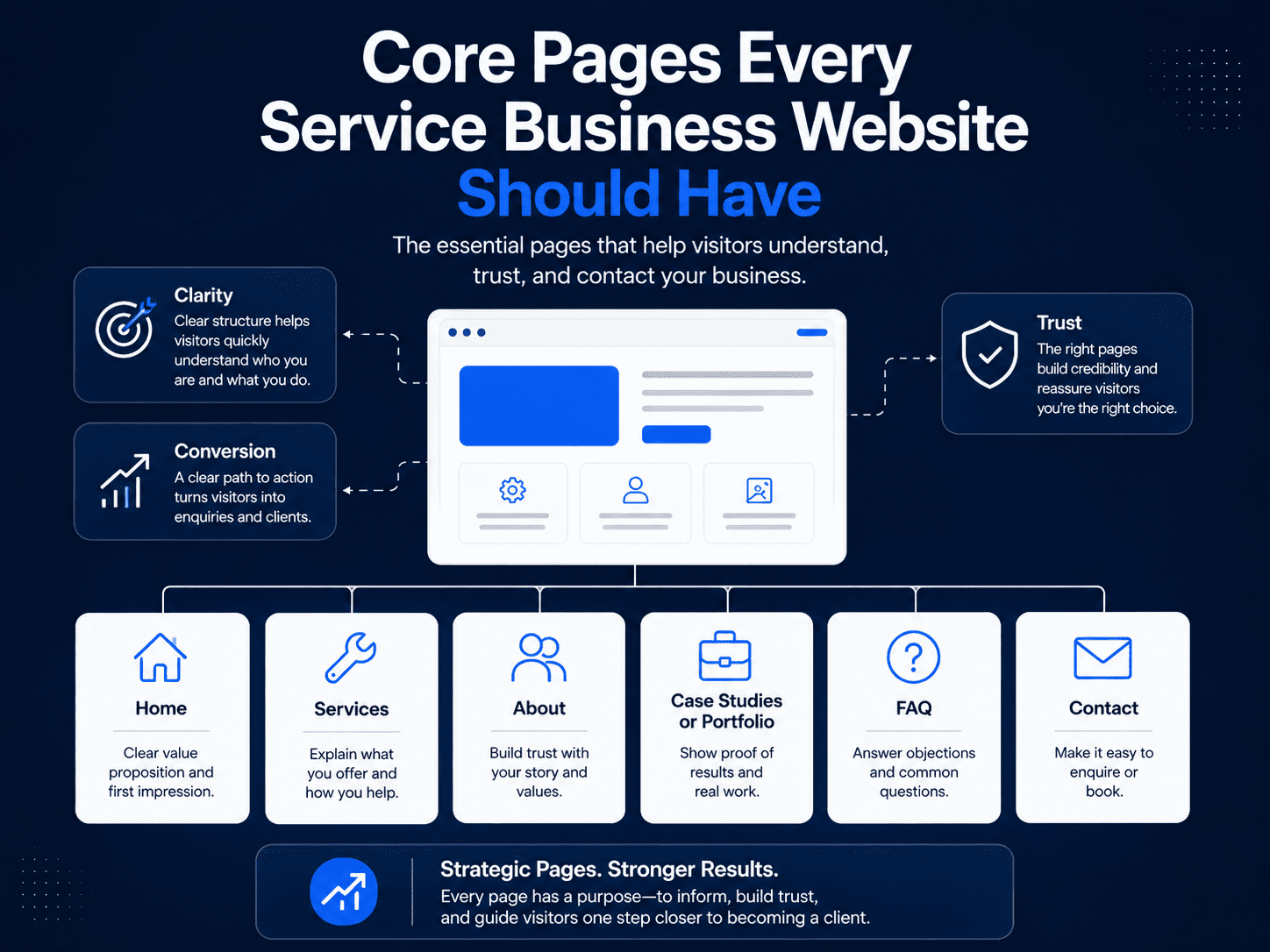
Your navigation should be simple and easy to understand.
A recommended menu:
- Home
- Services
- Pricing
- Work
- Blog
- Contact
For local businesses:
- Home
- Services
- Areas Served
- Reviews
- About
- Contact
For consultants or agencies:
- Home
- Services
- Case Studies
- Insights
- About
- Book a Call
The header should also include a visible CTA button.
Examples:
- Book a Call
- Request a Quote
- Get Started
- Contact Us
Best Footer Structure
The footer is often overlooked, but it helps navigation and trust.
A strong footer should include:
- Business name
- Short description
- Main service links
- Contact details
- Social links
- Legal links
- Location or service area
- CTA
- Copyright notice
For local businesses, include the address, phone number, and service area clearly.
Conversion Elements Every Service Website Needs
A service business website should include conversion elements across multiple pages.
Important conversion elements include:
- Clear headline
- Strong CTA buttons
- Contact form
- Click-to-call button
- WhatsApp button
- Booking link
- Testimonials
- Case studies
- Pricing guidance
- FAQ sections
- Trust badges
- Process explanation
- Service benefits
- Lead magnet
- Analytics tracking
These elements help move visitors from interest to enquiry.
SEO Structure for Service Business Websites
A strong SEO structure helps search engines understand your website.
Recommended SEO structure:
- Homepage targets your main business category
- Services page targets broad service keywords
- Individual service pages target specific service keywords
- Location pages target city or area keywords
- Blog posts target educational and comparison keywords
- Case studies target proof and niche-specific keywords
- Internal links connect related pages
For example, a WAAS business could structure SEO like this:
- Homepage: Website-as-a-Service for Small Businesses
- Service page: Monthly Website Plans
- Service page: Custom Website Design
- Service page: Landing Page Design
- Blog post: Website-as-a-Service Explained
- Blog post: Monthly Website Plan vs One-Time Website Build
- Blog post: Landing Page vs Website
- Blog post: Website Redesign Checklist
This structure creates topical authority around business websites and lead generation.
Common Website Structure Mistakes
Many service business websites struggle because of avoidable structure mistakes.
Common mistakes include:
- Putting all services on one page only
- Hiding contact information
- Using vague page titles
- Having no clear CTA
- No pricing guidance
- No testimonials or proof
- No FAQ section
- Weak homepage headline
- Poor mobile layout
- No internal linking
- No service-specific pages
- No local SEO structure
- Blog posts with no link to services
- Contact form that is too long
Fixing these issues can improve both SEO and conversions.
Simple Website Structure for a New Service Business
If you are just starting, you do not need a huge website.
Start with five core pages:
- Homepage
- Services page
- About page
- FAQ page
- Contact page
Then add individual service pages and blog content over time.
A simple structure is better than a large website that is confusing or unfinished.
Advanced Website Structure for a Growing Service Business
If your business is growing, build a stronger structure:
- Homepage
- Services overview
- Individual service pages
- Pricing page
- Case studies
- Testimonials
- Blog or resources
- Location pages
- FAQ page
- Contact page
This gives your business stronger SEO coverage, more trust proof, and better conversion paths.
Final Thoughts
The best website structure for service businesses is built around clarity, trust, SEO, and conversion. Your website should help visitors quickly understand what you offer, why it matters, why they should trust you, and how to contact you.
A strong service business website should include a clear homepage, dedicated service pages, trust proof, pricing guidance, FAQs, contact options, and SEO-friendly content.
You do not need to build everything at once. Start with the most important pages, then expand over time as your business grows.
The goal is not to have more pages. The goal is to have the right pages arranged in a way that helps visitors become customers.