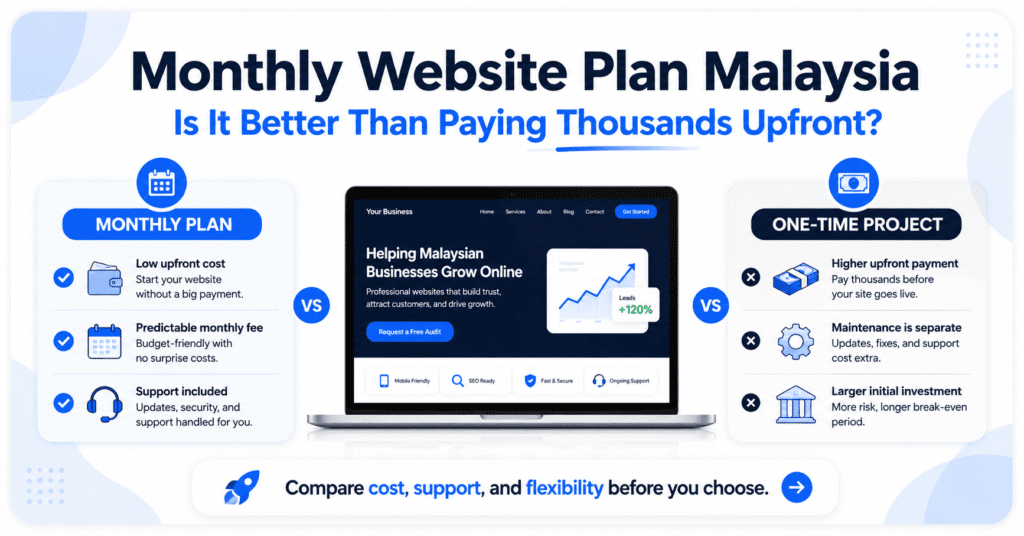
For many small business owners in Malaysia, building a website can feel like a big decision. You know your business needs a professional online presence, but the upfront cost can be difficult to justify, especially when you are still trying to manage cash flow, marketing, operations, staff, rent, and daily business expenses.
A traditional website project usually requires you to pay a lump sum before the website goes live. Depending on the scope, this may cost a few thousand ringgit or more. For some businesses, that is perfectly fine. They have the budget, they know exactly what they want, and they are ready to invest in a full custom website.
But for many small businesses, the situation is different. They need a website, but they do not want to spend RM5,000, RM8,000, or RM10,000 upfront. They also do not want to struggle with DIY website builders, technical setup, hosting, updates, plugins, design decisions, and content writing.
This is where a monthly website plan becomes useful.
A monthly website plan, sometimes called Website-as-a-Service, allows businesses to launch a professional website with a lower upfront cost. Instead of treating the website as a one-time project, the website becomes an ongoing service that includes setup, hosting, maintenance, support, and updates depending on the plan.
For Malaysian SMEs, this can be a practical middle ground between hiring an expensive agency and trying to build everything yourself.
The question is not whether a monthly website plan is always better. The real question is whether it is better for your current business stage, budget, and growth goals.
What Is a Monthly Website Plan?
A monthly website plan is a website service where you pay a recurring monthly fee instead of paying one large upfront project fee.
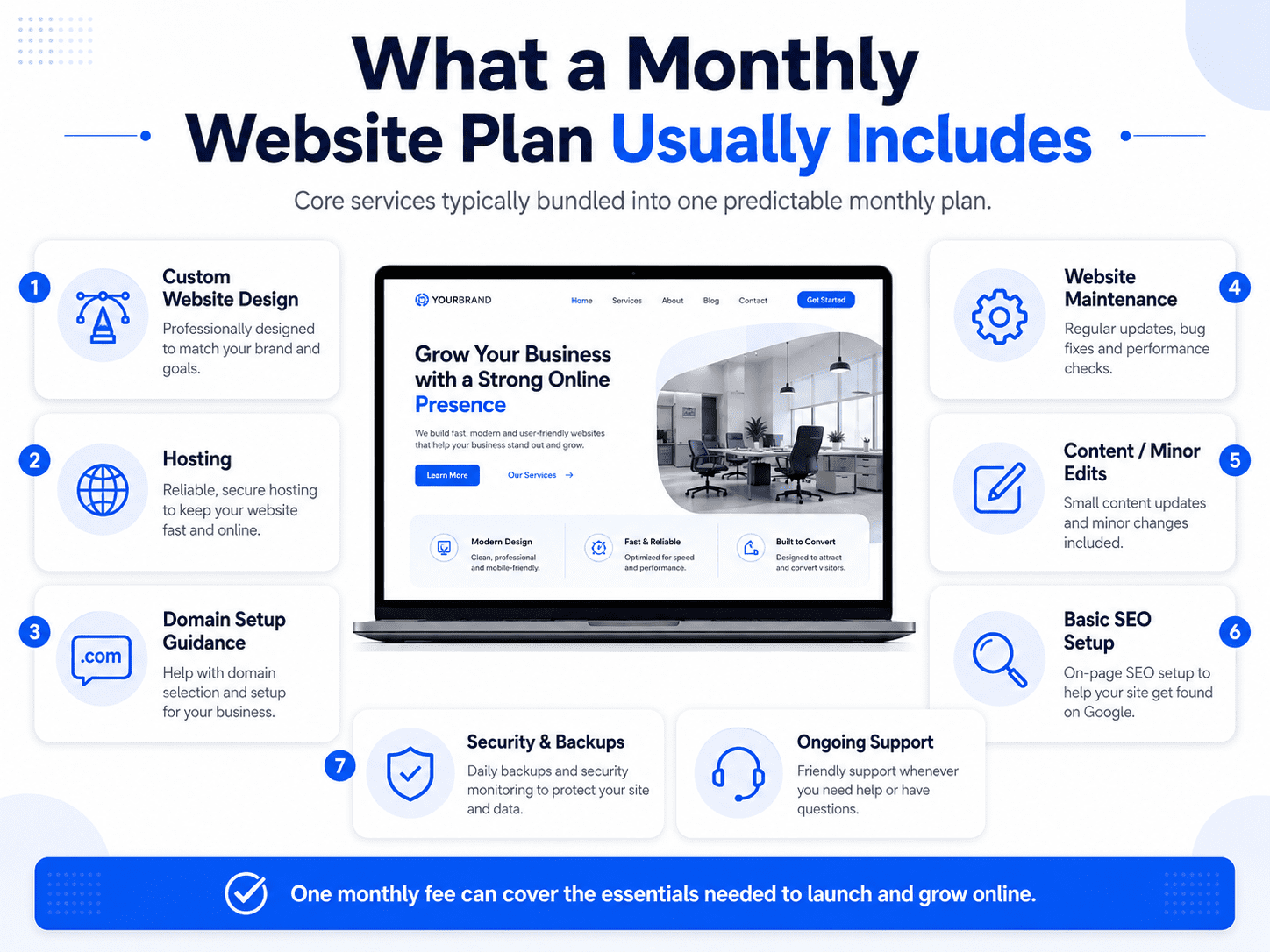
The exact structure depends on the provider, but a proper monthly website plan usually includes the website setup, mobile-friendly design, basic pages, hosting, SSL, maintenance, support, and small content updates. Some plans may also include landing pages, blog setup, SEO structure, analytics, WhatsApp button, enquiry forms, and conversion suggestions.
In simple terms, you are not only paying for the website design. You are paying for the website to be built, launched, maintained, and supported over time.
This is different from a DIY website builder where you pay for the platform but still need to do everything yourself. With a monthly website plan, the goal is usually to make the process easier for business owners who want a professional result without learning web design, SEO, hosting, and technical maintenance.
It is also different from a traditional one-time website project. With a one-time build, the provider completes the website and hands it over. After that, support, updates, maintenance, hosting, and improvements may be charged separately.
A monthly website plan is designed for businesses that prefer predictable costs and ongoing support.
Why Monthly Website Plans Are Becoming More Attractive
The way small businesses use websites has changed. In the past, many businesses treated their website like a digital brochure. They built it once, published it, and left it untouched for years.
Today, that approach is no longer enough.
Customers search online before they contact a business. They compare websites, check reviews, look for proof, browse services, and decide whether a company looks trustworthy. If your website feels outdated, unclear, slow, or difficult to use on mobile, potential customers may leave before contacting you.
For service businesses, the website is often part of the sales process. It needs to explain your offer, answer common questions, build credibility, and guide visitors toward WhatsApp, phone call, booking, or enquiry form.
This means a website should not be left untouched after launch. Over time, you may need to update your services, improve your homepage, add new testimonials, publish blog posts, create campaign landing pages, adjust pricing, or improve your call-to-action.
A monthly website plan fits this reality better because it treats the website as an ongoing business tool instead of a one-time design project.
For small businesses that do not have an in-house marketing or technical team, this kind of support can be valuable.
Monthly Website Plan vs One-Time Website Build
A one-time website build is the traditional way of creating a website. You agree on the scope, pay a project fee, go through the design and development process, review the website, and launch it.
This works well when the business has a clear budget and wants a custom website with more control from the beginning. If you are an established company, launching a major rebrand, building a corporate website, or developing a custom platform, a one-time project may be the better option.
A monthly website plan works differently. Instead of paying a large upfront amount, you pay a smaller recurring fee. This helps reduce the initial financial pressure. It is often better suited for small businesses that want to launch quickly, keep costs predictable, and receive ongoing support after the website goes live.
The difference is similar to buying a car versus subscribing to a service. Buying gives you ownership and control, but you are responsible for more upfront cost and future maintenance. A subscription gives you easier access and ongoing support, but you need to understand the terms clearly.
Neither option is automatically better. The right choice depends on your business needs.
If your priority is full customisation, complete ownership from day one, and a fully tailored website project, a one-time website build may be more suitable.
If your priority is lower upfront cost, speed, support, and simplicity, a monthly website plan may be a better fit.
Why Small Businesses Choose Monthly Website Plans
Many small businesses choose monthly website plans because they want to avoid the stress of a large upfront payment.
For a new clinic, beauty salon, gym, renovation company, consultant, coach, or local service provider, cash flow matters. Paying thousands of ringgit upfront for a website may not feel comfortable, especially when the business still needs to spend on advertising, equipment, rental, staff, inventory, signage, and operations.
A monthly website plan makes it easier to start.
Instead of delaying the website for months because the upfront cost feels too high, the business can launch sooner and start building online credibility. This is important because not having a proper website can also cost money. Potential customers may search for your business and choose a competitor simply because they look more established online.
Another reason small businesses prefer monthly plans is support. Many business owners do not want to manage hosting, updates, plugins, security, backups, or technical issues. They just want their website to work.
With a proper monthly website plan, the website provider handles the technical side so the business owner can focus on running the business.
This is especially useful for owners who are not comfortable editing websites themselves or who do not have time to chase freelancers every time they need a small change.
The Main Benefits of a Monthly Website Plan
The biggest benefit is lower upfront cost. A monthly plan allows your business to get online without paying a large project fee at the start. This can be helpful for new businesses or small businesses that want to manage cash flow carefully.
Another benefit is ongoing support. A website is not something you only need once. Business information changes. Services change. Promotions change. Staff changes. Customer expectations change. A monthly plan gives you a support structure for these updates.
A monthly plan can also make website maintenance easier. Technical maintenance is often ignored by small businesses, but it is important. Websites need updates, backups, security monitoring, and occasional fixes. If these are not handled properly, the website may become slow, broken, or vulnerable over time.
There is also the benefit of speed. Many monthly website plans are built around pre-designed structures or templates, which means the website can often be launched faster than a fully custom website project.
For many small businesses, this is enough. They do not need a complicated website. They need a professional, clear, mobile-friendly website that helps customers understand their business and contact them easily.
What Should Be Included in a Good Monthly Website Plan?
A good monthly website plan should include more than just a basic webpage.
At minimum, the website should be mobile-friendly, professionally designed, easy to understand, and structured around your business goals. It should include clear messaging, service sections, contact details, WhatsApp button, enquiry form, basic SEO setup, and essential technical setup.
Hosting and SSL should also be clear. Your website should load securely and reliably. If hosting is included, you should understand what type of hosting is provided and whether there are any usage limits.
Maintenance is another important part. A monthly plan should explain how updates, backups, security checks, and technical support are handled. If the website is built on WordPress, maintenance is especially important because plugins and themes need regular updates.
Content updates should also be defined clearly. Some plans may include minor monthly updates, such as changing text, replacing images, updating business hours, adding testimonials, or adjusting contact details. Larger changes, new page builds, custom features, or redesign work may cost extra.
A good monthly website plan should also include clear communication. You should know how to request changes, how long updates usually take, and what is considered within the monthly plan.
The clearer the plan, the fewer problems you will face later.
What to Check Before Signing Up for a Monthly Website Plan
Before choosing a monthly website plan in Malaysia, you should understand the terms clearly.
The first thing to check is ownership. Ask who owns the domain, website content, images, design, and website files. If you provide your own content and photos, you should be able to keep them. If the provider builds the website on their system, you should understand what can be exported if you cancel.
You should also ask about cancellation. Is there a minimum contract period? What happens if you stop paying? Can you keep the website? Can you export your content? Is there a buyout option? These questions are important because you do not want to be surprised later.
Support scope is another important area. Some providers include only technical support, while others include design updates, content changes, SEO support, or landing page support. Make sure you understand what is included and what will be charged separately.
You should also ask whether the monthly plan includes SEO. Some plans only include basic SEO setup, while others may include keyword planning, blog support, local SEO pages, or analytics. These are very different levels of service.
Finally, check whether the website can grow with your business. You may start with a simple one-page website today, but later you may need more service pages, landing pages, blog posts, booking forms, or integrations. A good monthly website plan should give you a clear upgrade path.
Is a Monthly Website Plan Cheaper in the Long Run?
This depends on how you compare the cost.
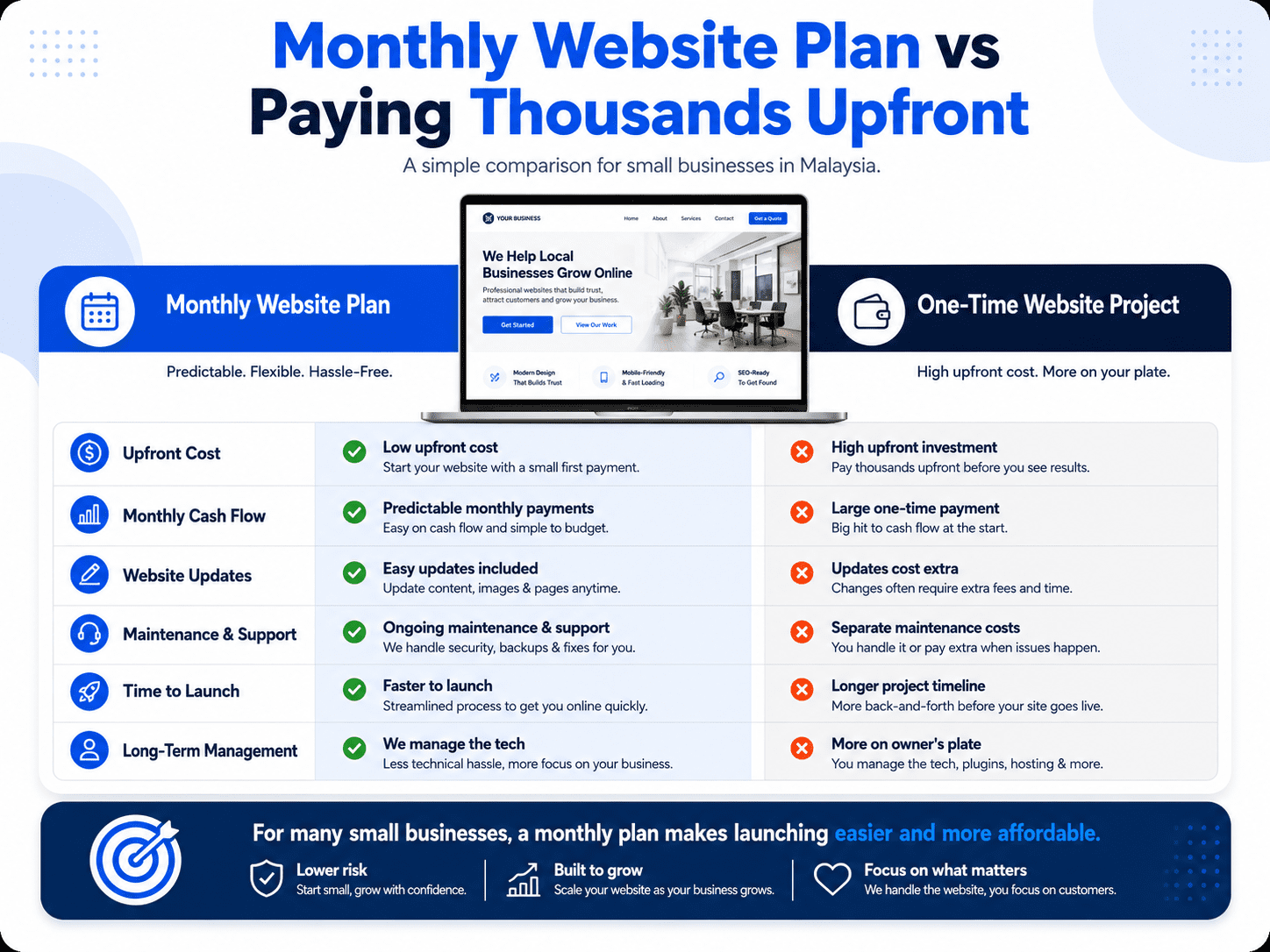
A monthly website plan is usually cheaper at the beginning because you avoid a large upfront payment. This is helpful if your main concern is cash flow.
However, over a longer period, the total amount paid monthly may become similar to or higher than a one-time website build. For example, if you pay monthly for several years, the total cost will add up.
But the comparison is not only about total price. You also need to compare what is included.
If the monthly plan includes hosting, maintenance, support, updates, technical fixes, and improvements, then you are not only paying for the website design. You are paying for ongoing service.
With a one-time website build, you may still need to pay separately for hosting, maintenance, updates, support, redesign, troubleshooting, or SEO improvements. These costs can also add up over time.
So the better question is not simply, “Which one is cheaper?”
The better question is:
Which option gives your business better value, less stress, and a website that continues to support your growth?
If you have the budget and want full control, a one-time build may make sense. If you prefer predictable monthly cost and ongoing support, a monthly plan may be more practical.
Who Should Choose a Monthly Website Plan?
A monthly website plan is suitable for small businesses that need a professional website but do not want to handle everything themselves.
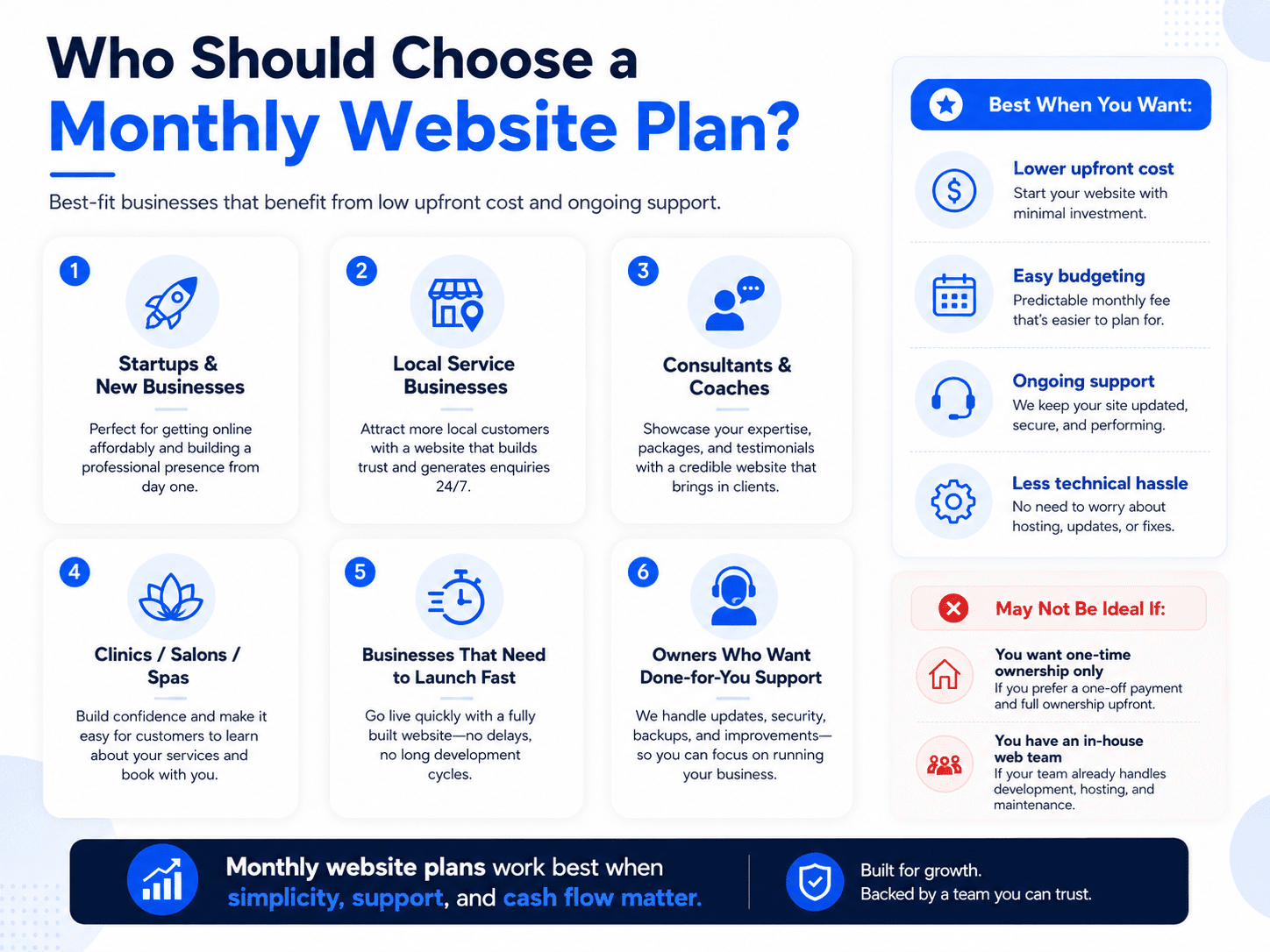
It is especially suitable for new businesses that want to launch quickly, local service businesses that rely on enquiries, and business owners who are not technical. It also works well for consultants, coaches, clinics, salons, gyms, home service providers, agencies, freelancers, and professional service businesses.
If your business mainly needs a website to explain your services, build trust, capture leads, and direct people to WhatsApp or a contact form, a monthly plan can be a strong option.
It is also useful if your business changes often. For example, if you regularly update promotions, packages, services, testimonials, or landing pages, ongoing support can be more useful than a one-time project.
However, if you need a fully custom web application, advanced eCommerce system, complex booking engine, membership platform, or deep backend system, a standard monthly website plan may not be enough. In that case, a custom website or web application project may be more suitable.
Who Should Choose a One-Time Website Build?
A one-time website build may be better if your business wants full customisation and has a clear website budget.
It is suitable for established companies that need a more strategic website, stronger branding, custom page layouts, advanced functionality, or a more complete SEO and content strategy.
It may also be better if you already have an internal team to manage the website after launch. For example, if you have a marketing person, content team, IT support, or in-house designer, you may not need monthly website support from the provider.
A one-time build is also suitable if you want clearer ownership from the beginning and prefer to manage hosting, maintenance, and updates separately.
The main thing is to make sure you do not treat the website as a finished project forever. Even if you pay one time, your website still needs to be updated, maintained, and improved over time.
Monthly Website Plan vs DIY Website Builder
Some business owners compare monthly website plans with DIY website builders because both involve recurring payment.
But they are not the same.
A DIY website builder gives you the tools to build your own website. You choose the template, write the content, arrange the sections, set up the pages, connect the domain, and make updates yourself.
This can work if you enjoy doing it and have time to learn.
A monthly website plan is usually more service-based. The provider helps you build, launch, and maintain the website. This is better for business owners who want the result but do not want to spend time learning web design or dealing with technical setup.
DIY may look cheaper, but the hidden cost is your time. If you spend weeks trying to build the website and the final result still does not look professional, the savings may not be worth it.
For business owners who are already busy managing customers, staff, sales, and operations, paying for a done-for-you or done-with-you monthly website plan can be more practical.
Why a Website Should Be Treated as a Business Tool
Many businesses still think of a website as a one-time item. They build it because people say every business needs a website.
But a good website should do more than prove that your business exists.
It should help customers understand your offer. It should answer their questions. Or, it should make your business look reliable. It should support your Google visibility. It should make it easy for visitors to contact you.
For Malaysian businesses, this often means having strong mobile design and clear WhatsApp call-to-action. Many customers prefer to enquire through WhatsApp because it feels fast and convenient. If your website makes that process difficult, you may lose potential leads.
Your website should also support your other marketing channels. If you post on Facebook, Instagram, Rednote, TikTok, LinkedIn, or Pinterest, your website can become the place where interested people learn more and take the next step.
This is why ongoing improvement matters. A website that gets reviewed and updated regularly has a better chance of supporting your business compared to a website that is left untouched for years.
Common Mistakes When Choosing a Monthly Website Plan
One common mistake is choosing only based on the lowest monthly price. A cheap monthly plan may look attractive, but it may include very limited support, weak design, no SEO structure, no content help, or unclear cancellation terms.
Another mistake is not asking about ownership. Business owners may assume they can keep everything if they cancel, but this depends on the provider’s terms. It is better to clarify this before signing up.
Some businesses also make the mistake of expecting unlimited custom work under a low monthly fee. A monthly website plan usually includes defined support, not unlimited design and development. If you need custom features, extra pages, advanced integrations, or major redesign work, those may cost extra.
The best way to avoid disappointment is to ask clear questions before starting. A good provider should be transparent about what is included, what is not included, and how the website can grow in the future.
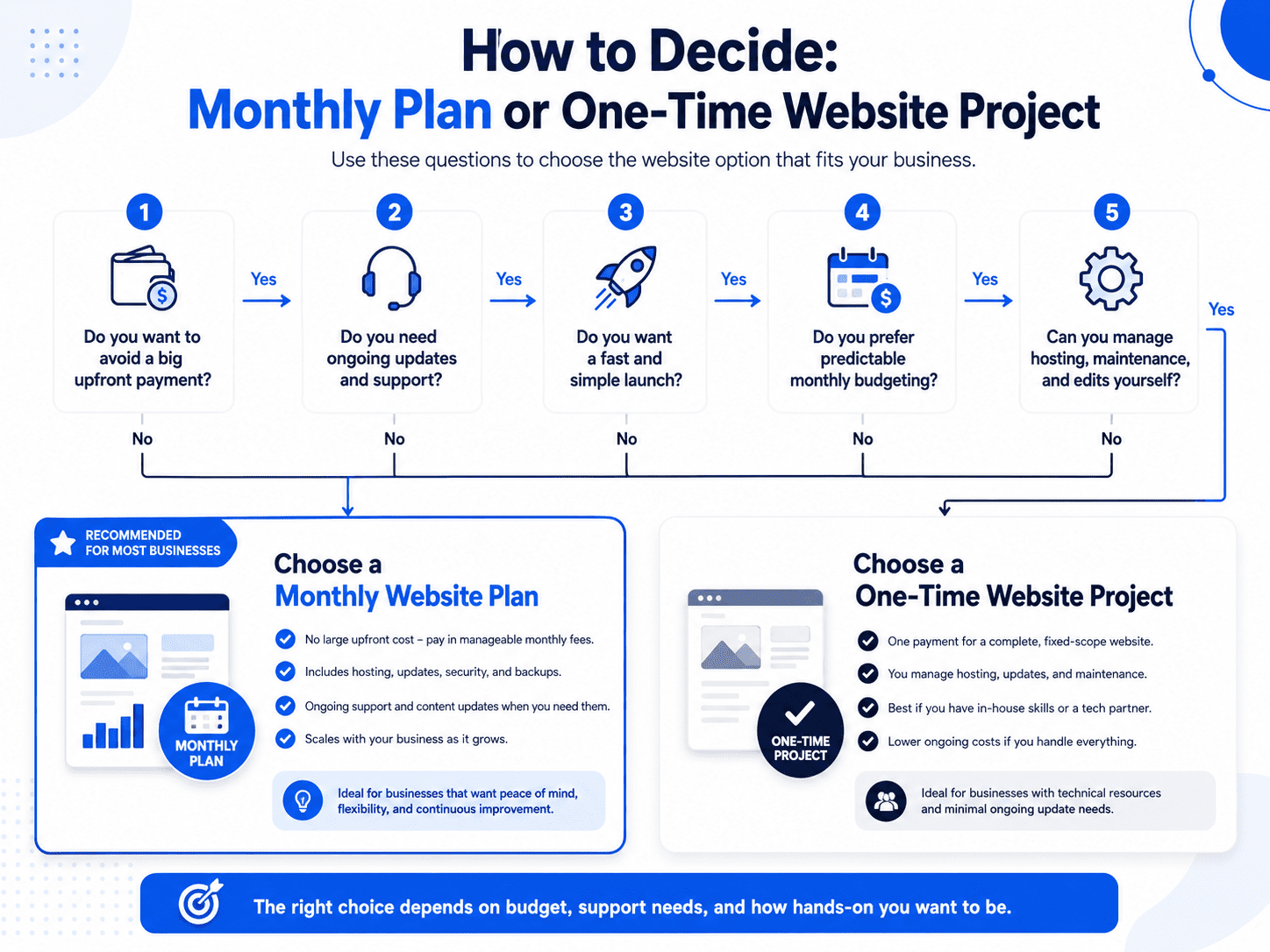
How to Decide Which Option Is Right for You
If your business is just starting and you want a professional online presence without high upfront cost, a monthly website plan may be the better choice.
If your current website looks outdated and you want to improve it gradually with support, a monthly plan can also work well.
And if you have a larger budget and want a fully customised website project from the beginning, then a one-time website build may be more suitable.
If you are comfortable building websites yourself and have time to learn, a DIY website builder can be an affordable option.
The decision should depend on your budget, time, technical confidence, support needs, and business goals.
The most important thing is to choose a website solution that helps your business move forward. A website that never gets launched because the upfront cost feels too high does not help you. A cheap website that does not build trust also does not help much. A beautiful website that nobody maintains can become outdated quickly.
The right website solution should fit your business stage and help you get found, trusted, and contacted.
Final Thoughts: Is a Monthly Website Plan Worth It?
A monthly website plan can be worth it for Malaysian small businesses that want a professional website without paying thousands upfront.
It is especially useful for business owners who want lower initial cost, faster launch, ongoing support, technical maintenance, and a website that can be updated over time.
However, it is not automatically the best option for everyone. If you need a complex custom website, full ownership from day one, or advanced functionality, a one-time custom build may be better.
The best choice depends on what your business needs right now.
If your goal is to launch a clear, professional, mobile-friendly website that helps customers understand your services and contact you easily, a monthly website plan can be a practical and affordable way to start.
A good website should not just sit online. It should support your marketing, build trust, and help your business get more enquiries.
For many SMEs, that is the real value of a monthly website plan.
Need a Professional Website Without Paying Thousands Upfront?
If you want a business website but do not want to spend a large amount upfront, a monthly website plan may be a better option.
At Bennie Tay, we help small businesses build professional, conversion-focused websites designed to generate enquiries, improve trust, and support business growth.
Whether you need a simple one-page website, a full business website, a landing page, or ongoing website support, the goal is to help your business get found, trusted, and contacted.
Start with a website plan that fits your current stage, then improve as your business grows.
FAQ: Monthly Website Plan Malaysia
What is a monthly website plan?
A monthly website plan is a website service where you pay a recurring monthly fee instead of paying a large upfront project cost. Depending on the plan, it may include website setup, hosting, SSL, maintenance, support, and content updates.
Is a monthly website plan suitable for small businesses in Malaysia?
Yes, it can be suitable for small businesses that want a professional website with lower upfront cost and ongoing support. It is especially useful for service businesses, consultants, clinics, salons, gyms, and local businesses that rely on enquiries.
Is a monthly website plan cheaper than a one-time website build?
It is usually cheaper at the beginning because you avoid a large upfront payment. Over time, the total cost may add up, but the monthly fee may also include hosting, maintenance, support, and updates that would otherwise be charged separately.
What should I check before choosing a monthly website plan?
You should check what is included, whether there is a minimum contract period, who owns the domain and content, what happens if you cancel, whether support is included, and whether you can upgrade later.
Is Website-as-a-Service the same as a DIY website builder?
No. A DIY website builder gives you tools to build the website yourself. Website-as-a-Service usually includes more support, where the provider helps build, launch, maintain, and update the website for you.