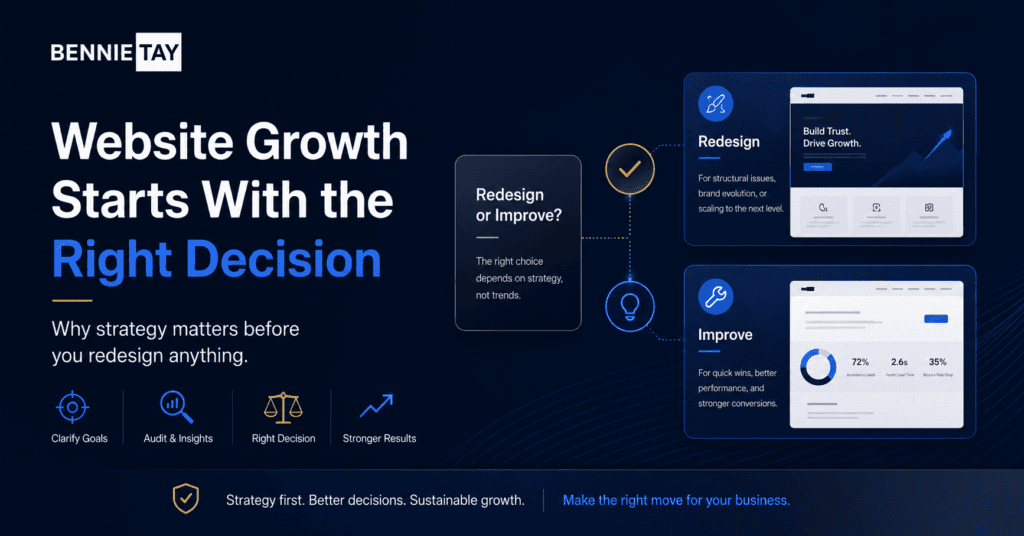
Many business owners know their website is not performing well, but they are unsure whether they should redesign the whole thing or improve what they already have. This is an important decision because both options can work, but they solve different problems.
A full website redesign can give you a cleaner structure, stronger messaging, better mobile experience, and a more modern brand impression. It can also take more planning, time, and budget. Smaller improvements can be faster and more affordable, but they only work when the existing website still has a solid foundation.
The best choice depends on what is actually holding the website back. If the problem is unclear wording, weak calls to action, slow pages, or missing proof, you may not need to start from zero. If the website is difficult to update, poorly structured, outdated, or built around the wrong business message, a redesign may be the better long-term move.
Start with the business problem
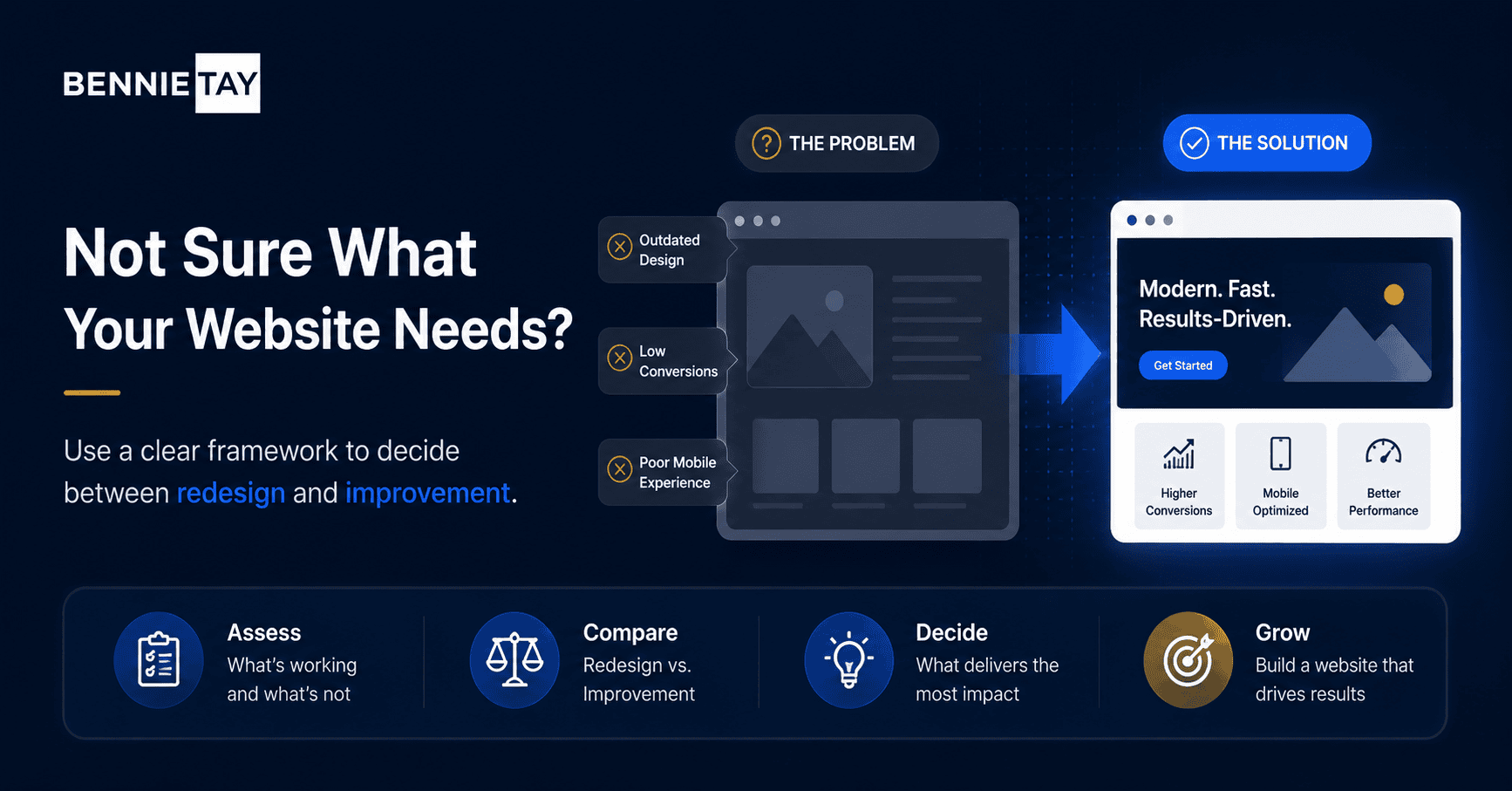
Before deciding what to do, look at the business problem behind the website. Is the website failing to generate enquiries? Are visitors leaving quickly? Are the wrong people contacting you? Are sales conversations starting with confusion because the website does not explain your offer clearly?
A website is not only a visual asset. It is part of your sales and trust-building process. If the site looks acceptable but does not guide visitors toward action, the issue may be strategy rather than design. If the design is clean but the content is vague, improving copy and page structure may make a big difference.
On the other hand, if your business has changed significantly, your website may no longer represent what you sell. You may have new services, a different target market, better case studies, or a stronger positioning angle. In that situation, patching the old site can create more confusion because the foundation is outdated.
When improvements may be enough
Improving the existing website can be the right choice when the basic structure still works. For example, your pages may load properly, the design may still look credible, and the content management system may be easy to use. The issue might be that important sections are missing or not strong enough.
You might improve the homepage headline, add clearer service descriptions, rewrite weak calls to action, improve contact forms, add testimonials, or update photos. These changes can be enough if visitors already understand your business but need more confidence before contacting you.
This approach is especially useful when you need results quickly. If you are running ads, sending traffic from social media, or relying on search traffic, small improvements can reduce wasted traffic while you plan a larger redesign later.
When a redesign is the better choice
A redesign is usually better when the website has too many structural problems. If the navigation is messy, the mobile layout is hard to use, the pages feel disconnected, or the site is slow and difficult to maintain, small fixes can become expensive without solving the core issue.
You should also consider a redesign if the website gives the wrong impression. A professional service business can lose trust if the website looks old, inconsistent, or unfinished. Visitors may not say this directly, but design affects how they judge credibility, quality, and attention to detail.
A redesign also makes sense when your offer needs a clearer sales journey. Instead of adding more random pages, you can rebuild the website around the path a visitor should take: understand the problem, see your solution, trust your experience, compare options, and take action.

Check whether the content still matches your business
Content is often the biggest reason an old website stops working. Many websites were written when the business was smaller, less focused, or targeting a different type of customer. Over time, the website becomes a collection of old pages instead of a clear explanation of what the business does today.
Read your website as if you were a new visitor. Does it explain who you help? Does it show the problems you solve? Does it explain what makes your service different? Does it answer the questions people usually ask before they contact you?
If the answers are mostly yes, content improvements may be enough. If the answers are mostly no, a redesign can help because you can rebuild the pages around better positioning instead of trying to force new messaging into an old layout.
Look at mobile experience and speed
Most visitors will judge your website from a phone first. If buttons are hard to tap, text is too small, images load slowly, or forms are awkward, you may lose enquiries before people even understand your offer.
Some mobile issues can be fixed inside the existing website. Others are signs that the theme, builder, or layout system is outdated. If every small change creates another problem, the site may need a stronger technical foundation.
Speed also matters because slow pages reduce patience. A website does not need to be perfect, but it should feel responsive. If the site is heavy, full of unused scripts, and hard to optimize, a redesign may be more efficient than repeated patching.
Review conversion points
A website can look good and still fail because the conversion points are weak. Look at where visitors are supposed to take action. Is the contact button visible? Is the offer clear before the form? Does the page explain what happens after someone submits an enquiry?
If the main issue is weak conversion flow, you may be able to improve the existing website. Add stronger calls to action, reduce form friction, place enquiry buttons in natural locations, and add proof near decision points.
If conversion points are weak because the entire site journey is unclear, a redesign will be more useful. The goal is not just to add more buttons. The goal is to build confidence before asking for action.
Consider SEO risk before deciding
If your website already receives search traffic, do not redesign carelessly. A redesign can improve SEO, but it can also damage rankings if URLs change without redirects, important content is removed, page titles are rewritten badly, or technical settings are missed.
Smaller improvements may be safer when the website has valuable pages that already rank. You can update content, improve internal links, and strengthen calls to action without changing the entire structure.
If the site has poor SEO structure, thin content, duplicate pages, or outdated URLs, a planned redesign may be a better opportunity. The key is to map existing pages, keep what has value, redirect changed URLs, and rebuild around clearer topics.
Use cost as one factor, not the only factor
Improving an existing website usually costs less upfront. That makes it attractive, especially for small businesses. However, it is not always cheaper in the long run if you keep paying for fixes on a site that still feels outdated or difficult to manage.
A redesign usually costs more because it includes strategy, structure, copy, design, development, testing, and launch planning. But if it gives you a better website for the next few years, it may be the more practical investment.
The wrong decision is choosing the cheapest option without understanding the problem. Spend where the return is clearer. If small improvements can unlock better enquiries, start there. If the site is holding the business back at a deeper level, redesign properly.
A simple decision framework
Choose improvements if your website is technically stable, the design still looks credible, the business message is mostly accurate, and the main problems are specific. Examples include weak calls to action, missing testimonials, unclear service copy, poor photos, or a contact form that needs work.
Choose a redesign if the website is outdated, slow, confusing, difficult to update, off-brand, or built around old services. A redesign is also better when you need to reposition the business or create a more complete sales journey.
If you are unsure, start with an audit. List the issues, rank them by business impact, and separate surface problems from structural problems. This helps you avoid redesigning for the wrong reason or patching something that should be rebuilt.
Final thoughts
You do not always need to redesign your website. Sometimes a focused improvement plan can make the existing site clearer, faster, and more effective. But when the foundation is outdated, a redesign can save time and create a stronger platform for future growth.
The practical answer is to diagnose before deciding. Look at messaging, structure, mobile experience, speed, SEO, proof, and conversion flow. Once you know what is really limiting results, the right option becomes much clearer.
What to review before making the decision
Before choosing between improvements and a full redesign, review your analytics, enquiry quality, top landing pages, and common sales objections. These signals show whether visitors are finding the right information and whether the website is supporting real business goals.
Useful reference: Before redesigning, compare your current site against Google Search Central’s SEO Starter Guide to see what can be improved first. See Google Search Central SEO Starter Guide.Also ask your team what prospects commonly misunderstand. If the same questions keep appearing in calls, proposals, or messages, your website may need clearer explanations. Sometimes the most valuable
improvements are not visual at all. They are better answers placed where visitors need them.