Meta Title: Best Website Structure for Service Businesses That Want More Leads
Introduction
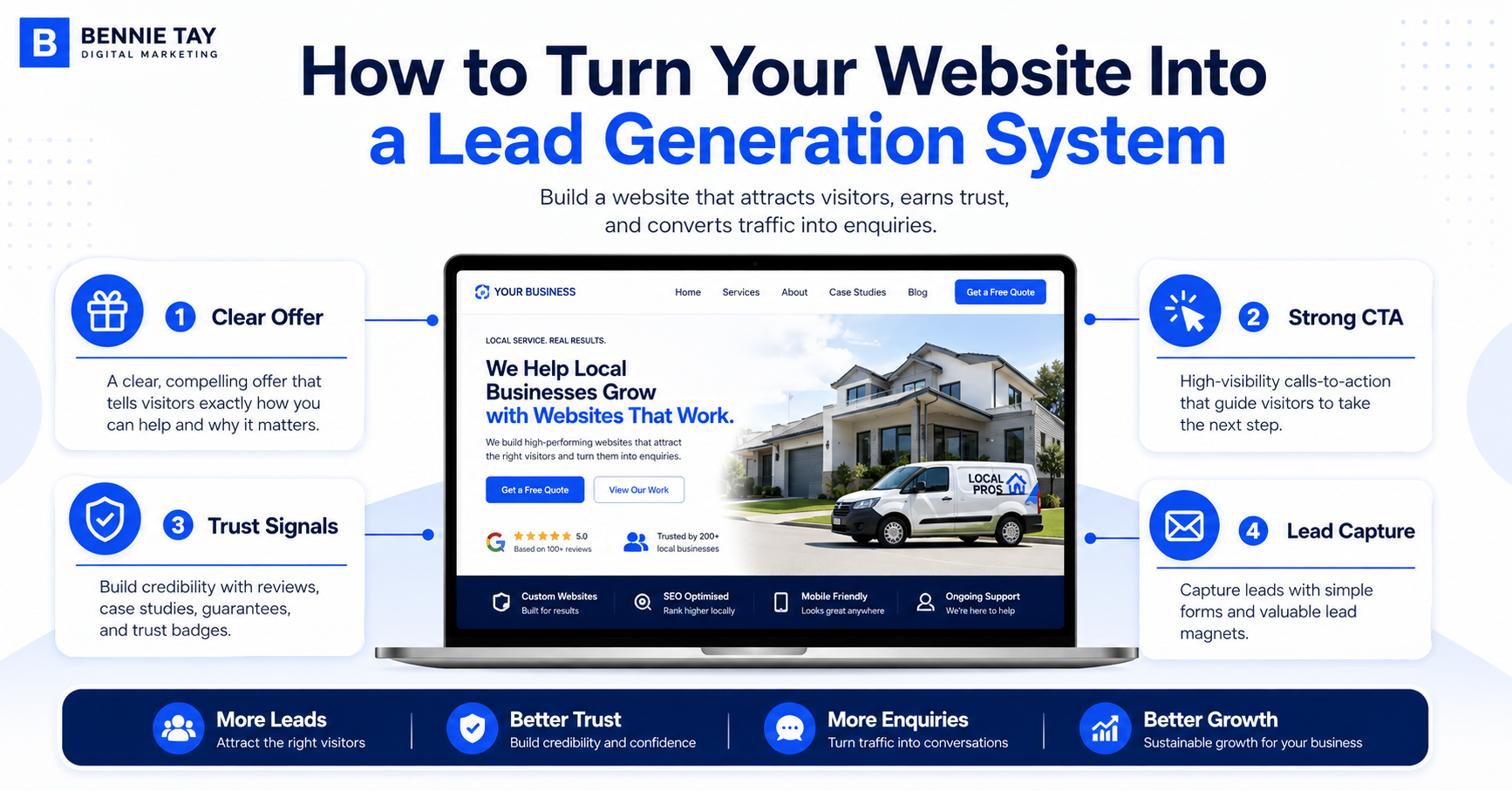
A service business website should do more than look professional. It should help visitors understand what you offer, trust your business, and take action.
For many small business owners, the website becomes an online brochure. It has a homepage, an about page, a services page, and a contact page. Everything looks acceptable on the surface. The logo is there. The photos are there. The menu works. The design may even look clean.
But the website still does not bring in enough leads.
That is because having a website and having a lead generation website are two very different things.
A lead generation website is structured around the customer journey. It guides visitors from first impression to enquiry. It answers their questions, removes doubt, shows proof, explains the next step, and makes it easy to contact you.
This matters especially for service businesses. Unlike an online store, where customers can quickly compare products and prices, service customers need more reassurance. They want to know whether you understand their problem, whether your solution is suitable, whether you are credible, and whether contacting you is worth their time.
If your website structure is confusing, too thin, too generic, or missing important pages, visitors may leave without taking action. Not because they are uninterested, but because your website failed to guide them properly.
In this guide, we will break down the best website structure for service businesses that want more leads, including the key pages, sections, content strategy, and conversion elements your website should include.
Why Website Structure Matters for Lead Generation
Website structure is not just about how pages are arranged in the menu. It affects how visitors move through your website, how clearly they understand your offer, and how easily search engines can understand your business.
A strong website structure helps with three important goals.
First, it improves user experience. Visitors should be able to find what they need quickly. They should not have to guess where your services are, how to contact you, or whether you serve their area.
Second, it improves conversion. A well-structured website guides visitors toward action. It places calls-to-action at the right points, builds trust before asking for contact, and reduces unnecessary friction.
Third, it improves SEO. Search engines need clear pages, logical internal links, and relevant content to understand what your business offers. If all your services are squeezed onto one vague page, it becomes harder to rank for specific search terms.
For example, a business that offers website design, landing page design, website redesign, and local SEO website services should not rely on one general “Services” page only. Each service has different search intent, customer problems, and selling points. Dedicated pages help you rank better and convert better.
A poor website structure usually creates problems such as:
Visitors cannot quickly understand what the business does
Important services are hidden or poorly explained
The contact button is not visible enough
There are no dedicated pages for SEO keywords
The homepage tries to say everything but convinces no one
Visitors do not see enough proof before being asked to enquire
The website feels generic and interchangeable with competitors
Your website structure should not be built around what is easiest to publish. It should be built around how customers actually make decisions.
The Core Website Structure Every Service Business Needs
A strong service business website does not need to be complicated. In many cases, simplicity works better. But it does need the right foundation.
At minimum, a lead-focused service business website should include these core pages:
Homepage
About page
Main services overview page
Individual service pages
Portfolio, case studies, or results page
Testimonials or reviews page
FAQ page
Blog or resource section
Contact page
Location or service area pages, if relevant
Not every business needs dozens of pages immediately. A new consultant, coach, salon, clinic, agency, contractor, or local service provider can start with a lean structure and expand over time.
The key is to avoid building a website that only talks about the company. Your structure should support the way customers search, compare, evaluate, and contact.
Let’s go through the most important parts.
- Homepage: Your Main Lead Generation Page
Your homepage is often the first page visitors see. It needs to make a strong impression quickly.
The homepage should answer the visitor’s most important questions within the first few seconds:
What do you do?
Who do you help?
What problem do you solve?
Why should someone trust you?
What should they do next?
A good homepage for a service business should not be a random collection of company information. It should act like a guided sales page.
The ideal homepage structure usually includes:
A clear hero section
A short explanation of your service
A strong call-to-action
Key benefits
Main services
Trust signals
Customer pain points
Your process
Testimonials
Portfolio or examples
FAQ section
Final call-to-action
The hero section is the top part of your homepage. This is where many websites go wrong. They use vague headlines such as “Professional Solutions for Modern Businesses” or “Your Trusted Partner in Excellence”.
These phrases sound polished but say very little.
A better homepage headline should be specific and outcome-focused.
For example:
“Professional Website Design for Small Businesses That Need More Leads”
Or:
“Reliable Accounting Services for SMEs That Want Clearer Finances and Less Stress”
Or:
“Renovation Services for Homeowners Who Want Quality Work Without Project Headaches”
A strong headline tells visitors they are in the right place. The supporting text below the headline should explain the offer in simple language. Then the call-to-action should make the next step obvious.
For example:
“Request a Free Consultation”
“Get a Quote”
“Book an Appointment”
“WhatsApp Us Today”
“Check Service Availability”
Your homepage should also show proof. Testimonials, project examples, client logos, certifications, years of experience, and results can help visitors feel safer contacting you.
The homepage does not need to explain every detail. Its job is to introduce your business, build interest, and direct visitors to the right next page.
- Services Overview Page: Help Visitors Understand What You Offer
A services overview page gives visitors a clear summary of everything your business provides.
This page is useful when you offer multiple services or packages. It helps visitors compare options and choose the most relevant one.
For example, a website design business may include:
Business website design
Landing page design
Website redesign
Website-as-a-Service monthly plans
Local SEO website pages
Website copywriting
Maintenance and support
Each service should have a short description and a link to its own dedicated service page.
The mistake many businesses make is placing all service information on one long page without proper structure. This makes the page harder to scan and weaker for SEO.
A good services overview page should include:
A clear headline
A short introduction
Service categories
Brief explanation of each service
Who each service is suitable for
Links to individual service pages
Trust elements
A strong CTA
This page helps visitors who are still exploring. They may not know exactly which service they need yet. Your structure should help them self-select instead of making them feel lost.
For lead generation, this page should not just list services. It should connect services to customer outcomes.
Instead of saying:
“Website Design”
Say:
“Website Design for Small Businesses That Need a Professional Online Presence and More Enquiries”
That is clearer because it links the service to a result.
- Individual Service Pages: The Most Important Pages for SEO and Conversion
Individual service pages are where your website can become much more powerful.
Each main service should have its own dedicated page. This helps you rank for specific keywords and speak directly to customers searching for that service.
For example, instead of having only one “Services” page, a service business could create pages such as:
Website Design for Small Businesses
Landing Page Design
Website Redesign Services
Monthly Website Plan
Local SEO Website Design
Business Website Maintenance
Each page should target a specific customer need.
A strong service page should include:
A clear service-focused headline
Who the service is for
The problem customers are facing
How your service solves the problem
What is included
Benefits of the service
Your process
Examples or case studies
Testimonials
FAQ
Clear CTA
This structure works because visitors landing on a service page often have higher intent. Someone searching for “website redesign service Malaysia” or “small business website design package” is not casually browsing. They may already be comparing options.
Your service page should give them enough information to take the next step.
Avoid writing thin service pages with only two paragraphs. A page that says “We provide high-quality website design services. Contact us today” is not enough. That kind of content gives visitors nothing to evaluate and gives search engines very little context.
A good service page should feel helpful, specific, and reassuring.
It should answer questions such as:
What exactly do you provide?
Who is this service best for?
What problems does it solve?
What does the process look like?
How long does it take?
What does the customer need to prepare?
What makes your service different?
What happens after they enquire?
The more clarity you provide, the easier it is for customers to contact you.
- About Page: Build Trust, Not Just Tell Your Life Story
The about page is one of the most misunderstood pages on a service business website.
Many businesses treat it like a company biography. They write about when the business started, their passion, their mission, and their values. These things can matter, but visitors are still asking one main question:
“Can I trust this business to help me?”
Your about page should build confidence.
It should explain who you are, what you do, who you help, why your work matters, and what makes your business credible.
A strong about page may include:
A short business introduction
Your experience or background
Your approach to service
Who you work with
Why customers choose you
Team photos or founder photo
Certifications or credentials
Values that affect the customer experience
A CTA to contact or view services
The best about pages are not self-indulgent. They connect your story to the customer’s needs.
For example, instead of only saying:
“We are passionate about helping businesses grow.”
You could say:
“We help small business owners build practical, professional websites that explain their services clearly and turn more visitors into enquiries.”
This is more useful because it tells the visitor what your experience means for them.
People want to work with service providers they feel comfortable with. A good about page can make your business feel more human, especially if your competitors use generic stock content.