
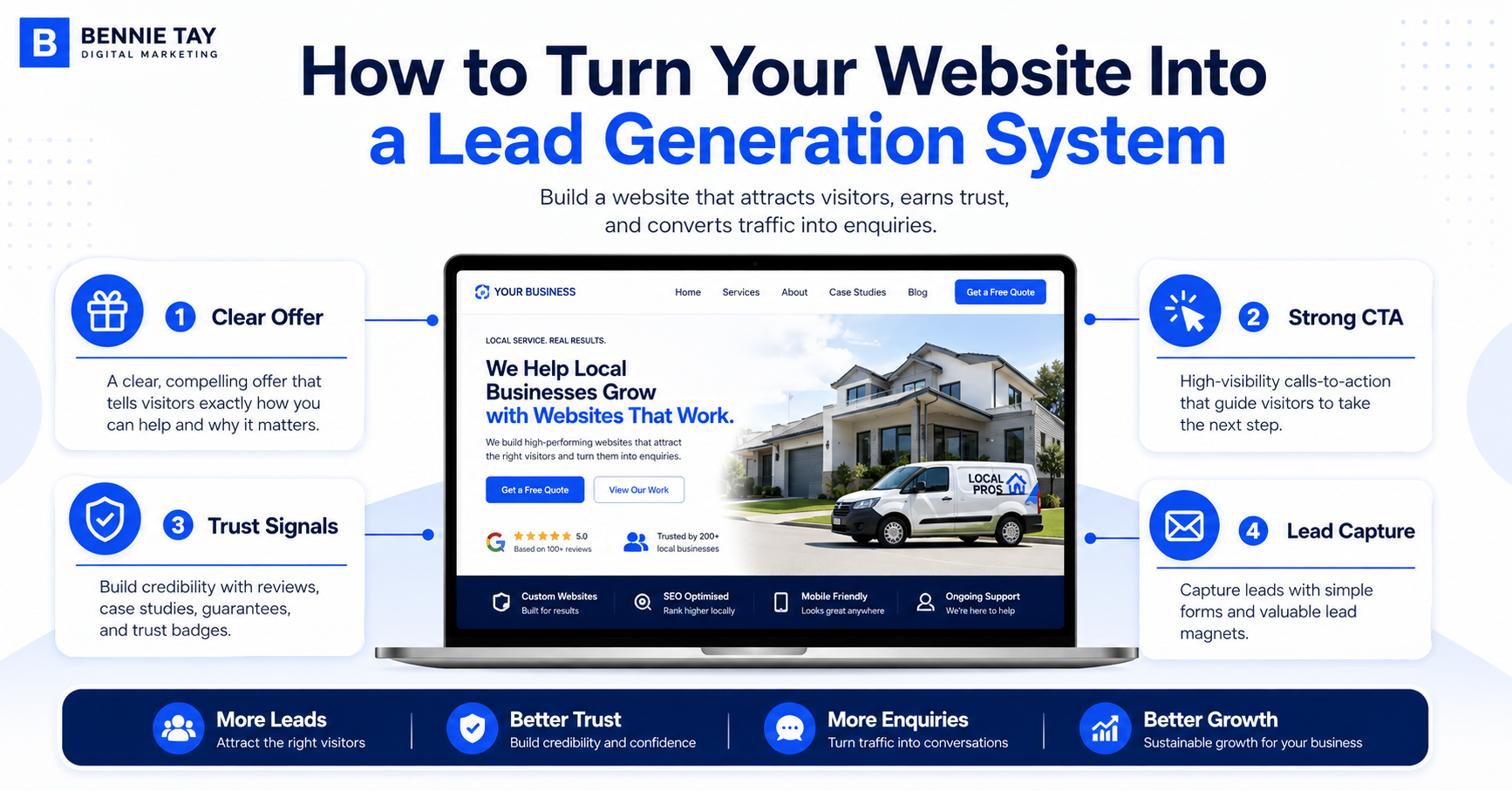
A website should do more than sit online and look respectable.
For many small businesses, the website is supposed to help bring in enquiries, bookings, calls, quote requests, consultations, or sales opportunities. Yet many business websites do not generate leads at all. They exist, they load, they have a homepage, they show a logo, and then they quietly do nothing.
This is a common problem.
Many businesses treat their website like a digital company profile. They include an About page, a Services page, a Contact page, maybe a few images, and then expect leads to appear. But a website does not generate enquiries just because it exists. It needs to be structured, written, designed, and optimised to guide visitors toward action.
A lead generation website works differently.
It is not just a brochure. It is a system.
A proper lead generation system attracts the right visitors, answers their questions, builds trust, removes doubt, presents a clear offer, and makes it easy for them to contact you. It also tracks what is working so you can improve over time.
For SMEs, consultants, clinics, local service providers, agencies, contractors, coaches, and professional businesses, this matters because your website can become one of your most valuable sales assets.
But only if it is built properly.
This guide explains how to turn your website into a lead generation system, what pages and elements you need, how to improve conversions, and what mistakes to avoid if you want your website to bring real business enquiries instead of just being an expensive online decoration.
What Is a Lead Generation Website?
A lead generation website is a website designed to convert visitors into potential customers.
A lead can be someone who:
Fills in a contact form
Sends a WhatsApp message
Calls your business
Requests a quotation
Books a consultation
Downloads a guide
Signs up for a newsletter
Registers interest in a service
Schedules an appointment
The goal is not just traffic. Traffic is useful, but traffic without enquiries is just digital sightseeing.
A lead generation website focuses on turning the right visitors into action-takers. It does this through clear messaging, strong page structure, trust-building content, relevant offers, simple contact options, and conversion tracking.
A normal business website may say, “Here is who we are.”
A lead generation website says, “Here is the problem we solve, here is why you can trust us, and here is the next step.”
That difference is huge.
Why Most Business Websites Do Not Generate Leads
Many websites fail at lead generation because they are designed from the company’s point of view, not the customer’s.
The website talks about the company history, mission, vision, values, and “commitment to excellence,” because apparently every business on earth has been issued the same sentence from a corporate vocabulary warehouse.
But customers do not visit your website to admire your mission statement.
They want to know:
Can you solve my problem?
Do you understand my situation?
What exactly do you offer?
Are you trustworthy?
How much does it cost?
What is the process?
Have you helped people like me before?
What should I do next?
If your website does not answer these questions clearly, visitors leave.
Common reasons websites do not generate leads include:
Unclear headline
Generic service descriptions
Weak calls to action
No trust signals
Poor mobile experience
Slow loading speed
Confusing navigation
No dedicated landing pages
No SEO structure
Too much company-focused content
Contact form is hard to find
No tracking or analytics
No follow-up system
A lead generation website fixes these problems by creating a clear journey from visitor to enquiry.
Step 1: Define What Counts as a Lead
Before improving your website, you need to define what you want visitors to do.
Different businesses have different lead goals.
For example:
A clinic may want appointment bookings.
A contractor may want quote requests.
A consultant may want discovery calls.
A tuition centre may want trial class enquiries.
A beauty salon may want WhatsApp bookings.
A B2B supplier may want contact form submissions.
A website service provider may want package enquiries.
Your website should be built around one or two primary actions.
Do not make visitors guess.
If your goal is WhatsApp enquiries, make WhatsApp visible. If your goal is consultation bookings, make the booking button clear. Or if your goal is quote requests, create a simple quote form.
A website with too many possible actions can confuse visitors. A website with no clear action wastes them entirely.
Step 2: Build the Website Around the Customer Journey
A lead generation website should follow the way customers think before contacting you.
Most visitors go through a simple journey:
They realise they have a problem.
They search for possible solutions.
They compare providers.
They look for proof.
They check if the offer fits their needs.
They decide whether to contact you.
Your website should support this journey.
That means your content should explain:
The problem your customer faces
The service you provide
The benefits of solving the problem
Why your solution is different
What proof you have
How the process works
What the customer should do next
For example, if you provide website design for SMEs, your website should not only say “We design websites.” It should explain how your websites help small businesses look professional, generate enquiries, improve trust, support SEO, and launch faster.
Customers need context before they take action.
The more clearly you guide them, the more likely they are to enquire.
Step 3: Make Your Homepage Clear and Action-Focused
Your homepage is often the first page visitors see. It needs to communicate quickly.
Within a few seconds, visitors should understand:
What you do
Who you help
What result you provide
Why they should trust you
What to do next
A strong homepage should include:
Clear headline
Short value proposition
Main call-to-action
Service overview
Trust signals
Benefits
Process
Testimonials
FAQ
Contact section
Avoid vague homepage headlines such as:
“Welcome to Our Company”
“Your Trusted Partner”
“Providing Quality Solutions”
These sound professional only in the way empty meeting rooms sound professional.
A better headline is specific.
For example:
“Professional Websites for Small Businesses That Need More Enquiries”
“Affordable Monthly Website Plans for Malaysian SMEs”
“Conversion-Focused Websites Built to Help Service Businesses Get Leads”
A strong homepage does not try to say everything. It gives visitors enough clarity to continue.
Step 4: Create Dedicated Service Pages
One of the biggest lead generation mistakes is putting all services on one generic page.
If your business offers multiple services, each important service should have its own page.
For example, instead of one page called “Services,” a website design business may need pages such as:
Website Design for Small Businesses
Monthly Website Plans
Landing Page Design
Website Redesign
Local SEO Website Pages
Website Maintenance
Dedicated service pages are better because they allow you to target specific search intent.
Each service page should explain:
What the service is
Who it is for
What problem it solves
What is included
How the process works
Why choose your business
FAQs
Testimonials or proof
Clear call to action
This helps both users and search engines.
A generic services page tells visitors what you offer. A dedicated service page helps them decide whether that specific service is right for them.
That is how a website becomes a lead generation system instead of a digital menu.
Step 5: Use SEO to Attract the Right Visitors
A website cannot generate leads if the right people never find it.
Search engine optimisation helps your website appear when potential customers search for your services.
For lead generation, SEO should focus on buying-intent keywords.
Examples include:
website design Malaysia
affordable website design Malaysia
monthly website plan Malaysia
small business website Malaysia
clinic website design
website designer for SMEs
landing page design Malaysia
website maintenance Malaysia
local SEO website service
These keywords show that the visitor may already be looking for a solution.
A lead generation website should include SEO elements such as:
Keyword-focused page titles
Meta descriptions
Clear heading structure
Search-friendly URLs
Helpful service content
Internal links
Image alt text
Fast loading speed
Mobile-friendly design
Local business information
FAQ sections
SEO is not only about blog posts. Your core service pages are often more important for lead generation.
A blog can bring awareness traffic. A service page captures people who are closer to making a decision.
You need both, but the service pages should come first.
Step 6: Add Strong Calls to Action
A call to action tells visitors what to do next.
Many websites fail because they hide the next step or use weak calls to action.
Examples of weak calls to action include:
Learn More
Submit
Click Here
Contact
Read More
These are not always wrong, but they are often too vague.
Better calls to action include:
Get a Free Website Consultation
Request a Quote
WhatsApp Us for Website Packages
Book a Discovery Call
Check Monthly Website Plans
Start Your Website Project
Get a Free Website Audit
Your call to action should match the visitor’s intent.
For example, someone reading a service page may be ready to request a quote. Someone reading an educational blog post may prefer a free checklist or consultation.
Place calls to action in important areas:
Above the fold
After service explanation
After benefits
After testimonials
At the end of the page
In the website header
In the mobile sticky button
Do not make visitors hunt for the contact button. They will not. They have thumbs, options, and very little patience.
Step 7: Make Contact Easy
A lead generation website must make enquiry simple.
This sounds obvious, which means many websites still somehow get it wrong.
Your website should include multiple contact options:
Contact form
WhatsApp button
Click-to-call button
Email link
Booking calendar
Google Maps
Quote request form
For small businesses in Malaysia, WhatsApp is often one of the most important lead channels. If your customers prefer WhatsApp, make it visible.
Your contact form should be short and easy to complete.
A simple form may include:
Name
Phone number
Service needed
Message
If you want better-qualified leads, you can add:
Budget range
Preferred timeline
Business type
Location
Website URL
Project requirement
But be careful. The longer the form, the fewer people may complete it.
For high-value services, a longer form may be useful. For simple enquiries, keep it short.
The goal is to reduce friction.
Step 8: Build Trust Before Asking for the Lead
Visitors are more likely to enquire when they trust you.
Trust is especially important for service businesses because customers cannot always judge quality before buying.
Your website should include trust signals such as:
Customer testimonials
Case studies
Portfolio examples
Before-and-after results
Client logos
Google reviews
Certifications
Years of experience
Team photos
Business registration details
Clear contact information
Transparent process
FAQs
Real project photos
Trust signals reduce doubt.