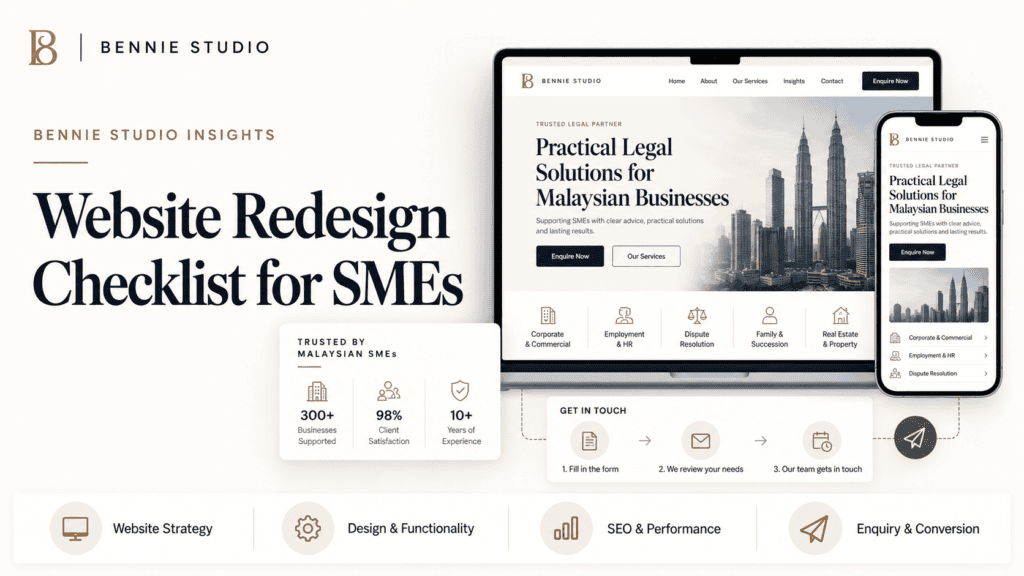
A business website should do more than sit online and look professional. For SMEs with an existing website that looks outdated or fails to generate consistent enquiries, the website has to explain the offer clearly, build enough trust for a visitor to continue reading, and guide that visitor toward a practical next step. That is why website redesign checklist Malaysia is not only a design topic. It is a business growth topic.
Many small businesses start with a homepage, a short about section, a few service descriptions and a contact form. That can be enough for visibility, but it is rarely enough for consistent enquiries. Visitors compare options quickly. They want to know what you do, who you help, what makes you credible, what the process looks like, how much confidence they should have, and what happens after they contact you.
The better approach is to treat the website as a complete journey. Every section has a job. Every page should reduce confusion. Every call to action should match the visitor’s stage of awareness. When the structure is planned properly, the website becomes easier to understand, easier to trust and easier to improve over time.
Key elements to include
- Clear homepage positioning
- Trust-building proof sections
- Service pages built around buyer questions
- Primary and secondary CTAs
- Form and WhatsApp lead capture
- SEO-ready headings, metadata and internal links
- Analytics and conversion tracking
Start with the business goal, not the design style
The first question is not whether the site should look minimal, premium, colourful or corporate. The first question is what the business needs the website to do. Some companies need more WhatsApp enquiries. Some need appointment bookings. Some need quote requests. Some need a clearer way to explain several services. The design style should support that goal instead of becoming the goal itself.
A practical website plan starts with the main conversion action, the target customer, the offer, the common objections and the proof needed to make the visitor comfortable. Once those pieces are clear, layout and copy decisions become easier. The homepage can introduce the offer. Service pages can answer buyer questions. Landing pages can support campaigns. Contact sections can remove friction.
Make the first screen explain the offer clearly
The first screen should answer three questions quickly: what you offer, who it is for, and what action the visitor can take next. If the visitor has to scroll, guess or decode vague branding language, the website loses momentum. Clear does not mean boring. It means the visitor understands the value before judging the design.
For custom website redesign and growth audit, the headline, short supporting copy and call to action should work together. A visitor should know whether the business is relevant to them within a few seconds. The hero section can also include trust cues such as location, business type, response time, review snippets or a simple service promise.
Build trust before asking for the enquiry
Most visitors will not contact a business just because a button is visible. They need reasons to believe the business can help. Trust can come from project examples, testimonials, founder experience, clear process steps, frequently asked questions, service guarantees, industry focus and transparent expectations.
The exact proof depends on the business. A clinic may need doctor profiles, treatment explanations and patient comfort cues. A contractor may need project photos, process details and warranty information. A consultant may need case examples, frameworks and client outcomes. The goal is the same: reduce perceived risk before the visitor reaches the form or WhatsApp button.
Create pages around real buying questions
A common mistake is to create very short service pages that only list what the business does. Search visitors usually need more context. They want to know what is included, who the service is suitable for, how the process works, what problems it solves, what to prepare and why this business is a sensible choice.
Good service pages support both SEO and conversion. They give search engines enough context to understand the page, and they give humans enough information to take the next step. This is where keyword planning should meet practical copywriting. The focus keyword should guide the page, but the content must still read naturally and answer real questions.
Use calls to action that match visitor intent
Not every visitor is ready to request a quote immediately. Some want to ask a quick question. Some want to compare packages. Some want to understand the process first. A strong website gives visitors more than one sensible path without making the page messy.
A primary CTA can invite a quote request, audit, booking or consultation. A secondary CTA can point to plans, portfolio, service details or WhatsApp. The important part is that each CTA sits near the information that makes it relevant. A button after a proof section should not feel the same as a button after a pricing explanation.
Plan the lead capture flow after the click
The enquiry flow does not end when the visitor clicks a button. The form questions, WhatsApp message prompt, thank-you page and follow-up process all affect lead quality. If the form asks too little, the business receives vague enquiries. If it asks too much, visitors may abandon it.
A practical flow collects enough information to qualify the lead while keeping the action easy. For example, a website audit form might ask for name, email, WhatsApp number, business type, website URL and the main problem the owner wants to solve. A WhatsApp CTA can pre-fill a message so the conversation starts with context.
Prepare the website for SEO from day one
SEO does not start only after publishing blog posts. The technical and structural basics should be in place at launch. That includes clean URLs, clear page titles, proper heading hierarchy, descriptive meta descriptions, internal links, image alt text, fast mobile loading and pages that target specific topics instead of mixing everything into one page.
For website redesign checklist Malaysia, the website should have a focused title, a clear meta description, supporting sections that mention related terms naturally, and internal links from relevant pages. This gives future SEO work a stronger base. It also makes the website easier for visitors to scan.
Measure what happens after launch
A website can only improve when the business tracks what is happening. Basic analytics, form tracking, WhatsApp click tracking and page performance checks help show where visitors are coming from and which pages are supporting enquiries. Without measurement, redesign decisions become guesswork.
The first version of a website does not need to be perfect. It needs to be clear, functional and measurable. Once data starts coming in, the business can improve headlines, service sections, CTAs, internal links and landing pages based on actual behaviour.
Common mistakes to avoid
The most common mistakes are outdated visual trust, slow mobile loading, unclear service pages, old copy that no longer matches the offer, weak conversion paths. These issues usually appear when the website is treated as a design project only. They are fixable, but they need to be addressed in the structure, copy and user journey.
Avoid copying a competitor’s layout without understanding their strategy. Avoid stuffing keywords into headings without answering the search intent. Avoid hiding contact options at the bottom of the page. Avoid launching without testing the mobile version, forms, WhatsApp links and page speed.
What a stronger website should achieve
A stronger website should create stronger credibility, faster mobile experience, clearer service positioning, better enquiry tracking and lead capture. These are business outcomes, not just design preferences. When a website is planned this way, it becomes easier to justify the investment because the structure is tied to trust, clarity and lead generation.
The best time to plan this is before the build starts. The second best time is before the next redesign. Even small improvements to messaging, page structure and lead capture can make a meaningful difference for a service business that already receives traffic.
How to review the page before publishing
Before publishing, read the draft from the viewpoint of a first-time customer. The page should make sense even if the visitor knows nothing about the business. Check whether the headline is specific, whether the first paragraph explains the service, whether the proof is close to the claims, and whether the next step is visible without feeling pushy.
It also helps to review the page on mobile. Many Malaysian customers will first see the website from a phone after clicking a Google result, ad, social profile or WhatsApp link. If the sections feel too long, the buttons are hard to tap, or the form is difficult to complete, the page will lose enquiries even if the desktop version looks polished.
A simple improvement plan for the next 30 days
After launch, choose one or two improvements instead of trying to change everything at once. Start by checking whether the main pages receive traffic and whether visitors click the intended CTAs. Then improve the weakest section: the hero message, service explanation, proof area, FAQ, form or WhatsApp prompt. Small changes become easier when the website has a clear structure.
For a service business, a useful 30-day plan is to publish or improve one service page, add one proof section, connect analytics, test the enquiry flow and write one helpful guide that answers a common customer question. This turns the website into a growing asset instead of a one-time launch project.
Final thoughts
The main lesson is simple: a redesign should improve business results, not only refresh colours, fonts and layout. A good-looking site helps, but the real value comes from the way the website explains, proves, guides and captures demand.
Start with a free website growth audit before redesigning so the new website fixes the right problems.
Next steps: view website design services, compare Malaysia website pricing, or browse website examples. If you want a tailored recommendation, generate a free website preview.