For a broader set of related guides, see the Website Design Malaysia resource hub for small businesses.
Many small businesses in Malaysia know they need a proper website, but the upfront cost can feel like a big
obstacle.
A business owner may understand that customers search online before making a decision. They may know that a professional website can help the business look more credible, explain services clearly, support ads, improve local SEO, and generate enquiries. But when they start asking for website quotations, the cost can feel heavy, especially for a new or growing business.
A traditional website project usually requires a larger upfront payment. For a startup, clinic, salon, contractor, consultant, coach, agency, home service provider, or local business, this can be difficult to manage. The business may need a website now, but it may not be ready to spend thousands of ringgit immediately.
This is where Website-as-a-Service becomes useful.
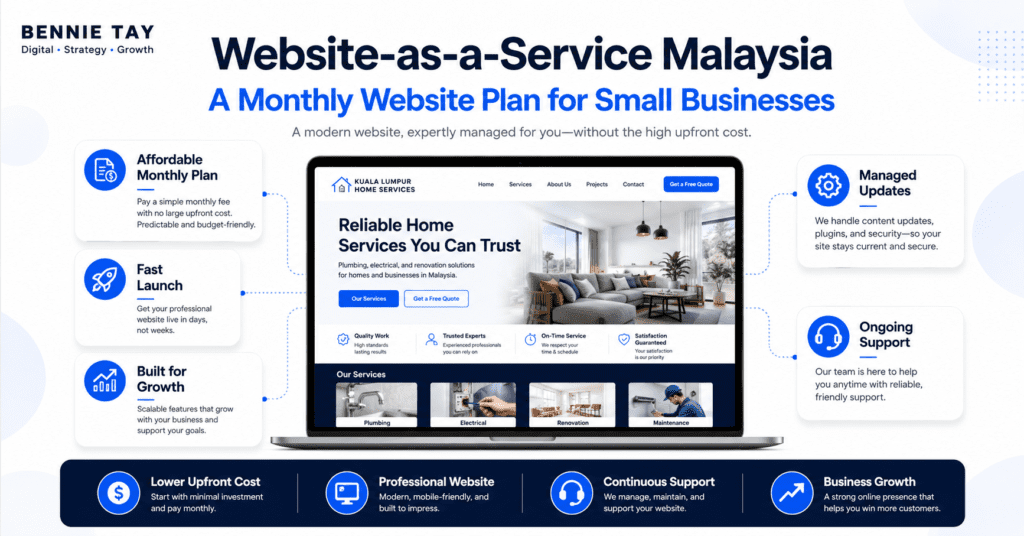
Website-as-a-Service, often called WAAS, is a monthly website plan that allows businesses to launch a professional website without a large one-time website development fee. Instead of paying everything upfront, the business pays a recurring monthly fee for the website and related support.
Depending on the provider, the plan may include website setup, hosting, maintenance, technical updates, security care, content changes, landing pages, basic SEO setup, and ongoing support.
For many small businesses, this model is easier to manage. It reduces the starting cost and removes much of the technical burden. Instead of trying to build a website alone or compare expensive agency quotations, a business can use a monthly website plan to get online faster.
This article explains how Website-as-a-Service works in Malaysia, who it is suitable for, what to check before choosing a monthly website plan, and how small businesses can decide whether WAAS is better than a traditional one-time website build.
What Is Website-as-a-Service?
Website-as-a-Service is a website delivery model where a business pays a monthly fee for a professional website instead of paying a large upfront project cost.
In a traditional website project, you usually hire a freelancer, web designer, or agency to build your website. You agree on the scope, pay a project fee, go through the design and development process, and receive the completed website at the end of the project. After launch, you may still need to pay separately for hosting, maintenance, updates, security, technical support, new pages, or future changes.
With Website-as-a-Service, the model is different. The website is provided as an ongoing service. The monthly fee may include the website build, hosting, support, maintenance, updates, and sometimes ongoing improvements depending on the plan.
The idea is similar to how many businesses now use subscription-based tools instead of buying expensive software licences. You pay monthly for access, support, and continued service.
For a small business, this can be a practical way to get a professional website online without delaying the project because of upfront cost.
The most important thing to understand is that Website-as-a-Service is not just cheap website design. A good WAAS plan should still provide a professional website that is clear, mobile-friendly, conversion-focused, and suitable for the business. The monthly model is simply a different way to deliver and support the website.
Why Website-as-a-Service Is Becoming Popular
Website-as-a-Service is becoming more popular because small businesses need to move faster online.
In the past, some businesses could operate for years with only referrals, a Facebook page, Instagram profile, or Google Business Profile. These channels still matter, but they are no longer enough on their own. Customers often compare businesses online before deciding who to contact.
Even if a customer first discovers your business through social media, they may still look for your website to confirm whether the business is real, professional, and trustworthy.
A website gives your business a central online home. Social media platforms are useful for visibility, but they are not fully under your control. Your reach can change, posts can get buried, and customers may not see the most important information when they need it.
A website gives you a clearer way to present your services, pricing guidance, testimonials, portfolio, location, enquiry process, and contact options.
The problem is that many small business owners do not want a complicated website project. They may not have time to manage hosting, update plugins, write website copy, test forms, fix technical issues, or figure out SEO structure.
They simply want a website that looks professional, works properly, and helps customers contact them.
Website-as-a-Service solves this by turning the website into a managed monthly service. Instead of building the website and leaving the business owner alone after launch, the provider continues supporting the website.
For small businesses without an internal marketing or IT team, this can be a major advantage.
Who Is Website-as-a-Service Suitable For?
Website-as-a-Service is suitable for business owners who want a professional website but prefer a lower upfront cost and ongoing support.
It is especially useful for new businesses that need to launch quickly. A new consultant, coach, clinic, beauty salon, contractor, home service provider, agency, or local business may not want to spend a large amount before the business has steady revenue. A monthly website plan allows them to start with a credible online presence while keeping cash flow under control.
WAAS is also suitable for small businesses that do not want to manage technical website tasks. Many business owners are busy serving customers, managing staff, handling operations, following up with leads, and trying to grow sales. They do not want to worry about hosting, backups, plugin updates, broken forms, website security, or technical errors.
A monthly website plan can also work well for businesses that expect their website to change over time. For example, a business may want to add new services, update promotions, create landing pages, publish blog posts, or improve the website after seeing how customers respond.
Website-as-a-Service is also useful for businesses testing a new offer. Instead of investing heavily in a custom website before validating the market, they can launch a professional website or landing page first, collect enquiries, and improve from there.
However, WAAS is not always the best option for every business. If you need advanced custom functionality, complex integrations, full custom system development, or a highly unique digital product, a traditional custom website build or web application project may be more suitable.
Why Small Businesses Choose Monthly Website Plans
The biggest reason small businesses choose a monthly website plan is cash flow.
A one-time website build may require a few thousand ringgit upfront. For some businesses, this is manageable. For others, that money may be needed for rent, stock, salaries, equipment, advertising, renovation, operations, or customer acquisition.
A monthly website plan spreads the cost over time. This makes it easier for business owners to launch a proper website without waiting months to save for a full custom build.
Another reason is convenience. A monthly website plan often includes ongoing support, which means the business owner does not need to manage everything alone after launch. If the website needs small updates, technical fixes, or maintenance, there is already a support arrangement in place.
This is important because many small business websites fail not because the first version is bad, but because nobody maintains or improves them. The business changes, services change, pricing changes, and customers ask new questions, but the website remains the same.
A monthly plan can help the website stay active and useful.
Small businesses also choose WAAS because it reduces complexity. Instead of dealing separately with domain, hosting, website builder, designer, developer, maintenance provider, and support person, they can work with one provider for the full website setup and care.
For a busy business owner, simplicity has value.
Website-as-a-Service vs Traditional Website Build
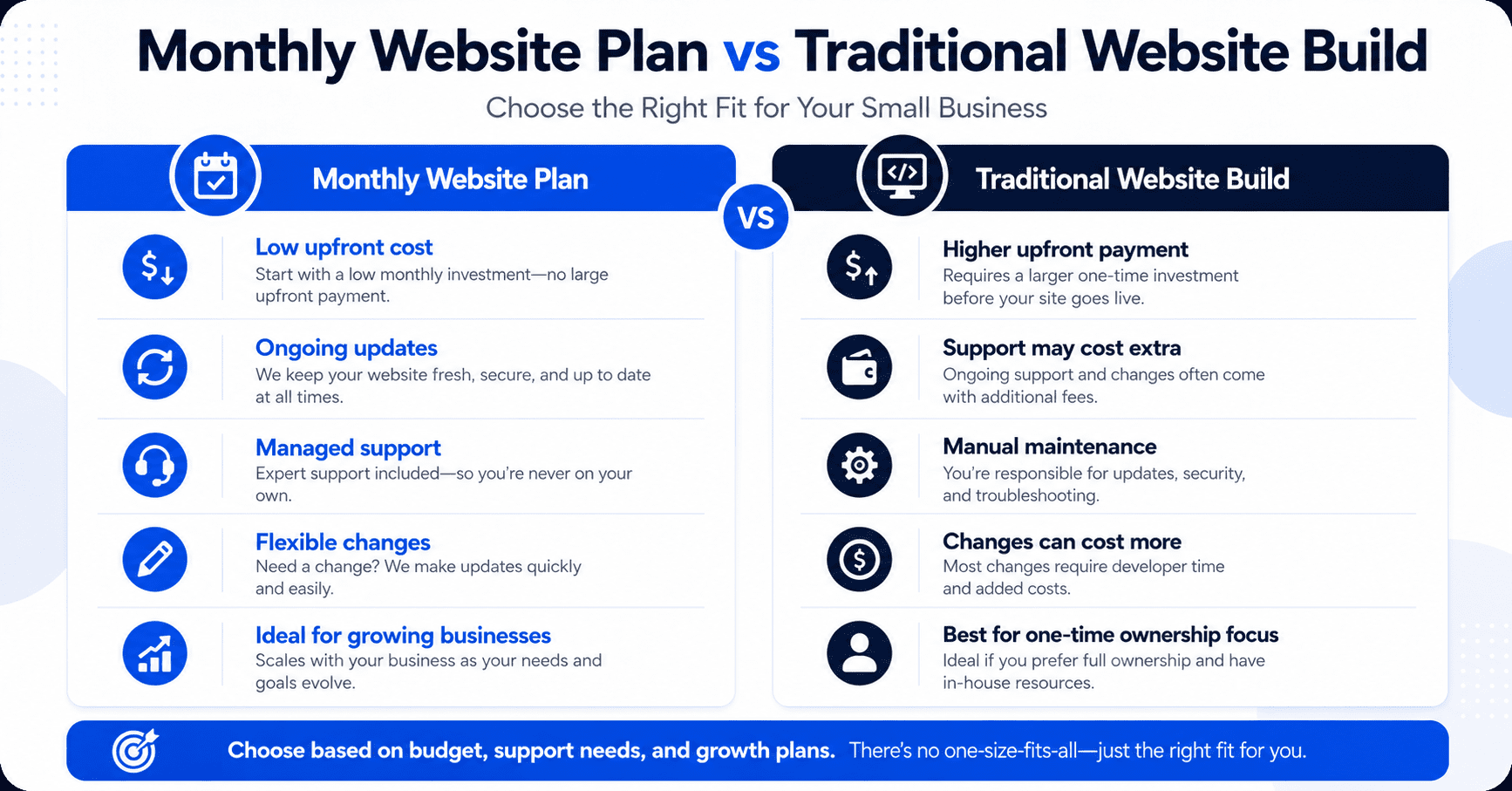
A traditional website build and Website-as-a-Service can both be good options. The better choice depends on the business stage, budget, goals, and support needs.
A traditional website build usually works well when the business has a clear direction, budget, and specific requirements. The business pays an upfront project fee, receives the completed website, and then manages hosting, maintenance, updates, and future changes separately or through another support plan.
This can be suitable for established businesses that want full custom design, deeper strategy, unique layouts, or more control over the project scope.
Website-as-a-Service is different because the website is packaged into a monthly plan. The business gets a website with ongoing service and support, usually with a lower starting cost.
This can be better for small businesses that want to launch quickly, avoid high upfront fees, and have someone manage the technical side.
The difference is not only payment style. It is also about relationship. A traditional website project may end after launch. A WAAS plan continues after launch.
For businesses that want ongoing help, WAAS can be more practical.
Website-as-a-Service vs DIY Website Builders
Many small business owners consider using DIY website builders because they seem affordable and easy to start.
DIY website builders can be useful if you have time, design confidence, copywriting skills, and a clear website structure. They allow you to build a website yourself without hiring a developer.
The problem is that many business owners underestimate the work involved. Building a website is not only about dragging sections onto a page. You still need to decide what to write, how to structure the homepage, what pages to create, how to explain your services, how to make the site mobile-friendly, how to set up forms, how to add SEO basics, and how to guide visitors toward enquiry.
A DIY website can look acceptable but still fail to generate leads if the message and structure are weak.
Website-as-a-Service gives small businesses another option. Instead of doing everything alone, the business gets a professionally built website with support included. This can save time and help avoid common mistakes.
The right choice depends on your situation. If you enjoy building websites and have time to learn, DIY may work. If you want to focus on running your business and need a website that is structured properly, WAAS may be the better route.
What Should Be Included in a Website-as-a-Service Plan?
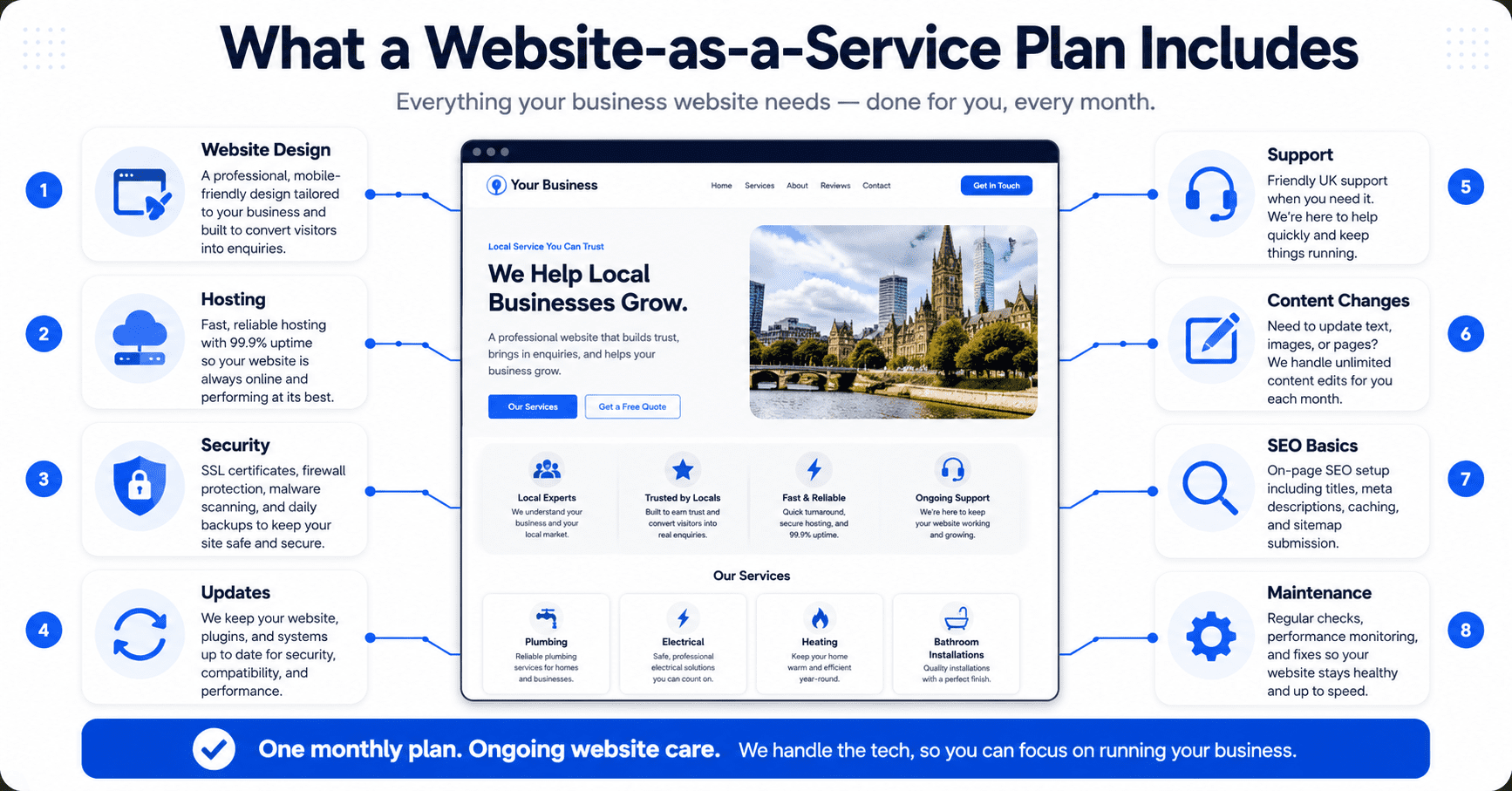
A good Website-as-a-Service plan should include more than just a website template.
At minimum, it should include a professional website setup, mobile-friendly design, hosting, basic technical maintenance, clear service sections, contact forms or WhatsApp buttons, and support after launch.
A stronger WAAS plan may also include website copywriting guidance, basic SEO setup, blog setup, landing page support, analytics installation, speed optimization, security monitoring, backups, and ongoing content updates depending on the package.
The website should also be built with conversion in mind. This means the website should not only look good. It should help visitors understand your offer, trust your business, and take action.
For small businesses in Malaysia, WhatsApp integration is especially important. Many customers prefer WhatsApp enquiries, so the website should include clear WhatsApp buttons, service-specific calls to action, and possibly pre-filled messages.
If the plan includes SEO, check what kind of SEO is included. Basic SEO may cover page titles, meta descriptions, heading structure, clean URLs, and mobile-friendly design. Full SEO may include keyword research, blog strategy, content writing, local SEO pages, and ongoing optimization.
Not all WAAS plans are the same. Always check what is actually included before comparing prices.
The Website Should Be Built for Leads, Not Just Looks
A Website-as-a-Service plan should not only give your business a nice-looking website. It should help generate enquiries.
A lead-generation website is different from a basic brochure website. A brochure website mainly presents information. A lead-generation website is planned around the visitor’s decision process.
It explains the problem, presents the solution, shows services clearly, builds trust, answers common questions, and guides visitors toward a specific action.
For example, a small business website should make it easy for visitors to request a quote, book an appointment, send a WhatsApp message, submit a form, or schedule a consultation.
The homepage should have a clear message. Service pages should explain what is included. Trust signals should appear naturally. The contact process should be simple. The website should work well on mobile.
This matters because many businesses already get some traffic from social media, referrals, Google, or ads. But if the website is unclear, that traffic may not convert.
A good WAAS website should help turn attention into action.
SEO Benefits of Website-as-a-Service
Website-as-a-Service can support SEO if the website is built with the right structure.
A good WAAS website should not only have a homepage and contact page. It should include clear service pages, SEO-friendly headings, proper page titles, useful content, clean URLs, mobile-friendly design, and internal links.
For small businesses, SEO is valuable because it can bring people who are already searching for your service. For example, someone may search for “website design Malaysia,” “clinic website design,” “landing page for Facebook Ads,” “website redesign for small business,” or “monthly website plan Malaysia.”
If your website has relevant pages for those topics, you have a better chance of being found.
WAAS can also support local SEO. If your business serves a specific city or area, your website should include location information, service areas, and local content where appropriate.
For example, a contractor may need pages for renovation services in different areas. A clinic may need location and service pages. A website designer may create content around website design for small businesses in Malaysia.
SEO takes time, but a website with the right structure gives your business a stronger foundation.
GEO Benefits of Website-as-a-Service
GEO, or Generative Engine Optimization, is becoming more important as people use AI tools to search for answers, compare services, and understand business options.
A GEO-friendly website is easy for AI search engines to understand. It clearly explains what the business does, who it helps, where it operates, what services are available, how the process works, and how customers can take the next step.
Website-as-a-Service can support GEO if the provider builds the website with clear content structure. This includes direct explanations, useful FAQs, service pages, location details, process sections, and helpful blog content.
For example, a WAAS website for a clinic should clearly explain the clinic’s services, appointment process, location, practitioner information, and FAQs. A WAAS website for a consultant should explain the consulting offer, target audience, process, case studies, and booking flow.
AI search engines are more likely to understand websites that are specific and structured. Vague marketing phrases do not help much. Clear, useful content does.
A website that is good for GEO is usually better for customers too, because the content is easier to understand.
Why Ongoing Support Matters
One of the biggest advantages of Website-as-a-Service is ongoing support.
Many traditional website projects end after launch. The website goes live, the final payment is made, and the business owner is left to manage the site. Over time, small issues appear. Plugins need updates. Text becomes outdated. Services change. Photos need replacing. Blog posts need publishing. Forms may stop working. The website slowly becomes less accurate and less useful.
With a monthly website plan, support is part of the service. The business can ask for updates, maintenance, or improvements depending on the plan.
This is important because a website should evolve with the business. A website that is not updated can quickly become outdated, even if it looked good when it launched.
Ongoing support also gives business owners peace of mind. They do not need to search for a developer every time something small needs to be changed.
For small businesses that do not have an internal marketing team, this support can be one of the most valuable parts of WAAS.
Website Maintenance Should Not Be Ignored
Website maintenance is one of the less exciting parts of running a website, but it is important.
A website needs regular care to remain secure, functional, and reliable. This may include software updates, plugin updates, backups, uptime checks, security checks, speed monitoring, broken link checks, and form testing.
Many small business owners only think about maintenance when something breaks. By then, the problem may already affect customers.
For example, a broken contact form can cause lost enquiries. A slow website can reduce conversions. A security issue can damage trust. An outdated plugin can create technical problems.
A good Website-as-a-Service plan should include maintenance so the business owner does not need to handle these technical tasks alone.
Maintenance may not be as visible as design, but it protects the website’s performance over time.
Website-as-a-Service for Different Types of Businesses
Website-as-a-Service can work for many types of small businesses.
For clinics, a WAAS website can include service pages, doctor profiles, appointment buttons, WhatsApp enquiry, location information, and FAQs. This helps patients understand services and contact the clinic more easily.
For beauty salons and spas, a WAAS website can show treatments, pricing guidance, real photos, reviews, booking options, and local SEO content. This helps turn social media interest into bookings.
For contractors and home service businesses, a WAAS website can include service pages, project photos, location pages, quote request forms, and WhatsApp buttons. This helps customers request quotations more easily.
For coaches and consultants, a WAAS website can include personal branding, service pages, testimonials, case studies, booking links, and authority-building blog content.
For gyms, studios, and fitness businesses, the website can include class schedules, membership information, trainer profiles, trial booking, and local SEO pages.
For agencies and professional service firms, a WAAS website can help explain services, show proof, and generate consultation enquiries.
The model is flexible because most small businesses need the same core outcome: a professional website that helps customers understand the offer and take action.
When Website-as-a-Service May Not Be Suitable
Website-as-a-Service is useful, but it is not the right solution for every situation.
If your business needs a fully custom web application, complex booking system, marketplace, membership platform, advanced automation, custom dashboard, or deep system integration, WAAS may not be enough. You may need a custom development project.
WAAS may also not be suitable if you want full control over every design and technical detail from the beginning. Monthly website plans often use structured systems and proven layouts to keep the service efficient and affordable.
It may also not be the best fit if you prefer to pay once and manage everything yourself. Some businesses are comfortable handling hosting, updates, security, and content changes internally. In that case, a one-time website build may be better.
The key is to choose based on your business needs. WAAS is best for businesses that want a professional website, lower upfront cost, ongoing support, and a clear path to launch.
What to Check Before Choosing a WAAS Provider
Before choosing a Website-as-a-Service provider, look carefully at what is included in the monthly plan.
Ask whether hosting is included. Ask whether maintenance is included. Ask how many pages are included. Ask whether copywriting support is provided. Ask whether the website is mobile-friendly. Ask whether basic SEO setup is included. Ask whether WhatsApp integration is available. Ask whether you can request updates after launch.
You should also check what happens if you cancel the plan. This is important. Different providers have different terms. Some may allow you to export the website after a certain period. Others may treat the website as part of the ongoing subscription. Make sure you understand the ownership and cancellation terms before signing up.
Also ask about support response time. If you need updates, how do you request them? How many updates are included each month? Are there extra charges for new pages, landing pages, or major changes?
A good provider should make the terms clear. You should not need to guess what is included.
The cheapest monthly plan is not always the best. The best plan is the one that gives your business the right balance of affordability, quality, support, and growth potential.
WAAS and Website Ownership
Website ownership is an important question in any monthly website plan.
Because WAAS is a service model, the terms may differ from a traditional website build. Some providers include the website as part of the ongoing subscription. Some may transfer ownership after a minimum contract period. Some may allow you to buy out the website. Some may provide the content but not the full design or platform setup if you cancel.
There is no single rule, so you should ask clearly.
The most important thing is transparency. You should understand what you own, what you are renting, what happens to your content, and what happens if you stop paying.
For small businesses, this does not mean WAAS is bad. Many businesses are comfortable paying monthly because they value the ongoing service and support. But you should still understand the terms before making a decision.
A professional WAAS provider should be clear about ownership, cancellation, migration, and support.
How Much Does Website-as-a-Service Cost in Malaysia?
Website-as-a-Service pricing in Malaysia can vary depending on the provider, number of pages, design quality, support level, hosting, maintenance, SEO setup, and update limits.
Some monthly website plans may be very affordable and focus on a simple online presence. Others may cost more but include better strategy, copywriting, landing pages, SEO structure, and ongoing support.
When comparing WAAS pricing, do not only look at the monthly fee. Look at what the plan includes.
A lower monthly price may not include many updates, SEO setup, custom pages, or proper support. A higher monthly price may be more valuable if it includes hosting, maintenance, content updates, landing pages, conversion strategy, and technical support.
Also consider whether there is a setup fee. Some WAAS plans have no upfront fee, while others have a smaller setup fee plus monthly subscription. This is normal because building the website still requires planning, design, setup, and content work.
The right plan depends on your business stage. A new business may start with a simple monthly plan. A growing business may need a stronger plan with more pages, landing pages, SEO content, and ongoing improvements.
How WAAS Helps With Faster Launch
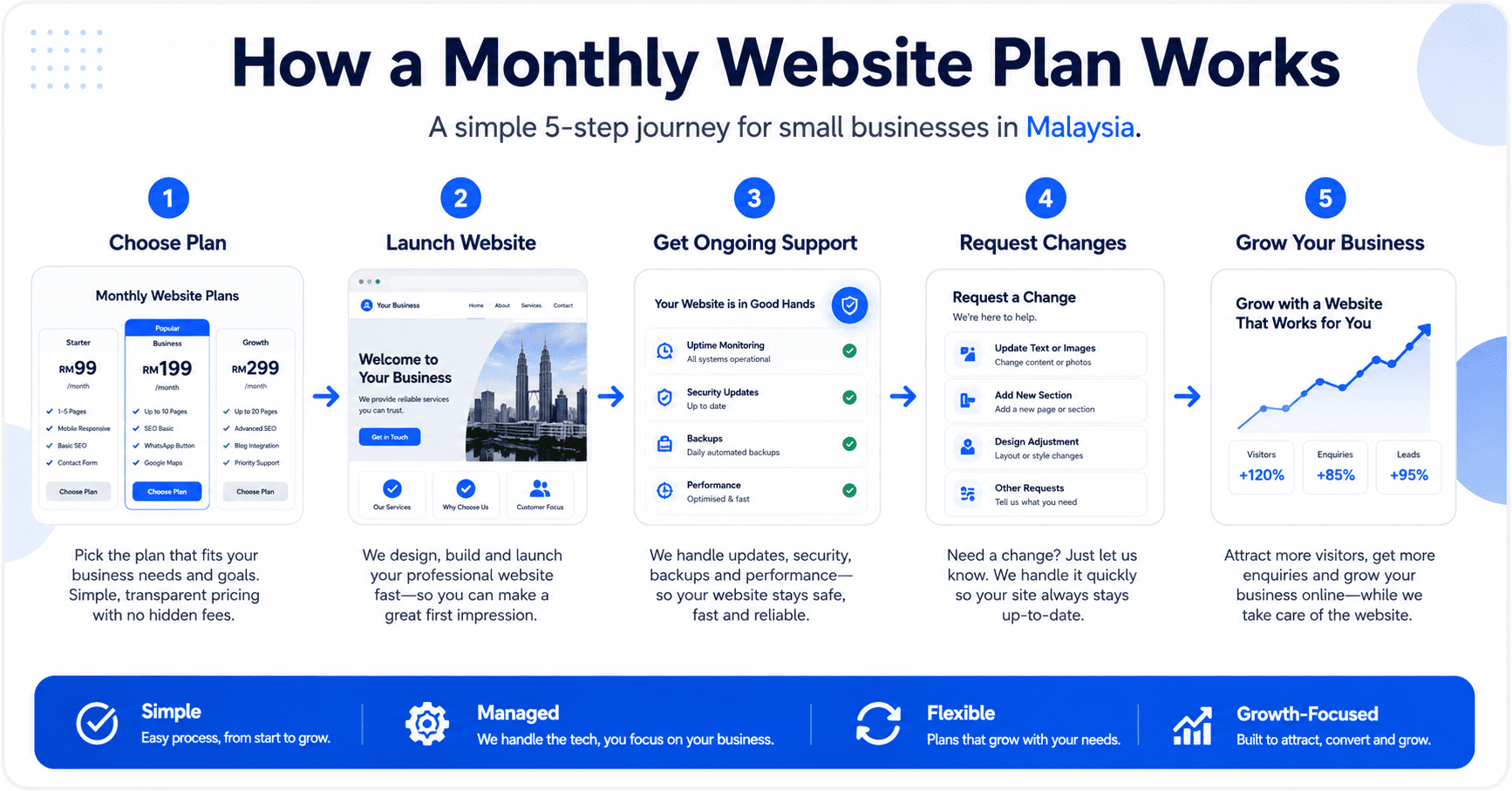
One of the main benefits of Website-as-a-Service is speed.
A traditional custom website project can take longer because it may involve deeper strategy, custom layouts, multiple revisions, content preparation, and development. This is useful for some businesses, but it can delay launch if the business only needs a strong professional website quickly.
WAAS often uses proven structures and repeatable systems, which can make the launch process faster. The provider does not need to reinvent everything from scratch for every project. Instead, they can use tested layouts and customize them for the business.
This is helpful for small businesses that need to start generating enquiries soon.
For example, a new clinic, salon, consultant, or contractor may not want to wait months before going online. They need a website that explains their services, shows trust, and allows customers to contact them.
A faster launch does not mean the website should be low quality. It means the process should be efficient.
Why WAAS Works Well With Landing Pages
Website-as-a-Service can work well with landing pages because many small businesses need campaign-specific pages.
A normal website introduces the business. A landing page focuses on one offer, campaign, or service. If you run Facebook Ads, Google Ads, TikTok content, Rednote posts, email campaigns, or WhatsApp outreach, landing pages can improve conversion.
For example, a business may have a main website, then create separate landing pages for a free website audit, clinic appointment, beauty treatment promotion, renovation quote, coaching consultation, or event registration.
A WAAS plan that allows landing page creation can be valuable because the business can respond quickly to new campaigns.
Instead of rebuilding the whole website, you can add a focused landing page that supports one offer.
This makes the website more useful as a marketing tool. It becomes more than an online brochure. It becomes part of your lead generation system.
WAAS and Local SEO Pages
For businesses that serve specific areas, Website-as-a-Service can support local SEO pages.
Local SEO pages are pages designed to target services in specific locations. For example, a website designer may create pages for website design in Kuala Lumpur, website design in Petaling Jaya, or website design in Shah Alam. A contractor may create renovation service pages for different service areas. A clinic may create location pages for each branch.
These pages can help customers find your business when they search for services in their city or area.
However, local SEO pages must be useful. They should not be thin pages that only change the city name. A good local SEO page should explain the service, local relevance, service area, customer needs, proof, FAQs, and enquiry process.
A WAAS provider that understands local SEO can help structure these pages properly.
For small businesses, this can create long-term search value.
WAAS and Website Copywriting
Website copywriting is one of the most important parts of a successful website.
Many small businesses struggle to write their own website content. They know what they do, but they find it difficult to explain it clearly on a website. This often leads to vague, generic, or overly simple content.
A good Website-as-a-Service plan should provide copywriting guidance or website content structure. The provider should help turn your business information into clear website sections that visitors can understand.
Good website copy explains what you offer, who you help, what problem you solve, why customers should trust you, and what they should do next.
Without clear copy, even a good-looking website may fail to generate enquiries.
This is why WAAS should not be seen only as a design service. The best WAAS websites combine design, structure, copywriting, SEO, and conversion thinking.
WAAS and WhatsApp Lead Generation
For Malaysian small businesses, WhatsApp is often one of the most important lead channels.
A Website-as-a-Service plan should support WhatsApp enquiries properly. This means more than adding one floating WhatsApp icon.
The website should use clear WhatsApp calls to action throughout important pages. A service page can invite visitors to ask about that specific service. A pricing section can invite visitors to check package suitability. A landing page can direct visitors to request a quote or book an appointment through WhatsApp.
Pre-filled WhatsApp messages can also improve the experience. Instead of opening a blank chat, the visitor can start with a message such as, “Hi, I would like to ask about your monthly website plan,” or “Hi, I would like to request a free website audit.”
This makes the conversation easier to start.
For small businesses, a website that connects well with WhatsApp can turn more visitors into real conversations.
How to Know Whether WAAS Is Working
A Website-as-a-Service plan should be measured by results, not only by whether the website is online.
Important metrics include website visits, service page views, WhatsApp clicks, form submissions, call clicks, booking requests, quote requests, organic traffic, keyword rankings, and lead quality.
You should also look at how customers respond. Are enquiries more specific? Do people understand your services better? Are sales conversations easier because the website already explains your offer? Are visitors asking better questions?
A good WAAS website should make your business easier to understand and easier to contact.
Over time, you can improve the website based on what visitors do. You may add new service pages, improve headlines, publish blog posts, create landing pages, update testimonials, or add local SEO pages.
WAAS works best when the website is treated as a living business asset, not a one-time project.
Common Mistakes When Choosing a Monthly Website Plan
One common mistake is choosing based only on the lowest monthly price.
A cheap monthly website plan may look attractive, but it may not include the support, SEO structure, copywriting, updates, or conversion planning your business needs.
Another mistake is not checking cancellation terms. Before signing up, understand what happens if you stop the plan, whether you can keep the website, and what happens to your content.
Some businesses also assume that all monthly website plans include unlimited updates. This is not always true. Check how many updates are included and what counts as a small update versus a major change.
Another mistake is ignoring SEO. A website may look good but still be difficult for search engines to understand if the structure is weak.
Some businesses also fail to plan the main conversion action. A website should not simply exist. It should guide visitors toward WhatsApp, forms, calls, bookings, quotes, or consultations.
A good monthly website plan should be clear, practical, and aligned with your business goals.
Recommended Website Structure for a WAAS Website
A strong Website-as-a-Service website should usually include a homepage, about page, service pages, contact page, FAQs, testimonials, and clear calls to action.
The homepage should explain what the business does and guide visitors toward enquiry. The about page should build trust. Service pages should explain each main offer clearly. The contact page should make it easy to enquire. FAQs should answer common questions. Testimonials should provide proof.
For SEO, each major service should ideally have its own page. For local businesses, location information should be included. For lead generation, WhatsApp buttons, forms, and booking links should appear in the right places.
For businesses that want to grow through content, the website should also include a blog. Blog articles can target useful search topics and guide readers toward relevant services.
For businesses running ads, landing pages should be added for specific campaigns.
This structure gives small businesses a stronger foundation than a simple one-page website.
Final Thoughts
Website-as-a-Service in Malaysia can be a practical solution for small businesses that need a professional website without a large upfront cost.
Instead of treating the website as a one-time project, WAAS turns it into an ongoing monthly service. This can include the website build, hosting, maintenance, support, updates, and improvements depending on the plan.
For small businesses, this model offers several advantages. It improves cash flow, reduces technical stress, supports faster launch, and gives the business ongoing help after the website goes live.
However, not all WAAS plans are equal. A good monthly website plan should still provide clear messaging, mobile-friendly design, SEO structure, WhatsApp enquiry flow, trust signals, and conversion-focused pages.
The goal is not only to have a website. The goal is to have a website that helps customers understand your business and contact you with confidence.
If you are a small business owner in Malaysia and want a professional website without high agency fees or DIY website builder frustration, Website-as-a-Service may be a strong option to consider.
Need a Monthly Website Plan for Your Small Business?
At Bennie Tay, we help small businesses build professional, conversion-focused websites without high agency fees or complicated DIY website builders.
Whether you need a Website-as-a-Service monthly plan, landing page, website redesign, local SEO page, or full business website, the goal is simple: create a website that helps your business look credible, explain your offer clearly, and turn more visitors into enquiries.
Request a Free Website Growth Audit to find out whether a monthly website plan is the right fit for your business.
FAQ
What is Website-as-a-Service?
Website-as-a-Service is a monthly website plan where a business pays a recurring fee for a professional website instead of paying a large upfront website development cost. Depending on the plan, it may include hosting, maintenance, support, updates, and ongoing improvements.
Is Website-as-a-Service good for small businesses?
Yes. Website-as-a-Service can be a good option for small businesses that want a professional website, lower upfront cost, ongoing support, and less technical responsibility.
How is Website-as-a-Service different from a traditional website build?
A traditional website build usually involves a one-time project fee. Website-as-a-Service is provided as a monthly service that may include the website, hosting, maintenance, and support.
Is Website-as-a-Service cheaper than custom website design?
WAAS usually has a lower upfront cost than a custom website build. However, the long-term cost depends on the monthly fee, contract length, included services, and support level.
What should be included in a monthly website plan?
A monthly website plan should include website setup, mobile-friendly design, hosting, maintenance, support, contact forms or WhatsApp integration, and basic SEO setup. Better plans may also include updates, landing pages, blog support, and conversion improvements.
Do I own the website with Website-as-a-Service?
This depends on the provider. Some WAAS plans include ownership after a certain period, while others provide the website as part of the subscription. Always check ownership and cancellation terms before signing up.
Can Website-as-a-Service help with SEO?
Yes, if the website is built with SEO structure. This includes service pages, proper headings, meta titles, clean URLs, mobile-friendly design, internal links, and helpful content.
Can Website-as-a-Service support WhatsApp enquiries?
Yes. A good WAAS website can include WhatsApp buttons, service-specific calls to action, and pre-filled WhatsApp messages to help visitors start conversations more easily.
Who should use Website-as-a-Service?
Website-as-a-Service is suitable for small businesses, startups, clinics, salons, contractors, coaches, consultants, local service providers, and businesses that want a professional website with lower upfront cost and ongoing support.
When is Website-as-a-Service not suitable?
WAAS may not be suitable if your business needs a complex web application, advanced custom system, marketplace, membership platform, or deep software integration. In those cases, custom development may be better.