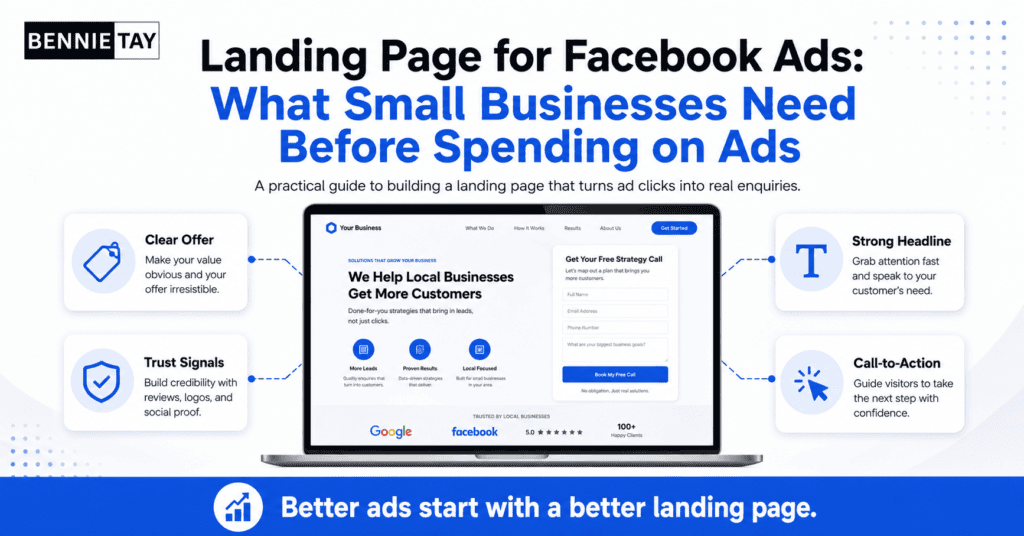
Facebook ads can bring traffic quickly, but traffic alone does not create sales. If someone clicks your ad and lands on a confusing page, your budget is wasted. The ad may get attention, but the landing page has to turn that attention into an enquiry.
Many small businesses in Malaysia start by adjusting the ad image, headline, or targeting. Those things matter, but the landing page often has a bigger impact than expected. If the page is slow, unclear, too general, or hard to use on mobile, people leave before taking action.
Before spending more on Facebook ads, make sure your landing page is ready.
What is a landing page?
A landing page is a focused page built for one campaign, one audience, and one main action. It is different from your homepage. A homepage may introduce your whole business, show multiple services, link to different pages, and serve many types of visitors.
A landing page should be more direct. It should match the promise in your ad and guide the visitor toward one next step. That step may be filling in a form, booking a call, sending a WhatsApp message, calling your office, downloading a guide, or claiming an offer.
If your ad says “Get a renovation quote,” the landing page should continue that message. If the page suddenly talks about your company history, all services, awards, and unrelated promotions, the visitor may lose focus.
Start with one clear offer
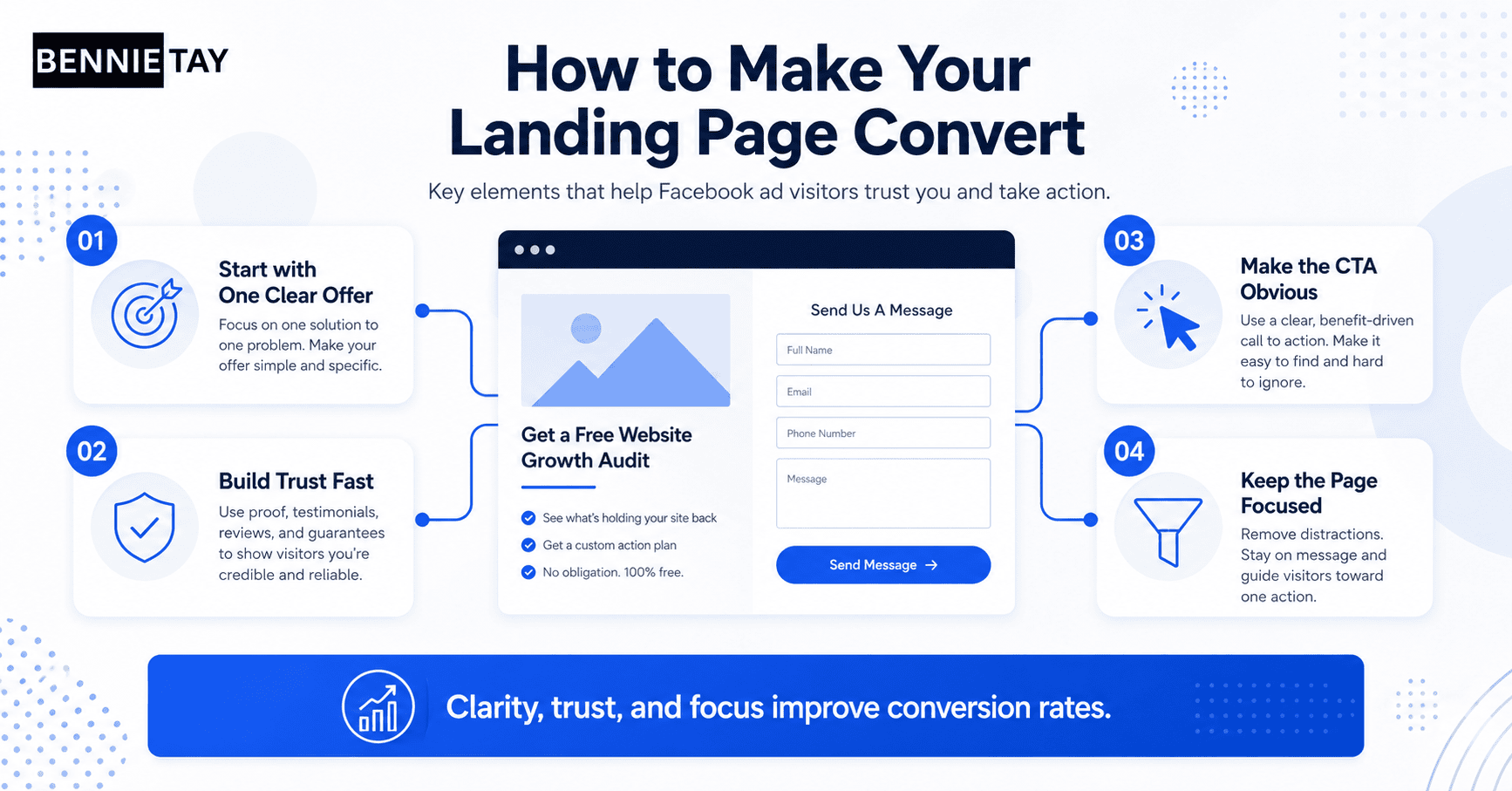
Your landing page should make the offer obvious within a few seconds. The headline should tell people what you provide, who it is for, and why it matters.
Avoid vague headlines such as “Welcome to our company” or “Your trusted solution partner.” These do not explain enough. A clearer headline might be “Renovation Contractor in KL for Homeowners Who Want a Proper Quotation Before Starting Work” or “Book a Trial Class for Your Child at Our English Tuition Centre.”
The goal is not to sound clever. The goal is to reduce confusion. A clear offer helps the right people stay on the page and helps the wrong people leave, which can improve lead quality.
Keep the page focused
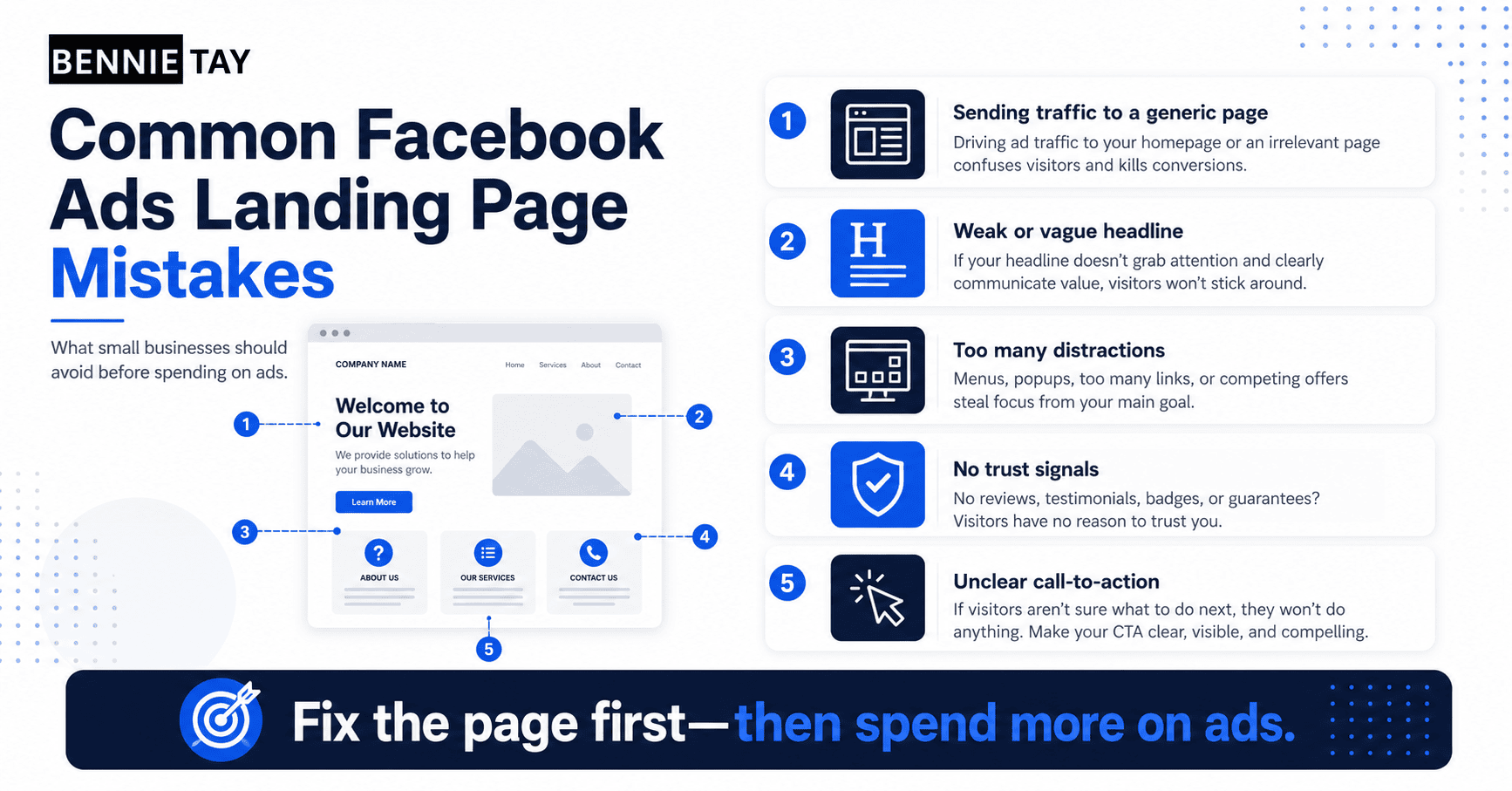
A landing page should not try to do everything. Too many menu links, service options, popups, and unrelated sections can distract visitors. If the campaign goal is to get consultation bookings, every section should support that goal.
A strong landing page usually includes a clear headline, short explanation, main benefits, proof, process, frequently asked questions, and a direct call to action. It does not need to be complicated. It needs to be easy to understand.
For service businesses, the page should answer basic questions: What do you do? Who is it for? What problem do you solve? Why should people trust you? What happens after they enquire? How can they take the next step?
Match the ad message
Message match is important. When people click an ad, they expect the landing page to continue the same topic. If your ad promotes a specific service, the landing page should focus on that service. If your ad promotes a limited offer, the offer should be visible on the page.
For example, if your Facebook ad targets homeowners looking for kitchen renovation, do not send them to a general contractor homepage. Send them to a kitchen renovation page with relevant photos, process, pricing guidance, testimonials, and a quotation request.
When the ad and page match, visitors feel that they are in the right place. That can improve conversion rates and reduce wasted clicks.
Build trust before asking for action
People who click Facebook ads may not know your business yet. They need reasons to trust you. Add proof that feels real and relevant.
This can include testimonials, reviews, project photos, case studies, client logos, before-and-after images, certifications, years of experience, media mentions, or guarantees. The type of proof depends on your business.
For a clinic, credentials and patient experience may matter. For a contractor, project photos and reviews may matter. For a coach or consultant, case studies and client outcomes may matter. For a tuition centre, parent reviews and student progress may matter.
Do not overload the page with generic claims. Specific proof is stronger than broad statements like “best service” or “trusted by many.”
Make the call to action easy
The call to action should be clear and repeated at natural points on the page. If you want people to message you on WhatsApp, use a clear WhatsApp button. If you want form submissions, keep the form short and simple.
Ask only for information you need at the first step. A long form can reduce conversions, especially on mobile. Name, phone number, service needed, and a short message may be enough for many service businesses.
Also explain what happens after submission. For example: “Submit the form and our team will contact you within one business day.” This removes uncertainty and makes people more comfortable taking action.
Design for mobile first
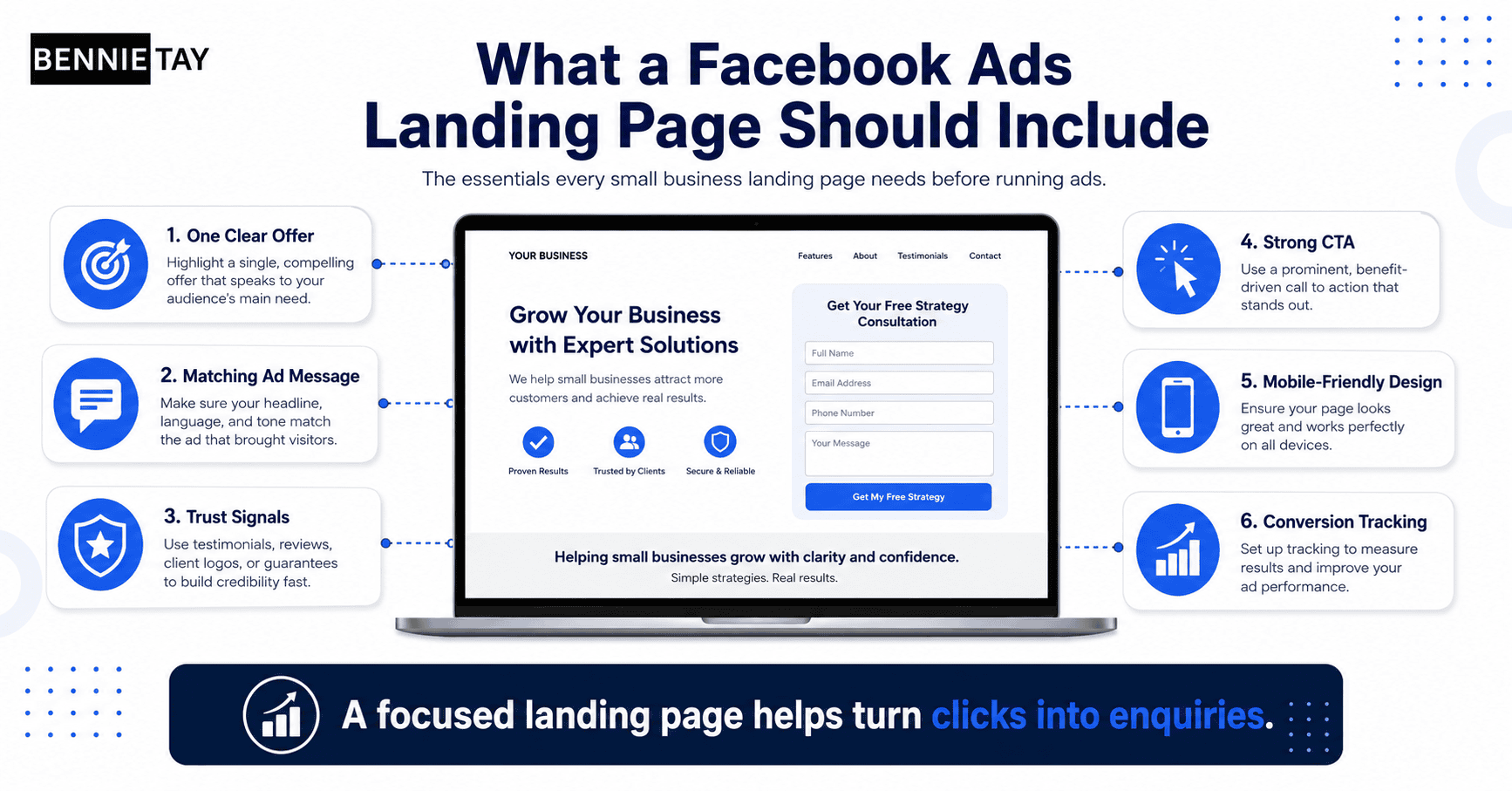
Many Facebook ad clicks happen on mobile. Your landing page should load quickly, have readable text, and make buttons easy to tap. Avoid large image files, tiny fonts, long blocks of text, and forms that are difficult to complete on a phone.
Check the page on a real mobile device before launching the campaign. Look at the headline, first section, buttons, form, images, and loading speed. If the mobile experience is weak, fix it before increasing your ad budget.
Track conversions properly
Without tracking, you are guessing. Set up the Meta Pixel and track important actions such as form submissions, WhatsApp clicks, phone clicks, and thank-you page visits. If possible, connect your leads back to campaigns so you can see which ads bring better enquiries.
Tracking does not need to be perfect at the beginning, but you should at least know how many people clicked, how many submitted, and how many became real leads.
A simple landing page structure
If you are not sure what to include, use a simple structure. Start with a hero section that has one clear headline, a short supporting sentence, and a visible call-to-action button. This first section should tell visitors they are in the right place.
Next, explain the problem. Show that you understand the visitor’s situation. For example, a renovation business can mention unclear quotations, delays, poor workmanship, and the stress of choosing the wrong contractor. A clinic can mention symptoms, treatment concerns, or the need for professional guidance.
After that, introduce your service or offer. Keep it specific. Explain what is included, who it is for, and why it is useful. Do not make visitors guess whether the service fits them.
Then add proof. Use reviews, project images, results, certifications, or case studies. Proof should appear before the final call to action because people need confidence before they enquire.
Finally, answer common questions. Address price range, timeline, location, process, warranty, consultation details, or any concern that may stop someone from contacting you. A good FAQ section can reduce hesitation.
What to avoid on a Facebook ads landing page
Do not send visitors to a page that is too general. If your ad promotes one service, the page should focus on that service. A general homepage may have too many paths and not enough campaign-specific information.
Do not make the page too long without structure. A long page can work if it is organized, but a wall of text will lose readers. Use headings, short paragraphs, bullet points, and clear buttons.
Do not hide important information. If people need to know your service area, consultation process, or basic pricing guidance, include it. You do not need to reveal every detail, but you should answer enough for visitors to decide whether to enquire.
Do not use weak stock images if real photos would build more trust. For businesses such as renovation, beauty, fitness, tuition, events, clinics, and consulting, real photos can make the page feel more credible.
How to improve results after launch
Once the campaign is running, review the numbers. If many people click but few enquire, the landing page may need work. If people submit forms but the leads are poor quality, your message may be attracting the wrong audience.
Test one improvement at a time. You can test a clearer headline, shorter form, stronger proof, different call to action, better first image, or more specific offer. Avoid changing everything at once because you will not know what helped.
You should also review actual enquiries. What questions do people ask after submitting? What objections come up in WhatsApp or calls? Add those answers to the landing page. The best landing pages improve based on real customer conversations.
When to build more than one landing page
If you advertise different services or audiences, one landing page may not be enough. A contractor may need separate pages for kitchen renovation, bathroom renovation, and office renovation. A training provider may need separate pages for corporate training and public workshops.
Separate pages allow each campaign to speak directly to the right audience. The message, proof, images, FAQs, and call to action can match the ad more closely. This usually performs better than sending every click to one general page.
Final thoughts
Before spending more on Facebook ads, improve the landing page. A better page can make the same ad budget work harder by turning more visitors into enquiries.
Focus on one offer, match the ad message, build trust, keep the mobile experience smooth, and make the next step obvious. Ads bring people to the door. The landing page decides whether they walk in.